
Empty Sudoku Grid: Free Printable Blank Boards to Use Your Way
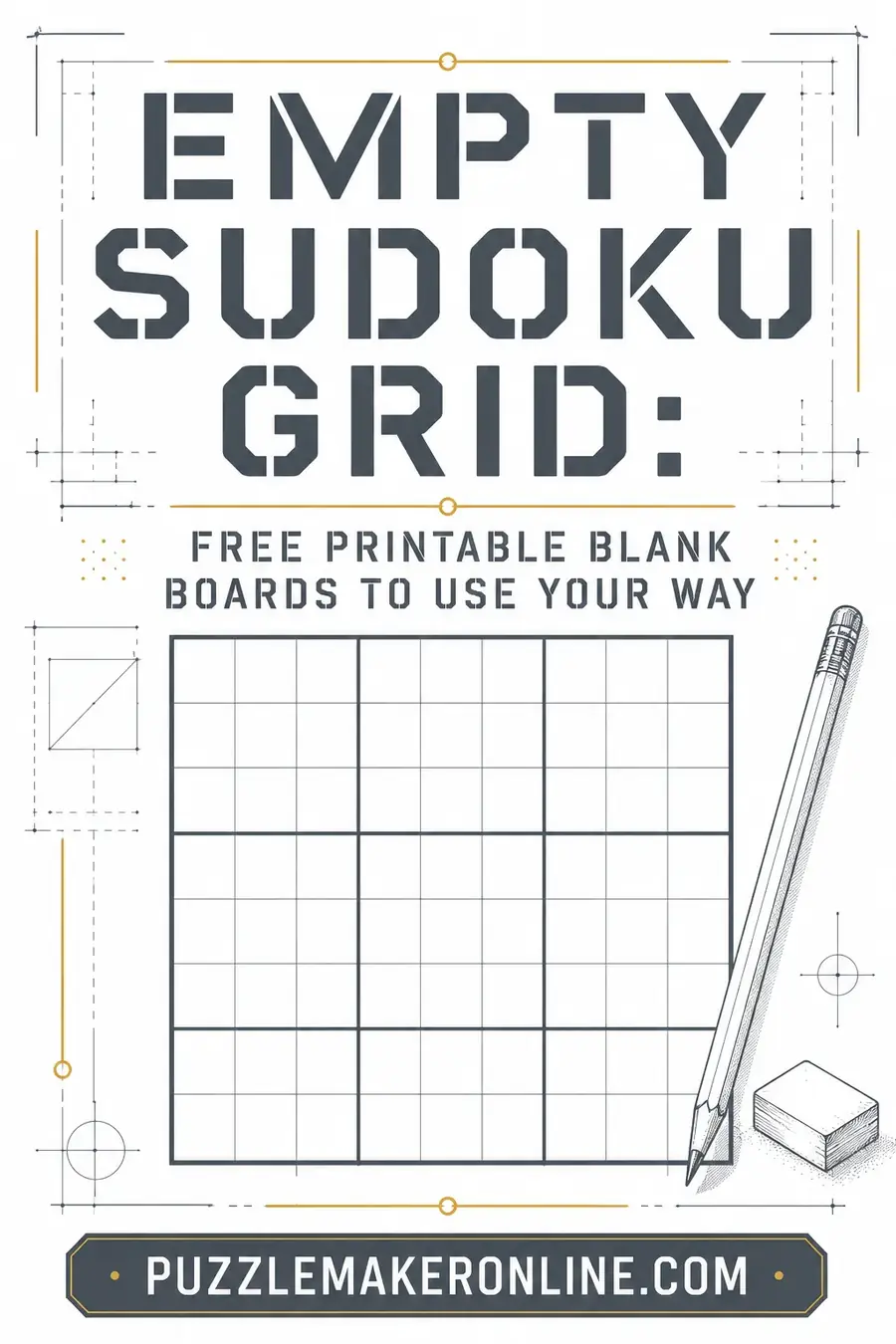
A blank sudoku grid — no starting numbers at all — is a genuinely useful tool for several completely different purposes: building your own custom puzzle, practicing pencil-mark technique on paper, or teaching someone the grid structure before introducing any actual numbers. It's a simple resource, but the range of ways people actually use it is broader than it first seems.
Why Someone Would Want a Completely Blank Grid
Building a custom puzzle from scratch. Some solvers or puzzle designers prefer to construct their own sudoku by hand rather than using a generator — a blank 9x9 grid, correctly divided into rows, columns, and 3x3 boxes, is the starting canvas for that process.
Teaching the grid structure before introducing numbers. For a genuine sudoku beginner, understanding the physical layout — nine rows, nine columns, nine 3x3 boxes — is worth a moment on its own before diving into actual solving. A blank grid lets you point out and trace these regions without the distraction of numbers already filled in.
Practicing full pencil-mark technique. Some solvers use a blank grid purely as scratch space to practice writing clean, organized candidate numbers (1-9 in the corner of each cell) before applying that skill to a real puzzle, since neat, consistent pencil marks matter a lot for solving harder puzzles accurately.
Recreating a puzzle from another source. If you're working from a puzzle in a book or app that you can't write directly on, transcribing it onto a blank grid lets you mark it up freely with pencil marks and corrections.
What a Correctly Structured Blank Grid Needs
A 9x9 arrangement of cells, with bold or thicker lines clearly dividing the grid into nine 3x3 boxes — this visual distinction matters, since it's easy to lose track of box boundaries on a poorly marked grid, especially when working through advanced techniques that depend on box-level deduction.
Enough cell size to write pencil marks. If you plan to use the grid for real solving (not just building a puzzle), each cell needs to be large enough to comfortably fit small candidate numbers 1-9 in the corners without them becoming illegible.
Clean printing with no unnecessary clutter, since a blank grid used for either teaching or building should be visually simple and uncluttered — extra decoration or small print can make an already-dense grid harder to read.
Building Your Own Puzzle on a Blank Grid
If you're using a blank grid to design your own sudoku, the tricky part isn't filling in numbers randomly — it's ensuring the completed grid you're working from is actually valid (follows all row/column/box rules) and that removing enough numbers still leaves a puzzle with exactly one unique solution. Manually verifying uniqueness by hand is genuinely difficult and time-consuming, which is why most people either start from a known-valid completed grid and remove numbers carefully, or use a sudoku puzzle maker to generate a properly validated puzzle and print it, rather than building entirely from scratch.
Using a Blank Grid for Practice
If your goal is purely practicing pencil-mark technique or working through advanced sudoku techniques without committing to a full real puzzle, a blank grid works well as scratch space — write out a hypothetical scenario (a few placed numbers, then fill in what the resulting candidates would look like) to build familiarity with the process before applying it under the pressure of an actual timed or graded puzzle.
Using a Blank Grid for Classroom or Group Settings
Teachers and group activity leaders often find a blank grid useful in ways that go beyond individual solving. A blank grid projected or photocopied for a whole class can be filled in collaboratively, with different students contributing numbers as the group works through the logic together out loud — a genuinely effective way to teach the reasoning process, since students can see and discuss each deduction as a group rather than working silently and individually. This collaborative approach works especially well as an introduction before students move to solving their own individual printed puzzles.
A Blank Grid as a Diagnostic Tool
For a solver working on genuinely difficult puzzles, a spare blank grid nearby can serve as useful scratch space for testing a hypothesis without risking the main puzzle. If you're stuck on an extreme puzzle and want to explore what a specific assumed placement would lead to (a technique sometimes called "trial and error," used cautiously and only after logical techniques have been exhausted), working it out on a separate blank grid first — rather than directly on your primary puzzle — protects your actual progress from being erased or confused if the hypothesis turns out to be wrong.
Printing Considerations for a Genuinely Useful Blank Grid
An empty sudoku printable is a simple thing to get wrong, and the mistake only shows up when you try to write candidate numbers in it. If you're printing your own blank grid rather than using a pre-made one, a few small details make a real difference in usability: leave enough white space in each cell for the small corner numbers used in pencil-mark technique (rather than sizing cells only for one large final answer), use a slightly heavier line weight for the 3x3 box boundaries than for the individual cell lines so the box structure stays visually clear even after the grid fills up with numbers, and print on paper heavy enough to handle repeated erasing if you plan to reuse the same physical sheet multiple times.
Using a Blank Grid to Understand Solved Puzzle Structure
A less obvious but genuinely useful application: taking a completed, solved sudoku grid and studying its structure on a blank reference grid to better understand what a "valid" finished puzzle actually looks like. New solvers sometimes have a vague or incomplete mental model of what they're working toward — seeing several fully completed, valid grids and actively checking that every row, column, and box genuinely does contain 1-9 with no repeats helps cement the target state more concretely than reading the rule description alone.
A Note on Digital "Blank Grid" Tools
Beyond printable options, some sudoku apps and websites include a genuinely blank grid mode specifically for building custom puzzles digitally rather than on paper — useful if you want the convenience of easy editing and correction that a screen offers over a physical eraser. These digital blank grid tools sometimes include a built-in solution checker that can verify whether a completed grid you've built follows all the rules correctly, which removes some of the manual verification burden described in the puzzle-building sections above, though they generally still can't verify that a puzzle with numbers removed has a single unique solution without more specialized solving software behind the scenes.
Using a Blank Grid to Practice Specific Advanced Techniques
Beyond general pencil-mark practice, a blank grid can be used more deliberately to drill a single advanced technique in isolation. Set up a hypothetical partial grid specifically constructed to contain an X-Wing or naked pair pattern, then practice spotting and correctly eliminating candidates based on just that pattern, without the surrounding noise of a full, complex puzzle. This kind of isolated, deliberate practice — building a specific scenario rather than hoping a technique happens to show up in a random puzzle — is a genuinely effective way to build confidence with a technique you're still learning before relying on spotting it naturally in real solving.
The Anatomy of a Sudoku Grid, and What Everything Is Called
A blank grid is a good place to learn the vocabulary, because every term describes a piece of the empty structure rather than anything to do with a particular puzzle.
Cell. One of the 81 squares. Row and column are the nine horizontal and nine vertical lines of cells. Box — also called a block or region — is one of the nine 3x3 subdivisions marked by the heavier borders.
Unit. Any row, column, or box; a grid contains 27 of them. Nearly every solving technique is stated in terms of units, which is why the word appears constantly in technique guides.
Peers. The 20 cells that share a row, column, or box with a given cell. A digit placed in a cell is eliminated as a candidate from all 20 of its peers, every time.
Band and stack. A band is a horizontal group of three boxes; a stack is the vertical equivalent. Both are useful for scanning, since a digit appearing in two boxes of a band is confined to one row in the third.
Givens and candidates. Givens are the printed starting digits; candidates, or pencil marks, are the possibilities you write in yourself.
Coordinates. The common shorthand is r5c5, meaning row 5, column 5, counting rows from the top and columns from the left. Some books instead label columns A-I and rows 1-9, giving E5. Either works, but pick one before writing notes you intend to reread.
Laminated Grids and Sudoku Whiteboards
A blank grid becomes considerably more useful once it stops being disposable.
Laminate a single sheet. One printed blank grid, laminated, plus a fine-tip dry-erase marker gives you an endlessly reusable board. Copy a puzzle's givens onto it in one color and solve in another, and the whole thing wipes clean. This is the cheapest way to practice the same hard puzzle repeatedly, which is genuinely valuable when you are drilling a specific technique.
Dry-erase pockets work as well as lamination and cost less if you want several. Slide any printed puzzle inside and write on the sleeve — useful for a classroom set where the underlying puzzles change weekly.
Draw a large grid on a whiteboard for group solving. For a class or a family, a wall-sized grid lets everyone see the same board and argue about the next placement, which is by far the fastest way to teach a technique. Draw the box borders in a different color from the cell borders, and make them noticeably thicker — on a whiteboard, the box structure disappears at distance otherwise.
Two practical cautions. Use fine-tip markers rather than standard chisel tips, since pencil marks in a whiteboard cell need a genuinely thin line. And wipe daily: dry-erase ink left on a laminated grid for weeks starts to ghost, and a ghosted grid is worse than no grid at all.
Frequently Asked Questions
Is a completely blank sudoku grid the same as an "easy" puzzle? No — a blank grid has zero starting numbers at all, which is different from even the easiest real sudoku puzzle, which always has some starting clues. A truly empty grid with no clues has many possible valid solutions, not one unique answer, so it isn't a solvable puzzle on its own.
Can I build a valid sudoku puzzle just by filling in a blank grid randomly? Not reliably — a valid sudoku puzzle needs to have exactly one unique solution, which is genuinely difficult to guarantee by placing numbers randomly. Most reliable puzzle creation starts from a known-valid completed grid and removes numbers carefully, or uses generation software that verifies uniqueness automatically.
What's the best use for a printable blank sudoku grid? The most common practical uses are teaching the grid structure to a beginner before introducing real numbers, and using it as scratch space to practice pencil-mark technique — building an entirely custom puzzle by hand is possible but considerably more involved.
Do blank sudoku grids come in sizes other than 9x9? Yes — blank grids are available in smaller sizes too, including 4x4 and 6x6, which are especially useful for teaching young beginners the core logic on a much simpler scale before moving up to the standard 9x9 format.
Can I get a blank sudoku grid in sizes other than 9x9? Yes — blank grids are commonly available in 4x4, 6x6, and 9x9 sizes, and less commonly in larger formats like 16x16, matching whatever puzzle size you're working with or teaching.
Is a blank sudoku grid useful for anything besides sudoku itself? Occasionally, yes — the basic 9x9 grid structure has been repurposed for other logic puzzle variants that share a similar row/column/region format, though this is a niche use beyond standard sudoku-related purposes.
Do I need special software to design my own blank grid template? No — a blank grid can be built with basic tools like a spreadsheet program or word processor using a table with adjusted borders, no specialized design software required for a functional, printable result.
Can I print multiple blank grids on one page to save paper? Yes — most printable blank grid templates can be formatted two or four to a page depending on the intended cell size, which is a practical option for teachers or anyone needing several grids for a group activity.
Is a blank sudoku grid useful for testing a puzzle app or generator's output before relying on it? Yes — manually transcribing a generated puzzle onto a blank grid and solving it by hand is one way to spot-check a new or unfamiliar puzzle source's reliability before trusting it for regular use.
Can a blank sudoku grid be used as decor or a design element, not just for solving? Some people do use a stylized blank grid pattern decoratively (on stationery, wall art, or classroom decor), separate entirely from its functional puzzle purpose, simply because the grid itself has a clean, recognizable visual appeal.
Is a blank grid ever included as a bonus page in published sudoku puzzle books? Some puzzle books do include a few blank grids at the back specifically for readers who want to design their own puzzles or need scratch space, treating it as a small bonus feature beyond the main puzzle content.
Where can I get a printable empty sudoku grid? Any generator that produces puzzles can usually output a blank grid, and a blank 9x9 is also easy to draw with a table in a word processor — nine columns, nine rows, with a heavier border every third line. What matters is that the box borders are visibly thicker than the cell borders and that cells are at least half an inch square if you plan to write candidates.
Can I reuse a printed blank grid? Yes — laminate it or slide it into a dry-erase pocket and write with a fine-tip dry-erase marker. One laminated grid replaces a stack of printouts and is the practical choice for repeating the same puzzle while drilling a technique.