
Games Like Sudoku: 12 Logic Puzzles to Try Next
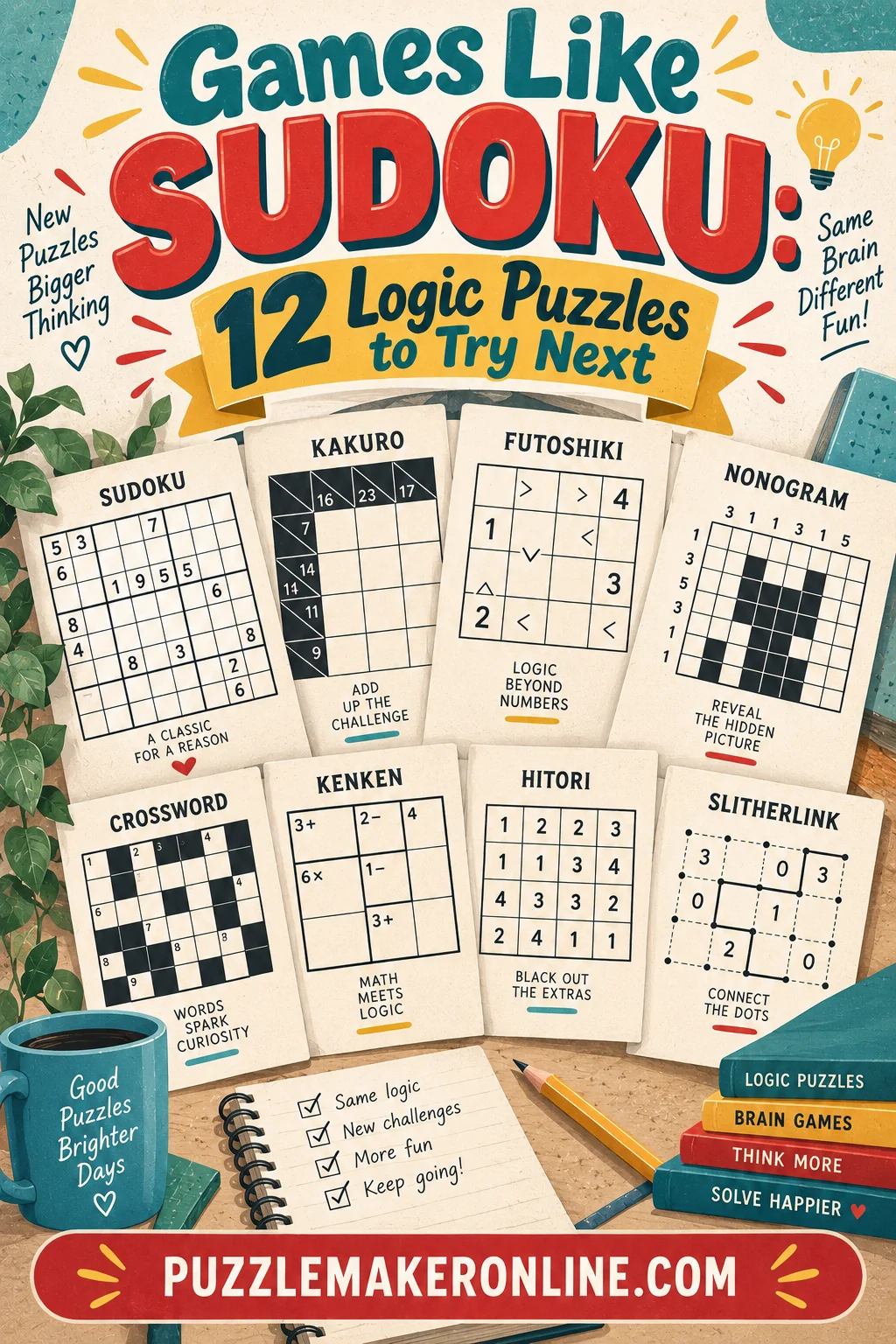
The best games similar to sudoku share three things with it: a single guaranteed solution, no hidden information, and a chain of deductions that always exists if you look hard enough. Everything else, including whether numbers are even involved, is negotiable. Below are twelve puzzles that pass that test, sorted so you can pick by what you actually enjoy about sudoku rather than by how the grid looks.
Worth saying up front: sudoku is not really a number game. Swap the digits for nine colors or nine letters and the puzzle is identical. What you are actually doing is constraint propagation, and that skill transfers to every puzzle on this list.
What makes a puzzle a real sudoku relative
Plenty of things get filed under sudoku related games without deserving it. A useful filter is four questions.
Is the solution unique? A well-made logic puzzle has exactly one answer, which is what lets you reason by elimination and trust the result.
Can it be solved without guessing? Good puzzles have a deduction path from start to finish. If a puzzle regularly forces trial and error, it is a search problem, not a logic puzzle.
Is all the information visible from the start? No dice, no hidden cards, no timer pressure changing the rules.
Do constraints interact? Sudoku is interesting because a placement in row 1 changes what is possible in box 7. Puzzles where each clue only affects its own neighborhood get boring fast.
The twelve below all pass. They differ mostly in what the constraints are about: arithmetic, order, visibility, connectivity or shape.
The quick comparison
| Puzzle | Core constraint | Arithmetic needed | Best if you like |
|---|---|---|---|
| Killer sudoku | Sudoku plus cage sums | Addition | Sudoku with an extra layer |
| Kakuro | Sums along runs, no repeats | Addition | Cage math without the 9x9 rules |
| KenKen | Latin square plus cage operations | All four operations | Mental arithmetic and small grids |
| Futoshiki | Latin square plus inequality signs | None | Ordering and chain logic |
| Str8ts | Consecutive runs in compartments | None | Range reasoning |
| Skyscrapers | Visibility counts from the edges | Counting | Spatial reasoning |
| Binairo | Balanced rows of two symbols | Counting | Very fast pattern work |
| Hitori | Shade out duplicates | None | Working backwards from conflicts |
| Nonogram | Block lengths per row and column | Counting | A picture as a reward |
| Slitherlink | One closed loop, edge counts | Counting | Topology and loop logic |
| Nurikabe | Islands and one connected sea | Counting | Region carving |
| Hashiwokakero | Bridge counts between islands | Counting | Network puzzles |
The closest cousins: number placement on a grid
1. Killer sudoku
Ordinary sudoku rules, plus dotted cages with a target sum. Digits cannot repeat inside a cage, so each sum has a fixed list of possible digit sets. A three-cell cage of 7 can only be 1, 2 and 4.
The difference from plain sudoku is that killer grids often start with no given digits at all. Every early move comes from arithmetic on the cages, and the classic sudoku scanning techniques only kick in once you have placed a handful of numbers. It also introduces the 45 rule: every row, column and box sums to 45, so cages that almost cover a house give you the leftover cell for free.
Try it if you like sudoku and want more of it. The overlap in technique is close to total, so nothing you already know goes to waste.
2. Kakuro
A crossword-shaped grid where each horizontal and vertical run of white cells carries a clue sum. Fill the run with digits 1 to 9, no repeats within a run. There are no boxes and no rows of nine, just intersecting runs of two to nine cells.
Kakuro is where the combination charts really live. A two-cell run of 16 is 7 and 9, always. A three-cell run of 24 is 7, 8 and 9. The whole game is finding intersections where two runs' possible sets overlap in only one digit.
Try it if the cage arithmetic is your favorite part of killer sudoku. Kakuro is that, undiluted, and it scales up to genuinely hard puzzles.
3. KenKen (also called Calcudoku or MathDoku)
Fill an n by n grid so each row and column contains 1 to n once. Cages carry a target and an operation: addition, subtraction, multiplication or division. Unlike killer sudoku, digits may repeat within a cage as long as they do not repeat in a row or column.
Grids run from a gentle 4x4 up to a brutal 9x9. Division and subtraction cages are the interesting ones, because a two-cell cage marked "3 divide" in a 6x6 grid can only be 1 and 3, or 2 and 6.
Try it if you want the arithmetic to be more varied than plain sums, or if you want something that works well at small sizes for a five-minute break.
4. Futoshiki
An n by n Latin square with inequality signs between some adjacent cells. Usually 5x5 to 9x9, with very few starting digits. Rows and columns each hold 1 to n once, and every greater-than sign must be satisfied.
The core technique is chain length. In a 5x5 grid, a run of three cells connected by a less-than chain means the first cell is at most 3 and the last is at least 3. String enough of those together and the grid collapses.
Try it if you enjoy pure ordering logic with no arithmetic at all. Futoshiki is probably the friendliest puzzle here for someone who likes sudoku's reasoning but has no interest in sums.
5. Str8ts
A 9x9 grid split by black cells into compartments, which are the unbroken runs of white cells in each row and column. Each compartment must contain a set of consecutive numbers in any order, so a four-cell compartment might hold 4, 6, 5, 7 but never 4, 6, 7, 9. Rows and columns still cannot repeat a digit, and black cells sometimes carry a clue digit that removes that digit from its row and column.
The reasoning is about ranges rather than exact values. If a three-cell compartment already contains a 5, its other two cells are drawn from 3, 4, 6 and 7, and nothing else.
Try it if you like the moment in sudoku where you realize a whole region is restricted to a narrow band of digits. Str8ts is built entirely from that feeling.
6. Skyscrapers
A Latin square where each digit represents a building of that height. Clues sit outside the grid and tell you how many buildings are visible from that direction, with taller buildings hiding shorter ones behind them.
The opening moves are memorable. In a 5x5 grid, a clue of 1 means the nearest cell is a 5. A clue of 5 means the row is exactly 1, 2, 3, 4, 5 in order. A clue of 2 means the 5 is not in the nearest cell but everything before it is climbing.
Try it if you want a puzzle that makes you think in three dimensions while filling in a flat grid. It is also a great one to introduce to someone who finds sudoku dry, because the clue rule has an immediate physical meaning.
7. Binairo (also called Takuzu or Binary Puzzle)
Fill a grid with two symbols, usually 0 and 1. Three rules: never three identical symbols in a row or column, each row and column contains equal numbers of both, and no two rows are identical and no two columns are identical.
Individual moves are simple, so a 10x10 binairo solves in a couple of minutes once you spot the standard patterns. The "no two rows identical" rule is the one that produces the clever endgame deductions.
Try it if you want something fast. This is the puzzle equivalent of a short walk rather than a hike.
Shading and cell-state puzzles
8. Hitori
You get a grid already full of numbers. Shade cells so that no number appears twice unshaded in any row or column. Two extra rules: shaded cells may never be orthogonally adjacent, and all unshaded cells must remain connected as one group.
The technique is the mirror image of sudoku. Instead of deciding what goes into a cell, you decide which duplicates must be removed. The connectivity rule is what makes it hard, because shading a cell can strand a corner of the grid.
Try it if you like the elimination half of sudoku more than the placement half. There is also a satisfying signature pattern to learn: three identical numbers in a row means the middle one stays.
9. Nonogram (also Picross or Griddlers)
Numbers along the top and side of a grid give the lengths of consecutive filled blocks in that line, in order, with at least one empty cell between blocks. Solve it and the filled cells form a picture.
The fundamental technique is overlap. In a row of ten cells with a single clue of 7, the block can start at position 1, 2, 3 or 4, so cells 4 through 7 are filled in every case. Marking known-empty cells with a cross is as important as filling cells, exactly like eliminating candidates in sudoku.
Try it if you want a visual payoff. Nonograms are also unusually good on a phone, and they scale from 5x5 warm-ups to 30x30 sessions that take an hour.
10. Nurikabe
Numbered cells are islands, and the number is how many cells that island contains. Shade the rest into a single connected sea. Islands may not touch each other orthogonally, and the sea may never contain a filled 2x2 block.
The no-2x2 rule sounds arbitrary and turns out to be the engine of the whole puzzle. It constantly forces a specific cell to belong to an island, which then constrains everything around it.
Try it if you like carving space rather than filling it. Nurikabe rewards a very different kind of vision from sudoku, so it takes longer to click, and it is more rewarding when it does.
Loop and line puzzles
11. Slitherlink
A grid of dots with numbers in some of the cells. Draw a single closed loop along the edges between dots. Each number says exactly how many of that cell's four edges are part of the loop.
Corners and clue combinations do most of the work. A 3 next to a 3 in the same row forces the edge between them plus their two outer edges. A 0 kills all four of its edges immediately. Every dot must have either zero or two line segments touching it, which is the constraint that ties distant parts of the grid together.
Try it if you like the global feel of sudoku, where a deduction in one corner matters in another. Slitherlink has that quality more strongly than anything else here, and the loop-closure logic is genuinely different from anything sudoku teaches.
12. Hashiwokakero (Bridges or Hashi)
Numbered islands scattered on a grid. Connect them with horizontal or vertical bridges, at most two between any pair, no bridges crossing. Each island's number is the total count of bridges touching it, and every island must end up connected to every other in one network.
Openings are formulaic and pleasant. An island marked 8 must have two bridges in all four directions. An island marked 3 in a corner with only two neighbors must have two bridges to one and one to the other. The connectivity requirement supplies the hard endgame deductions.
Try it if network and graph shaped problems appeal to you. It is also one of the easiest on this list to teach to a child, since the rules fit in two sentences.
Which one should you play first
Pick based on what you like about sudoku.
If you like the arithmetic in killer cages, go to kakuro, then KenKen.
If you like the pure elimination and never want to do math, go to futoshiki, then hitori.
If you like the moment a whole region locks into place, go to str8ts, then skyscrapers.
If you want something completely different that still uses the same brain, go to slitherlink, then nurikabe.
If you want a quick daily habit, binairo and small nonograms both fit in a coffee break.
One practical note. Almost all of these are better on paper than on a screen, because you need somewhere to mark uncertainty, and pencil marks beat any app's notes mode. If you want printable grids across sudoku and its variants, our puzzle maker generates and prints them at a range of sizes and difficulties.
Frequently Asked Questions
Which puzzle is closest to sudoku? Killer sudoku, because it keeps every sudoku rule and only adds cage sums. Outside the sudoku family, futoshiki is closest in feel, since it is a Latin square solved by elimination with no arithmetic involved.
Are there sudoku related games that use no numbers at all? Yes. Nonograms, slitherlink, nurikabe and hashiwokakero all use numbers only as counts, not as values to place. Hitori uses numbers but you never write one, you only shade. All four are solved with the same constraint reasoning sudoku uses.
Which of these is hardest? It depends on the individual puzzle, but slitherlink and nurikabe have the steepest learning curves because their key techniques are unlike anything sudoku teaches. Hard kakuro and hard killer sudoku are more difficult in the moment but feel familiar from the start.
Do sudoku solving techniques transfer to these puzzles? The specific patterns do not, but the underlying habits do. Tracking candidates, spotting when a value is forced into one of two places, and working from the most constrained region outward are useful in every puzzle on this list.