
Halloween Sudoku: Free Printable Puzzles for Kids and Adults
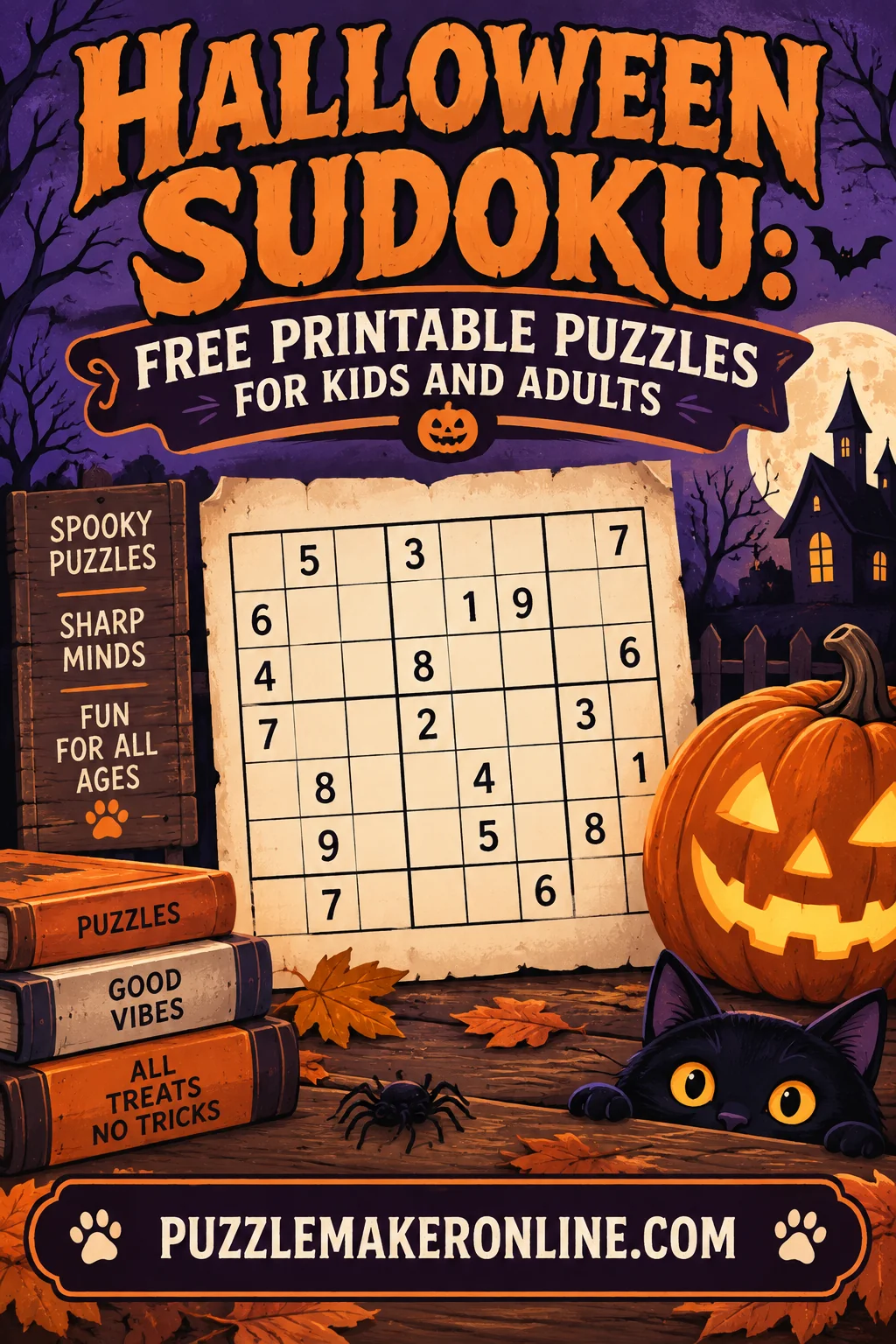
A halloween sudoku is an ordinary sudoku puzzle with the digits 1 through 9 swapped for pumpkins, bats and ghosts, or a plain grid framed with October artwork. The rule does not budge. Every row, every column and every box still holds each symbol exactly once, and a solver who can finish a standard grid can finish this one at the same speed.
What the swap changes is the reading load. A digit has to be recognized as a numeral before it can be compared; a pumpkin does not. For a five-year-old still sounding out numerals, a picture grid is easier than a number grid, which is the opposite of what most adults assume.
The Problem This Actually Solves
October 31 in an elementary classroom is not a normal teaching day. Costumes come off and go back on, a parent volunteer arrives with cupcakes at an unpredictable hour, the afternoon is chopped into fragments, and half the room has eaten more sugar by noon than in the previous week. Sustained instruction is wasted effort, and anything needing supplies gets abandoned halfway through.
What survives is a short, self-contained, self-checking task on one sheet of paper. Sudoku fits precisely. One pencil, no setup, no partner, no explanation past the first time, and it can be picked up and dropped four times across an afternoon without losing its thread.
That is the honest reason halloween sudoku gets searched for in the second half of October. A themed page reads as party-appropriate to the students while staying a genuine reasoning task on the lesson plan, and both have to be true at once for it to be usable.
Symbols That Survive a Half-Inch Cell
This is where most themed printables go wrong. A cell on a one-puzzle-per-page 9x9 grid is roughly half an inch square, and the picture inside it has to be identified in a fraction of a second, in black and white, dozens of times per puzzle, by a tired kid. Most Halloween clip art fails that test.
The rule that predicts success is silhouette distinctness. Fill each symbol in solid black and look at the outline alone. If two shapes still read as different, they work. If they blur into the same rounded blob, the puzzle becomes a squinting exercise.
Symbols that hold up:
| Symbol | Why it works |
|---|---|
| Pumpkin | Wide, squat, unmistakable outline |
| Bat | Spread wings give a long horizontal shape nothing else shares |
| Ghost | Tall with a scalloped bottom edge |
| Candy corn | A pure triangle, the cleanest shape in the set |
| Spider | Radiating legs read even when tiny |
| Cat | The pointed ears plus arched back are distinctive in profile |
| Crescent moon | A thin curve, the lightest mark on the page |
| Cauldron | A deep bowl on short legs, wider than tall |
| Skull | Round with two dark eye sockets |
That set is deliberately built from nine different overall shapes rather than nine different Halloween nouns.
Symbols that fail, and why:
A haunted house is the most common mistake. At full size it is charming; at half an inch it collapses into a gray rectangle with texture. Anything architectural has the same problem, because the detail that identifies it is fine linework, and fine linework is the first casualty of scaling down.
A witch figure fails for the same reason plus one more. A standing human figure with a hat and a broom is mostly vertical strokes, and it is easily confused with any other standing figure such as a scarecrow or a mummy. One human figure is fine; two is a problem.
Overly dark symbols fail differently. A solid black cat, bat and spider on one grid all print as heavy ink blots, and three blots in a nine-symbol set makes the page feel muddy. Keep at most two solid-fill symbols and let the rest be outlines.
Similar outlines are the quiet killer. A pumpkin and a cauldron are both wide and round-bottomed, so if you use both, make the cauldron clearly narrower with visible legs. Test the set at print size, not on screen at 200 percent.
Difficulty by Age
Grid size does more work than clue count in matching a puzzle to a solver. A 4x4 with four symbols is a different activity from a 9x9, not a watered-down one, and a kindergartener handed a 9x9 will guess rather than reason.
| Level | Grid | Symbols | Typical given clues | Time |
|---|---|---|---|---|
| Pre-K to kindergarten | 4x4 | 4 pictures | 8-10 of 16 | 3-5 min |
| Grades 1-2 | 6x6 | 6 pictures or digits | 16-20 of 36 | 6-12 min |
| Grades 3-5 | 9x9 easy | digits, themed border | 36-40 of 81 | 10-20 min |
| Middle school and up | 9x9 standard | digits | 28-32 of 81 | 20-30 min |
| Adults | 9x9 hard | digits | 22-26 of 81 | 30-60 min |
The clue counts at the younger levels are far higher than a puzzle book would use, and that is intentional: a first puzzle that gets finished beats a challenging one that gets abandoned, and on a party day nobody is free to unstick a frustrated child.
Note also that the picture symbols stop at grade two. Nine distinct pictures at 9x9 cell size are hard to scan quickly even when the shapes are well chosen, and scanning is the entire task. Above 6x6, keep the theme in the border and put digits in the cells.
Keeping It Not Scary and School Appropriate
A Halloween page that goes home in a backpack passes through more hands than you plan for, and a little restraint keeps it usable across a whole school.
Pumpkins, cats, bats, candy corn, moons and friendly ghosts read as autumn decoration to almost everyone. Blood, gravestones and realistic monsters read as horror to some five-year-olds and as objectionable to some families. There is no logic-puzzle benefit to the scarier imagery, so nothing is lost by skipping it.
A useful test: would this page be fine pinned to a hallway board the pre-K class walks past? Skulls sit near the line and land fine drawn round and cartoonish rather than anatomical, but in the youngest grades, swapping the skull for a candy bucket costs nothing.
Some schools sidestep October imagery and run a fall or harvest theme instead. Pumpkin, leaf, acorn, apple, scarecrow, corn, owl, sunflower and squirrel has excellent silhouette variety and fills the same slot without anyone needing to opt out.
Running It in a Classroom Without Thirty Different Sheets
The differentiation problem is real and the fix is simpler than it looks. You do not need thirty versions. You need three, printed in stacks, using the same nine symbols throughout.
Print one stack of 4x4 picture grids, one of 6x6, and one of 9x9 easy. Because the artwork is identical across all three, a student holding the 4x4 is visibly doing the same Halloween activity as the one beside them holding the 9x9. Nobody is on the baby version, because the pages look like siblings rather than a remedial track. That is the reason to keep one symbol set across the rotation.
Then the rules for the day write themselves:
Early finishers. A tray on the counter with the three stacks and a pencil cup. A student who finishes their work takes the next size up from whatever they finished last.
Substitute plans. A folder of thirty pages with the answer key clipped on top is the most reliable emergency activity a sub can be handed. No context, no manipulatives, no knowledge of where anything in the room is kept.
Indoor recess. The 4x4 and 6x6 stacks, because they finish inside the time available. A 9x9 does not, and an unfinished puzzle at the bell is a disappointment you can avoid.
Party rotation. Sudoku as one station of four on a fifteen minute rotation. Every rotation needs a quiet station.
Homework packets. Two pages, one at grade level and one a step above, marked optional. The label turns the harder page into a choice rather than an assignment.
Party and Event Use
Outside the classroom, the same pages do a different job.
At a class party or a home party, put a stack on the food table while the pizza is being cut. The gap between arrival and eating is where parties fall apart, and a table activity that needs no explanation fills it. Sudoku also works as one station in a party circuit, and it is the station that needs no adult standing over it.
Keep a few 4x4 and 6x6 sheets in a quiet corner away from the noise. Halloween parties are loud, crowded and heavily costumed, and at least one child at every party needs to sit out for ten minutes without it being framed as a time-out. A puzzle sheet gives that child a reason to be sitting there.
For a trick-or-treat table, a themed grid printed two-up and cut in half makes a takeaway that is not candy. And if a costume contest ends in a tie, a timed easy 9x9 settles it.
Printing Halloween Sudoku Without Wasting Ink
Design in black and white first. Color ink is the expensive part of any classroom printable, and most school printers are monochrome anyway. If the puzzle only works in orange and black, it does not work.
If you do print in color, use orange for the border only. A grid full of orange symbols is expensive and lower contrast than black on white. Black symbols in an orange frame gets the whole seasonal effect for a fraction of the ink.
Use heavier paper for anything reused. A station sheet ten kids handle in an afternoon needs card stock or at least 28 lb paper. Copy paper is soft by the third solver.
Sleeve it and hand out a dry-erase marker. A page in a clear sheet protector becomes reusable, turning five sheets into a station that serves a class. It is also the fix for a child who finds erasing frustrating.
Print two-up to save paper. Two 6x6 grids per sheet is comfortable. Two 9x9 grids is not, because the cells drop below half an inch and the symbols stop being legible. Check before running thirty copies.
Set margins to half an inch and use scale-to-fit. Grids running near the paper edge get clipped by most home printers, and a clipped border column makes a valid puzzle look broken.
Test one page at arm's length, not on screen. If you cannot tell the bat from the spider, no child will.
Put the answer key on a separate sheet, not the back. Copy paper is thin enough that a solution shows through, and once one student notices, the whole stack is finished as a puzzle.
Making Your Own, and Reusing It All Year
Pre-made themed packs rarely match the grid size, difficulty and clue count you want, and a set assembled from three sources usually leaves you with pages that have no answer keys. Generating your own takes ten minutes and gives you a matched set.
Produce the grids at each size and difficulty with a sudoku generator, print them plain, then either drop them into a document with a Halloween header and border or let students decorate their own page before solving. Plain grids plus five minutes of drawing time turns one activity into two and costs nothing in color ink.
Because the theming is separable from the puzzle, the same three stacks carry across the calendar. Swap the border and symbol set and the October pages become harvest pages, then winter, then spring. Grid sizes, clue counts and the routine stay identical, so you build it once and re-skin it four times a year.
What It Is Good For, and What It Is Not
Sudoku is not a math worksheet, and it is worth being able to say so clearly if a parent or an administrator asks what the party-day activity was teaching.
Standard sudoku contains no arithmetic. Nothing is added, compared or ordered. The digits are nine labels that happen to be numerals, which is exactly why swapping them for pumpkins changes nothing. What the puzzle trains is deductive reasoning and systematic elimination: working out what a cell must contain by ruling out everything it cannot, holding three constraints in mind at once, and verifying your own work without a key because a contradiction announces itself.
That carries a benefit arithmetic drills do not. A student who struggles with math facts is not disadvantaged at sudoku, because there are no math facts involved, and on a party afternoon that reversal is worth having.
What it will not do is practice a standard, reinforce a unit, or produce anything gradeable beyond finished or not finished. Treat it as a reasoning activity that keeps a hard day productive rather than as instruction.
Frequently Asked Questions
Is a halloween sudoku harder than a regular sudoku? No. The rules are identical, and a themed grid is exactly as hard as a plain grid at the same difficulty. The only variable is how quickly you can tell the symbols apart, which is a design question rather than a logic one.
What age can kids start Halloween sudoku? Around four or five with a 4x4 grid using four picture symbols, since that requires no reading or number recognition at all. Move to 6x6 in grades one and two, and to a 9x9 easy grid with digits from about grade three.
Which Halloween symbols work best on a printed grid? Pumpkin, bat, ghost, candy corn, spider, cat, crescent moon, cauldron and skull, because all nine have clearly different outlines. Avoid detailed art like a haunted house and avoid two standing human figures in one set, since both turn into indistinct marks at cell size.
How do I run Halloween sudoku for a whole class at different levels? Print three stacks at 4x4, 6x6 and 9x9 easy using the same artwork throughout, then let students take the size that suits them. Every page looks like part of the same activity, so nobody is visibly on an easier sheet and you manage three versions instead of thirty.