
Hexadecimal Sudoku: The 16x16 Grid for Experienced Solvers
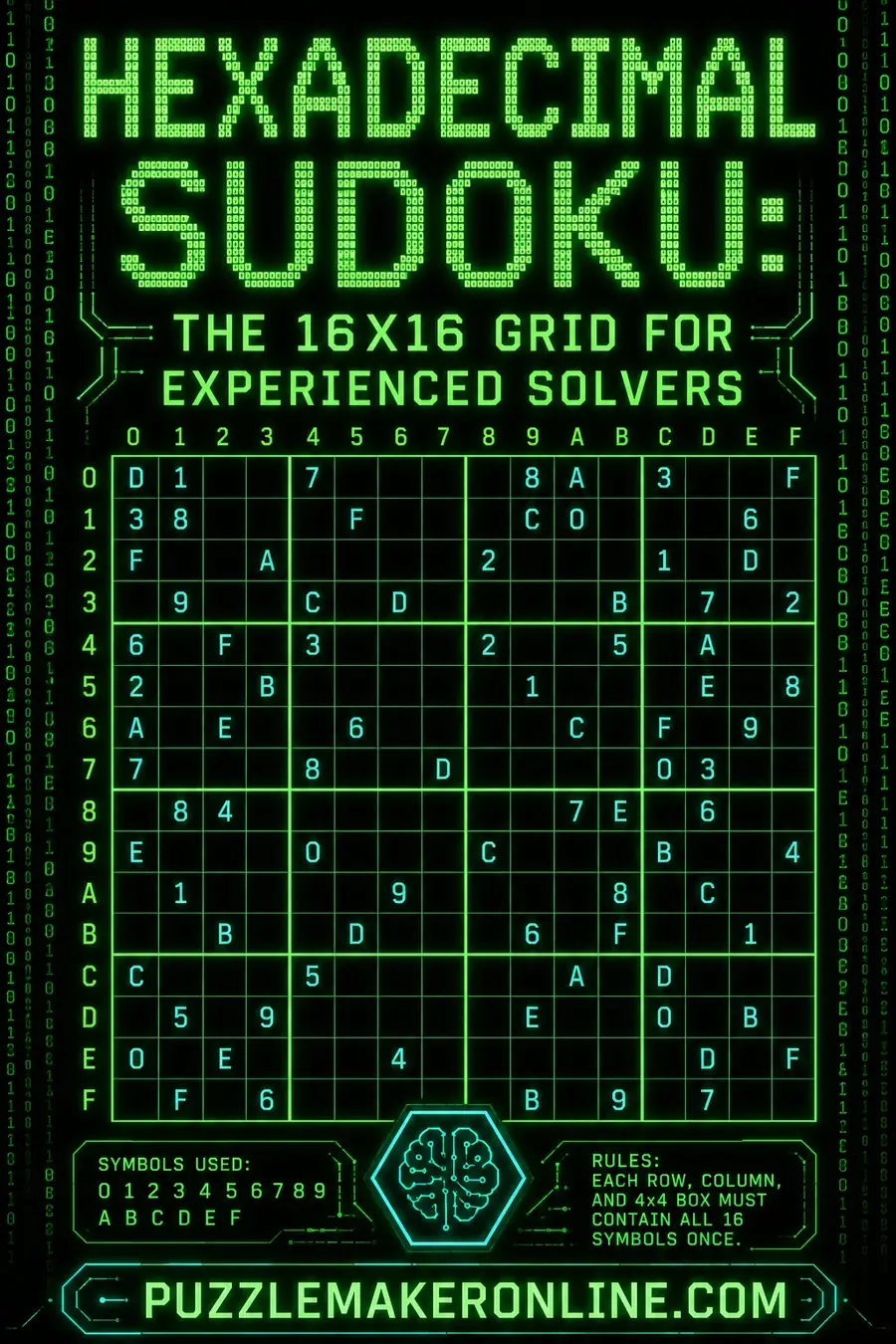
Hexadecimal sudoku scales the standard 9x9 puzzle up to a 16x16 grid, using the sixteen hexadecimal symbols (0-9 and A-F) instead of just 1-9, with sixteen 4x4 boxes instead of nine 3x3 boxes. The core rule is identical to standard sudoku — no repeats in any row, column, or box — but the sheer size of the grid makes it a genuinely different, more demanding solving experience, not just a "bigger" version of the same puzzle.
The Rule Structure at 16x16
- Every row (16 cells) must contain all sixteen symbols (0-9, A-F) exactly once
- Every column (16 cells) must contain all sixteen symbols exactly once
- Every 4x4 box (sixteen of them, arranged in a 4x4 pattern of boxes) must contain all sixteen symbols exactly once
The symbol set (0-9 and A-F) comes directly from standard hexadecimal notation, the base-16 number system used in computing — hence the puzzle's name, even though solving it doesn't actually require any hexadecimal math or computing knowledge. The letters A-F are simply used as extra unique symbols beyond 0-9, since a 16-symbol grid needs more distinct characters than the ten digits alone provide.
Why 16x16 Is Genuinely Harder, Not Just Bigger
More candidates per cell. In a standard 9x9 puzzle, each empty cell can have up to 9 possible candidates. In a 16x16 grid, that jumps to up to 16 possible candidates per cell — nearly double the information to track and eliminate for every single empty cell.
More cells overall. A 9x9 grid has 81 cells; a 16x16 grid has 256 cells — over three times as many, meaning a full pencil-marking pass alone takes considerably longer and requires much more sustained attention to complete accurately.
Techniques scale up too. All the standard techniques (naked/hidden singles and pairs, pointing pairs, and advanced techniques like X-Wing) still apply the same way logically, but spotting these patterns across a much larger grid, with more candidates per cell, is significantly more demanding — patterns that were quick to spot on a 9x9 grid take real, sustained concentration to find on a 16x16 grid.
Getting Started With Hexadecimal Sudoku
Don't attempt it before you're genuinely comfortable with standard 9x9 sudoku, including intermediate techniques like naked and hidden pairs. The 16x16 format amplifies every basic and intermediate technique's complexity, so shaky fundamentals at the 9x9 level will make the 16x16 grid feel overwhelming rather than just larger.
Use complete, careful pencil marks from the start. Given the sheer number of cells and candidates involved, trying to track anything mentally without full candidate notes is genuinely impractical at this scale — this is one puzzle format where skipping pencil marks isn't really an option even for experienced solvers.
Expect it to take significantly longer than a standard puzzle. A 16x16 puzzle at a comparable relative difficulty to a medium 9x9 puzzle can easily take several times longer to complete, simply due to the volume of cells and candidates — this is normal and expected, not a sign you're doing something wrong.
Work in sections mentally. Treating the grid as four quadrants (each containing four of the sixteen boxes) can make the scale feel more manageable, since it's easier to hold one quadrant's patterns in mind at a time than the entire 256-cell grid at once.
Trying Hexadecimal Sudoku
If you want to attempt a 16x16 puzzle, a sudoku puzzle maker that supports larger grid sizes can generate and print a properly validated hexadecimal sudoku at your chosen difficulty, which is far more practical than attempting to build one by hand given the scale involved.
Adapting Advanced Techniques to the Larger Grid
All the advanced techniques that apply to standard 9x9 sudoku — X-Wing, swordfish, empty rectangle — apply identically in principle to a 16x16 hexadecimal grid, but they become genuinely harder to spot in practice simply due to scale. An X-Wing pattern in a 9x9 grid requires comparing two rows against nine possible column positions; the same search in a 16x16 grid means comparing against sixteen possible column positions, which meaningfully increases the visual search space even though the underlying logic hasn't changed at all. Solvers who are already fast at spotting these patterns on standard puzzles typically find they need to consciously slow down and be more systematic when first applying the same techniques at hexadecimal scale, since the instinctive pattern recognition built on a 9x9 grid doesn't fully transfer to the larger format without some adjustment.
Managing the Sheer Volume of Pencil Marks
At 16 possible candidates per cell across 256 cells, a fully pencil-marked hexadecimal grid contains a genuinely large amount of written information — organizing it clearly on paper becomes its own small challenge. Many solvers find a slightly larger cell size than they'd normally use, specifically to keep sixteen small candidate marks legible in a 4x4 arrangement within each cell, makes a real difference in avoiding misread candidates later in the solve. If solving digitally, a tool with reliable auto-fill and auto-update candidate features (see what is candidate mode) becomes considerably more valuable at this scale than at standard 9x9 size, simply because the manual bookkeeping burden is so much larger.
Is Hexadecimal Sudoku Worth Attempting?
For solvers who've genuinely mastered standard 9x9 sudoku, including advanced techniques, and are looking for a fresh kind of challenge without learning entirely new logic, hexadecimal sudoku offers exactly that — the same rules and same core techniques, but demanding significantly more sustained concentration and organizational discipline to apply them correctly across a much larger grid. It's not for everyone, and there's no reason to feel obligated to attempt it even as an experienced solver — but for those who enjoy the scale-up specifically, it's one of the more accessible "next level" challenges available, since it doesn't require learning a genuinely new rule set the way killer sudoku or diagonal sudoku do.
A Realistic Time Estimate Before You Start
Setting accurate expectations matters for enjoying a hexadecimal puzzle rather than abandoning it partway through out of frustration at the time commitment. A medium-difficulty 16x16 puzzle can reasonably take a solid hour or more for a solver who's fast and comfortable at standard 9x9 medium difficulty, and a genuinely hard 16x16 puzzle can extend well beyond that for even experienced solvers. This isn't a puzzle format suited to a quick coffee-break solve the way an easy 9x9 puzzle is — it's better approached as a dedicated activity with a real chunk of uninterrupted time set aside, ideally without the pressure of needing to finish in one sitting, since it's completely reasonable to pause a large hexadecimal grid partway through and return to it later, as long as your pencil marks and progress are clearly preserved.
Where to Find Genuinely Well-Constructed 16x16 Puzzles
Because hexadecimal sudoku is a niche variant compared to standard 9x9 puzzles, the overall pool of available puzzles is smaller, and quality can vary more than with the heavily-tested standard format. A sudoku puzzle maker that specifically supports and validates larger grid generation is worth seeking out over informally shared puzzles from less rigorously tested sources, since a hexadecimal puzzle with a construction error (an accidental non-unique solution, for instance) is considerably more frustrating to discover an hour into solving than the same issue would be in a much shorter standard puzzle.
Why Some Solvers Treat Hexadecimal Puzzles as a Personal Challenge Milestone
For solvers who track their own progress and enjoy setting concrete personal goals, successfully completing a hexadecimal puzzle often becomes a meaningful milestone in itself — a clear marker of having genuinely mastered standard sudoku technique well enough to apply it confidently at a much larger scale. Some dedicated puzzle communities and forums even track and celebrate completion of specific hard 16x16 puzzles the way other hobbies track personal records, which adds a layer of community and accomplishment beyond the puzzle itself for solvers who enjoy that competitive or achievement-oriented framing.
Super Sudoku, Mega Sudoku, 16x16: One Grid, Several Names
The same puzzle circulates under a confusing number of labels. Super sudoku is the most common commercial name for a 16x16 grid, particularly in puzzle magazines and books. Mega sudoku and monster sudoku turn up on some sites for the same format. And the size itself gets written every possible way, so searches for sudoku 16x16, 16 x 16 sudoku, and 16 by 16 sudoku all land on the same format — worth knowing when hunting for puzzles, since a source that uses one spelling often will not surface under another.
There is one real difference hiding behind the naming. Not every 16x16 puzzle uses hexadecimal symbols. Publishers split roughly three ways: 0-9 plus A-F, which is the true hexadecimal set and the one this article uses; 1-16 written as two-digit numbers, which is common in magazines aimed at readers who find letters off-putting; and 1-9 plus A-G, which starts counting at 1 rather than 0.
The solving logic is identical in all three, but the practical experience is not. Two-digit numbers eat far more cell space, which matters enormously once you are writing sixteen candidate marks per cell, and the 1-9 plus A-G set makes it easy to reflexively look for a 0 that does not exist. Check which symbol set a puzzle uses before you start pencil-marking, because switching conventions halfway through a 256-cell grid is a reliable way to introduce errors you will not find for an hour.
Giant, Huge and Samurai: The Formats Above 16x16
Once solvers finish a 16x16 grid, the natural question is what sits above it, and the labels giant sudoku and huge sudoku both get used for two genuinely different things.
Larger single grids. 25x25 is the usual next step, with 625 cells and twenty-five symbols per region — normally 1-25 or A-Y. The logic never changes, but the pencil-marking workload roughly doubles again over 16x16, and a single missed candidate can cost hours rather than minutes. These are endurance puzzles, usually solved across several sittings.
Samurai sudoku. Often typed as samari sudoku by mistake, this is five standard 9x9 grids overlapped in an X shape, sharing four corner boxes — 369 cells in total. It is the most popular of the giant formats, and it is a different kind of challenge from a 25x25. Each individual grid stays at familiar 9x9 scale, so no technique is harder than usual; the skill lies in working the shared boxes, where a placement in one grid immediately constrains a neighbor. Solvers who stall on one sub-grid can nearly always find progress in another and come back. Related overlapping formats include butterfly, windmill, and gattai layouts, which vary the number of grids and how they intersect.
If you want a genuine step up in solving depth, a hard 16x16 will test you more than a samurai. If you want a long, absorbing puzzle to spread across an afternoon, the samurai is the better pick — and it prints far more legibly, since every cell is standard 9x9 size.
Frequently Asked Questions
Do I need to know hexadecimal math to solve hexadecimal sudoku? No — despite the name, solving the puzzle involves zero arithmetic or number-base conversion. The symbols 0-9 and A-F are simply used as sixteen distinct, easily typeable characters; the puzzle logic itself is identical to standard sudoku, just at a larger scale.
How much longer does a 16x16 puzzle take compared to a standard 9x9 puzzle? It varies by individual solver and puzzle difficulty, but many solvers find a 16x16 puzzle takes three to five times longer (or more) than a comparably-difficult 9x9 puzzle, largely due to the much higher number of cells and candidates involved.
Are there sudoku grid sizes even larger than 16x16? Yes, though they're far less common — 25x25 grids (using numbers or letters as 25 distinct symbols) exist as an even more extreme variant, generally attempted only by very experienced solvers specifically seeking an extended challenge.
Is hexadecimal sudoku appropriate for beginners? Not recommended as a starting point — the scale amplifies the difficulty of every technique, so it's much better suited to solvers who are already comfortable with standard 9x9 sudoku, including intermediate techniques like naked and hidden pairs.
Are there sudoku variants even larger than 16x16 that are commonly available? 25x25 grids exist and are occasionally offered by specialized puzzle sources, though they're considerably rarer than 16x16 and are aimed at an even smaller niche of dedicated, highly experienced solvers.
Do 16x16 puzzles use the same difficulty rating scale as 9x9 puzzles? Generally yes in concept (easy through extreme), though the practical time and effort required at each label tends to run higher at 16x16 than the equivalent label at 9x9, given the larger scale involved.
Is hexadecimal sudoku related to actual computer hexadecimal number systems in any functional way? No — the connection is purely in borrowed terminology (using the same 0-9, A-F symbol set that hexadecimal notation uses in computing), not in any actual mathematical or computational relationship between the puzzle and real hexadecimal arithmetic.
Do hexadecimal sudoku puzzles ever use symbols other than 0-9 and A-F? Rarely — 0-9 and A-F is the standard, widely recognized symbol set for this variant, chosen specifically because it matches real hexadecimal notation and provides exactly the sixteen distinct characters needed.
Is there a print-friendly way to display 16x16 puzzles without cells becoming too small to read? Printing on larger paper (tabloid/A3 size rather than standard letter/A4) or splitting a very dense grid across a landscape orientation both help keep cells legible enough for comfortable pencil-marking at this scale.
Do any competitive puzzle events feature hexadecimal sudoku specifically? Some larger puzzle championships and specialized competitions do include larger-grid sudoku variants as part of their event lineup, though it remains a niche category compared to standard-size competitive sudoku rounds.
Is there a smaller intermediate step between 9x9 and 16x16, similar to how 6x6 sits between 4x4 and 9x9? Some sources offer 12x12 grids as an intermediate step, using numbers 1-9 plus a few extra symbols, which can ease the transition before attempting a full 16x16 hexadecimal puzzle.
What is super sudoku? It is a common commercial name for a 16x16 grid — the same puzzle as hexadecimal sudoku, though some publishers use the numbers 1-16 or the set 1-9 plus A-G instead of the hexadecimal 0-9 and A-F.
Is samurai sudoku harder than a 16x16 grid? Longer, not harder. A samurai puzzle is five overlapping 9x9 grids, so every individual deduction stays at standard scale — it takes far more time but rarely demands techniques beyond what a hard 9x9 requires. A 16x16 is the tougher test of technique.
Do all 16x16 puzzles use letters? No. Hexadecimal 0-9 and A-F is the standard, but magazine versions often use the numbers 1 through 16 instead. Confirm the symbol set before you begin, since candidate marks written in one convention are useless in the other.