
Hexagon Sudoku: Rules and Printable Hexagonal Puzzles
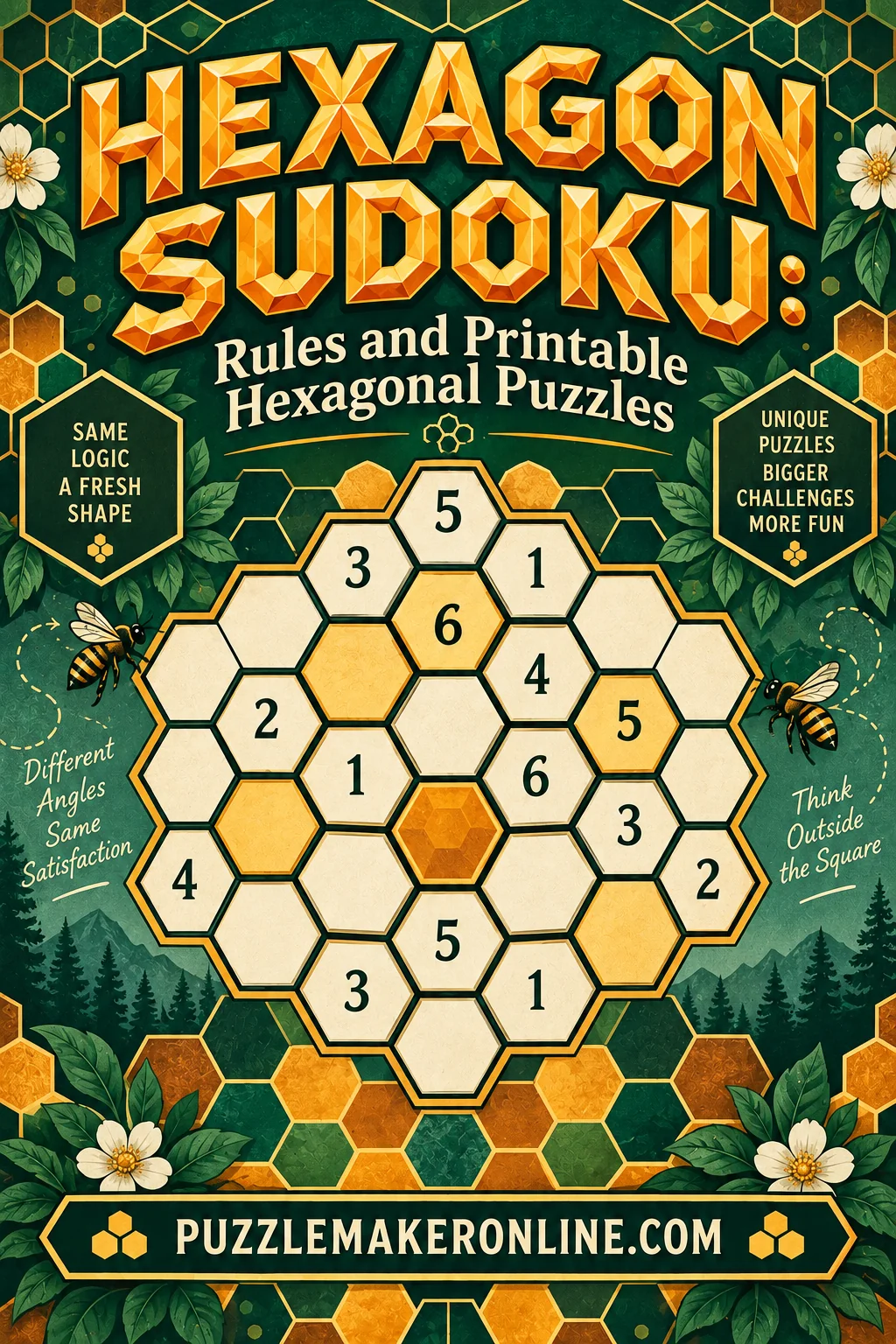
Hexagon sudoku is played on a honeycomb of six-sided cells instead of a square grid, and because a hexagon has neighbors in three directions rather than two, the puzzle constrains lines running three ways instead of just rows and columns. That single geometric change is what makes it feel unlike anything on a square board. There are no rows and columns in the familiar sense, the lines are different lengths, and the "no repeats" rule has to be stated more carefully than it does on a 9x9.
It is also the sudoku variant most often confused with something else, so it helps to sort that out before getting into how it actually works.
First, the Name Confusion
Three different puzzles get called hexagon sudoku, and only one of them is genuinely hexagonal.
Hexadecimal sudoku is a 16x16 square grid using the sixteen hexadecimal symbols 0-9 and A-F. The word "hex" in its name refers to base sixteen, not to hexagons. It is a square puzzle in every respect, and it is a different topic entirely from what this page covers. If that is what you were looking for, the hexadecimal sudoku page is the right one.
Hexagon-shaped sudoku is a square-celled grid whose overall outline is trimmed into a hexagon shape, usually for decorative reasons. The cells are still squares and the rules are still standard. This is mostly a presentation choice.
True hexagonal sudoku uses hexagonal cells packed into a honeycomb. This is the real variant, and the rest of this article is about it. You will also see it published as hexadoku, rokudoku, honeycomb sudoku, or hex sudoku, depending on the publisher.
How a Honeycomb Board Is Built
Stack hexagons together and they tile perfectly with no gaps. Arrange enough of them and the whole shape settles into a larger hexagon, which is the standard board.
The board is described by the length of its side. A board with three cells along each edge has 19 cells in total. A board with four cells per edge has 37 cells. A board with five cells per edge has 61 cells. Those numbers come from the centered hexagonal sequence, and they are the sizes you will meet most often on printables.
The important structural difference is that a square grid has uniform lines. Every row on a 9x9 has exactly nine cells. On a hexagonal board, the line through the center is the longest and the lines toward the edges get shorter. On a 19-cell board, for example, the lines running in any given direction have 3, 4, 5, 4, and 3 cells.
That uneven line length is the reason the rule has to be phrased differently, which is the next point and the one that trips up most first-time solvers.
The Rules, Stated Correctly
On a standard sudoku, the rule is "every row, column and box contains each symbol exactly once." On a hexagonal board, that is impossible for the short lines, because a three-cell line cannot contain seven symbols.
So hexagonal sudoku uses the weaker, more general rule:
No line may contain the same symbol twice.
Lines run in three directions across the honeycomb rather than two. Depending on how the board is drawn, those are typically the horizontal lines plus the two diagonals, or the two steep diagonals plus the vertical lines. Either way, every cell sits at the intersection of exactly three lines, where a cell on a square grid sits at the intersection of two lines plus a box.
Some hexagonal puzzles add a fourth constraint using regions. The most common regional form groups the cells into "flowers," each made of one central cell surrounded by its six neighbors, giving seven-cell regions. When a puzzle uses flowers, each flower must contain all seven symbols exactly once, and this is the closest analogue to the 3x3 box.
Other publishers cut the hexagonal board into three rhombus-shaped areas, or into irregular jigsaw regions of equal size. Whenever regions appear, the printed borders will be heavier than the cell borders, exactly as on a square grid. Read the borders before you start.
Symbol Sets You Will See
| Board style | Cells | Symbols | Region rule |
|---|---|---|---|
| Small honeycomb, side 3 | 19 | 1-5 or colors | none, lines only |
| Flower sudoku | 19 to 61 | 1-7 | seven-cell flowers |
| Standard honeycomb, side 4 | 37 | 1-7 | lines only, or flowers |
| Large honeycomb, side 5 | 61 | 1-9 | lines, sometimes rhombus areas |
| Kids' honeycomb | 7 to 19 | colors or shapes | lines only |
Six and seven are the natural symbol counts for hexagonal boards, because a hexagon has six sides and a flower has seven cells. Nine-symbol hexagonal puzzles exist but they are less elegant, since nine does not correspond to anything in the geometry.
Color and shape versions are common in children's printables and in classroom material, and they work well here for a specific reason: on a honeycomb, tracing a line in three directions is a visual task, and colors are much easier to scan along an unfamiliar axis than digits are.
Why Hexagonal Grids Are Harder
Solvers who are fluent on a 9x9 often stall on their first hexagonal puzzle, and it is not because the logic is more advanced. It is because the visual habits do not transfer.
Your eye does not know where the lines go. On a square grid, rows and columns are aligned with the page and with the edges of your field of view. You do not consciously trace them. On a honeycomb, two of the three line directions are diagonal, and diagonals through offset hexagons zigzag slightly rather than running dead straight. Following one accurately takes deliberate effort for the first several puzzles.
Three constraints per cell instead of two plus a box. The count is similar, but the shapes are unfamiliar, so it takes longer to notice that a candidate has already been eliminated.
Uneven line lengths break your intuition about completeness. On a square grid, a row with one blank cell is instantly solvable. On a honeycomb, a short line with one blank cell tells you almost nothing on its own, because the line was never required to hold every symbol. Beginners repeatedly try to "complete" short lines and get stuck wondering why the deduction does not work.
Cross-hatching works differently. The classic move of eliminating a symbol from a box by looking at the rows and columns that already contain it still applies when the puzzle uses flower regions, but the flower's neighbors overlap with other flowers, which means eliminations propagate in a less orderly way than they do between disjoint 3x3 boxes.
Pencil marks are cramped. Hexagonal cells have less usable interior area than a square of the same width, and their corners are angled, so writing seven small candidate symbols inside one is awkward. Most solvers who work hexagonal puzzles regularly print them larger than they would print a square grid.
None of that makes the underlying logic more advanced. A hexagonal puzzle at medium difficulty is solved with the same singles-and-pairs toolkit that carries a standard 9x9. It just takes longer to see.
A Practical Solving Approach
Trace all three line directions before placing anything. Put a finger on a corner cell and follow each of the three lines through it end to end. Doing this once at the start builds the visual map you will need for the rest of the puzzle, and it takes about thirty seconds.
Start at the center. The longest lines in each direction pass through the middle of the board, which means the central cells are the most constrained. On a square grid it rarely matters where you start. On a honeycomb it does.
Work by symbol, not by cell. Pick one symbol and ask, for every region or long line, where it can still go. Because the lines cross at three angles, a single placement near the center eliminates that symbol from a surprisingly large fraction of the board.
Treat the short edge lines as low-value. They constrain fewer cells and they rarely produce placements early. Come back to them once the middle is filling in, at which point they often resolve immediately.
Use flowers first when the puzzle has them. A seven-cell flower with all seven symbols required is the strongest constraint on the board, far stronger than any line. If your puzzle has flower regions, they should be the first thing you scan.
Write candidates outside the cell. A trick that hexagonal solvers use: instead of cramming pencil marks inside the hexagon, keep a small candidate note in the margin keyed to cell positions, or print the puzzle at a size where the interior is genuinely writable. Fighting the cell geometry wastes more time than the notes save.
The core techniques are unchanged, and if you want a refresher on the ones that do most of the work here, the standard progression of tips for solving sudoku applies to hexagonal boards just as it does to square ones.
Printing Hexagonal Puzzles
Hexagonal grids are less forgiving in print than square ones, and a few specifics make the difference between a pleasant puzzle and an unusable page.
Print larger than feels necessary. A honeycomb with a cell width of half an inch is roughly as writable as a square grid with quarter-inch cells, because so much of the hexagon's area sits in the angled corners. Three-quarters of an inch across the flats is a comfortable target for a puzzle you intend to pencil-mark.
One board per page. Hexagonal boards are wider than they are tall on most layouts, so two per page leaves each one too small. If you want several on a sheet, use the small 19-cell boards and stop at two.
Make the region borders unmistakable. If the puzzle uses flowers or rhombus areas, those borders carry the constraint. On a square grid you can guess where the box lines belong; on a honeycomb you cannot. A faint region border makes the puzzle effectively unsolvable, so check the printed page rather than the screen preview.
Landscape orientation usually fits better. A hexagonal board is wider than tall in the standard flat-top layout, and landscape gives you a bigger board on the same paper.
Color versions need a color check. Color-symbol hexagonal puzzles are popular for young solvers, but they turn into indistinguishable gray blobs on a monochrome printer. If the classroom printer is black and white, use numbered or shape-based symbols instead.
Free hexagonal printables are scattered and often come in fixed sizes and difficulties. If you need a particular size, or several at matched difficulty for a group, generating them is quicker than searching. A sudoku puzzle maker lets you set the parameters and print directly, and it is also the practical way to get a matched answer key, which is worth having on a board where checking by hand means tracing three directions through every cell.
Where Hexagonal Sudoku Fits
For experienced solvers, it is the best available cure for autopilot. If your 9x9 solving has become pattern recall rather than reasoning, a honeycomb forces you back into deliberate deduction, because none of your stored visual patterns apply.
For classrooms, hexagonal puzzles connect naturally to lessons on tessellation, symmetry, and why hexagons appear in beehives and other natural structures. The puzzle stops being a filler activity and becomes an illustration of something on the syllabus.
For young children, a small honeycomb with color symbols and lines-only rules works well and is often easier than a 4x4 numeric grid, because color matching precedes numeral fluency.
For puzzle books and activity packets, a hexagonal page is the visual break that keeps a book of square grids from looking monotonous. It reads as a feature page rather than as more of the same.
For accessibility settings, be cautious. The angled cells and diagonal lines demand more visual tracking than a square grid, so hexagonal puzzles are usually the wrong choice for low-vision solvers or anyone with visual tracking difficulties, even at large print sizes.
Hexagonal Sudoku Versus Other Variants
Every other well-known sudoku variant keeps the square board and changes what happens on it. Jigsaw sudoku swaps the 3x3 boxes for irregular regions. Diagonal sudoku adds two extra constrained lines. Hyper sudoku adds four overlapping interior squares. Samurai sudoku overlaps five whole grids. In each case, the geometry underneath is still a square lattice with rows and columns.
Hexagonal sudoku is the one that changes the lattice itself. That makes it the largest departure from standard sudoku that still counts as sudoku, and it is why it feels disproportionately unfamiliar compared with variants that sound more dramatic on paper. If you like it, the natural next stop is jigsaw sudoku, which trains the same skill of tracing regions your eye has not memorized, but on a board you already know how to read.
Frequently Asked Questions
What are the rules of hexagon sudoku? Fill the honeycomb so that no line contains the same symbol twice, with lines running in three directions instead of two. If the board is divided into regions, usually seven-cell flowers, each region must also contain every symbol exactly once. Note the rule is "no repeats within a line," not "every symbol in every line," because lines on a hexagonal board have different lengths.
How many symbols does hexagonal sudoku use? Most commonly seven, matching the seven cells in a flower region, though six and nine also appear. Children's versions frequently use five or six colors or shapes instead of numbers, which makes tracing the three line directions much easier for a young solver.
Is hexagon sudoku the same as hexadecimal sudoku? No. Hexadecimal sudoku is a 16x16 square grid using the symbols 0-9 and A-F, where "hex" means base sixteen. Hexagon sudoku uses actual six-sided cells arranged in a honeycomb. The names are similar and the puzzles have nothing in common beyond both being sudoku.
Is hexagonal sudoku harder than a normal 9x9? At the same stated difficulty it usually takes longer, but the extra time comes from unfamiliar geometry rather than harder logic. Once you have solved several and your eye learns the three line directions, a medium hexagonal puzzle sits at roughly the same level as a medium 9x9.