
Impossible Sudoku: Why Some Grids Feel Unsolvable
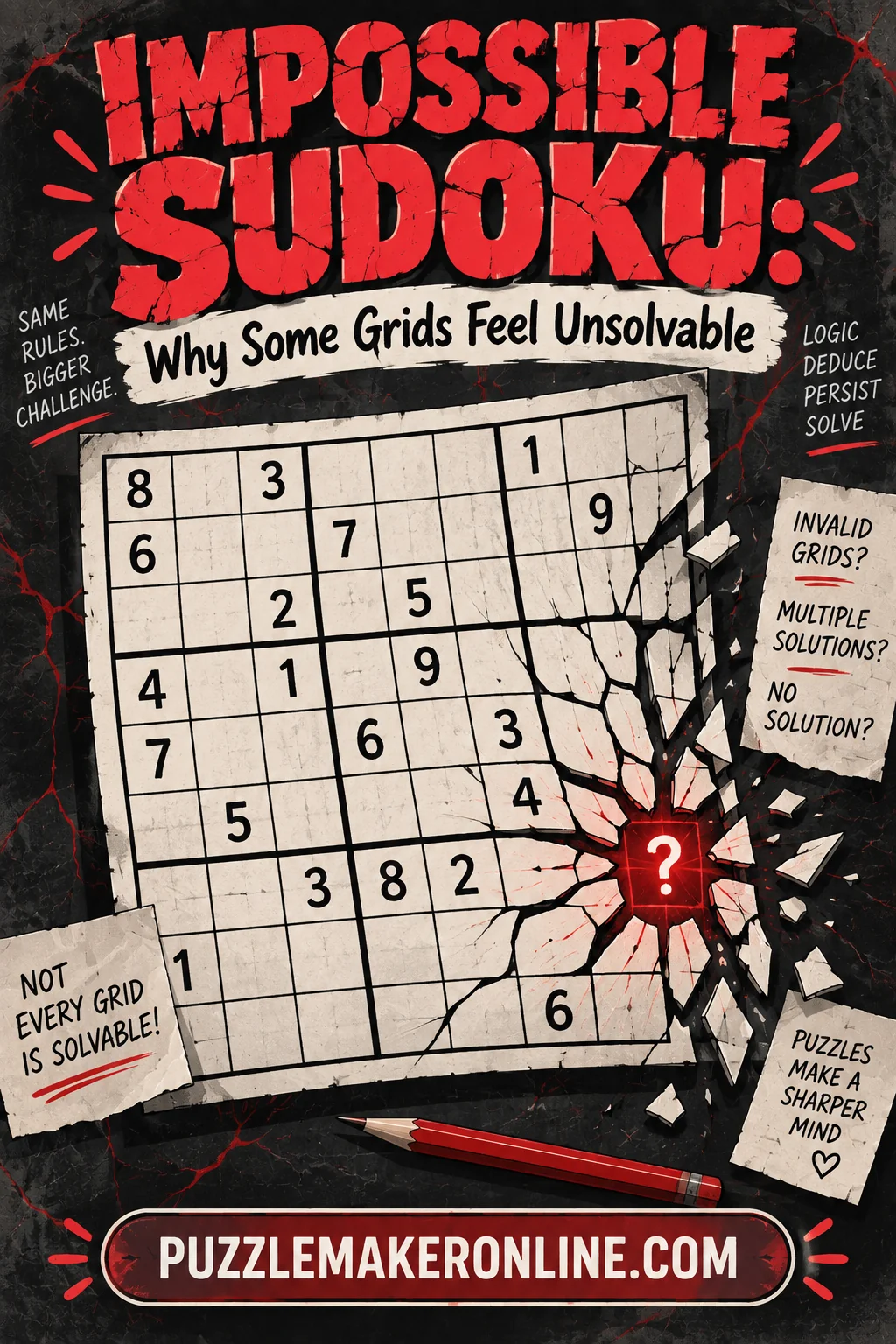
An impossible sudoku is one of two very different things: a genuinely broken grid with zero valid solutions or more than one, or a perfectly valid grid that requires a technique you have not learned yet, and roughly nine times in ten it is the second, or simply an error you made forty moves ago. The good news is that you can tell them apart in about three minutes with a systematic check, rather than staring at the grid hoping for inspiration.
This article covers what actually makes a grid unsolvable, the four errors that create fake impossibility, how to audit a stuck position, and why some legitimately hard puzzles feel like they are cheating when they are not.
The three states a stuck grid can be in
When a puzzle stops yielding, it is in exactly one of these states. Identifying which one saves you an hour.
State one: you made an error. A symbol was placed in the wrong cell, or a candidate mark was never erased after a placement eliminated it. The grid is now internally contradictory, and no amount of correct reasoning will fix it. This is the most common cause by a wide margin.
State two: the grid is valid and you have run out of technique. Every move you know has been exhausted, and the next move requires a pattern above your current ladder: a pointing pair, an X-Wing, a unique rectangle. The puzzle is fine. You are the bottleneck, and that is a solvable problem.
State three: the puzzle is genuinely broken. It has no solution, or it has several. This happens with badly generated grids, with puzzles typed by hand from another source, and with puzzles that had a symbol removed too many times during construction.
The audit below distinguishes all three.
The three-minute audit
Run these checks in order. Stop as soon as one fails, because the failure tells you what happened.
Check one: legality of every placed symbol. Go through the grid symbol by symbol, all the 1s, then all the 2s, and so on, and confirm no symbol appears twice in any row, column, or box. A duplicate means you made a placement error. This catches the majority of stuck grids.
Check two: every empty cell has at least one candidate. If a cell has no legal symbol at all, something upstream is wrong. Either a placement is incorrect or the puzzle is broken.
Check three: every symbol has a home in every unit. For each row, column, and box, confirm each unplaced symbol still has at least one cell that could take it. If some symbol has nowhere to go in a unit, the position is contradictory.
Check four: compare against the original clues. Pull up the starting grid and verify that every given clue is still in place and unmodified. Transcribing a puzzle from a book or a screen by hand introduces errors more often than anyone admits, and a single miscopied given produces a puzzle that looks reasonable and is unsolvable.
If all four checks pass and you are still stuck, the grid is valid and you are in state two. That is genuinely good news, because it means there is a move on the board and you just have not found the shape of it yet.
What a genuinely broken grid looks like
Two distinct failures both get called impossible sudoku, and they behave differently.
No solution. Somewhere in the grid, the constraints conflict. You reach a cell with no legal candidate, or a unit where a symbol has nowhere to go. Detection is straightforward, because you hit a hard contradiction and cannot proceed regardless of skill.
Multiple solutions. This one is more insidious, because you can finish the puzzle and still be "wrong." A grid with too few or badly chosen clues can admit two or more valid completions. You fill in a legal answer, check it against the printed solution, and it does not match, even though yours breaks no rule.
Multiple-solution grids nearly always show a telltale structure: somewhere in the puzzle there are four cells forming a rectangle across two rows, two columns, and exactly two boxes, all holding the same two candidates. Swap those two symbols around the rectangle and you get a second valid grid. This is the basis of the unique rectangle technique, which uses the assumption of a single solution to make eliminations. It is worth knowing because if you spot that structure and there is no third candidate anywhere in it, the puzzle you are solving is defective.
| Symptom | Likely cause | What to do |
|---|---|---|
| Cell with zero candidates | Placement error, or broken grid | Run the legality check |
| Two valid answers, both legal | Too few clues; grid not unique | Discard the puzzle |
| No move visible, no contradiction | Technique ceiling | Learn the next technique |
| Contradiction appears very late | Stale candidate mark earlier | Rebuild from the givens |
The four errors that fake impossibility
Almost every "unsolvable" grid that turns out to be fine failed on one of these.
The stale candidate mark. You placed a 6 in a cell and never went back to erase 6 from the candidate lists of the other cells in that row, column, and box. Twenty moves later, a naked pair that does not exist leads you to a wrong elimination. Paper solvers hit this constantly; it is the single strongest argument for updating candidates the instant you place a symbol.
The misread box boundary. In a printed grid where the box borders are not much heavier than the cell lines, it is genuinely easy to treat a cell as being in the wrong box. Every deduction after that is unsound. Good grid design, meaning visibly heavier box borders, prevents it.
The confident guess. You could not see a move, so you tried the more likely of two options and carried on. It felt harmless. It was not, because you no longer have a logical chain to unwind, and the contradiction surfaces far from its cause.
The unfinished cascade. You placed a symbol, saw it was correct, and moved on to scan elsewhere without working the three units that placement affected. The information was there; you just left it on the table. This does not corrupt the grid, but it produces the very common feeling that a puzzle has stalled when in fact three placements are sitting in plain view.
When a valid grid legitimately feels impossible
Set aside errors and broken puzzles, and there remains a real category: correctly constructed grids that resist every technique most solvers know.
Difficulty in sudoku is structural, not decorative. Grading software solves a puzzle using a ranked list of techniques and reports the hardest one that was required. A grid rated at the top of the scale is one where, at some point in the solve, every simpler technique is exhausted and the only available move is an advanced pattern. There is exactly one door and it needs a specific key.
That is why difficulty in this puzzle is so unlike difficulty in a crossword. A hard crossword may be permanently out of reach if you do not have the vocabulary. A hard sudoku is out of reach only until you learn the technique, and then it becomes routine. Solvers regularly describe going back to a grid they abandoned months earlier and finishing it in fifteen minutes, not because they got smarter but because they learned pointing pairs in the interim.
Clue count, incidentally, is a poor predictor. The known minimum for a unique 9x9 solution is 17 clues, but plenty of 17-clue grids are moderate, and plenty of 26-clue grids are savage. What matters is where the clues sit and which deductions they force, not how many there are.
Chains, and the ceiling above X-Wing
Above the standard technique ladder sits a family of methods that most published puzzles never require, and knowing they exist changes how you interpret a stuck grid.
Forcing chains follow a candidate through a series of implications: if this cell is a 4, then that cell must be a 7, which makes this third cell a 2. Run the chain from both possible values of a starting cell, and if both routes force the same symbol into some cell, that symbol is confirmed regardless of which branch is true.
Coloring does something similar with a visual notation, marking linked candidates in two alternating groups and looking for a contradiction where two same-colored candidates end up in the same unit.
These are not guessing. Every step is a valid implication and the conclusion holds either way. But they are laborious, and a puzzle that requires them is doing something unusual. If your audit says the grid is valid and no standard technique applies, this is where the answer lives — and it is entirely reasonable to decide the puzzle is not worth it.
Practical advice for a grid that will not move
Three things worth doing before you give up.
Rebuild from the givens. Take a clean sheet, copy in only the original clues, and re-solve. It sounds wasteful. It is the fastest reliable fix, because it discards every accumulated error at once, and you will usually get further the second time simply because you now know which parts of the grid are contested.
Put it down for a day. This is not mysticism. Coming back with fresh eyes breaks the visual fixation that makes you re-scan the same three boxes repeatedly while ignoring the one holding the move.
Change the medium. If you have been on paper, enter the position into a digital grid. Automatic candidate updates strip out stale marks instantly, and a clean candidate display frequently makes the next move obvious. Working the other way, printing a screen puzzle and solving it by hand, helps too, for the opposite reason: it slows you down.
If you want fresh grids at a known difficulty rather than fighting one suspect puzzle, our sudoku puzzle maker generates them with a single valid solution, which removes the broken-grid possibility entirely.
How people look for hard grids
Search phrasing around difficult puzzles is peculiar, mostly because suggestion boxes append text to queries that already contain it. Logs are full of doubled entries like sudoku sudoku online and even the stacked sudoku online sudoku online sudoku online, which is autocomplete rather than intent. Underneath, the request is ordinary.
People searching for free sudoku at high difficulty, for online sudoku that grades honestly, or for sudoku online free with no download are all after the same thing: a supply of grids hard enough to be interesting but well made enough to be fair. That combination is the real point. Free online sudoku is easy to find; free online sudoku with a guaranteed unique solution and an honest difficulty label is the part worth checking before you spend an hour on a grid.
Frequently Asked Questions
Is there such a thing as a truly impossible sudoku? Yes, but it is a defect rather than a difficulty level. A grid with no valid completion, or with more than one, is broken, and no solving skill will fix it.
How can I tell if I made a mistake or the puzzle is unfair? Check every symbol for duplicates in its row, column, and box, then confirm every empty cell still has at least one legal candidate. If both checks pass, the grid is intact and the obstacle is a technique you have not applied.
Why does my answer differ from the printed solution? Usually because the puzzle has more than one valid solution, which means it was badly constructed. Verify your grid against the rules; if it breaks none of them, your answer is legitimate and the puzzle is at fault.
Do the hardest sudoku puzzles require guessing? No. A properly constructed grid is always solvable by logic alone, though the top tier may need chain-based methods that are tedious enough to feel like guessing without actually being it.