
Letter Sudoku: How the Letters-Instead-of-Numbers Variant Works
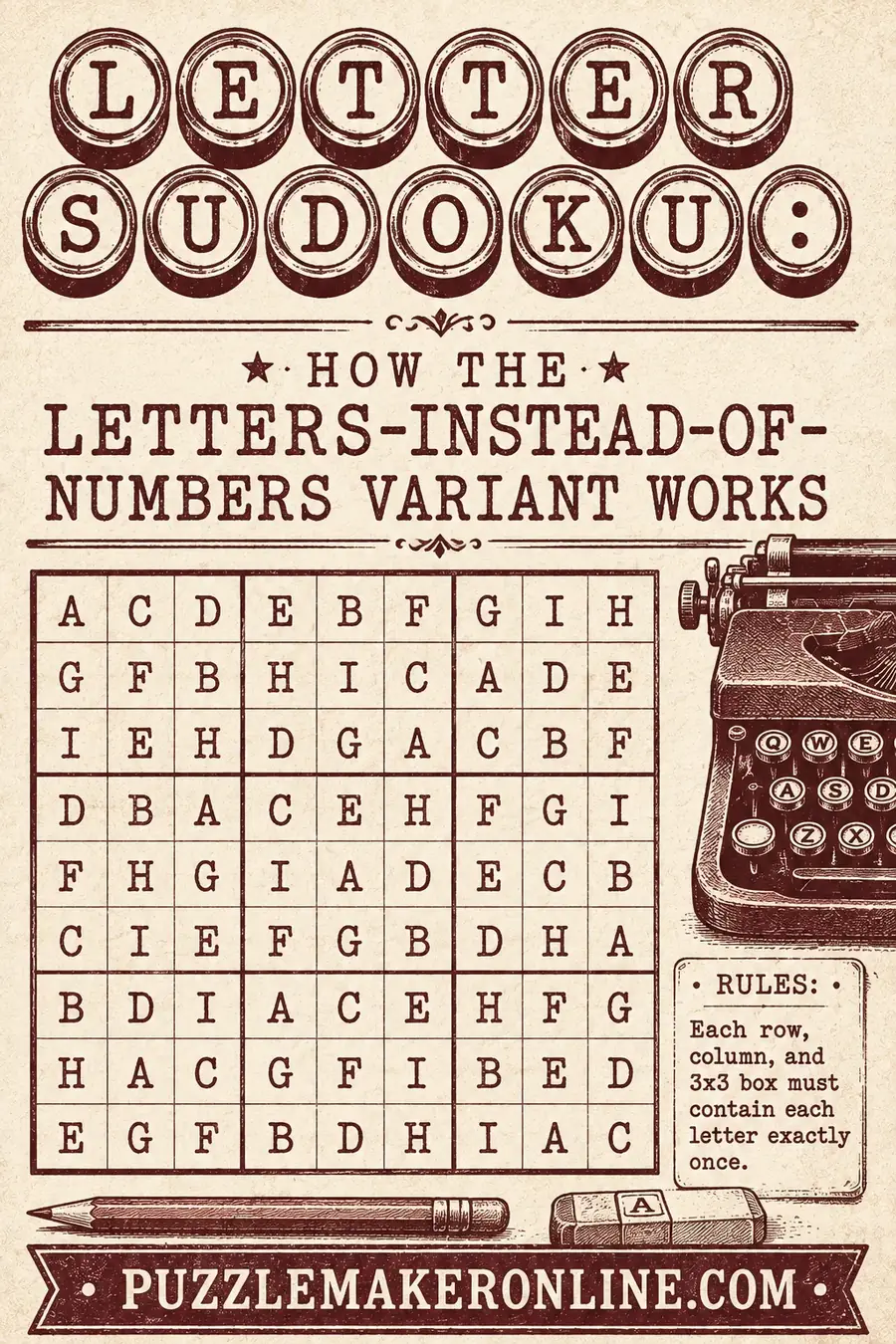
Letter sudoku uses the exact same rules as standard sudoku — no repeats in any row, column, or 3x3 box — just with letters (A through I, or a themed 9-letter word) substituted for the numbers 1 through 9. The logic is identical; only the symbols change, which makes it a genuinely accessible variant for anyone who finds letters more intuitive than numbers, or for puzzles built around a specific themed word.
The Basic Rule Structure
Every row, column, and 3x3 box must contain nine distinct letters exactly once, with no repeats — functionally identical to how standard sudoku requires the digits 1-9. Most letter sudoku puzzles use either:
A-I (the first nine letters of the alphabet), which most directly mirrors standard sudoku's structure, simply substituting A=1, B=2, and so on through I=9.
A themed 9-letter word, where each letter of a specific word (with no repeated letters) takes the place of a digit. This is sometimes called "word sudoku," and it adds a fun bonus: a correctly completed grid often reveals the theme word running along a specific row, column, or diagonal, depending on how the puzzle was designed.
Why Letter Sudoku Exists as a Variant
Accessibility for pre-number-fluent kids. Some educators use letter-based sudoku with young children who are more comfortable and confident with the alphabet than with numeric reasoning, since the underlying logical skill (checking uniqueness across rows, columns, and boxes) transfers directly to number-based sudoku later.
Novelty and theming. A themed word sudoku (using letters from a holiday word, a school name, a company name, or any 9-unique-letter word) adds a small "reveal" element to a completed puzzle that standard number sudoku doesn't have — completing the grid correctly often spells out the hidden word somewhere in the solution.
A fresh challenge for experienced solvers. Even solvers who are completely comfortable with standard number sudoku sometimes find letter sudoku surprisingly different to work through at first, simply because letters don't carry the same automatic numeric ordering that numbers do — there's no natural "1 comes before 2" instinct to lean on with letters, which can make scanning feel slightly different.
Solving Letter Sudoku: What Changes From Standard Sudoku
Nothing about the actual technique changes — scanning, pencil marks, naked and hidden singles, pairs, and even advanced techniques like X-Wing all apply exactly the same way to letters as they do to numbers. The only real adjustment is mental: since letters don't have the same instinctive ordinal sense that numbers do, some solvers find it briefly slower to track "which letters are missing from this row" compared to numbers, until they get used to treating the letter set the same way they'd treat 1-9.
One practical tip: mentally (or literally, on scratch paper) map each letter to a number 1-9 in order if you're new to the variant — this can bridge the gap while you build comfort with letter-based scanning directly.
Requirements for a Valid Letter Set
Whether using A-I or a themed word, the nine letters used must all be unique — no repeated letters within the set of nine. This is why themed word sudoku requires a specific type of word: exactly nine letters long with no letter repeated (a word like "SATURDAY" wouldn't work as-is, since it repeats the letter A).
Trying Letter Sudoku Yourself
If you want to practice or create a themed letter sudoku (for a classroom, an event, or just for fun), a sudoku puzzle maker that supports custom symbol sets can generate a properly validated puzzle using your chosen letters, applying the same uniqueness verification a standard number puzzle requires.
Choosing a Good Theme Word for Word Sudoku
Not every 9-letter word with unique letters makes an equally satisfying puzzle. A few things worth considering when picking a theme word: choose something meaningful to your audience (a classroom's school name, a company's name for a corporate event, a couple's names combined for a wedding-themed puzzle) so the reveal at the end feels genuinely rewarding rather than arbitrary. Avoid words with visually similar letters that could be mistaken for each other at a glance in handwriting or small print (like a word containing both "O" and "Q," or "I" and "L," depending on the font) since this can introduce unnecessary confusion during solving that has nothing to do with the actual puzzle logic. And keep in mind that shorter or more common words are naturally easier to remember as you solve, which can actually help newer solvers track the letter set more comfortably than a completely unfamiliar nine-letter word would.
Where Word Sudoku Shows Up in Practice
Beyond casual home use, themed word sudoku puzzles are a popular choice for special occasions and events — wedding favor puzzle sheets using the couple's combined initials or names, classroom puzzles built around a school mascot or motto, corporate team-building events using a company name or project codename. The format works particularly well for these settings because the puzzle itself doubles as a small piece of personalized content, giving it a purpose beyond generic entertainment, and often becomes a keepsake or conversation piece in a way a standard number puzzle wouldn't.
A Simple DIY Approach to Building Your Own Word Sudoku
If you have a specific 9-unique-letter word in mind and want to build a puzzle around it yourself, the most reliable approach mirrors making your own sudoku generally: start from a valid, completed standard number sudoku grid, then substitute your chosen letters for the numbers 1 through 9 in a fixed mapping (A for 1, B for 2, and so on, matching your word's letters to the digits in whatever order you choose), and remove numbers from the completed grid exactly as you would for any standard puzzle. The letter substitution is purely cosmetic and happens after the actual puzzle-validity work is already done, which keeps the harder part of the process (ensuring a unique solution) identical to standard puzzle construction.
Letter Sudoku in Language Learning Contexts
Beyond general accessibility and theming, letter sudoku has found a genuine niche use in language education specifically — teachers introducing a new alphabet (for a foreign language class, for instance) sometimes use a themed letter sudoku built from that alphabet's characters as a low-stakes, engaging way to build familiarity with the new letter forms outside of direct vocabulary memorization. The repeated, careful attention required to track and place each letter correctly throughout a puzzle reinforces basic letter recognition in a genuinely different context than flashcards or direct reading practice, making it a nice supplementary activity for early language learners specifically working on alphabet fluency.
Why the Puzzle Concept Translates So Cleanly to Any Symbol Set
The fact that sudoku's core logic works equally well with numbers, letters, or (as covered elsewhere) hexadecimal characters says something genuine about the puzzle's underlying structure: the actual symbols used are entirely arbitrary placeholders for "nine distinct, mutually exclusive values," and the logic never actually depends on those values being numbers specifically. This is part of why sudoku has proven so adaptable across so many variant formats over the decades since its popularization — the core mechanic is fundamentally about distinctness and placement, not arithmetic, which is exactly what makes letter sudoku, hexadecimal sudoku, and even themed symbol or emoji versions all fundamentally the same puzzle wearing different clothes.
Adapting Letter Sudoku for Non-English Alphabets
The letter sudoku concept isn't limited to the English alphabet — any writing system with at least nine distinct characters can theoretically be used, making it a flexible format for language classrooms teaching non-Latin scripts too. A teacher introducing Cyrillic, Greek, or another alphabet entirely can build a themed letter sudoku using nine characters from that specific script, giving students repeated, low-pressure exposure to unfamiliar letterforms in a genuinely engaging puzzle format rather than pure rote memorization drills.
Wordoku, Godoku and the Other Names for the Same Puzzle
Letter sudoku collects a surprising number of names, and they do not all mean quite the same thing.
Wordoku is the most common commercial name, and it usually implies the stronger version of the variant: the nine letters spell a real word, and that word appears somewhere in the completed grid — often along a diagonal or in one row — as a bonus reveal at the end.
Godoku is used for the same idea, most often in newspaper puzzle pages.
Alphadoku more often refers to a large grid, typically 25x25 using the letters A through Y, rather than a nine-letter puzzle.
Letter sudoku and word sudoku tend to be used loosely for either version: a puzzle using arbitrary letters with no word behind them, or a proper themed one.
The distinction matters for one practical reason. If the nine letters do spell something, a solver who spots the word part-way through can complete cells by guessing at spelling rather than by deduction, which changes the puzzle's difficulty considerably — usually making it easier than its rating suggests. Constructors who want to prevent that pick a word whose letters are unremarkable, or place the hidden word off the diagonals where it will not be noticed early. If you are solving one competitively or for practice, it is worth deciding up front whether you will use the word as a solving aid or ignore it and solve by logic alone.
Frequently Asked Questions
Is letter sudoku easier or harder than standard number sudoku? The underlying difficulty is identical, since the logic and techniques required are exactly the same — any perceived difference in difficulty usually comes down to how used a solver is to scanning letters versus numbers, which is largely a matter of familiarity rather than genuine puzzle complexity.
Can any 9-letter word be used for a themed word sudoku? Only if the word has nine unique letters with none repeated — a word with a repeated letter (like "AARDVARK," which repeats A and R) can't be used directly, since the puzzle requires nine distinct symbols.
Do the techniques for solving standard sudoku work exactly the same for letter sudoku? Yes, completely — scanning, pencil marks, naked/hidden singles and pairs, and advanced techniques like X-Wing all apply identically, since the underlying logical structure of the puzzle hasn't changed, only the symbols used.
Is letter sudoku a good way to teach sudoku logic to kids who aren't confident with numbers yet? Many educators find it a useful bridge for exactly that reason — it lets a child practice the core logical reasoning skill using a symbol set (letters) they may already feel more confident with, before transitioning to standard number-based sudoku.
Can letter sudoku use lowercase and uppercase letters as distinct symbols? Typically no — standard letter sudoku uses a single case (usually uppercase) for all nine symbols, since mixing cases would just be an unnecessary visual complication without adding any real puzzle depth.
Is there a standard difficulty rating system for letter sudoku like there is for number sudoku? Letter sudoku generally uses the same difficulty framework as standard number sudoku (easy, medium, hard, expert, extreme), since the underlying logic and required techniques are identical regardless of symbol type.
Do letter sudoku puzzles work well for people with dyslexia? This varies by individual — some solvers with dyslexia find numbers easier to track than letters, while others find the opposite; there's no universal answer, so it's worth simply trying both formats to see which feels more comfortable.
Can I combine letter sudoku with a crossword-style clue for extra difficulty? This isn't a standard variant, but nothing prevents a puzzle designer from layering additional wordplay elements on top of a letter sudoku for a custom, more elaborate challenge, especially for a special event or advanced puzzle collection.
Do word sudoku puzzles ever use fewer or more than nine letters? Standard word sudoku sticks to exactly nine unique letters to match the 9x9 grid, though the underlying letter-substitution concept could theoretically apply to smaller grid variants (like 4x4 or 6x6) using a shorter unique-letter word instead.
Is there a way to make letter sudoku progressively harder using the same theme word? Yes — generating multiple puzzles with the same theme letters but progressively fewer starting clues creates a themed difficulty progression, useful for a classroom or event wanting several related puzzles at increasing challenge levels.
Can letter sudoku be used for team-building word themes at a company event? Yes — a company name, motto, or internal project codename with nine unique letters makes for a genuinely fun, personalized letter sudoku for a corporate event, distinct from a generic printed activity.
What is word sudoku? A nine-letter version of standard sudoku where the letter set spells a real word, which typically also appears in the finished grid. The rules are identical to a normal puzzle — each row, column, and box holds all nine letters once — and the hidden word is a bonus rather than a constraint.
Is word sudoku easier than a number puzzle? Sometimes, and not for logical reasons. If a solver recognizes the theme word early, spelling can suggest placements that logic has not yet proven, which effectively hands over free cells. Solved purely by deduction, the difficulty is identical to the same grid written in digits.