
The Mathematics of Sudoku: Grids, Counts and Why 17 Clues Matter
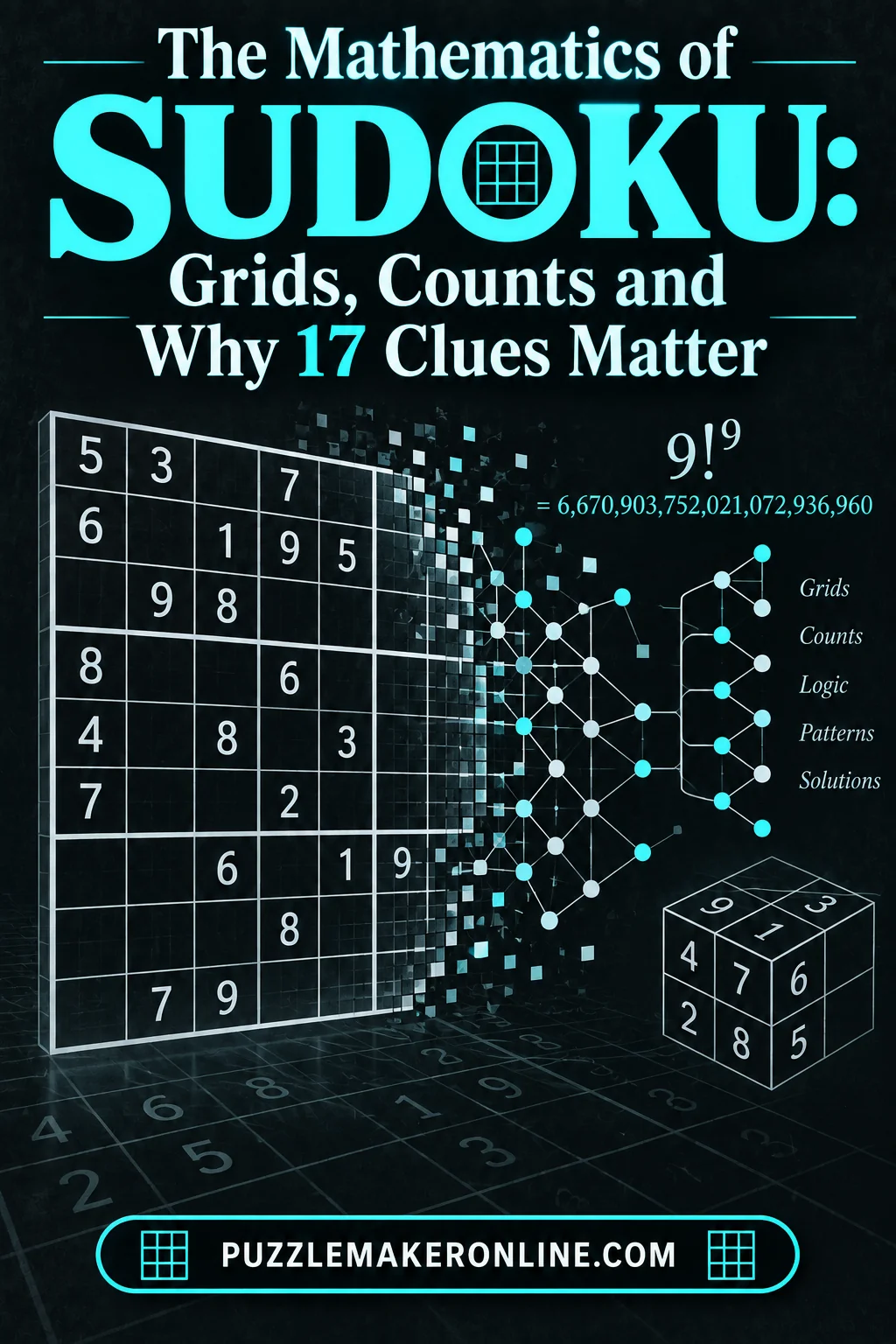
There are 6,670,903,752,021,072,936,960 valid completed sudoku grids, only 5,472,730,538 of them are genuinely different from one another, and no puzzle with a single solution can be built from fewer than 17 given digits. Those three numbers are the backbone of mathematical sudoku, and every one of them was settled by computer rather than by insight.
That last detail is the interesting part. The grid count fell in 2005, the 17-clue question in 2012, and both resisted elegant proof entirely. What follows is what each result actually says, why the second number matters more than the first, why symmetry is an aesthetic choice rather than a rule, and what the whole business looks like from the position of someone holding a pen over a real grid.
The Numbers, in One Place
| Quantity | Value | How it was settled |
|---|---|---|
| Completed 9x9 grids | 6,670,903,752,021,072,936,960 | Computed by Felgenhauer and Jarvis, 2005 |
| Essentially different grids | 5,472,730,538 | Russell and Jarvis, by Burnside counting |
| Grid-preserving transformations | 3,359,232 | Combinatorial argument |
| Digit relabelings | 362,880, which is 9 factorial | Direct |
| Latin squares of order 9 | 5,524,751,496,156,892,842,531,225,600 | Known independently of sudoku |
| Minimum clues for a unique solution | 17 | McGuire, Tugemann and Civario, 2012 |
| Maximum clues that can still be ambiguous | 77 | Small combinatorial argument |
| Cells adjacent to any given cell | 20 | Direct count |
Sudoku Is Not Arithmetic
Worth clearing up first, because it is the most common misunderstanding about the puzzle and it distorts everything that follows.
Nothing in sudoku adds up. The digits one through nine are labels, not quantities. Replace them with nine colors, nine letters or nine small drawings and the puzzle is identical in every respect: same solutions, same difficulty, same solving techniques. Nothing about the ordering of the numerals is ever used.
So when people call it a math puzzle, they are right for a reason that has nothing to do with the digits. The mathematics of sudoku is combinatorial and logical rather than numerical. It is about how many arrangements exist, which constraints force which conclusions, and how much information you need to pin down a unique answer. That is a genuinely mathematical subject. It just is not arithmetic, and the sum-based variants like killer sudoku are the exception that proves it, since they have to bolt addition on from outside.
Counting the Grids
The count of completed 9x9 sudoku grids is 6,670,903,752,021,072,936,960, or about 6.67 sextillion, computed by Bertram Felgenhauer and Frazer Jarvis in 2005.
The method was a mix of clever reduction and brute force. There are 9 factorial ways to fill the top-left box alone, which is 362,880, and the naive approach of extending that outward is hopeless. What Felgenhauer and Jarvis did instead was classify the possible arrangements of the top band of three boxes, reduce those to a manageable number of equivalence classes using the symmetries of the grid, and then count completions for one representative of each class. The total came out of a computation that ran for hours rather than years, which is the whole trick: they replaced an impossible search with a possible one by throwing away arrangements that were copies of each other.
The number itself is hard to hold in your head, so a comparison helps. It is roughly fifteen thousand times the number of seconds that have elapsed since the universe began. It is also almost exactly 0.00012 percent of the number of 9x9 Latin squares, which brings us to the next point.
Why 5,472,730,538 Is the More Interesting Number
The 6.67 sextillion figure counts a great many grids that are the same puzzle wearing a different coat.
Take any completed grid. Swap every 1 for a 7 and every 7 for a 1, and you have a grid that counts separately in the big total but is not a different puzzle in any meaningful sense. The same goes for rotating the grid, reflecting it, swapping two rows inside the same band, swapping two whole bands, or transposing the whole thing.
Collect all the transformations that preserve validity and you get a group of order 3,359,232. Combine that with the 362,880 ways of relabeling the digits and you have 1,218,998,108,160 ways of dressing up a single underlying grid. Dividing the total by that figure gets you close to the right answer, and a careful Burnside count, which handles the grids that are symmetric enough to be fixed by some transformation, gives the exact figure: 5,472,730,538 essentially different grids, computed by Ed Russell and Frazer Jarvis.
Five and a half billion is still an enormous number, but it is a comprehensible one, and it is the number that describes how much genuine variety the puzzle contains.
Sudoku Inside the Family of Latin Squares
A Latin square of order 9 is a grid where each of nine symbols appears once in every row and once in every column. That is sudoku with the box constraint removed, and mathematicians were studying these long before anyone made a puzzle out of them.
There are 5,524,751,496,156,892,842,531,225,600 Latin squares of order 9. Divide by the sudoku count and you find that only about one Latin square in 828,000 also satisfies the box rule.
That ratio is the whole design of the puzzle in a single number. The box constraint is not decorative. It cuts the solution space by nearly six orders of magnitude, and in doing so it makes the grid tight enough that human-scale reasoning can crack it. A pure Latin square puzzle with the same number of givens would usually be a search rather than a deduction. The historical route from Euler's Latin squares to the modern grid is covered in more detail on the sudoku origin page.
The 17-Clue Result
In 2012, Gary McGuire, Bastian Tugemann and Gilles Civario proved that no sudoku with a unique solution can have fewer than 17 given digits.
This had been an open question for years. Thousands of 17-clue puzzles were known; not one 16-clue puzzle had ever turned up despite a great deal of searching, and nobody could prove none existed.
The proof is an exhaustive search, and the interesting part is how they made an impossible search possible. Rather than checking every arrangement of 16 clues, which is astronomically out of reach, they worked through the 5,472,730,538 essentially different completed grids and asked, for each one, whether any 16 of its cells could serve as a valid puzzle. Then they made that question cheap using unavoidable sets, and made the whole thing feasible with a hitting-set algorithm and a great deal of processor time. The published figure for the computation is roughly 7.1 million core-hours on a supercomputer.
No elegant argument has replaced it. The result is true, it is checked, and it is the kind of theorem that exists because a machine looked at everything.
Why 16 Fails: Unavoidable Sets
The idea behind the proof is worth understanding on its own, because it also explains a lot about puzzle construction.
An unavoidable set is a group of cells in a completed grid whose contents can be rearranged among themselves to produce a different, still-valid grid. The smallest one is four cells: two digits sitting at the corners of a rectangle, inside two rows, two columns and two boxes. Swap them and you have another legal grid.
Now the key point. If a puzzle contains no given inside an unavoidable set, then the solver can never distinguish the original arrangement from the swapped one, and the puzzle has at least two solutions. So every valid puzzle must include at least one clue from every unavoidable set in its grid.
A typical completed grid contains a large number of these sets, many of them small and overlapping. Finding a set of 16 cells that touches every single one turns out to be impossible for every grid, and that is exactly what the search established.
What 17 Does Not Mean
Three things get read into the 17-clue result that it does not support.
It does not mean 17-clue puzzles are common. They are extraordinarily rare. A collection of roughly 49,000 essentially different 17-clue puzzles has been gathered over years of searching, chiefly by Gordon Royle, and nobody has proved the collection is complete. Against 5.47 billion grids, that is a vanishingly thin slice.
It does not mean fewer clues means harder. Clue count and difficulty are only loosely related. A 24-clue puzzle requiring a chain of inferences can be far harder than a 17-clue puzzle that happens to open cleanly. Difficulty is about which techniques the solving path demands, not how much you were handed at the start.
It does not apply to symmetric puzzles. Every known 17-clue puzzle has an irregular clue pattern. The smallest rotationally symmetric puzzles anyone has found carry 18 clues, which is the natural bridge to the next point.
The 77-Clue Puzzle With Two Answers
Here is the counterintuitive companion result. You can hand someone 77 of the 81 cells and still fail to produce a unique solution.
Leave exactly four cells blank, arranged as the corners of a rectangle within two rows, two columns and two boxes, and holding just two distinct digits. That is the smallest unavoidable set, and with no clue inside it the two digits can be placed either way around. The solver has 77 givens and two legal answers.
This is the single cleanest demonstration that uniqueness in sudoku is about which cells you give away, not how many. Seventeen well-chosen cells can pin down a grid completely. Seventy-seven badly chosen ones cannot.
Why Symmetry Matters, and Where It Does Not
Most published sudoku have a rotationally symmetric pattern of givens: turn the page 180 degrees and the clues sit in the same places. This is worth being precise about, because it is often mistaken for a rule.
It is not a rule. A puzzle with an asymmetric clue pattern is perfectly valid, perfectly solvable and mathematically indistinguishable from a symmetric one. The convention comes from the Japanese publisher Nikoli, which introduced it in the 1980s as a mark of craft, along with a cap on the number of givens.
It does matter for construction and for feel. Symmetry constrains the setter, which is precisely why it functions as a quality signal: a symmetric puzzle with a clean solving path took more work than an asymmetric one. It also has a small mathematical consequence, since a symmetric pattern forces the clue count to be even unless the center cell is a given, and it pushes the achievable minimum from 17 up to 18.
It changes nothing about solving. No technique exploits the symmetry of the clue pattern. It is information about the setter, not about the grid.
Sudoku as Graph Coloring
There is a second way to describe the puzzle that makes its structure obvious.
Draw one vertex for each of the 81 cells. Connect two vertices whenever their cells share a row, a column or a box. Each cell shares a row with 8 others, a column with 8 others and a box with 8 others, and the box overlaps the row and the column by 2 cells each, so every vertex has exactly 20 neighbors. The graph has 810 edges and is 20-regular.
A completed sudoku is then a proper coloring of that graph with nine colors: no two connected vertices share a color. The chromatic number of the sudoku graph is 9, and a puzzle is a partial coloring that extends to exactly one full coloring.
This reframing is useful for two reasons. It makes it immediately clear why the digits are arbitrary labels, because colors obviously are. And it connects the puzzle to a large body of existing work on graph coloring, which is where the complexity result comes from.
Exact Cover, and Why Software Solves It Instantly
The other standard formulation turns sudoku into an exact cover problem, where you must choose a set of rows from a matrix so that every column is covered exactly once.
Build it like this. Each of the 729 possible placements, meaning 81 cells times 9 digits, becomes a row. Each of the 324 constraints becomes a column: 81 for "this cell holds exactly one digit," 81 for "this row holds this digit once," 81 for the same in columns and 81 for the same in boxes. Solving the puzzle is exactly choosing 81 placements that cover all 324 constraints once each.
Donald Knuth's Algorithm X, implemented with the doubly linked list technique he called Dancing Links, chews through this in milliseconds. That is why generators can produce and grade a puzzle in the time it takes a page to load, and it is also why difficulty ratings on generated puzzles are computed by asking which human techniques are required rather than by asking whether a computer finds it hard. A computer never finds a 9x9 grid hard.
Generalized Sudoku Is NP-Complete
If a computer solves 9x9 grids instantly, why is sudoku considered computationally interesting?
Because 9x9 is a fixed size, and fixed-size problems are always solvable in constant time in principle. The meaningful question is what happens as the board grows. Yato and Seta showed in 2003 that deciding whether a partially filled n-squared by n-squared sudoku can be completed is NP-complete, which places general sudoku in the same complexity class as graph coloring and satisfiability.
Two things follow. There is almost certainly no efficient general algorithm that scales to arbitrary board sizes. And the 9x9 case is easy purely because the board is small, not because anyone found a shortcut.
What Any of This Means at the Kitchen Table
Very little, honestly, and that is worth saying plainly. None of these results changes how you place a digit.
One consequence is real, though, and it is pleasant. With 5.47 billion essentially different grids underneath it, a free sudoku produced by a generator is almost certainly a puzzle no person has ever attempted. Not rare, not unlikely, but effectively certain. Everyone who has solved a puzzle from a modern generator has been the first solver of that specific grid, and there is no reason to think anyone will ever see it again.
The second consequence is about difficulty. Because a machine can test which techniques a grid requires, difficulty stopped being a fact about the puzzle you were handed and became a setting you choose. That is a modern luxury. A newspaper reader in 2005 solved whatever arrived that morning.
You can check any claim on this page against a real grid. The sudoku generator produces graded puzzles you can work through in a browser, and it is the fastest way to see that the 17-clue minimum, the unavoidable rectangle and the box constraint all behave exactly as described.
One footnote on how people look for these grids, since search logs are unusually revealing here. The requests cluster into a handful of near-identical phrasings: free sudoku, online sudoku, sudoku free, free online sudoku and sudoku online free are all the same request in different word orders, and the stacked ones that turn up in the logs, online sudoku online among them, are artifacts of autocomplete appending suggestions to text somebody had already typed rather than anything a person meant to write. All of them want the same object, which is a grid to solve now.
Frequently Asked Questions
How many sudoku puzzles are there?
The number of completed grids is known exactly: 6,670,903,752,021,072,936,960, reducing to 5,472,730,538 essentially different ones once you account for relabeling, rotation, reflection and row and column permutations. The number of distinct puzzles, meaning valid arrangements of clues, has never been counted and is far larger.
Why is 17 the minimum number of clues?
Because an exhaustive computer search in 2012 checked every essentially different completed grid and found that no set of 16 cells can pin down a unique solution in any of them. The underlying reason is unavoidable sets: every valid puzzle must include a clue inside each group of cells that could otherwise be rearranged, and 16 clues can never hit them all.
Is sudoku actually mathematics?
Yes, but combinatorial rather than numerical. The digits are labels and no calculation is ever performed on them, so the puzzle is really about counting arrangements, constraint satisfaction and graph coloring. Replacing the numerals with nine colors changes nothing at all about the puzzle.
Does a puzzle with fewer clues have to be harder?
No. Clue count and difficulty are only loosely connected, because difficulty depends on which techniques the solving path forces you to use. A 17-clue puzzle can open cleanly with simple scanning, while a 26-clue puzzle can demand a chain of inferences several steps deep.