Middle School Word Search: Free Printable Puzzles
A middle school word search uses a large grid, longer subject words, and all eight directions, with terms like PHOTOSYNTHESIS, ALGEBRA, and CONSTITUTION hidden across, down, diagonally, and backwards. Grades 6 through 8 can handle 15x15 to 20x20 grids and 18 to 25 words, which makes for a genuine challenge. The fastest way to build one is a free puzzle maker that turns any word list into a clean, printable grid.
Want to make one now? Open the free puzzle maker, paste in your words (there's a ready-made list below), and print a class set in seconds. No sign-up, no software, no cost.
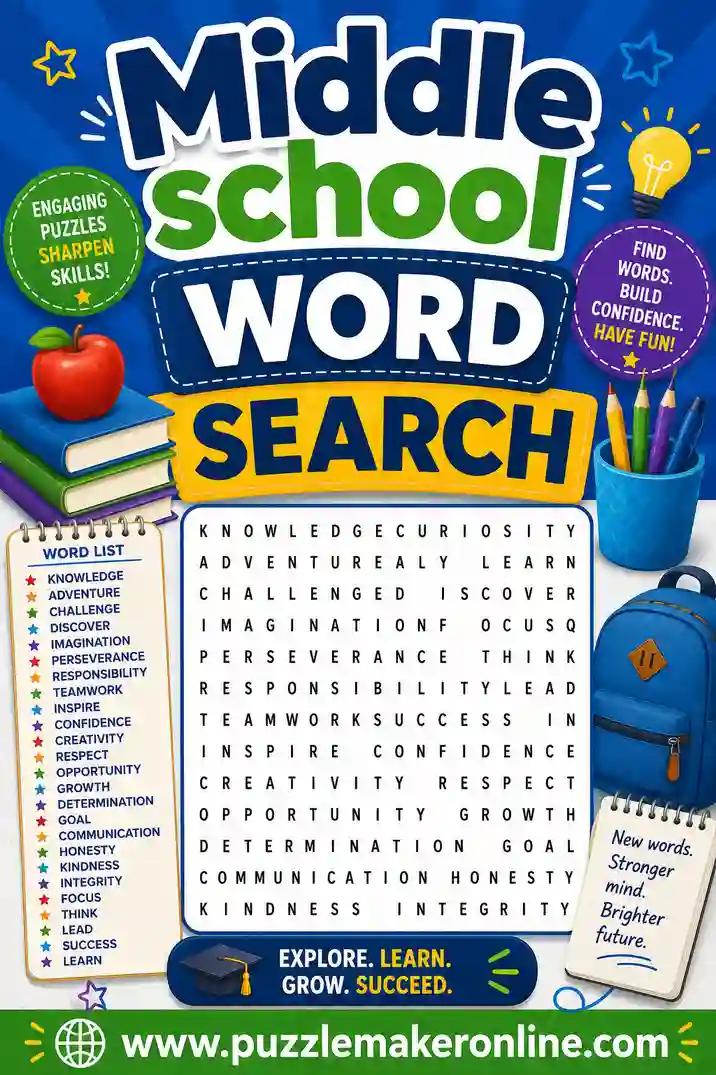
What Makes a Word Search "Middle School" Level?
By sixth grade, a simple grid won't cut it. Students read fluently, want a real challenge, and are studying serious vocabulary across every subject. A middle school word search rises to meet that.
Here's what defines the right level for grades 6 to 8:
- Long, content-rich words. Eight to fourteen letters are common. Think PHOTOSYNTHESIS, HYPOTENUSE, and AMENDMENT.
- Large grid. A 15x15 to 20x20 grid gives long words room and adds plenty of search time.
- All eight directions. Across, down, diagonal, and backwards in every direction make for a true hunt.
- Dense overlap. More words packed in means letters share space, so the grid reads like a wall of letters.
With a puzzle maker, you control grid size and direction settings, so you can tune the difficulty for a sixth grader or crank it up for a competitive eighth-grade class.
Why word searches still work for older students
Middle schoolers groan at worksheets but happily attack a puzzle. A word search built from this week's vocabulary gets them rereading and re-spelling tough terms without realizing it. It's effective review for biology, algebra, history, or English, and it works great as bell-ringer work, sub plans, or a calm-down activity after a test.
Free Middle School Word Search Word List (Copy & Paste)
Here's a ready-to-use list of 30 subject words. Pick 18 to 25 for a single puzzle, or mix across columns. Copy them straight into the generator.
| Science | Math | History & English |
|---|---|---|
| Photosynthesis | Hypotenuse | Constitution |
| Mitosis | Algebra | Amendment |
| Isotope | Equation | Democracy |
| Genome | Polygon | Metaphor |
| Velocity | Variable | Narrative |
| Ecosystem | Integer | Revolution |
| Molecule | Exponent | Continent |
| Organism | Quotient | Civilization |
| Nucleus | Coordinate | Adjective |
| Gravity | Perimeter | Paragraph |
Match the column to whatever your class is covering. A puzzle built from real unit vocabulary turns review into something students actually want to finish.
Theme ideas students enjoy
- Cell biology. Nucleus, membrane, ribosome, cytoplasm, organelle. Perfect for a life-science unit.
- U.S. government. Senate, veto, judiciary, ballot, amendment. Great for civics.
- Literary terms. Simile, irony, theme, climax, foreshadow. Useful before a novel test.
- Geography. Equator, latitude, peninsula, plateau, isthmus. Pairs well with a map unit.
How to Make a Middle School Word Search in 4 Steps
It takes just a few minutes. Here's the whole process.
- Pick a theme and 18 to 25 words. Use the list above or your own unit vocabulary.
- Set a 15x15 or larger grid. Bigger grids fit long words and add a serious hunt.
- Turn on all directions. Include diagonals and backwards words for a true middle school challenge.
- Print. Hit print and you've got a class set ready to go.
That's it. If a puzzle comes out brutal, trim the longest words or shrink the grid by a few rows.
Turn it into test prep
Got a vocabulary or terms list before a big test? Drop it into the puzzle maker. Students hunt for the exact words they need to know, rereading each spelling as they scan. It's review they'll finish without complaint, and it takes you about three minutes to set up.
Word Search Difficulty by Grade
Matching the puzzle to the grade keeps students challenged without tipping into frustration. Here's a quick guide.
| Grade | Grid size | Word count | Directions |
|---|---|---|---|
| 6th grade | 15x15 | 15–18 | All directions |
| 7th grade | 17x17 | 18–22 | All directions, longer words |
| 8th grade | 20x20 | 20–25 | All directions, dense overlap |
| Challenge | 22x22 | 25+ | All directions, no word list shown |
For a tougher puzzle, add words before you add grid rows. More words means more overlap, and that density is what makes a middle school grid genuinely hard.
Strategies for Solving Tough Grids
Big grids reward smart searching. Coach students to work with a plan instead of scanning randomly.
- Sweep systematically. Go row by row first, then column by column, then diagonals. Don't bounce around.
- Target rare letters. Words with Q, X, Z, or J pop out. Find the letter, find the word.
- Use both word ends. Spotting the first and last letters confirms a match fast.
- Check all directions. If a word won't appear forward, read backwards and along diagonals.
- Cross off found words. Mark each one so the search keeps narrowing.
Make it a competition
Middle schoolers love a challenge. Run it as a timed race, a partner hunt, or a points game where each found word earns a point. You can even hide the word list for an "expert mode" where students have to recall the unit terms from memory before they search.
Great Ways to Use These Puzzles
A subject-themed word search fits all over a middle school day.
In the classroom
Use them as bell-ringers, unit review, sub-day plans, and end-of-test wind-downs. A puzzle built from current vocabulary doubles as study time and keeps a class calm and on task.
For test and quiz prep
Build a puzzle from the exact terms on an upcoming assessment. Students reread and re-spell every key word as they search, which beats passively rereading notes.
For clubs and study halls
Science clubs, history bowls, and study halls can theme a puzzle to the day's focus. It's low prep for you and engaging for students who'd rather not sit idle.
Printing Tips for Clean, Readable Puzzles
Large grids need a little care to stay legible.
- Keep the print sharp. A 20x20 grid has hundreds of letters, so avoid tiny fonts and faint print.
- Print in black and white. It saves ink and reads cleanly. Students can highlight finds in color.
- Keep the word list on the page, unless you're running an expert no-list round.
- One puzzle per page. A large grid needs the full sheet to stay readable.
- Run a test print. Confirm the grid and list fit before printing a class set.
Make it reusable
Slip puzzles into clear sleeves so students can solve with dry-erase markers, then wipe clean. One puzzle covers a whole class across the week.
Pair the Word Search With Other Puzzles
A word search is a great start, but you can build a fuller review with the same word list. The puzzle maker turns one set of terms into three different puzzles, which keeps students engaged and reinforces the same vocabulary in different ways.
Add a crossword for definitions
A crossword forces students to connect a term to its meaning, not just its spelling. Write a short clue for each vocabulary word and the puzzle becomes real study. For example, "the process plants use to make food" cues PHOTOSYNTHESIS. Pair the word search (recognition) with the crossword (recall) and you cover both ends of learning.
Add a word scramble for spelling
A scramble of the same terms drills spelling. Students unscramble MITOSIS or HYPOTENUSE letter by letter, which makes the tricky spellings stick. Scrambles work well as a quick bell-ringer or an exit ticket before students leave class.
Stapling all three into a short packet gives you a no-prep review day or a sub-day plan that ties straight to your unit. Build them once from a single word list and you've got a week of activities.
Frequently Asked Questions
How many words should a middle school word search have?
Aim for 18 to 25 words. That fills a large grid and gives grades 6 to 8 a real challenge. For an expert-level puzzle, push past 25. The puzzle maker lets you set exactly how many you want.
What grid size works best for middle school?
A 15x15 grid suits sixth grade, 17x17 for seventh, and 20x20 for eighth. Bigger grids fit long subject words and add search time. For more difficulty, add words before you grow the grid further.
Should I include backwards and diagonal words?
Yes. Middle schoolers can handle all eight directions, and that's what makes a grid genuinely challenging. You can toggle each direction on or off in the generator to fine-tune the difficulty.
Are these word searches really free to print?
Yes. You make and print them yourself at no cost, with no sign-up and no watermark. You can run a whole classroom or a test-prep packet on a single free word list.
Can I use my own unit vocabulary?
Absolutely. Paste your unit or test vocabulary into the generator and students hunt for the exact terms they need to know. It's one of the most popular ways teachers use the tool for review.
How do I make an extra-hard "expert" puzzle?
Use a 22x22 grid, 25 or more long words, all directions including backwards, and hide the word list so students recall the terms from memory. The dense overlap and missing list make it a true challenge.
Ready to Print Your Middle School Word Search?
Grab the word list above, open the free puzzle maker, and you'll have a challenging, printable word search ready in minutes. It's free, there's no sign-up, and you control the words, grid size, and difficulty.
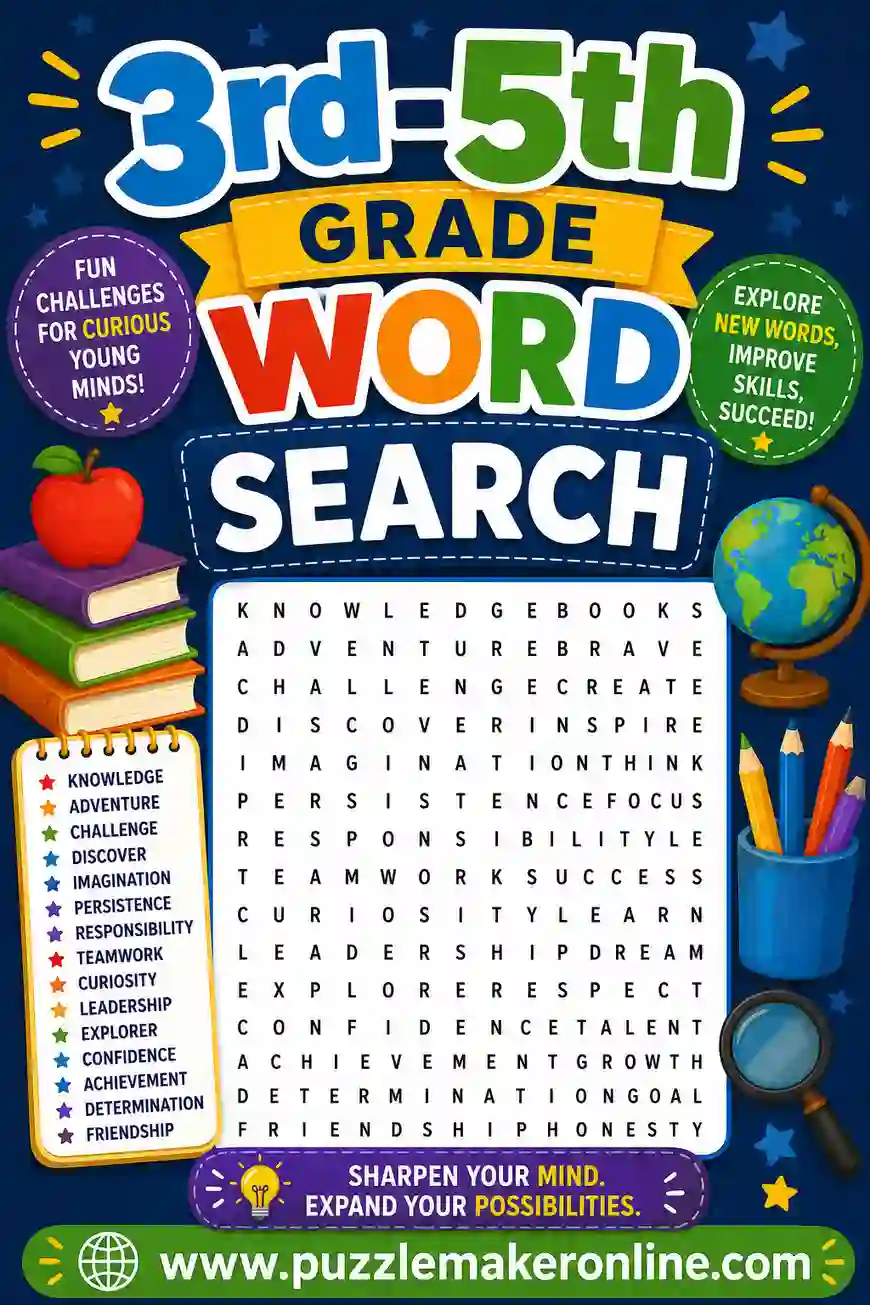
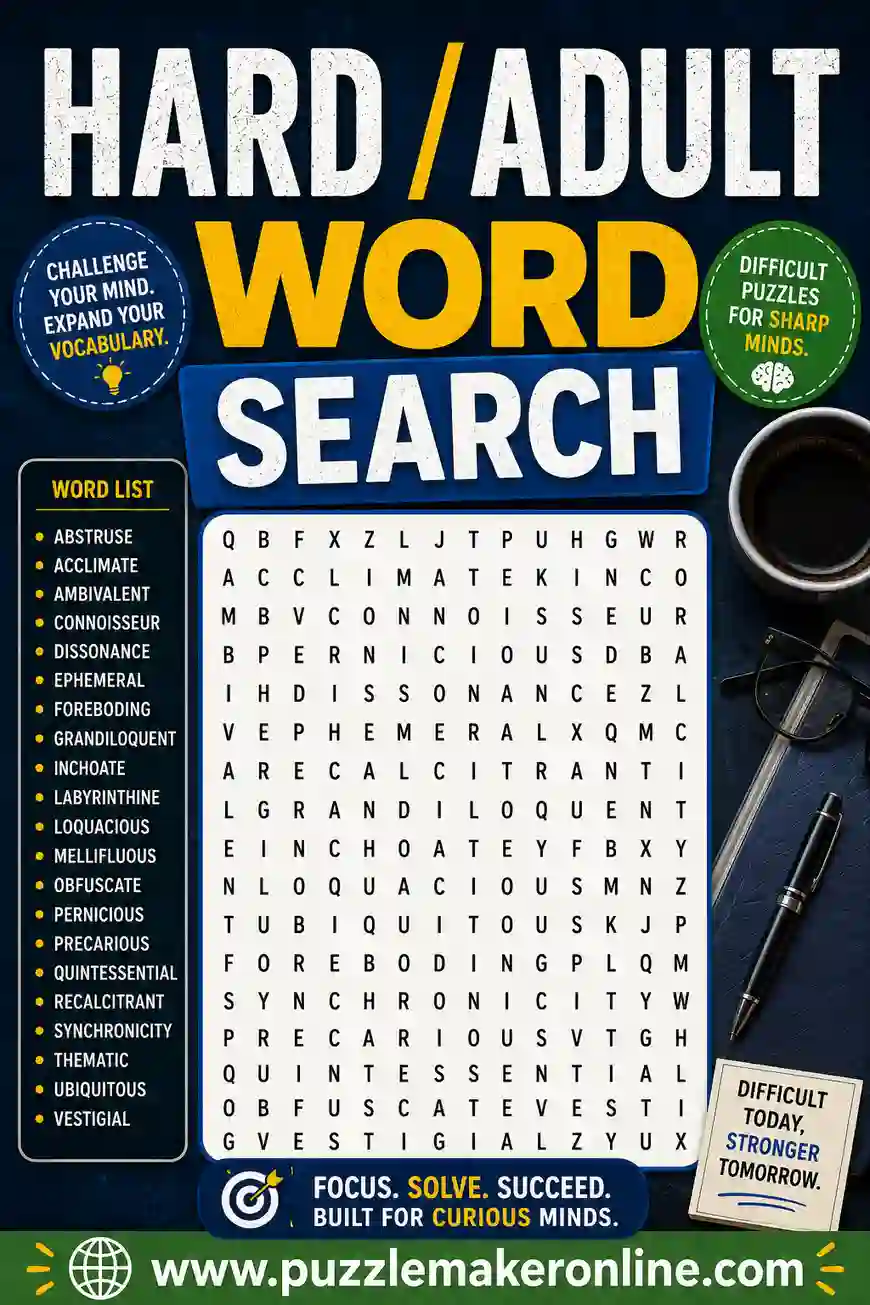
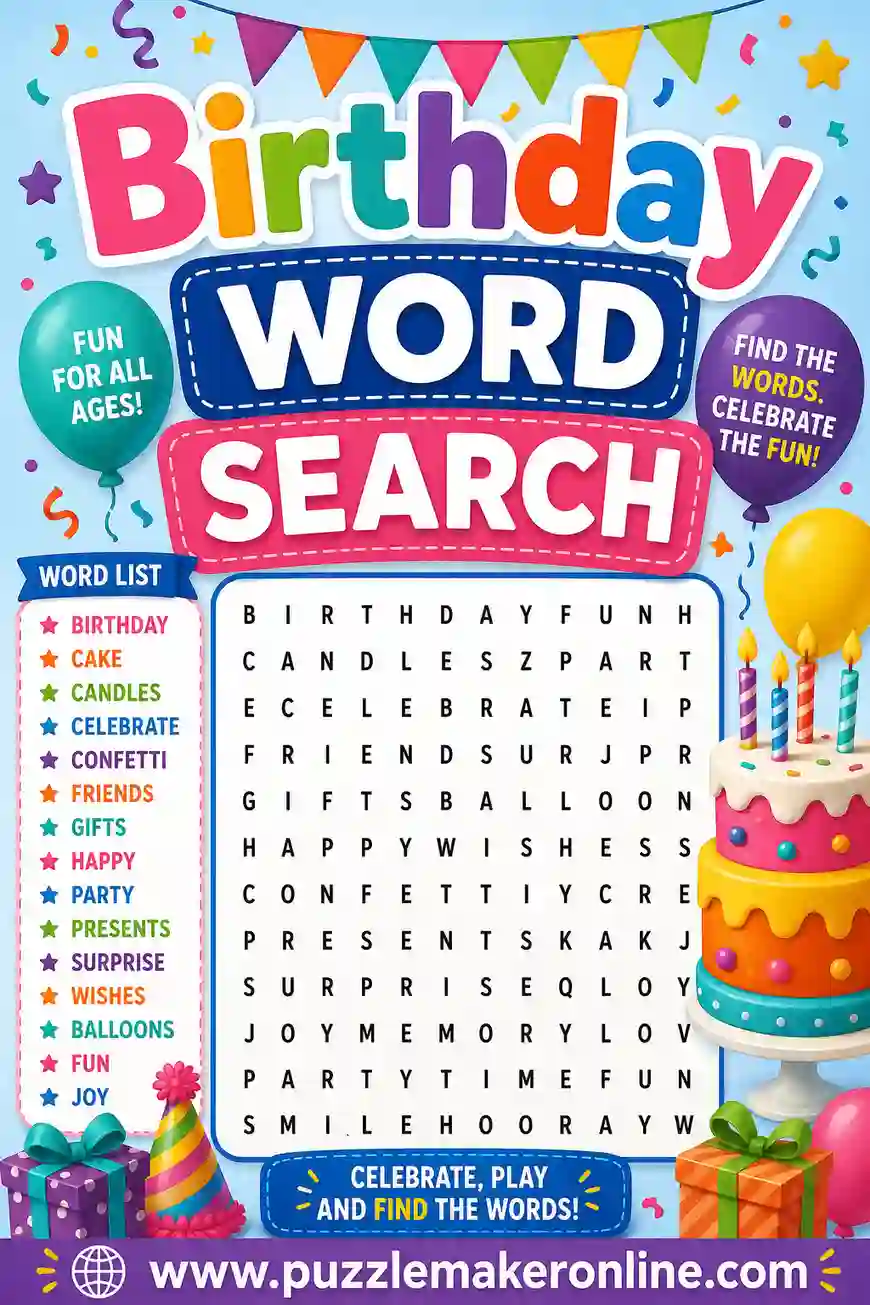
Want other levels and themes? Try our 3rd-5th grade word search for younger students, push the difficulty with a hard / adult word search, or make a fun birthday word search for a class celebration. Happy hunting!