
Mini Sudoku: Small-Grid Puzzles Explained (and How to Pick a Size)
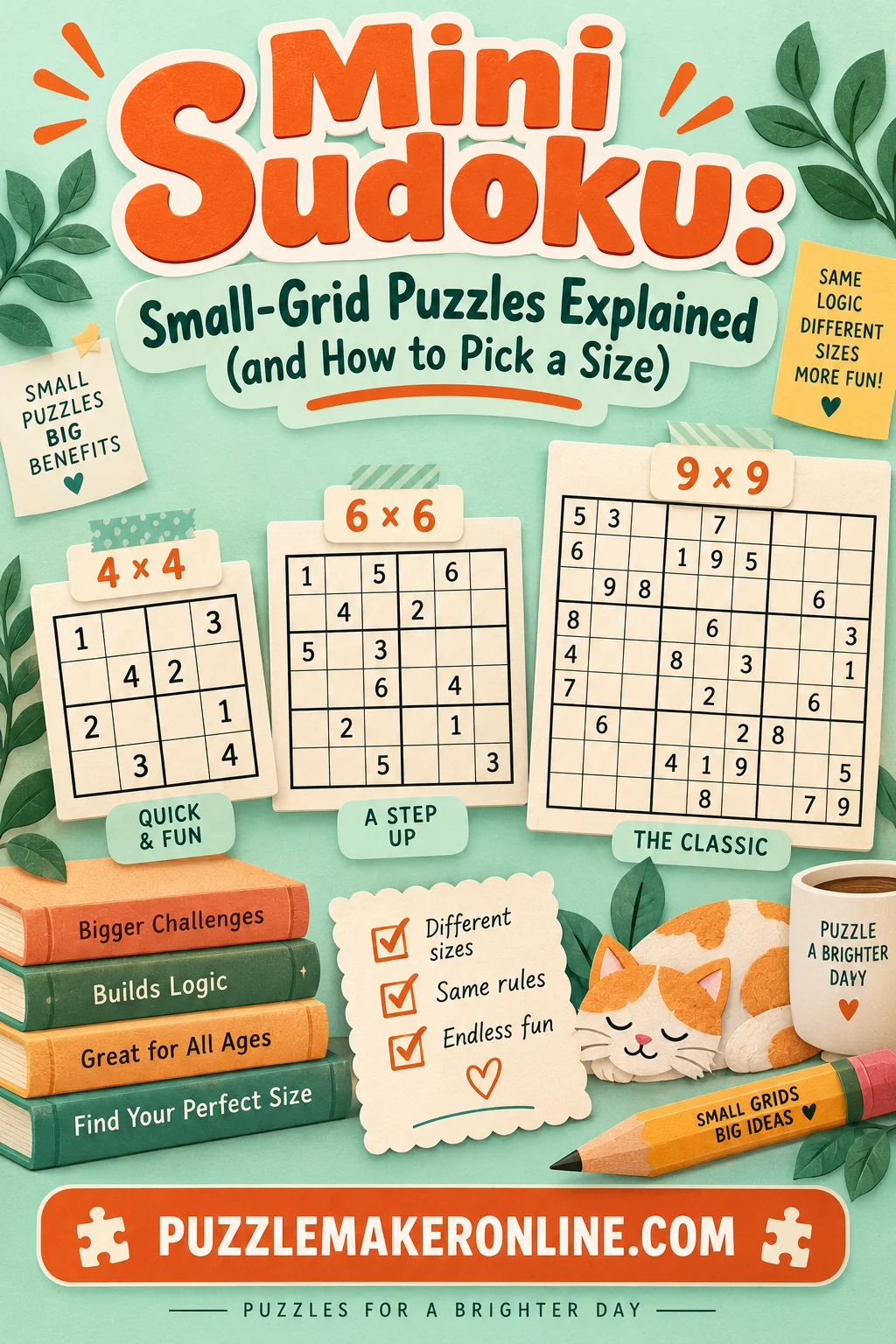
Mini sudoku is the umbrella term for any sudoku played on a grid smaller than the standard 9x9, and in practice that means one of three formats: 4x4, 5x5, or 6x6. They all follow the same core promise as full-size sudoku, which is that every row, every column, and every marked region holds each symbol exactly once. What changes is how long a puzzle takes, how much scanning your eyes have to do, and which solving habits actually get exercised. Picking the right one is mostly a question of who is solving and how much time they have, not a question of which grid is "real" sudoku.
This page is the comparison. If you already know which size you want, the individual grid pages go deeper on each one. What follows is the decision layer: what separates the three formats, where each one genuinely fits, and how to avoid the common mismatch of handing someone a grid that is either trivially small or quietly harder than it looks.
What Counts as a Mini Sudoku
A mini sudoku is defined by two things at once: the number of cells on a side, and the shape of the regions inside it. The second one matters more than people expect.
On a 9x9 board, the nine regions are perfect 3x3 squares because 9 is a square number. Small grids do not all cooperate that way. A 4x4 board splits cleanly into four 2x2 boxes. A 6x6 board splits into six rectangular boxes that are three cells wide and two cells tall (some publishers flip that to two wide and three tall, which produces a different puzzle from the same grid). A 5x5 board cannot be split into rectangles at all, because 5 is a prime number, so its five regions have to be irregular jigsaw shapes that snake across the grid.
That single structural fact is the reason 5x5 sits oddly in the middle of the family. It has more cells than a 4x4 and fewer than a 6x6, but the irregular regions make it behave less like a smaller sudoku and more like a small jigsaw sudoku. Solvers who have never met irregular regions before will find it slower than the cell count suggests.
The Three Small Grids at a Glance
| 4x4 | 5x5 | 6x6 | |
|---|---|---|---|
| Cells | 16 | 25 | 36 |
| Symbols used | 1-4 | 1-5 | 1-6 |
| Region shape | 2x2 boxes | irregular jigsaw regions | 3x2 (or 2x3) rectangles |
| Regions per grid | 4 | 5 | 6 |
| Typical solve time | 1-3 minutes | 4-8 minutes | 4-10 minutes |
| Techniques needed | scanning only | scanning plus region tracing | scanning, sometimes pairs |
| Best fit | ages 4-7, first-ever puzzle | solvers wanting something odd | ages 7-10, adult coffee break |
| Comfortable per page | 4 to 6 puzzles | 2 to 4 puzzles | 2 to 4 puzzles |
The times assume a solver who already understands the rule. A genuine first attempt on any grid takes longer, because most of the effort goes into learning that "no repeats" applies in three directions at once rather than just along the row.
Why Cell Count Is a Bad Difficulty Ruler
It is tempting to line the grids up by size and assume difficulty rises smoothly. It does not, for two reasons.
The first is that the number of valid completed grids collapses fast as boards shrink. A 4x4 sudoku has only 288 possible completed grids in total, which is a small enough universe that a solver who does a lot of them starts recognizing configurations rather than reasoning through them. A 6x6 has tens of millions of completed grids, and the full 9x9 has more than six and a half quintillion. That is why 4x4 puzzles feel repetitive to an adult after a dozen or so, while 6x6 puzzles stay fresh far longer.
The second reason is that the region shape controls how much information each clue carries. In a 4x4, placing one digit rules it out of a row, a column, and a four-cell box, which is a large slice of a sixteen-cell board. In a 6x6, the same placement removes a smaller proportion of the board, so you need more placements before the grid starts falling into place. And in a 5x5, tracing an irregular region takes real visual effort, because the shape does not sit still in your peripheral vision the way a rectangle does.
The practical takeaway: 4x4 is meaningfully easier than the other two, while 5x5 and 6x6 are much closer to each other in difficulty than their cell counts suggest.
How Mini Sudoku Compares to a Standard 9x9
Every mini grid is easier than a 9x9 of the same stated difficulty, but the gap is not uniform. A hard 6x6 can genuinely outpace an easy 9x9 in the amount of thinking required, because difficulty in sudoku comes from how sparse the clues are and which techniques the puzzle forces, not from the board's footprint.
Here is what actually gets removed when you shrink the grid:
Long-range scanning goes away. On a 9x9 you often work a digit across three stacked boxes at once. On a 6x6 there are only two boxes in a band, so that whole class of move becomes trivial.
Candidate lists stay short. A 9x9 cell can start with nine possibilities; a 6x6 cell starts with at most six and a 4x4 with four. Pencil marks stay readable without a sharp pencil and good eyesight, which is a real accessibility benefit and not just a beginner concern.
Advanced techniques mostly do not appear. X-wings, swordfish, and coloring chains need room to form. On mini grids you almost never need more than scanning, naked singles, hidden singles, and occasionally a naked pair. If someone is specifically training for advanced sudoku techniques, mini grids are the wrong practice surface.
The commitment shrinks. This is the underrated one. A 6x6 fits into the gap between two meetings. A hard 9x9 does not, and a half-finished 9x9 you come back to an hour later usually means re-deriving your own logic from scratch.
Which Size to Pick, by Solver
A child aged four to seven, or anyone meeting sudoku for the first time. Start at 4x4. The board fits inside a single glance, so the solver can actually see all three constraints operating at once, which is the conceptual leap that makes sudoku click. Using shapes or colored icons instead of digits works fine here and removes the reading requirement entirely.
A child aged seven to ten who already finishes 4x4 grids quickly. Move to 6x6 rather than 5x5. The rectangular regions keep the mental model identical to what they already learned, and the extra two symbols provide a real step up without introducing a new concept at the same time.
A solver who wants something structurally different. 5x5 is the interesting one. The irregular regions force you to trace shapes deliberately instead of relying on the box grid your eye has memorized, which is a useful skill and a genuinely different feel. It is also the best small-grid on-ramp to full-size jigsaw variants.
An adult wanting a short daily puzzle. 6x6 at medium or hard difficulty. It is the only mini format that reliably stays interesting for an adult over weeks rather than days.
A classroom or activity group with mixed ability. Print 4x4 and 6x6 side by side on the same handout rather than trying to find one difficulty that suits everyone. Faster solvers move on to the 6x6; slower solvers finish the 4x4 and feel done rather than behind.
Occupational therapy, memory care, or low-vision solvers. 4x4 and 6x6 both work, and the deciding factor is usually print size rather than difficulty. A 6x6 printed one per page gives cells large enough to write in with a marker, which matters more than the puzzle's rated difficulty.
Clue Count and What "Easy" Means on a Small Grid
Difficulty labels on mini sudoku are far less standardized than on 9x9 puzzles, so the same word means different things across sources. The number that actually predicts difficulty is the proportion of cells given as clues.
As a rough guide, an easy small grid gives you a little over half its cells. A medium one gives you closer to 40 percent. A hard one drops below a third, and on a 4x4 board that is close to the minimum that still leaves a single unique solution, which for 4x4 is four clues.
If you are generating your own puzzles, this is worth knowing because a "hard" 4x4 and an "easy" 4x4 can differ by only three or four given digits. That is a narrow band, which is another way of saying that 4x4 does not have much difficulty range to offer. 6x6 has considerably more.
Which Solving Habits Actually Transfer Upward
The reason mini sudoku is a good teaching tool is not that it is a shrunken 9x9. It is that it isolates the two habits that matter most and lets a solver drill them without noise.
Cross-hatching. Pick a symbol, look at every region that does not yet contain it, and eliminate the rows and columns where that symbol already sits. Whatever cell survives is the placement. This is the single most transferable move in sudoku, and on a 4x4 it is visible in one look.
Scanning a region for its missing symbol. When a region has one empty cell left, the answer is forced. Obvious, but beginners routinely miss it because they are staring at rows rather than regions. Small grids make the region the most salient shape on the board, which builds the habit.
Committing only to certainties. Guessing is punished less on a small grid, since a wrong guess is quicker to unwind, which makes small grids a low-stakes place to learn that a well-formed puzzle never actually requires a guess.
What does not transfer is stamina, and that is fine. Nobody needs a training program for sitting still. If you want the bridge techniques between mini grids and the full board, the standard progression is naked and hidden singles, then pairs, then pointing pairs, and there is a good walkthrough of the practical order in this collection of tips for solving sudoku.
Printing Mini Sudoku Without Wasting Paper
Small grids invite you to cram several onto a sheet, and that is usually the right call, but there is a floor. Cells smaller than about half an inch on a side stop being writable by a child holding a fat pencil, and cells smaller than about a third of an inch stop being writable by anyone.
Practical layout rules that hold up:
- Four 4x4 grids per page in a two by two arrangement leaves generous cell size and room for a name line at the top.
- Two 6x6 grids per page stacked vertically is the sweet spot for classroom use. Four per page works for adults but leaves no space for pencil marks.
- One grid per page whenever the solver has motor or vision limitations, or when you plan to laminate the sheet for dry-erase reuse.
- Print answers on a separate sheet, not on the reverse, if the pages will be double-sided. Backlit answers are visible through standard copy paper.
- Set margins to at least half an inch. Grids that run close to the paper edge get clipped by most home printers, and a clipped border column makes the puzzle look wrong even when it is not.
If you want a mix of sizes and difficulties in one session, generating them yourself is faster than hunting for matching sets. A sudoku puzzle maker lets you set the grid size and difficulty, then print the sheet directly, so you can build a page with two 4x4 grids and one 6x6 for a mixed-ability group in a single pass.
When to Move Up a Size
The signal is not speed alone. It is whether the solver finishes without hesitating.
If a 4x4 is finished in under two minutes with no pauses, the format has taught what it can, and the next step is 6x6. If a 6x6 at medium difficulty is finished comfortably, the honest next step is a 9x9 at easy difficulty rather than any other mini variant, because the remaining gap is scanning range, and only the full board trains that.
One thing worth resisting is jumping straight from 4x4 to a hard 9x9 because the solver seems capable. The 9x9 board demands sustained attention for long enough that a strong small-grid solver can stall out and conclude, wrongly, that sudoku stopped being fun. An easy 9x9 first, with a generous clue count, keeps the momentum.
Frequently Asked Questions
Is mini sudoku the same as kids' sudoku? Mostly, but not entirely. Kids' sudoku is a marketing label that usually means a 4x4 or 6x6 grid with shapes or colors instead of digits. Mini sudoku describes the grid size only, and plenty of adults solve 6x6 puzzles at hard difficulty for a quick daily challenge.
Which mini sudoku size is hardest? 6x6 at hard difficulty is generally the toughest of the three, because it has the most cells and the widest usable difficulty range. A 5x5 can feel harder on first contact because of its irregular regions, but once you are used to tracing jigsaw shapes it settles below a hard 6x6.
Can a mini sudoku have more than one solution? A properly generated one cannot. If a small grid has too few clues it becomes ambiguous, and 4x4 grids are especially prone to this because they need at least four well-placed clues to stay unique. Puzzles from a real generator check for uniqueness before printing.
Do the same solving techniques work on mini sudoku? The basic ones do, and they are the ones worth learning: cross-hatching, naked singles, hidden singles, and naked pairs all appear on small grids. Advanced pattern techniques such as X-wing need a larger board to form, so you will not encounter them on a 4x4 or 6x6.