
Pronunciation of Sudoku: How to Say It and What It Means
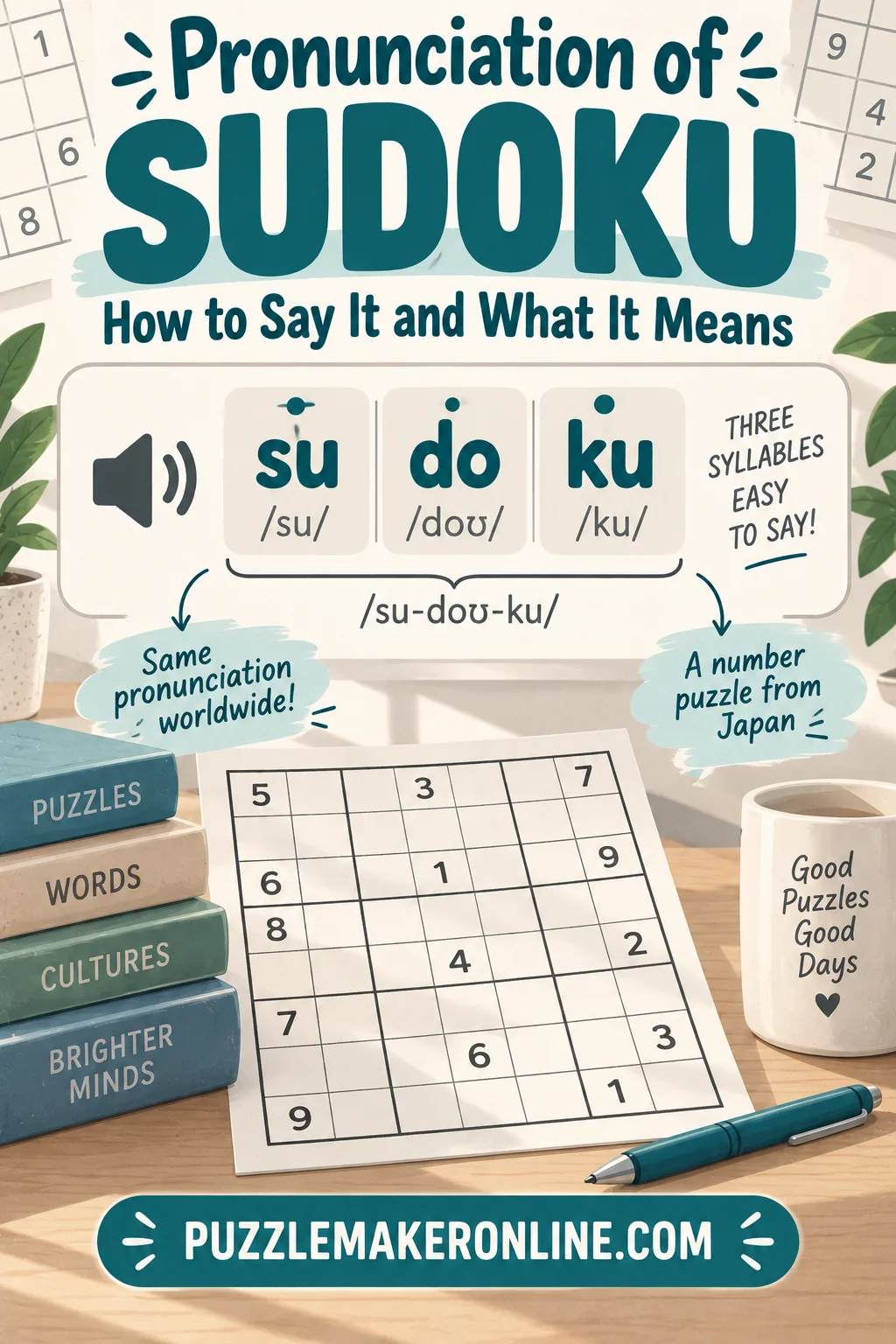
The standard English pronunciation of sudoku is soo-DOH-koo: three syllables, stress on the middle one, with a long "oo" at the start and a long "oh" in the middle, written in phonetic notation as /suːˈdoʊkuː/. It is not soo-DOO-koo, not suh-DOCK-oo, and not sudoko. The word is Japanese, and it is a shortening of a longer phrase meaning that the digits in the grid must stand alone.
That is the short version. The longer version is more interesting, because the name has an odd history: the puzzle was invented in the United States under an English name, renamed in Japan, and then exported back to English-speaking countries carrying its Japanese name. Almost nobody who solves one daily knows what the two halves of the word mean.
The Syllables, One at a Time
| Syllable | Say it like | Not like |
|---|---|---|
| su | "soo," as in soon | "sue-doh" with a Y glide, or "suh" |
| do | "doh," as in dough | "doo," as in do the dishes |
| ku | "koo," as in cuckoo | "kyoo," as in cue |
Put together: soo-DOH-koo. The middle syllable carries the stress in American and British English alike, though British speakers often flatten it toward soo-DOK-oo with a shorter middle vowel.
The two errors that account for nearly all mispronunciations are the middle vowel and the last one. Turning "do" into "doo" produces soo-DOO-koo, which is by far the most common miss. Turning "ku" into "kyoo" produces soo-doh-KYOO, which comes from English spelling habits, where the letter u after a consonant often carries a Y sound: cube, cute, mule. Japanese has no such rule. The u is a plain "oo" every time.
How It Sounds in Japanese
Japanese pronunciation differs from the English version in ways that are worth knowing even if you never use them.
Written in Japanese, the word is 数独, and in kana it is すうどく, which is four beats rather than three: su-u-do-ku. That doubled first vowel is a long vowel, and length in Japanese is a real distinction, not decoration. A Japanese speaker holds the opening "soo" noticeably longer than an English speaker does.
Japanese also does not use stress the way English does. Instead of hitting one syllable harder, Japanese distinguishes words by pitch, and every beat gets roughly equal time. So the native version sounds flatter and more even than soo-DOH-koo: four evenly measured beats with a pitch shape rather than a punch on the second syllable.
None of that makes the English pronunciation wrong. Borrowed words get re-fitted to the borrowing language's sound system, which is why English speakers stress the second syllable of a three-syllable word ending in a vowel almost automatically. Soo-DOH-koo is the correct English pronunciation. The even four-beat version is the correct Japanese one.
What Sudoku Means
The word is built from two elements:
- 数 (sū) — number, or figure
- 独 (doku) — single, alone, solitary
Together, roughly: single numbers, or numbers standing alone. That is a precise description of the rule that defines the puzzle. Each digit appears exactly once in each row, once in each column, and once in each box. No digit has company.
Why the Name Is an Abbreviation
Here is the part most people never hear. Sudoku is a clipped form of a longer Japanese phrase: 数字は独身に限る, romanized as sūji wa dokushin ni kagiru, which translates roughly as "the digits must be single" or "the numbers are limited to one occurrence." The first character of 数字 and the first of 独身 were pulled out and joined, and the result was sudoku.
That is a completely ordinary way to build a word in Japanese. The language shortens long compounds and borrowed phrases constantly by keeping the opening beats of each part: pasokon from personal computer, rimokon from remote control, depāto from department store. Sudoku follows the same pattern, which is why the word feels compact and slightly opaque even to Japanese speakers who have not been told the source.
Once you know the phrase, the pronunciation makes more sense too. The "su" is not a random syllable; it is the front of the word for number. The "doku" is the front of the word for single. Neither half is stressed in the original, which is why the flat Japanese reading feels more natural once you understand what is being abbreviated.
The Route the Name Traveled
The puzzle itself predates the name by decades. Number grids of this kind appeared in French newspapers in the nineteenth century, and the modern form — a nine-by-nine grid with a unique solution and a scatter of given digits — was published in the United States in the late 1970s under the plain English name Number Place.
A Japanese puzzle magazine picked it up in the mid-1980s and gave it the abbreviated Japanese name. It became a fixture in Japan while remaining almost unknown elsewhere. Then, in 2004, a New Zealander who had discovered the puzzles in Japan wrote a program to generate them and persuaded a British newspaper to run one. Other papers followed within months, and the puzzle spread across the English-speaking world under the Japanese name rather than the American one.
So the sequence is: invented in America, named in Japan, popularized in Britain, and now solved everywhere. The name we all struggle to pronounce is the middle stop on that route.
There is one more wrinkle. The name was registered as a trademark in Japan by the magazine that coined it, which is why Japanese publishers who are not that magazine often use a different name for the same puzzle: nanpure, itself an abbreviation of the English "number place." In Japan, in other words, the puzzle is frequently called by an abbreviated English name while the rest of the world calls it by an abbreviated Japanese one.
The Mispronunciations, Ranked
| What people say | What went wrong |
|---|---|
| soo-DOO-koo | Middle vowel flattened from "doh" to "doo" |
| soo-doh-KYOO | English U-glide added to the final syllable |
| suh-DOH-koo | Opening vowel reduced instead of held long |
| soo-DOCK-oo | Middle vowel shortened, common in British speech |
| sudoko | Letters transposed in the spelling, then read aloud |
| PSEUDO-ku | Reanalyzed as if related to "pseudo" |
| SOO-doh-koo | Stress moved to the first syllable |
The spelling error is worth a note of its own. Sudoko, with the O and U swapped at the end, is one of the most common misspellings of the word, and it is self-reinforcing: people who write it that way then read it aloud that way. The word ends in -ku, matching the "doku" it was clipped from.
The Same Mistake in Other Japanese Loanwords
Sudoku is not a special case. English borrows Japanese words and then re-fits them to English spelling rules, and the same three errors show up every time: a final vowel gets swallowed, a long vowel gets shortened, and stress gets dropped onto whichever syllable feels natural in English.
- Karaoke is kah-rah-OH-keh in the original, four beats with a full vowel at the end. The English "carry-oh-key" turns the opening into an English word and the ending into a "key" sound that is not there.
- Sake, the rice wine, is SAH-keh, not "sah-kee." The final e is a full vowel, exactly as in the last syllable of karaoke.
- Anime is ah-nee-meh, with the same principle applied a third time. Every one of these errors is the identical habit: English treats a final e as silent or as "ee," and Japanese does neither.
- Karate and tsunami survive better, because their vowel patterns happen to line up with English expectations. That is luck, not care.
Once you notice the pattern you can pronounce almost any Japanese loanword on sight. Give every vowel its full value, do not add sounds that are not written, and do not hammer any one syllable. Sudoku follows the rule perfectly: soo, doh, koo, with nothing swallowed and nothing added.
Saying the Other Japanese Puzzle Names
If you solve one of these you probably solve others, and the same vowel rules apply throughout. Japanese vowels are consistent: a as in father, i as in machine, u as in flute, e as in bed, o as in note.
- Kakuro — kah-KOO-roh. A crossword-shaped puzzle with sums instead of clues.
- Hitori — hee-TOH-ree. Shade cells so no number repeats in a row or column.
- Futoshiki — foo-toh-SHEE-kee. A small grid with greater-than signs between cells.
- Shikaku — shee-KAH-koo. Divide the grid into rectangles.
- Nonogram — NON-oh-gram. Not Japanese in name, though the puzzle is; it is also called a picture cross.
- Nanpure — NAN-poo-reh. The Japanese abbreviation of "number place," meaning the same puzzle as sudoku.
The pattern that trips English speakers most often across all of these is the final vowel. Japanese words very rarely end in a consonant, so the final syllable is almost always a full vowel sound, never a swallowed one.
Does the Pronunciation Actually Matter
For a solver alone with a grid, no. For a teacher introducing the puzzle to a class, a broadcaster, or anyone running a club, yes, mildly. Saying it the standard way avoids the small distraction of a room silently correcting you, and it takes ten seconds to fix.
There is also a practical benefit for anyone searching. If you say soo-DOO-koo, you are more likely to type sudoko, and the search results get worse. Getting the sound right keeps the spelling right.
How People Search for It
Search boxes see the word in every possible arrangement. Free sudoku, online sudoku, sudoku online free, free online sudoku, sudoku free — and doubled phrasings like online sudoku online show up constantly, because people repeat the qualifier without noticing. They all mean the same request: a grid to solve right now, in a browser, without setup.
That is worth saying plainly because the phrasing is confusing on the page and clear in intent. Nobody typing sudoku online free wants a history lesson. They want a puzzle. The pronunciation question tends to come from a different visitor entirely: someone who has been solving for years and finally wondered what the word means.
If you want to build grids rather than just solve them, a sudoku puzzle maker will generate a grid you can print or work through on screen.
A Quick Way to Remember It
Three sounds, all familiar English words:
Soo as in soup. Doh as in dough. Koo as in cuckoo.
Soup, dough, cuckoo. Say those three fast and you have the word, with the stress landing naturally in the middle. It is a silly mnemonic and it works, which is the only test a mnemonic has to pass.
Frequently Asked Questions
How do you pronounce sudoku correctly? Soo-DOH-koo, with three syllables and the stress on the middle one. The first syllable rhymes with "too," the middle with "go," and the last with "coo." In Japanese it is closer to four evenly timed beats with a long opening vowel and no stress at all.
What does the word sudoku mean? It combines the Japanese elements for number and single, and it is short for a longer phrase meaning the digits must stand alone. That describes the rule exactly: each digit appears once per row, once per column, and once per box.
Is sudoku a Japanese puzzle? The name is Japanese and the puzzle became popular there first, but the modern nine-by-nine form was published in the United States in the late 1970s as Number Place. It was renamed in Japan in the 1980s and returned to the English-speaking world under that name in 2004.
What is the plural of sudoku? Both sudoku and sudokus are used in English. Japanese does not mark plurals, so the unchanged form is closer to the original, but "sudokus" is common and perfectly clear. Newspapers tend to sidestep it by writing "sudoku puzzles."