Puzzles and Sudoku: Which Type Suits You Best
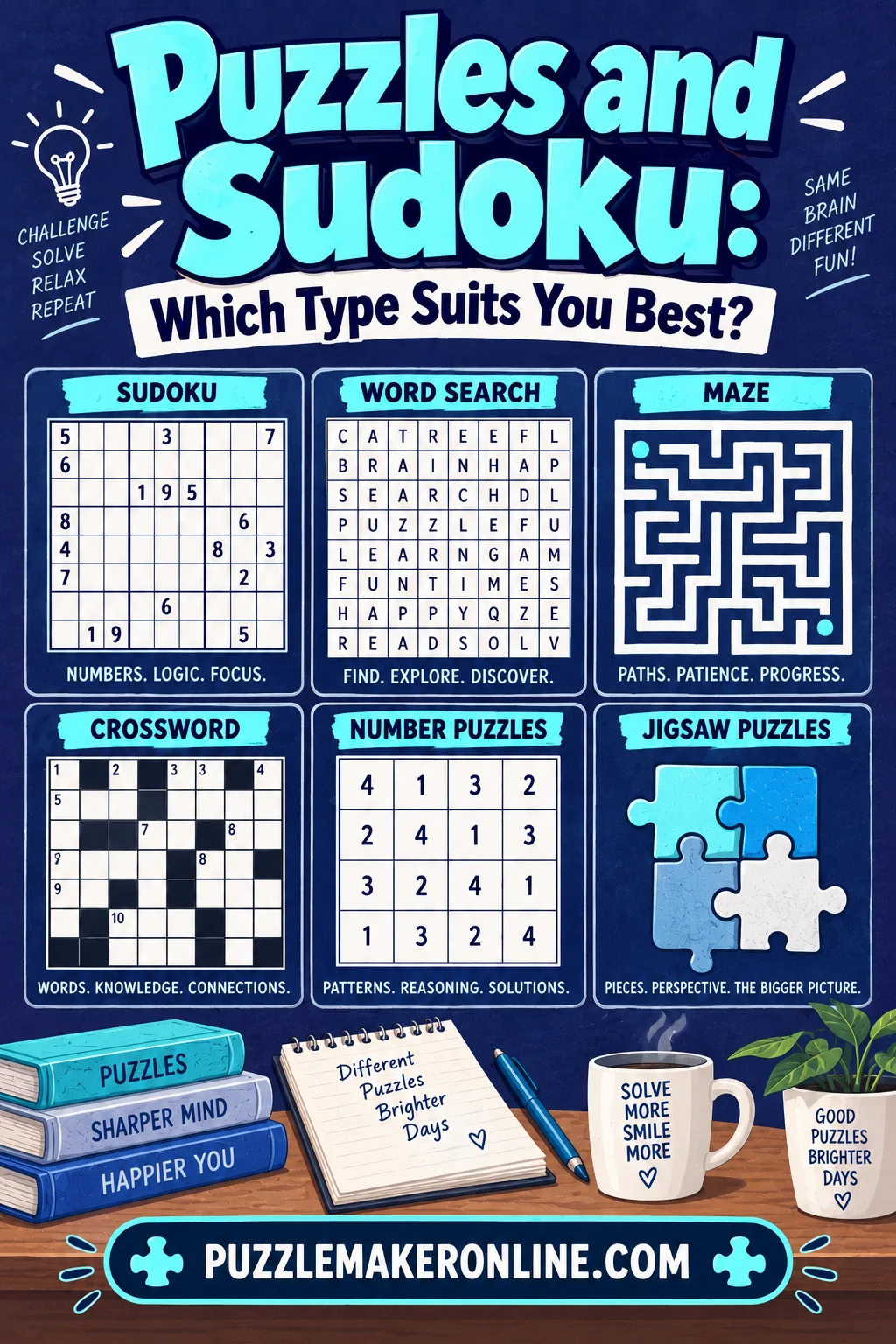
The choice between puzzles and sudoku comes down to one question: do you want a puzzle that tests what you know, or one that tests how carefully you reason? Crosswords, trivia grids, and most word games reward stored knowledge: vocabulary, references, spelling. Sudoku rewards none of that. Every fact you need to finish a sudoku is printed on the grid in front of you, which is exactly why it travels across languages, ages, and education levels better than almost any other puzzle in print.
That single distinction explains most of what follows. Below is a working comparison of the main puzzle families, what each one actually demands, how difficulty is built into each, and a short self-test for picking the one that will hold your attention past the first week.
The short answer, by what you want out of it
| If you want | Pick | Why it fits |
|---|---|---|
| Pure deduction, no outside knowledge | Sudoku | Self-contained; the grid holds all the information |
| Vocabulary and general recall | Crossword | Rewards reading, references, and wordplay |
| Low-effort unwinding | Word search | Visual scanning, almost no failure state |
| Arithmetic with logic | Kakuro | Sums plus placement constraints |
| Spatial reasoning | Nonogram, maze | Shape and route rather than symbols |
| Long shared activity | Jigsaw | Slow, social, interruptible |
The table is a starting point, not a verdict. Most people who stick with a puzzle habit end up rotating two or three of these, because each family fatigues a different part of your attention and they recover while you play something else.
What actually separates the families
Puzzles split cleanly into two groups, and the split matters more than the surface format.
Closed-system puzzles contain all the information required to solve them. Sudoku, kakuro, nonograms, slitherlink, and logic grids are closed. If you cannot finish one, the missing piece is a deduction you have not made yet, not a word you have never heard of. That property makes them fair in a way knowledge puzzles are not. It also makes them stubborn: there is nobody to blame.
Open-system puzzles require knowledge you brought with you. Crosswords, trivia, and anagram games are open. A clue about an obscure river is not solvable by reasoning; you either know it, infer it from crossing letters, or look it up. Open puzzles are more sociable, since two people bring two vocabularies, but they are also the ones people quit when the reference frame does not match their own.
Sudoku sits at the far closed end of that spectrum, and that position is the whole reason it spread the way it did. A sudoku printed in one country is solvable in every other one without translation. The symbols in the cells are labels, not numbers. You could replace 1 through 9 with nine colors or nine letters and the puzzle would be identical, which is something no crossword can claim.
What sudoku actually asks of you
A sudoku asks you to place nine distinct symbols so that each row, each column, and each of the nine boxes contains every symbol exactly once. That is the entire rule set. No arithmetic is performed at any point, a common misconception and one worth clearing up, because people who dislike math often avoid the puzzle for no reason.
What the puzzle really trains is elimination discipline. You look at a unit, work out what cannot go where, and narrow until only one option survives. Good solvers are not faster thinkers; they are more systematic ones. They scan in a fixed order, they write candidate marks the same way every time, and they follow each placement through to its consequences before moving on.
Three concrete skills carry almost all the load:
- Scanning. Reading a row, column, or box and asking where a specific symbol can still legally live.
- Candidate tracking. Keeping a small written list of possibilities per cell without letting the marks go stale.
- Consequence chasing. After a placement, immediately checking the three units that cell belongs to before looking anywhere else.
Everything with a fancy name (naked pairs, hidden triples, X-Wing) is a formalized shortcut on top of those three. Our guide to sudoku techniques and tips walks through the ladder in order if you want the progression rather than the summary.
Crosswords: the opposite temperament
A crossword is a conversation with a setter. The clue is written by a person who wants to be beaten, but only just, and half the pleasure is recognizing the trick. Cryptics take this furthest: the clue contains both a definition and a coded route to the same answer, and learning the codes takes months.
The temperament required is different from sudoku in a way that people underestimate. Crosswords reward broad, loose association, letting your mind wander until something clicks. Sudoku punishes wandering. A crossword solver can put the puzzle down mid-clue and come back sharper. A sudoku solver who loses track of which candidate marks are current usually has to redo a section.
If you enjoy the feeling of a word surfacing from nowhere, crosswords will hold you. If that feels like waiting rather than working, sudoku will suit you better.
Word searches, mazes, and the low-stakes tier
Word searches occupy a category of their own: almost no failure state. You cannot make a word search wrong, only unfinished. That makes them excellent for young children, for waiting rooms, and for anyone who wants a puzzle-shaped activity without the risk of getting stuck.
Mazes are similar in stakes but different in skill. A maze is a route-finding problem, and the standard trick, working backward from the exit, is the only technique most mazes require. Both formats sit alongside sudoku nicely in a printed collection because they use a completely different kind of attention: visual sweeping rather than logical elimination.
Kakuro and nonograms: the closest relatives
If you like sudoku and want the same feeling from a different shape, these two are the natural next steps.
Kakuro is a crossword grid with sums instead of clues. Each run of white cells has a target total, digits within a run cannot repeat, and the solving process is a hybrid of arithmetic and elimination. It is the closest thing to sudoku that actually uses numbers as numbers.
Nonograms, also called griddlers or picture logic, give you row and column counts and ask you to shade the cells that produce a hidden image. The deduction is pure, the payoff is visual, and the failure mode is brutal: one wrong shaded cell and the picture stops resolving.
Both are closed-system puzzles. Both reward the same discipline sudoku does. Neither requires a word of vocabulary.
How difficulty is built, family by family
This is the part most comparisons skip, and it is where the families genuinely diverge.
In a crossword, difficulty comes from obscurity and misdirection — rarer answers, more layered clue construction. Difficulty is authored.
In sudoku, difficulty comes from which solving techniques the grid forces you to use. An easy grid can be finished by scanning alone. A medium grid needs candidate marks and pairs. A hard grid holds back until you spot a pattern that spans two rows and two columns. Difficulty is structural, and that means it is measurable: a grading program solves the puzzle with a ranked list of techniques and reports the hardest one required.
That difference has a practical consequence. A hard crossword is hard because of what you do not know, so it may simply be impossible for you. A hard sudoku is hard because of a technique you have not learned yet, so it becomes possible the moment you learn it. Progress in sudoku is far more visible, which is a real reason people stay with it for years.
Puzzles and sudoku for specific situations
For children. Word searches and mazes first, then small 4x4 and 6x6 sudoku grids. The reduced grid keeps the logic honest while shrinking the working memory load.
For commuting. Anything you can pause. Sudoku is fine on a phone because the app holds the candidate marks for you; on paper in a moving vehicle it is less pleasant.
For unwinding before sleep. Word searches and easy sudoku. Avoid hard grids — the stuck feeling is stimulating, not calming.
For a group. Jigsaws and crosswords. Sudoku is stubbornly single-player; two people working one grid mostly get in each other's way.
For building a habit. One puzzle a day at a difficulty you finish about four times in five. Consistently failing kills the habit; consistently breezing through kills the interest.
Where to find sudoku puzzles worth solving
Quality varies more than people expect. A well-made grid has exactly one solution and a clean solving path that never requires a guess. A badly made one has multiple valid answers, which means the "correct" solution in the back of the book is arbitrary and your perfectly logical alternative is marked wrong.
Three things worth checking in any source of sudoku puzzles:
- Unique solution. Any respectable generator guarantees it. If a puzzle has two answers, it is broken regardless of how it looks.
- Honest grading. Easy should mean scanning-only. If the "easy" section makes you build candidate lists, the labels are decorative.
- Print legibility. Cell size matters if you write candidate marks by hand. Nine small digits in a cramped square is a recipe for misreading your own notes.
You can play free sudoku in a browser, work from printed sheets, or generate your own. Our sudoku puzzle maker builds grids on demand, which is useful when you want a specific size or difficulty rather than whatever the day's puzzle happens to be. For anyone who prefers pencil and paper, printing a batch of grids at the start of the week works better than printing one at a time.
A note on how people search for this
Search boxes stack suggestions on top of what you have already typed, so the queries people actually submit get strange fast. Logs for this topic are full of doubled phrases like sudoku sudoku online, and occasionally triple-stacked monsters like sudoku online sudoku online sudoku online, where an autocomplete suggestion was appended to a query that already contained it. Nobody means anything different by these. Someone typing free online sudoku, someone typing online sudoku, and someone typing sudoku online all want the same thing: a grid they can play in a browser without installing anything.
It is worth knowing because it affects what you find. Sites that chase those repeated phrases tend to be thin. Sites that just publish good grids tend to describe them plainly.
A short self-test
Answer these honestly and the choice usually makes itself.
Do you enjoy being stuck? If a dead end feels like an invitation, sudoku and other closed puzzles will reward you. If it feels like a wall, start with word searches and easy grids.
Do you like knowing things? Crosswords convert reading habits into puzzle skill. Sudoku gives no credit for anything you learned before you sat down.
Do you want to see yourself improve? Sudoku offers the clearest progression, because each new technique visibly unlocks a difficulty tier you could not finish last month.
How long is your session? Ten minutes suits a small sudoku or a word search. An hour suits a cryptic crossword or a hard grid. A jigsaw suits a week.
Most people land on a rotation rather than a single answer, and that is the healthiest outcome. Sudoku for the deduction, a crossword for the language, a nonogram when you want the same logic in a different shape.
Frequently Asked Questions
Is sudoku a math puzzle? No. Sudoku uses digits as labels, not quantities, and no arithmetic is ever performed. Swap the digits for nine letters or nine colors and the puzzle behaves identically.
Which puzzle type is best for keeping your mind active? There is no single winner, and rotating types is more useful than picking one. Sudoku exercises systematic elimination, crosswords exercise recall and language, and spatial puzzles like nonograms exercise something different again.
Can I play sudoku online free without creating an account? On most browser-based sites, yes. Grids are generated in the page and nothing needs to be saved unless you want to resume a puzzle later.
How do I know if a sudoku puzzle is well made? It has exactly one solution and can be finished by logic alone, with no guessing at any point. If you reach a position where two different symbols both seem valid and nothing in the grid decides between them, the puzzle is broken rather than hard.