Science Crossword: Free Printable Puzzle Maker
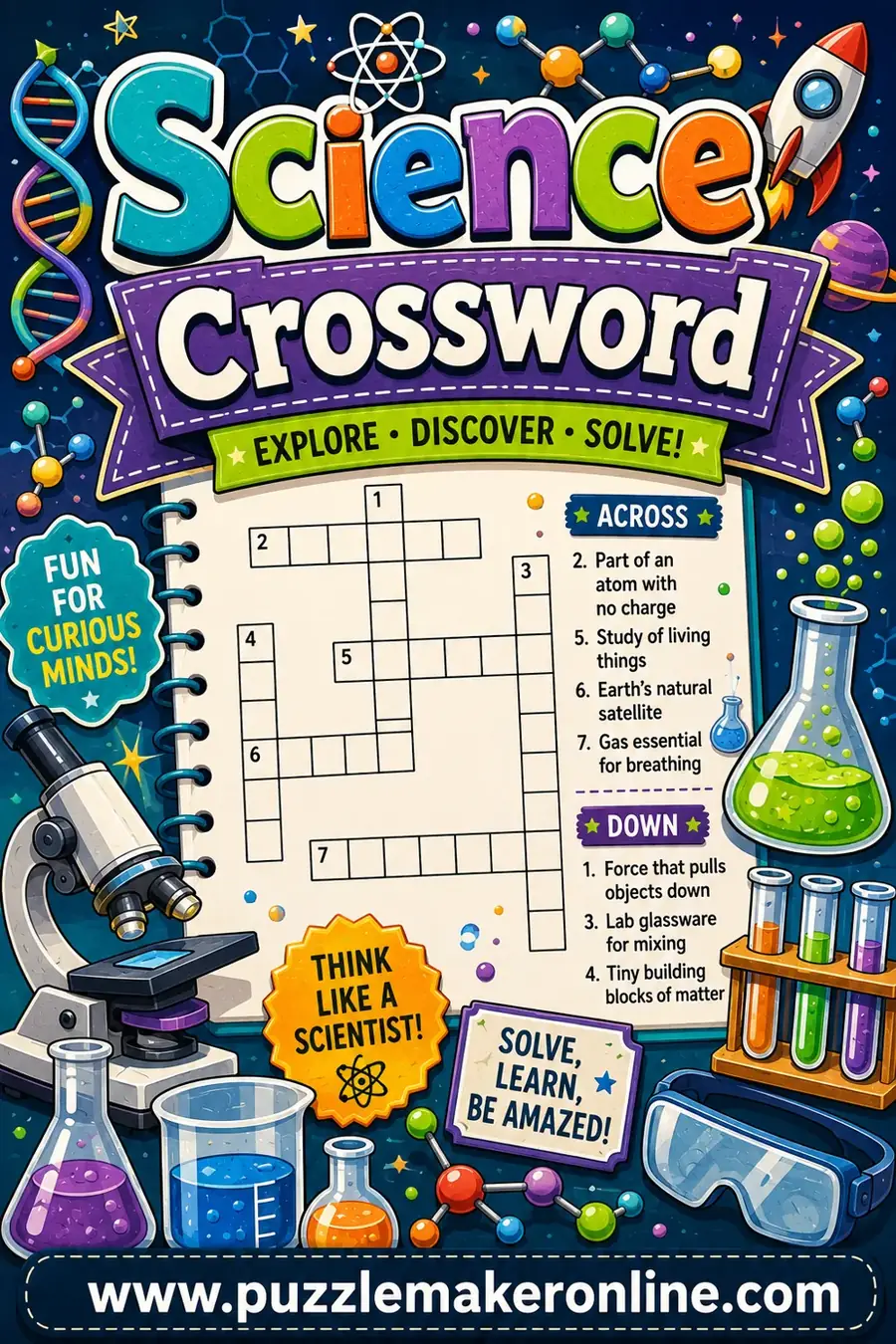
A science crossword is a printable grid where every answer is a science word like "atom," "gravity," or "cell," and each clue is a short hint or definition. You fill in the across and down answers until the grid is solved. The fastest way to make one is to use a free puzzle maker that turns your science word list into a finished grid, complete with clues and an answer key.
Want to skip ahead and just build it? Open the free puzzle maker, paste in a science word list (there's a ready-made one below), and print as many copies as you need. No sign-up, no fee, nothing to install.
What Is a Science Crossword?
Take a regular crossword and swap every answer for a science word. Some answers come from biology, like "cell" and "enzyme." Others come from physics, chemistry, or earth science. Each clue is a short hint, and the solver writes the answer into the numbered squares.
Science makes a strong theme because it splits so cleanly by subject. You can build one broad puzzle that touches every branch, or focus on a single unit like the solar system or the human body. The same tool handles both.
A good science crossword has two clear layers:
- The answers — the words in the grid, like "photosynthesis" or "orbit."
- The clues — the hints by each number, like "The center of an atom" for NUCLEUS.
Get those two right and the puzzle nearly builds itself.
Why Make Your Own Science Crossword
You can find pre-made science crosswords online, but building your own wins for a few simple reasons.
- It's free. A printable puzzle costs nothing when you make it yourself.
- You pick the words. Match the puzzle to this week's chapter, lab, or vocabulary list.
- You set the difficulty. Easy words for young learners, real terminology for high school science.
- You get an answer key. The maker builds the solution, so grading takes seconds.
It's fast, too. Most teachers go from "I need a review sheet" to a printed puzzle in under ten minutes.
Free Science Crossword Word List (Copy & Paste)
Here's a ready-to-use list of 30 science words, sorted by branch. Copy the column you like straight into the puzzle maker. Twenty-plus words make a nice, full grid.
| Life Science | Physical Science | Earth & Space |
|---|---|---|
| Cell | Atom | Planet |
| Enzyme | Molecule | Orbit |
| Genes | Energy | Comet |
| Tissue | Gravity | Erosion |
| Organ | Magnet | Volcano |
| Bacteria | Force | Mineral |
| Oxygen | Friction | Galaxy |
| Habitat | Circuit | Climate |
| Fossil | Voltage | Crater |
| Nerve | Mass | Eclipse |
Mix and match across columns for variety. If you're teaching young kids, lean on words they can picture, like planet, volcano, and magnet.
Theme variations to try
- Solar system crossword. Fill the grid with space terms only: "Mercury," "asteroid," "rotation," "satellite." Perfect for an astronomy unit.
- Human body crossword. Use organs and systems, like "lungs," "skeleton," "digestion," for a health or biology lesson.
- Chemistry crossword. Stick to elements and reactions, like "carbon," "compound," "reaction," for older students.
How to Make a Science Crossword in 4 Steps
You don't need any design skills. Here's the whole process.
- Pick your words. Paste at least 20 science words. More words give the maker room to build a fuller, more interesting grid.
- Write your clues. Add a short definition for each word, or let the maker prompt you. Keep clues clear and grade-appropriate.
- Choose your settings. Set the grid size and difficulty, then let the puzzle maker lock the words into place.
- Print. Print the puzzle and the answer key, and you're ready to hand it out.
That's it. If you want to reuse the worksheet, print on cardstock or slip copies into clear sleeves so students can solve with a dry-erase marker.
Writing Good Science Crossword Clues
The clue is where a science crossword teaches as it tests. A good clue nudges the student toward the term without giving it away. A few rules help.
- Match the grade. "A tiny living building block" suits beginners for CELL. "The smallest unit of life" suits older students.
- Keep it short. One line is plenty. Long clues crowd the page and confuse readers.
- Be accurate. A crossword is a teaching tool, so the science in the clue has to be correct.
- Use real definitions. Lean on the textbook wording so students recognize the term on a test later.
Easy clue swaps for younger players
If you're writing for kids, keep clues plain and concrete:
- PLANET → "Earth is one; so is Mars"
- MAGNET → "It pulls metal toward it"
- VOLCANO → "A mountain that can erupt"
- OXYGEN → "The gas you breathe to live"
Science Crossword Difficulty by Age and Grade
The same science theme stretches from grade school to a college lab. Adjust the word choice and grid size to fit.
| Level | Grid size | Word style | Tips |
|---|---|---|---|
| Early elementary (5–7) | Small (8–10 words) | Everyday science | Use pictures alongside clues. |
| Upper elementary (8–11) | Medium (12–15 words) | Basic terms by topic | Mix easy nouns with familiar concepts. |
| Middle school (12–14) | Medium (15–20 words) | Core vocabulary | Add processes like erosion and friction. |
| High school | Large (20–30 words) | Branch terminology | Include chemistry, biology, and physics terms. |
| Adults & science buffs | Large (25–30 words) | Mixed trivia | Throw in scientists, units, and theories. |
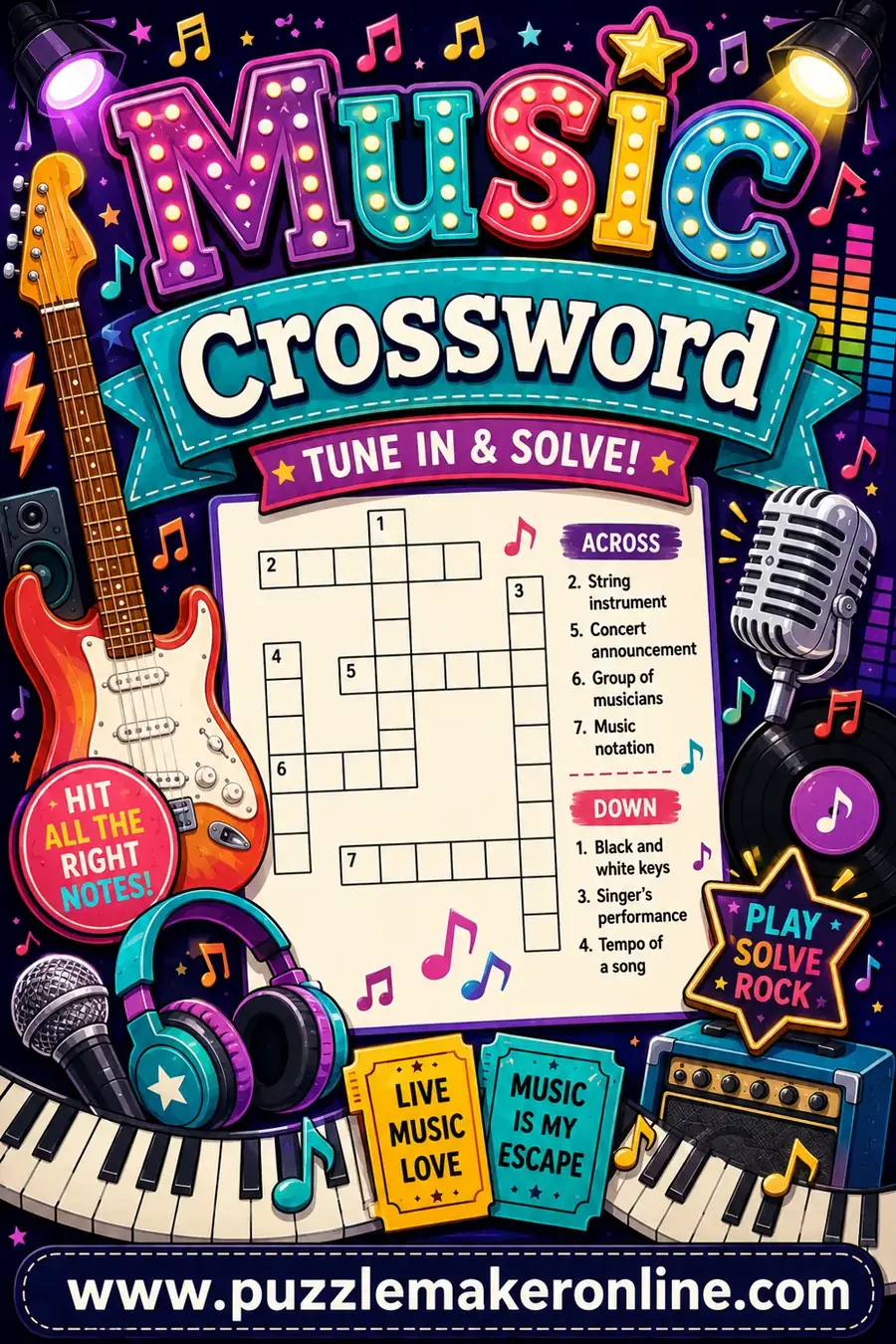
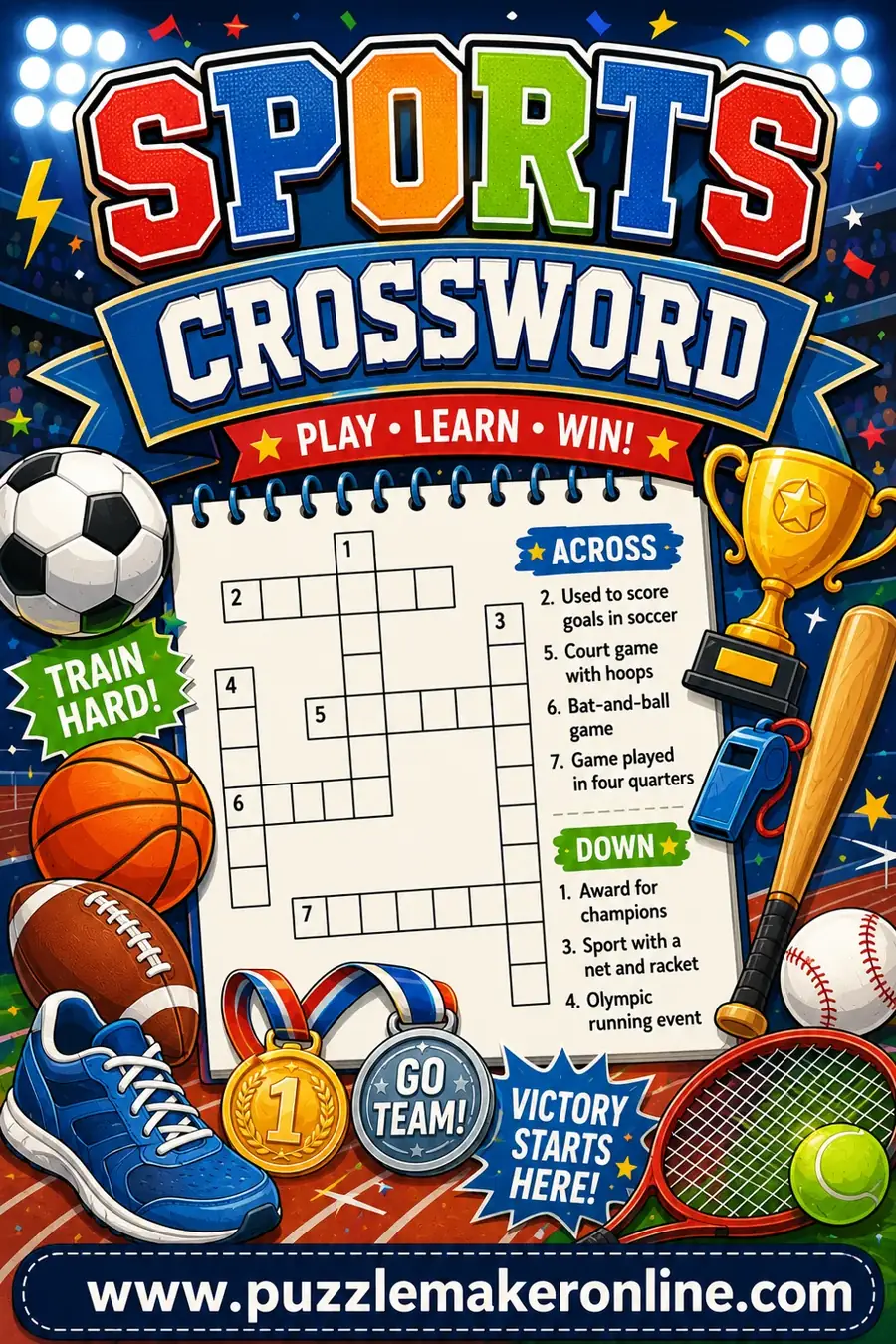
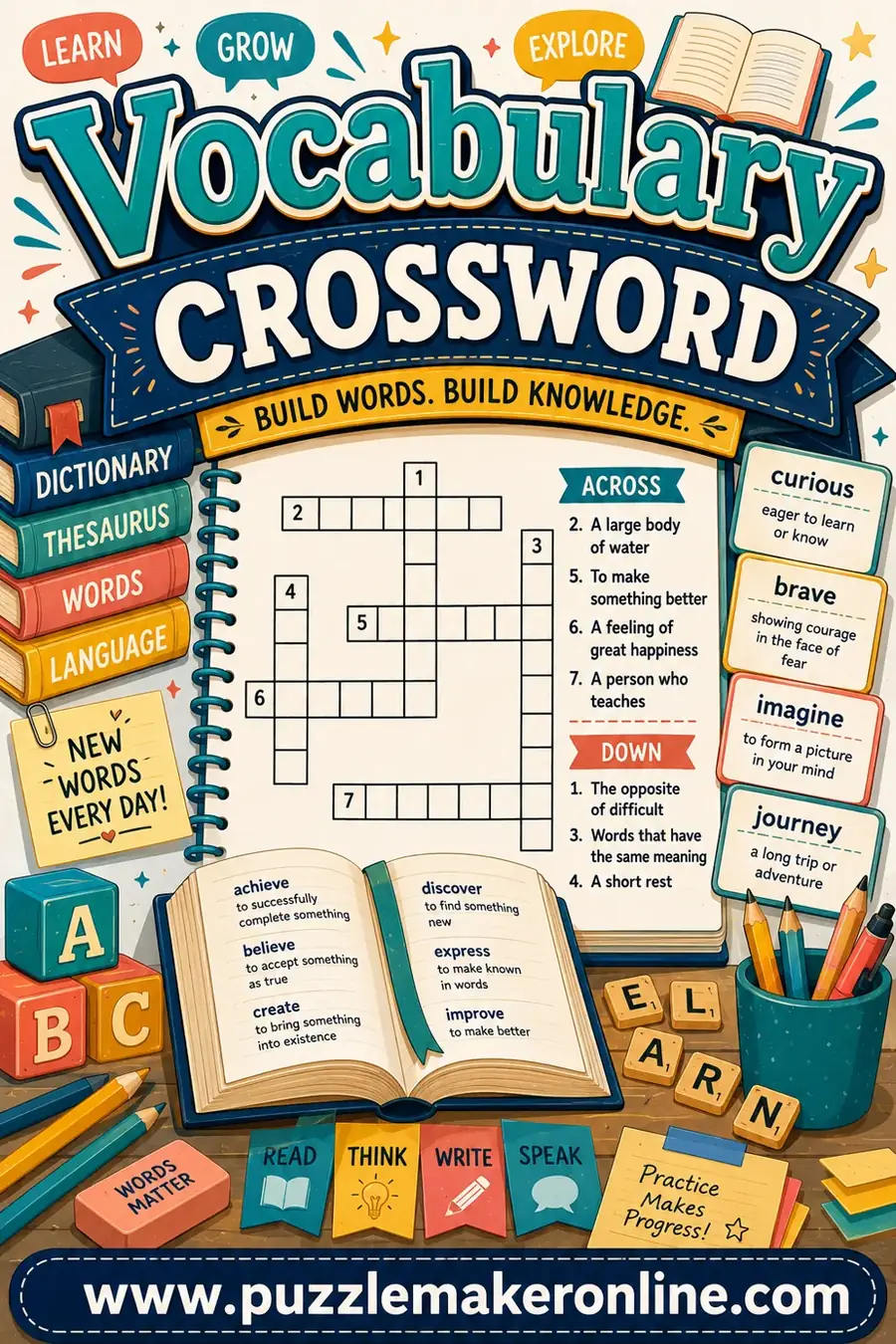
Loving the theme? You can build the same kind of puzzle for other subjects with our music crossword, sports crossword, and vocabulary crossword makers.
Who a Science Crossword Is Great For
This puzzle flexes to almost any group. A few of the most popular crowds:
Science teachers
A crossword is a low-prep way to review vocabulary before a unit test. Build one from the chapter's key terms, print a class set, and you've got a focused warm-up that grades itself.
Homeschool parents
Pair a science crossword with a hands-on experiment. Run the activity, then have your child fill in the terms they just saw in action. It cements the words better than a worksheet alone.
Substitute teachers
A printable science crossword is a reliable plan B when you walk into a class cold. Keep a few topic-based ones ready and you'll always have a clean, on-subject activity.
Tutors and study groups
Use a crossword to make review feel less like cramming. Solving for a term takes more brainpower than rereading notes, so the words stick.
Printing Tips for Clean, Reusable Puzzles
A few small choices make a big difference.
- Print a test page first. Check that the grid and clues fit on one sheet before you run a full class set.
- Use black and white to save ink. A crossword reads perfectly without color.
- Print the answer key separately. Keep it off the student copy so nobody peeks.
- Cardstock or sleeves for reuse. Then students solve with a dry-erase marker and you wipe the page clean.
- Bump up the font for younger kids. Bigger squares and larger clue text help small hands and new readers.
What to hand out with it
- A sharp pencil with a good eraser
- A highlighter to mark finished clues
- The answer key, kept by the teacher for quick grading
Fun Ways to Change Up a Science Crossword
Once the basic version feels familiar, try these twists to keep students interested.
- Lab-day crossword. Build a puzzle from the terms in today's experiment and hand it out as a wrap-up.
- Team solve. Split into pairs and let them help each other. Lowers the pressure and gets kids explaining concepts.
- Clue-writing challenge. Have students write the clues for a word list, then swap puzzles. Writing a definition teaches the term twice.
- Unit-of-the-week. Make a fresh puzzle for each topic, from cells to circuits, across a semester.
You can also tie a theme to a current event, like a meteor shower or a new space mission, to make the science feel alive.
Crossword vs. Other Science Puzzles
A crossword is one of three puzzles you can build from the same science word list, and each fits a different goal. Pick the one that matches your lesson.
- Science crossword. The deepest. Clues make students recall a term from its definition, so it's ideal for review before a test. It takes the longest to solve, which makes it a strong quiet-work sheet.
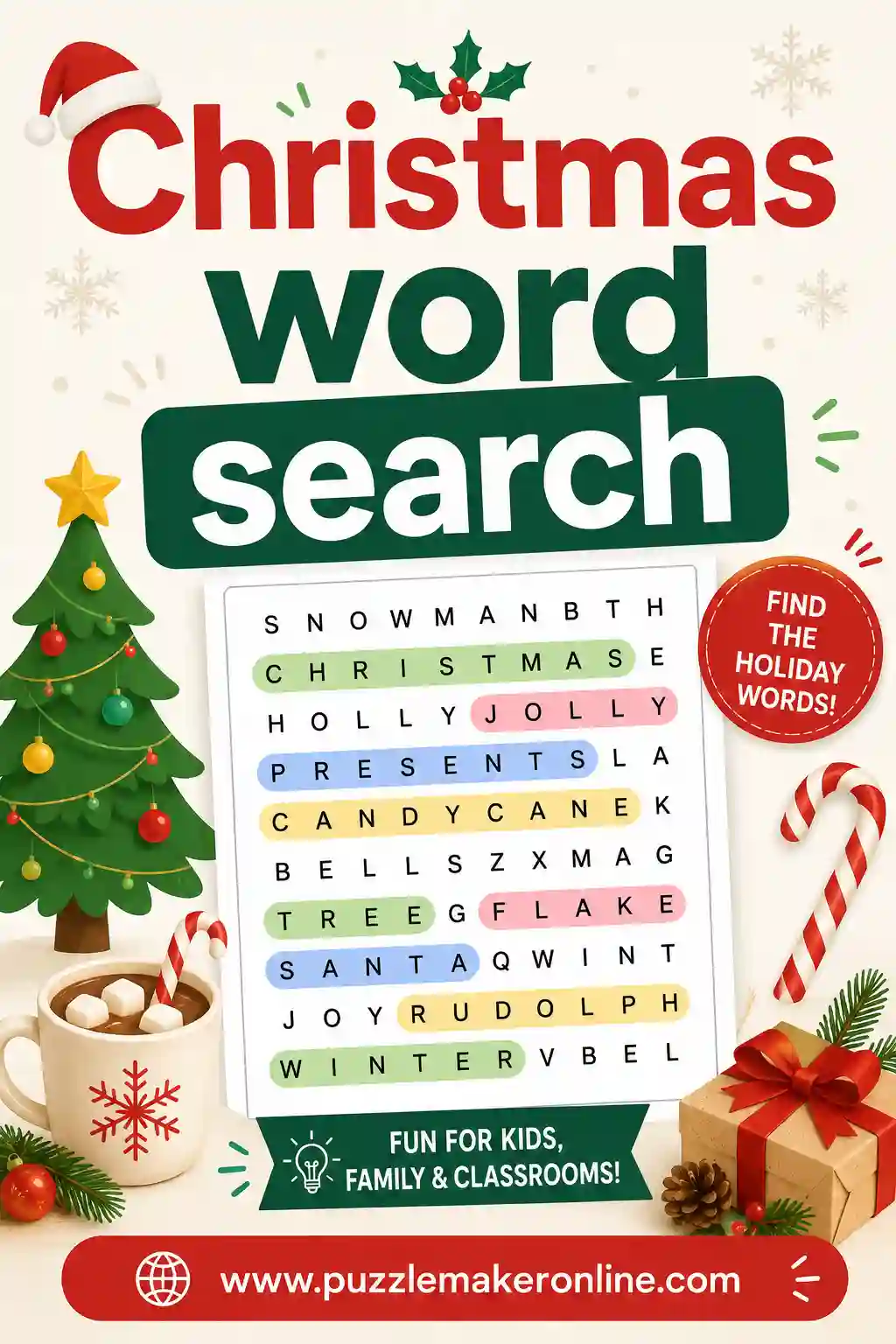
- Science word search. The calmest. Students hunt for hidden terms in a letter grid with no clues. Use it to introduce new vocabulary, since seeing the word spelled out helps it stick before the harder work begins.
- Science word scramble. The quickest. Letters of each term are jumbled, and students rearrange them. It's a fast spelling drill that suits warm-ups and mixed-ability classes.
A simple rule: use a crossword when you want students to know what a term means, a word search when you're introducing words, and a scramble for quick spelling practice. The same puzzle maker builds all three from one list, so you can hand a crossword to one group and a word search to another from the very same vocabulary.
Many teachers run all three across a unit. A word search introduces the chapter's terms, a scramble drills the spelling mid-week, and a crossword serves as the review the day before the test. By test day, students have met every word three ways.
Science Crossword Theme Ideas by Unit
Science splits cleanly into topics, which makes it easy to build a fresh puzzle for every chapter. Here are themed grids you can rotate through the year, each with a few starter words.
Solar system and space
Fill the grid with "planet," "orbit," "comet," "asteroid," "rotation," and "satellite." A space puzzle pairs perfectly with a night-sky lesson or a current event like a meteor shower or a rover landing.
Human body and health
Use "skeleton," "lungs," "digestion," "muscle," "nerve," and "circulation." A body puzzle works for both science and health units, and it gives students a chance to label what they're learning in another class.
Chemistry basics
Drop in "atom," "molecule," "element," "compound," "reaction," and "carbon." A chemistry crossword turns abstract terms into something students can pin down, which helps before they tackle formulas and equations.
Ecosystems and habitats
Build around "habitat," "predator," "prey," "food chain," "biome," and "adaptation." An ecology puzzle ties neatly to a field trip or an outdoor lesson, where students can spot the concepts in real life.
Rotating by unit keeps review feeling fresh. Each new chapter brings a new puzzle, and students start to expect it as part of the routine.
Common Mistakes to Avoid
A science crossword is a forgiving format, but a few slips can make one harder or less useful than you meant. Watch for these.
- Too few words. A grid with only eight or nine terms leaves big gaps and feels unfinished. Aim for at least 20 so the puzzle interlocks well.
- Clues that give it away. If your clue for OXYGEN is "a gas that starts with O," there's no thinking left. Hint at the term without spelling it out.
- Inaccurate science. A crossword is a teaching tool, so a wrong or sloppy clue teaches the wrong thing. Double-check that every clue matches the textbook.
- Mismatched grade level. Putting "photosynthesis" on a first-grade puzzle just frustrates kids. Match the words to the grade and save the big terms for older students.
- Forgetting the answer key. Always print the key. Grading 25 puzzles from memory is slow and error-prone.
Avoid these and your science crossword teaches as well as it tests.
Frequently Asked Questions
What words should go on a science crossword?
Pick clear science terms your students will know: atom, cell, gravity, energy, and topic words like planet and volcano. The word list above gives you 30 ready to copy. Aim for at least 20 so the grid fills out nicely.
How many words do I need for a science crossword?
Twenty to thirty works well for a full-page puzzle. Fewer than 15 leaves big gaps in the grid. The puzzle maker lets you paste a long list and fits it to the size you choose.
Is this science crossword maker really free?
Yes. You build and print the puzzle yourself at no cost. There's no sign-up and no watermark, so you can make a worksheet for every unit from one word list.
Can I make a science crossword for young kids?
Absolutely. Use a smaller grid, stick to everyday science words, and write simple picture-style clues. Bigger squares and larger text help non-readers and early learners follow along.
Can I focus a crossword on one topic?
Yes. Paste a word list from a single unit, like the solar system or the human body, and the maker builds a focused puzzle. It's a great fit for chapter reviews.
Does it make an answer key?
Yes. The maker builds the solved grid for you, so you can grade in seconds or let students check their own work.
Can I print a science crossword and a word search from the same list?
Yes. Paste your science word list once, then build a crossword for your older students and a word search for the younger ones. The same list works across every format, so you can match the difficulty to each group without retyping.
How long does a science crossword take to solve?
It depends on the grid size and the class. A 10-word puzzle for younger students runs about five to ten minutes. A full 25-word review crossword can take 20 minutes or more, which makes it a solid use of a class period before a test.
Ready to Print Your Science Crossword?
Grab the word list above, open the free puzzle maker, and you'll have a clean, printable science crossword in minutes. It's free, there's no sign-up, and you get a matching answer key every time, so your class or homeschool lesson is ready to solve. Have fun, and may every clue spark a little curiosity.