Subject Word Scramble: Free Printable Maker
A subject word scramble is a puzzle built around the vocabulary of a school subject, with words like "EQUATION" or "PHOTOSYNTHESIS" scrambled for students to unscramble. It's a low-prep way to review key terms before a test or kick off a new unit. The fastest way to make one is a free puzzle maker that takes your subject vocabulary, scrambles every word, and prints an answer key for you.
Want to skip ahead and just make one? Open the free puzzle maker, paste in your subject word list (there are ready-made ones below), and print a class set in seconds. No sign-up, no fee, nothing to install.
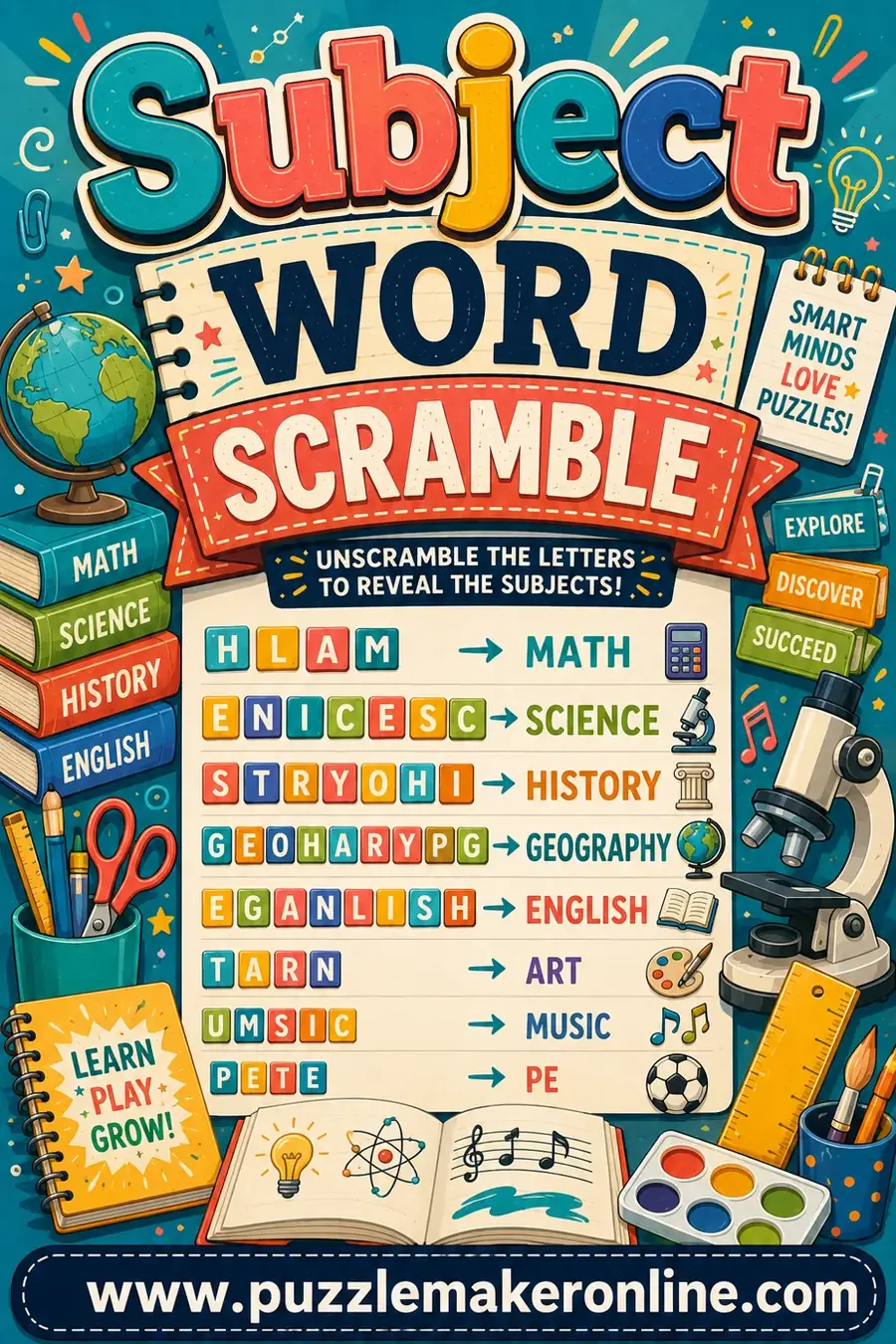
What Is a Subject Word Scramble?
It's a word scramble where every word comes from a single school subject. Instead of random words, you use the terms students actually need to know: parts of speech for English, planets for science, key dates for history. The letters are jumbled, and unscrambling them forces students to recall and spell each term.
That's what makes it a teaching tool, not just a time-filler. When a student untangles "PHOTOSYNTHESIS," they're rehearsing both the spelling and the concept. It's active recall hiding inside a puzzle, which is exactly why teachers reach for it before quizzes.
You can use it in a few ways:
- Warm-up. A quick five-minute scramble to wake up the class and prime the day's topic.
- Review sheet. A pre-test puzzle that surfaces the words students should know cold.
- Sub plan. An easy, self-explanatory activity any substitute can hand out.
Why Make Your Own Instead of Downloading One
You can find generic scramble worksheets online, but building your own beats a random PDF for three reasons.
- It's free. You pay nothing to create and print a custom sheet for your class.
- You match your curriculum. Use the exact terms from your textbook or unit, not someone else's.
- You get an answer key automatically. A good puzzle maker prints the solutions separately, so grading or checking is instant.
It's also faster than searching for a worksheet that happens to cover your topic. Most teachers go from word list to printed class set in a few minutes.
Free Subject Word Lists (Copy & Paste)
Here are three ready-to-use vocabulary sets. Drop any 12 to 20 words into the maker for one sheet. Copy the subject you're teaching straight into the tool.
| Math | Science | English & History |
|---|---|---|
| Equation | Molecule | Verb |
| Fraction | Gravity | Noun |
| Decimal | Cell | Adjective |
| Geometry | Atom | Pronoun |
| Multiply | Energy | Syllable |
| Perimeter | Habitat | Paragraph |
| Variable | Friction | Metaphor |
| Quotient | Mitosis | Revolution |
| Symmetry | Ecosystem | Continent |
| Polygon | Photosynthesis | Democracy |
Mix and match within a subject so your sheet has a range of word lengths. Short terms like "ATOM" keep struggling spellers in the game, while "PHOTOSYNTHESIS" stretches your strongest students.
Subject ideas beyond the big three
- Geography. Continents, oceans, capitals, latitude, equator.
- Music. Rhythm, melody, octave, tempo, treble.
- Art. Palette, texture, shading, portrait, sculpture.
- Foreign language. Vocabulary words from this week's lesson, with the meaning as a hint.
How to Make a Subject Word Scramble in 4 Steps
You don't need any tech skills. Here's the whole process.
- Pull your vocabulary. Grab 12 to 20 terms from your current unit.
- Paste them in. Drop the list into the puzzle maker, one term per line.
- Choose your settings. Pick word-scramble mode, add a title and a clue line if you want, and generate the answer key.
- Print. Hit print and you've got a class set ready to go.
That's it. To reuse the sheets across periods, slip them into sleeves so students solve with a dry-erase marker.
Matching Words to the Right Grade
A scramble only helps when the words fit the student. Here's a quick guide to picking the right difficulty.
| Grade level | Word length | Tips |
|---|---|---|
| K–2 | 3–5 letters | Use ADD, SUM, MAP. Add a picture clue. |
| Grades 3–5 | 5–7 letters | FRACTION, PLANET, NOUN. Keep it short. |
| Grades 6–8 | 7–10 letters | EQUATION, MOLECULE, METAPHOR. Add clues. |
| High school | 10+ letters | PHOTOSYNTHESIS, DEMOCRACY, SYMMETRY. |
| Mixed levels | 5–9 letters | Blend easy and hard so everyone solves a few. |
A useful trick: add a one-word definition or clue next to the hardest terms. It turns the scramble into a review without making it feel impossible.
Where Subject Word Scrambles Shine
This puzzle earns its keep in a lot of classroom moments. A few of the best:
Test review
The day before a quiz, hand out a scramble of the exact terms students will see. Untangling each word forces them to recall the spelling and the meaning, which sticks better than rereading notes. It's painless studying disguised as a puzzle.
Bell ringers
A short subject scramble is a perfect bell-ringer. Students settle in, focus on the topic, and you buy yourself five quiet minutes to take attendance and set up the lesson.
Substitute plans
A scramble with an answer key is a substitute's best friend. It explains itself, needs no prep, and keeps the class productive even when you're out. Leave the answer page so the sub can check work.
Vocabulary units
When you introduce a new word set, a scramble gives students a low-stakes first encounter. They don't have to know the words yet, they just have to recognize and spell them, which builds familiarity before the real lesson.
Spelling and word study
Beyond memorizing definitions, a scramble forces students to look closely at how a word is actually built, the order of the letters, the doubled consonants, the tricky vowel pairs. That close attention is exactly what good spelling instruction aims for. Unscrambling "RHYTHM" or "NECESSARY" makes the awkward spots impossible to ignore, so the word sticks better than copying it five times ever could.
Printing Tips for Clean, Reusable Sheets
A few small choices make a big difference.
- Print in black and white to save ink. Scrambles read fine without color, which matters for a full class set.
- Use a clear, readable font. Plain text keeps jumbled letters legible. Save any styling for the title.
- Keep the answer key separate. Print it on its own page so you can hand out puzzles without spoiling the solutions.
- Test one copy first. Print a single sheet to check margins before you run 30.
- Add a clue column for tough terms. A short definition next to hard words turns the scramble into a study guide.
What to hand out with the sheets
You don't need much:
- Pencils with good erasers
- A timer for optional speed rounds
- The answer key, kept at your desk
- Clipboards if students work outside their seats
Fun Ways to Change Up the Game
Once the basic version gets routine, try these twists.
- Definition match. After unscrambling, students write a short definition next to each term.
- Beat the clock. Set a timer and reward the most terms solved correctly.
- Partner check. Pairs swap sheets and check each other's spelling against the key.
- Category sort. Students group the solved words by sub-topic, like "geometry terms" versus "number terms."
You can tie small rewards to it too: bonus points, a homework pass, or first pick of a class job.
Turning a Scramble Into a Full Review Station
A single sheet is handy, but a subject word scramble really earns its place when you build a small routine around it. The trick is to layer a little structure on top of the puzzle so the recall sticks.
Pair it with the textbook
Have students keep their textbook or notes closed while they unscramble, then open them to check spelling and definitions after. That two-step rhythm, recall first, confirm second, is exactly how good studying works. The scramble forces the recall, and the book becomes the answer key for meaning.
Run it as a warm-up and a cool-down
Use the same word list twice in one lesson. Hand out the scramble at the start as a warm-up, teach the unit, then give the matching answer-key version at the end and ask students to write one sentence per term. They see the same words bookend the lesson, which reinforces what mattered most.
Build a unit folder
Print a scramble for every vocabulary set in a unit and keep them in a folder at a back table. Early finishers grab one whenever they're done with other work. Over a few weeks you've built a self-serve review station that costs nothing and runs itself.
Send one home
A scramble makes light, low-stress homework. Parents can help without needing to know the subject, since the answer key tells them whether a word is right. It's far friendlier than a worksheet of definitions, and kids are more likely to finish it.
Common Mistakes to Avoid
A scramble is simple, but a few small slips can make a sheet land flat. Here's what to watch for.
- Words that are too long for the grade. A twelve-letter term can crush a third grader. Match word length to the age, and save the monsters for your strongest students.
- Too many words at once. Twenty-plus terms on one page overwhelms struggling spellers. Split a big list across two sheets instead.
- No clues on hard terms. If a word is both long and unfamiliar, a blind scramble turns into a guessing game. Add a one-word hint so it's a review, not a riddle.
- Forgetting the answer key. Print it every time, even if you think you'll remember the words. You won't, and a sub definitely won't.
- Reusing the exact same sheet. Students memorize the layout. Reshuffle the list in the maker so the same words come out scrambled differently next time.
Subject Scramble vs. Other Puzzle Types
Not sure a scramble is the right review tool? Here's how it compares to the other puzzles you can make.
- Word scramble. Quick spelling and recall practice. Best for warm-ups and pre-test review.
- Word search. Calmer and great for word recognition, but it doesn't test spelling.
- Crossword. The strongest review because clues test the meaning, not just the spelling, though it takes longer to build and solve.
For deep review, a crossword pairs the term with its definition. For a fast warm-up, a scramble wins. The same puzzle maker builds all three from one vocabulary list.
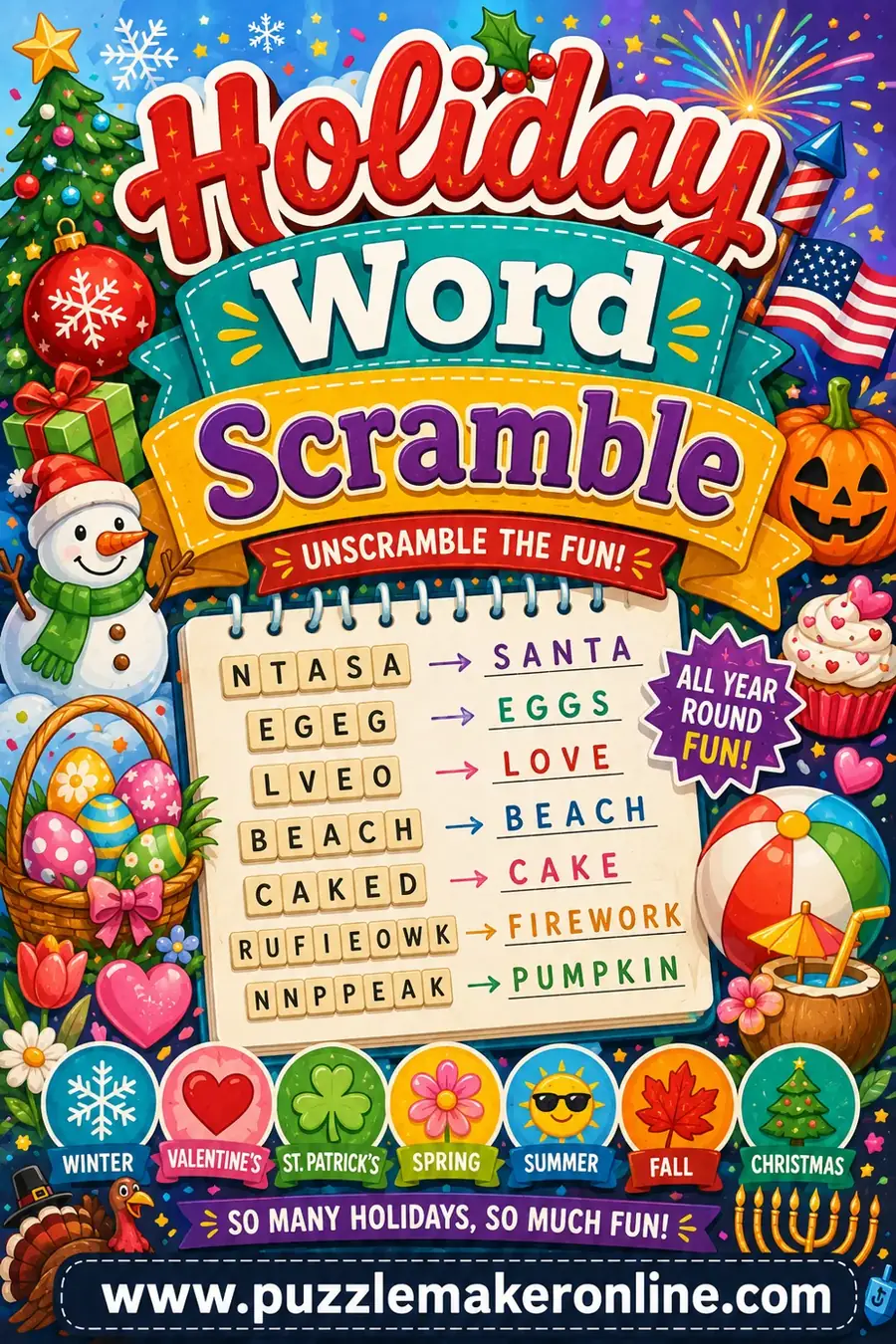
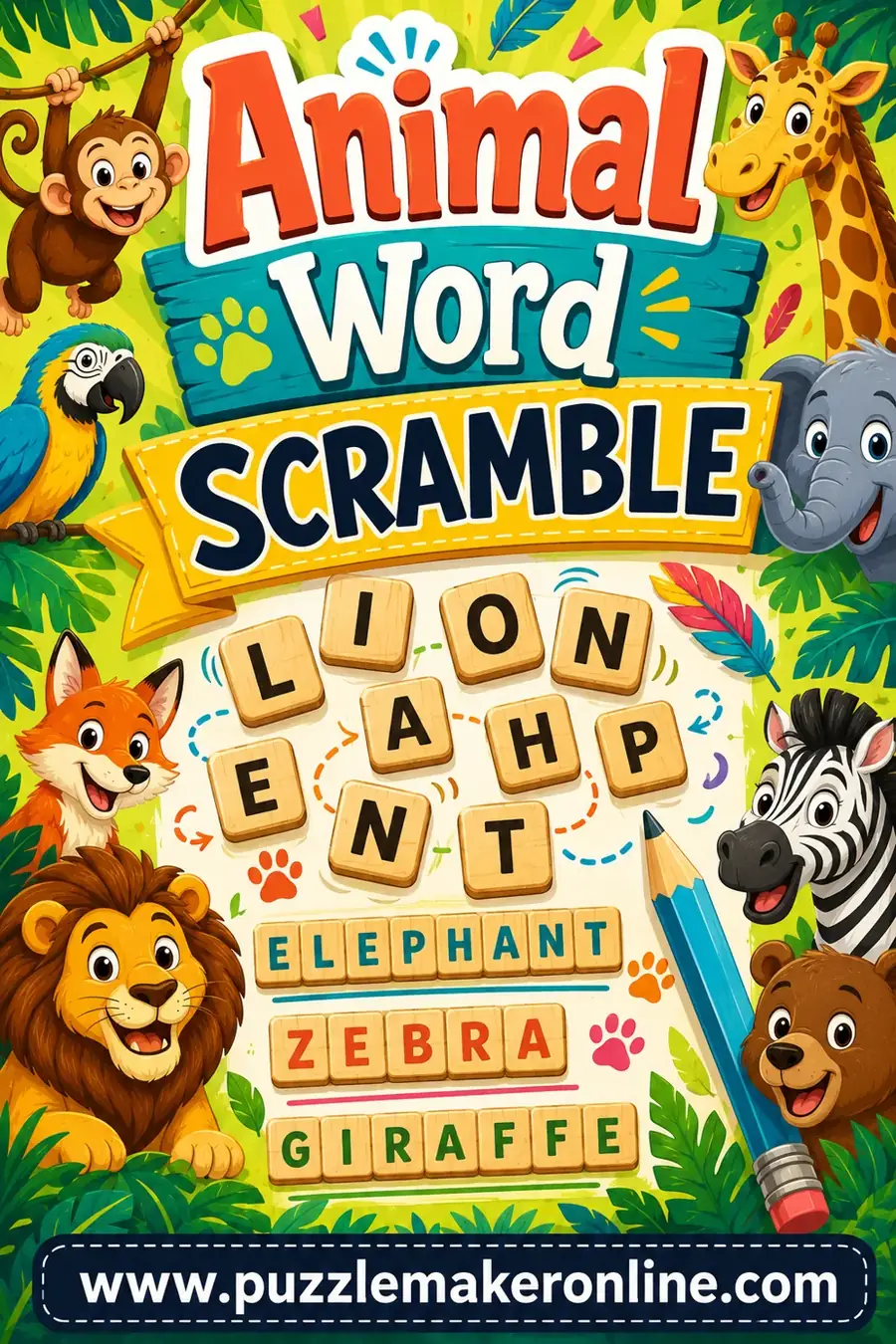
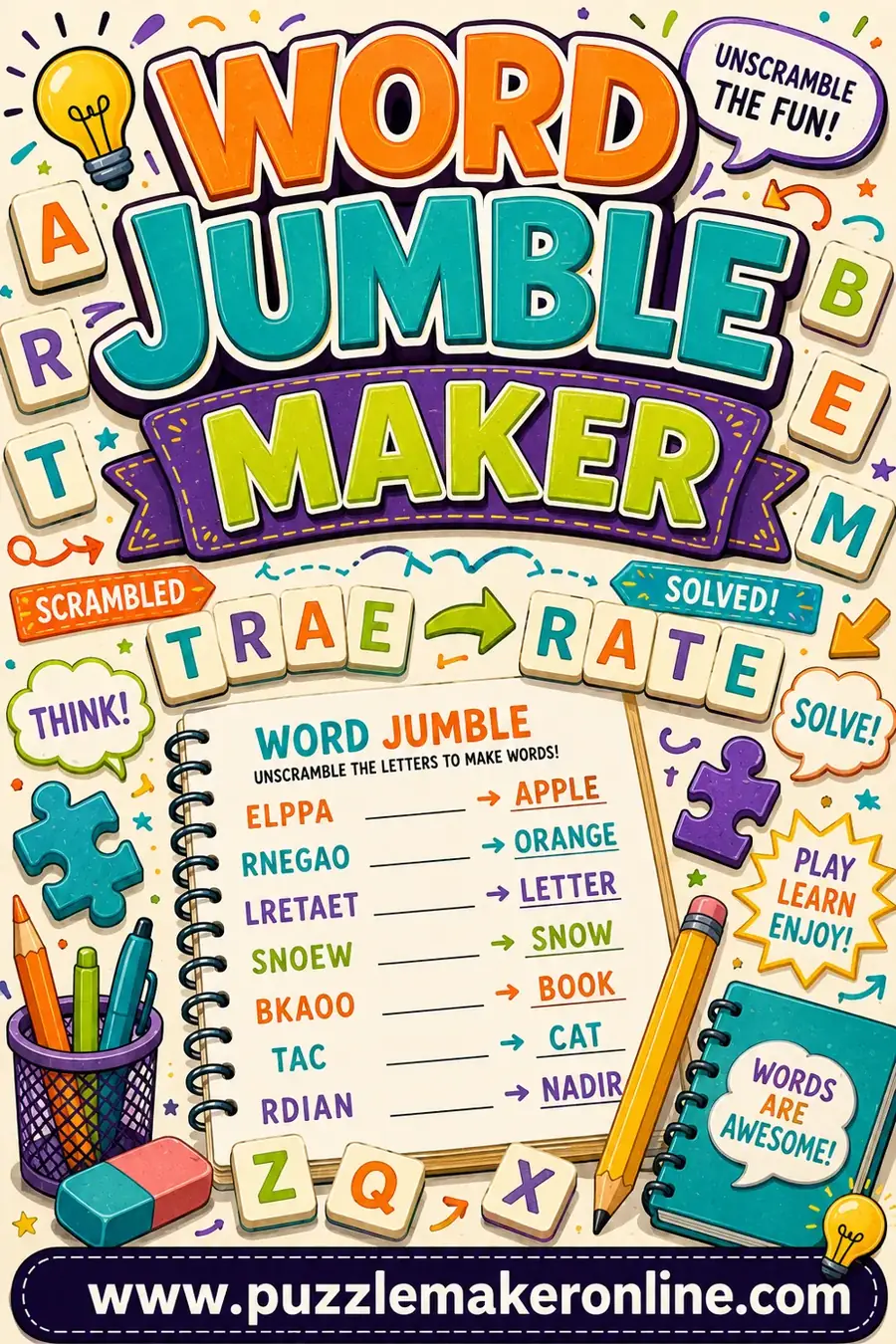
Loving the scramble format? Try the same setup with holiday word scramble, animal word scramble, and the all-purpose word jumble maker.
Frequently Asked Questions
How many words should a subject word scramble have?
For a single sheet, 12 to 20 terms is the sweet spot. Fewer feels too short, and more can overwhelm younger students. The puzzle maker lets you set any number, so match it to your grade level.
What words go on a subject word scramble?
Use the key vocabulary from your unit: equation, molecule, metaphor, continent, and so on. The lists above cover math, science, English, and history. Mix short and long terms so every student solves a few.
Is this subject word scramble really free to print?
Yes. You make and print the sheets yourself at no cost. There's no sign-up and no watermark, so a full class set runs on one free word list.
Can I add definitions or clues?
You can. Add a short clue next to the hardest terms so the scramble doubles as a study guide. This works especially well for foreign-language vocabulary, where the meaning is the hint.
Does the maker include an answer key?
Yes. The solutions print on a separate page automatically, so you or a substitute can check work fast without solving every puzzle by hand.
Can I reuse the sheets across class periods?
You can. Print on cardstock and laminate them (or use clear sleeves), then students solve with a dry-erase marker. Wipe them clean between periods and reuse all day.
How is a scramble different from a word search for review?
A scramble makes students produce the word from jumbled letters, so it tests spelling and recall. A word search only asks them to spot a word that's already spelled out, so it's gentler and better for recognition. For pre-test review, the scramble does more work; for a calm activity, the search is kinder.
Can I use a subject scramble for a non-English class?
Yes, and it shines for foreign-language vocabulary. Scramble the target-language word and put the English meaning beside it as the clue, so students decode the spelling while reviewing the translation. It works the same way for any subject with its own vocabulary, from music to coding.
Ready to Print Your Subject Word Scramble?
Grab a word list above, open the free puzzle maker, and you'll have a printable subject word scramble, answer key and all, in minutes. It's free, there's no sign-up, and you control every term on the page. Match it to your unit and watch your students review without even realizing it.