
12x12 Sudoku: Free Printable Oversized Grids
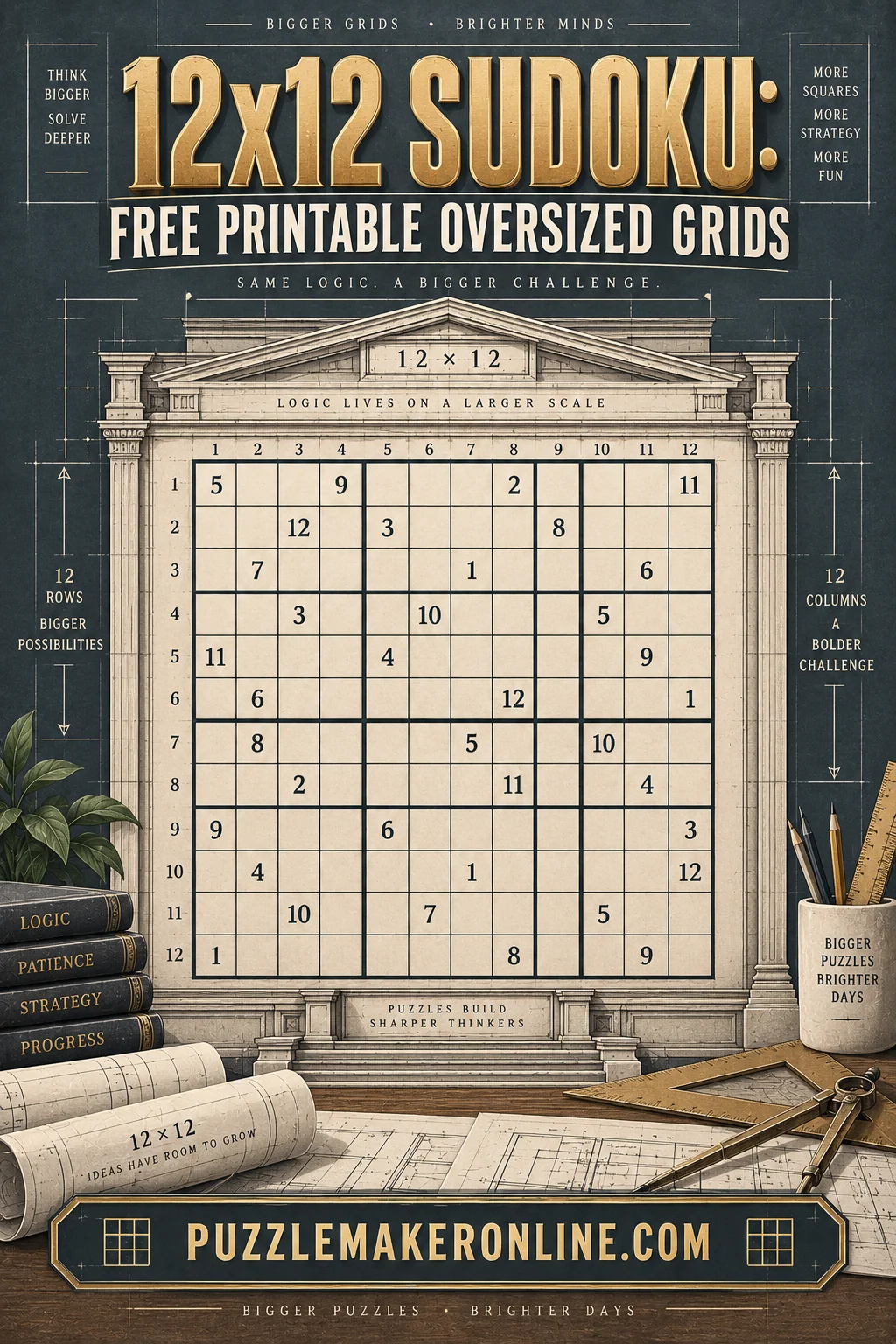
A 12x12 sudoku is played on a 144-cell grid divided into twelve rectangular regions that are four cells wide and three cells tall, and every row, column, and region must contain the twelve symbols exactly once. That is the whole rule change. Everything that makes it harder than a standard 9x9 comes from the geometry: rectangular regions behave differently from square ones, and twelve candidates per cell is a lot more to hold in your head than nine.
If you have solved a 9x9 comfortably, a 12x12 is a real step up rather than just a longer sitting. It is also one of the few oversized formats that stays practical on a single sheet of letter paper, which is why it shows up in puzzle books far more often than the 16x16 or 25x25 giants.
The Grid Structure
The 12x12 board is 12 cells wide and 12 cells tall. Twelve is not a square number, so the regions cannot be squares. Instead the board is cut into twelve rectangles of 12 cells each. The standard arrangement is regions that are 4 wide and 3 tall, which produces three regions across and four regions down.
That layout has a consequence worth understanding before you start solving. In a 9x9, every band of three boxes spans three rows and every stack of three boxes spans three columns, so cross-hatching works identically in both directions. In a 12x12 with 4x3 regions, a horizontal band of three regions covers three rows, while a vertical stack of four regions covers four columns. The board is asymmetric, and so is the scanning.
Some publishers use the transposed layout instead: regions 3 wide and 4 tall, giving four regions across and three down. The puzzles are equivalent in difficulty, just rotated. It is worth glancing at the printed region borders before you commit to a solving direction, because assuming the wrong orientation for the first few minutes is a common and irritating way to stall.
| 9x9 sudoku | 12x12 sudoku | 16x16 sudoku | |
|---|---|---|---|
| Cells | 81 | 144 | 256 |
| Symbols | 1-9 | 1-12 (or 1-9 plus A, B, C) | 0-9 plus A-F |
| Region shape | 3x3 square | 4x3 rectangle | 4x4 square |
| Regions | 9 | 12 | 16 |
| Regions per band | 3 across, 3 down | 3 across, 4 down | 4 across, 4 down |
| Typical clue count | 24-32 | 45-60 | 90-110 |
| Typical solve time | 10-30 minutes | 30-70 minutes | 60 minutes and up |
Which Symbols the Grid Uses
There are three common conventions, and printable puzzles use all of them, so check the legend before assuming.
Numbers 1 through 12. The most readable option and the most common on generated printables. The catch is that 10, 11, and 12 are two characters wide, so cells need to be physically larger and pencil marks get cramped. Solvers who write small candidate lists in the corners of cells feel this immediately.
Digits 1 through 9 plus the letters A, B, and C. This borrows the idea from hexadecimal sudoku, where letters extend the symbol set past 9. Every symbol stays one character wide, which keeps the grid compact and pencil marks legible. The trade-off is that letters and digits do not sort naturally in your head, so scanning "which symbol is missing from this region" takes slightly longer at first.
Digits 0 through 9 plus A and B. Less common, and mildly confusing because 0 rarely appears in sudoku. Worth mentioning only so you recognize it if you meet it.
Whichever set is used, the logic is identical. Symbols in sudoku are just twelve distinguishable labels, and you could equally solve the puzzle with twelve colors or twelve small pictures. Themed and children's variants do exactly that, though a 12-symbol picture set is usually too visually noisy to be pleasant on a board this size.
Why 12x12 Is Genuinely Harder
The extra difficulty is not simply "more cells to fill." Four specific things change.
Candidate lists get long. A blank cell on a 9x9 starts with nine possibilities. On a 12x12 it starts with twelve. Because eliminations happen along rows, columns, and regions of length twelve rather than nine, it takes more established placements before any given cell narrows to a single candidate. The middle stretch of a 12x12, after the easy placements are done but before the grid starts cascading, is noticeably longer and flatter than the equivalent stage on a 9x9.
Rectangular regions weaken cross-hatching. On a 9x9, if you know a symbol's row within a box, you have constrained a 3-cell line inside a 3-cell-wide box, which is a strong deduction. On a 12x12 with 4x3 regions, knowing the row constrains a 4-cell line inside the region, which eliminates proportionally less. The classic pointing-pair and box-line reduction moves still work, but each one buys you less ground.
The eye has to travel further. Sudoku scanning is a visual task before it is a logical one. Twelve columns is past the width most people can take in without moving their gaze, so errors of omission (missing that a symbol already appears at the far end of the row) become the dominant mistake type. This is why the printed grid's line weight matters so much on large boards, and why region borders need to be clearly heavier than cell borders.
Errors are expensive. A wrong placement on a 9x9 usually surfaces within a few minutes. On a 12x12, a wrong placement can sit undetected for twenty minutes of work before it produces a contradiction, and unwinding it means re-checking a large amount of the board. Solvers who normally write in pen switch to pencil at this size for a reason.
Against all of that, one thing gets easier: the clue count is proportionally generous. A typical 12x12 puzzle gives 45 to 60 clues on 144 cells, which is roughly a third of the board, close to the proportion on a standard 9x9. The opening phase where you place obvious symbols therefore feels familiar and rewarding, and it lasts longer.
Solving Strategy That Suits the Format
The techniques are the same ones you already know. What changes is the order you should apply them in and how much bookkeeping is worth doing.
Start with symbol frequency, not with the first empty cell. Count how many times each of the twelve symbols already appears on the board. The two or three most common symbols are where scanning pays off fastest, because they are already constrained across many regions. Working the rarest symbol first is a common beginner instinct and it wastes time on a board this large.
Work band by band rather than region by region. Take a horizontal band of three regions (or a vertical stack of four, depending on layout) and exhaust it before moving on. On a 12x12 the temptation to jump around the board is strong, and jumping is where lost progress happens, because you forget which deductions you have already tried.
Commit to pencil marks earlier than you would on a 9x9. On a small board it is often faster to hold candidates in your head. At twelve symbols it is not. Write candidates into a cell as soon as it is down to four or fewer possibilities. Filling every cell with a full twelve-symbol list at the start is the opposite error and will bury the grid in graphite.
Hunt naked and hidden pairs aggressively. These are the workhorse techniques at this size. A naked pair inside a 12-cell region removes two candidates from ten other cells, which is a much bigger payoff than the same move on a 9x9. If you want a refresher on how to spot them cleanly, this walkthrough of hidden singles, pairs and triples covers the pattern recognition that carries over directly.
Use box-line reduction on the long side of the region. With 4x3 regions, the four-cell direction is where a symbol confined to a single line inside a region gives you the most useful elimination along the intersecting row.
Do not bother with X-wings early. They exist on 12x12 boards and they do appear, but the basic techniques have far more work left to do than on a 9x9. Reach for pattern techniques only when scanning and pairs have genuinely stopped producing.
Printing 12x12 Grids So They Are Actually Usable
This is where oversized sudoku most often goes wrong. The puzzle is fine; the printout is unsolvable because the cells are too small to write in.
Print one puzzle per page. Always. Two 12x12 grids on a letter sheet produces cells around a quarter inch across, which leaves no room for a two-character symbol, let alone pencil marks.
Aim for cells of at least half an inch. On letter paper with half-inch margins you have about 7.5 inches of usable width, which gives roughly 0.62 inches per cell across twelve columns. That is comfortable. Anything below half an inch and pencil marks stop fitting.
Consider landscape or legal paper if you use the 1-12 numeric symbol set. Two-character symbols want wider cells, and legal paper gives you extra vertical room to keep the grid square rather than squashed.
Check that region borders print heavier than cell borders. On a 9x9 you can infer the box boundaries from memory. On a 12x12 with rectangular regions you cannot, and a printout where all lines are the same weight is genuinely difficult to solve correctly. If the borders come out faint, printing in grayscale at a higher quality setting usually fixes it before you need to change anything else.
Print the solution separately. With 144 cells, checking your own work by hand is tedious enough that most solvers want the answer key, and a key printed on the reverse of standard copy paper shows through.
Laminate for reuse if the puzzle is for a classroom or care setting. A 12x12 takes long enough that solvers often want to return to it across several sittings, and a dry-erase surface avoids the "someone else already wrote in it" problem.
If you want to control grid size, difficulty, and symbol set rather than taking whatever a book gives you, a sudoku puzzle maker will generate an oversized grid to your settings and print it at a usable scale straight from the browser.
Who 12x12 Sudoku Actually Suits
Solvers who finish hard 9x9 puzzles but want length rather than trickiness. This is the core audience. A 12x12 at medium difficulty is a long, steady, satisfying solve that rarely requires an obscure technique. It gives you more sudoku rather than harder sudoku, which is exactly what many regular solvers want.
People who find 16x16 too much. The jump from 9x9 to 16x16 more than triples the cell count and introduces hexadecimal symbols at the same time. 12x12 is the intermediate step, and it is the more sensible on-ramp.
Puzzle groups and classrooms working collaboratively. A single 12x12 printed large enough for several people to gather around works well as a group activity, because there is enough board for two or three people to work different bands without colliding.
Anyone building a puzzle book or activity packet. One 12x12 fills a page cleanly and gives a packet a centerpiece, where a page of four 9x9 grids reads as filler.
It suits children less well. The board is long enough that most kids lose the thread before the grid starts cascading, and the payoff arrives too late. A 6x6 or a standard 9x9 holds attention far better at that age.
Difficulty Ratings and What They Mean Here
Difficulty labels on oversized grids are even less standardized than on 9x9 puzzles, because there is no widely agreed rating scale for 12x12. Treat the label as relative to the source, not absolute.
As a working guide for generated puzzles: an easy 12x12 gives you around 55 to 60 clues and can be finished with scanning alone. A medium one sits around 48 to 54 clues and needs pairs. A hard one drops toward 45 or below and will require box-line reductions and patient candidate work. Below roughly 42 clues the puzzles tend to become slow rather than clever, which is a distinction worth keeping in mind if you are generating your own and tempted to push the difficulty slider as far as it goes.
Frequently Asked Questions
What are the rules of 12x12 sudoku? Each of the twelve rows, twelve columns, and twelve rectangular regions must contain every symbol exactly once, with no repeats. The regions are 4 cells wide and 3 cells tall (or 3 wide and 4 tall in the transposed layout), and the symbol set is usually 1 through 12 or 1 through 9 plus A, B and C.
Is 12x12 sudoku harder than 16x16? Generally no. A 16x16 has 256 cells against 144, uses sixteen symbols, and takes considerably longer. 12x12 is the middle step between a standard 9x9 and the larger hexadecimal grids, which is a large part of its appeal.
Why are the regions rectangles instead of squares? Because 12 is not a perfect square, so the board cannot be divided into square regions of equal size. Twelve cells per region has to be arranged as a 4x3 or 3x4 rectangle, which is why cross-hatching behaves differently in the horizontal and vertical directions.
Can I print a blank 12x12 grid to make my own puzzle? Yes, and it is a common request from teachers and puzzle constructors. A blank oversized grid is also useful for transcribing a puzzle you want to work at a larger scale than the book printed it, though building a valid puzzle by hand means checking that your clues leave exactly one solution.