
Sudoku Board Game: Physical Versions and How They Compare to Digital
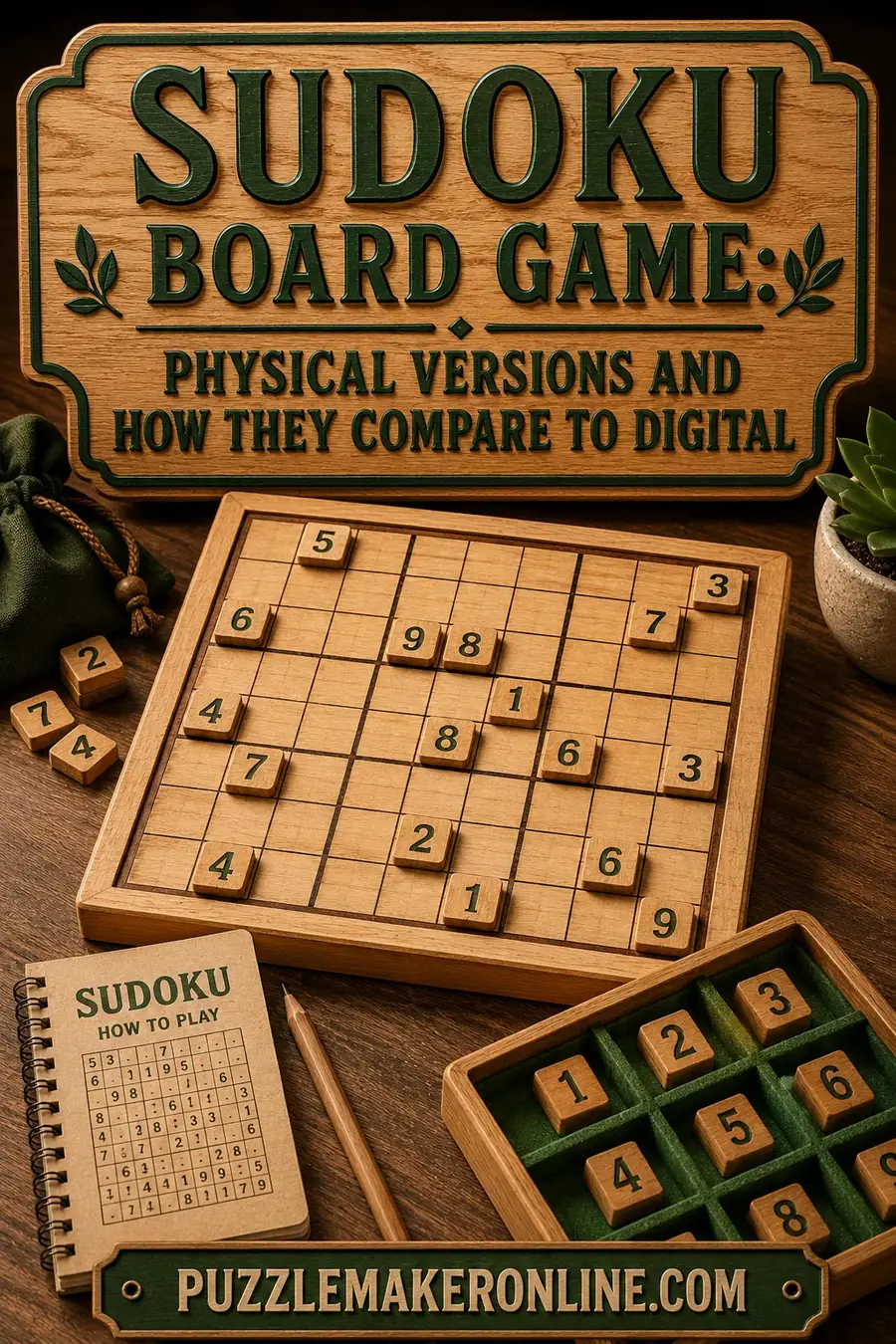
A physical sudoku board game translates the same standard 9x9 puzzle logic onto a reusable board with removable tiles or pegs instead of a pencil-and-paper grid — the rules don't change at all, only the format does. For some solvers, especially kids and tactile learners, that physical format makes a real difference in how enjoyable and accessible the puzzle feels.
How Physical Sudoku Board Games Work
Most physical sudoku board games use one of two formats:
Tile-based boards: a 9x9 grid tray with individual numbered tiles (1-9, usually in multiple sets) that you place into slots. Since tiles are removable, mistakes are easy to fix without erasing or crossing anything out, which is a real advantage over a paper grid for younger players.
Peg or dial-based boards: a grid with small rotating dials or peg slots at each cell, where you turn or insert to select the number 1-9. These tend to be more compact and portable than tile sets, since there's nothing separate to lose.
Both formats preserve the exact same rule set as standard sudoku: every row, column, and 3x3 box must contain 1-9 with no repeats.
Why Some Solvers Genuinely Prefer a Physical Board
Tactile engagement. For younger kids or anyone who finds screens fatiguing, physically placing and moving tiles adds a hands-on element that a printed page or digital app doesn't replicate.
No eraser marks or crossed-out mistakes. A tile-based board lets you swap out a wrong guess instantly and cleanly, which can feel less discouraging than an eraser smudge or a messy crossed-out number on paper, especially for kids still building confidence.
Zero screen time. For families intentionally limiting screen exposure, or for anyone who simply prefers an analog activity, a physical board delivers the full puzzle experience without a device involved at all.
Reusability without printing. Unlike a printed puzzle (which gets used once and then needs recycling or storing with pencil marks all over it), a tile-based board resets instantly for a new puzzle just by clearing and refilling with a new set of starting clues.
Where Digital or Printed Sudoku Still Wins
Puzzle variety and difficulty control. A physical board game typically ships with a fixed booklet of puzzles at set difficulties. A sudoku puzzle maker generates unlimited fresh puzzles at any difficulty level on demand, which a physical board simply can't match without buying additional puzzle books.
Pencil marks for advanced techniques. Serious solvers working through hard or expert puzzles rely heavily on candidate pencil marks (see tips for solving sudoku) — something a basic tile or peg board generally isn't built to support well, since there's no easy way to note multiple small candidate numbers per cell.
Portability without extra pieces. A printed puzzle or a phone app travels far more easily than a board with dozens of small tiles that can get lost, especially for travel or on-the-go solving.
Choosing the Right Format for Who's Playing
For young kids just learning the logic, a physical tile-based board removes the frustration of erasing mistakes and adds genuine hands-on engagement, which often matters more at that age than puzzle variety or difficulty range.
For older kids and adults working on harder difficulties, printed or digital puzzles with room for pencil marks generally serve the actual solving process better, since advanced techniques depend heavily on tracking multiple candidates per cell.
For a family game night or shared activity, a physical board can work well as a collaborative, screen-free activity, especially at easier difficulty levels where the group is working through it together rather than one person deep in pencil-mark strategy.
What to Look for When Buying a Physical Sudoku Board
If you're considering a physical board specifically, a few practical features are worth checking before buying, since quality varies a lot between products:
Tile or peg quality and size, especially for younger kids — small, fiddly pieces are both a choking hazard for very young children and a genuine frustration for anyone with less fine motor control, so larger, chunkier tiles are usually worth the tradeoff in portability.
Included puzzle variety and difficulty range — some boards ship with a fixed booklet of just a few dozen puzzles, which can be exhausted quickly by an enthusiastic solver; others include a larger book or a way to input custom puzzles from an external source.
Storage for tiles when not in use — a board without a dedicated storage tray or bag for its tiles is a near-guarantee that pieces eventually go missing, which is one of the most common complaints with tile-based sudoku sets specifically.
Combining a Physical Board With Digital or Printed Puzzles
Many families find the best setup isn't choosing one format exclusively, but using a physical board for the tactile, screen-free experience while supplementing with fresh printed puzzles once the board's included puzzle set runs low. A sudoku puzzle maker generates puzzles at whatever difficulty you need, which can be transcribed onto a blank grid or simply solved directly on paper alongside occasional physical-board sessions, giving you the tactile benefit when it matters most (with younger kids, or for screen-free time) and unlimited puzzle variety the rest of the time.
Why the Format Debate Matters Less Than Consistency
Ultimately, the format that gets used consistently — whether that's a physical board, a printed page, or a phone app — matters more for actually building sudoku skill than which format is theoretically "best." A physical board that sits unused on a shelf provides no benefit over a printed puzzle that gets solved every day. If you're choosing between formats, it's worth being honest about which one you or your child will actually reach for regularly, since consistent practice is what drives real improvement regardless of the medium.
Physical Boards as a Gift or Family Tradition
A quality physical sudoku board game makes a genuinely popular gift, particularly for grandparents or family members who enjoy puzzles but prefer not to navigate a phone or tablet interface. Unlike a phone app, which requires at least basic comfort with touchscreens and menus, a tile-based board offers an immediately intuitive, no-learning-curve physical experience that works well across a very wide age range without any technology barrier at all. Some families specifically maintain a shared physical board as an ongoing tradition — kept on a coffee table or in a family room, available for anyone to sit down and work through during a visit, functioning as a low-key shared activity rather than something any one person owns individually.
What Serious Solvers Say About the Physical Experience
Solvers who've tried both physical boards and digital or printed formats extensively often report a genuine, if hard-to-quantify, difference in how the two feel during actual use. Physically placing a tile carries a small but real sense of commitment and finality that tapping a touchscreen number doesn't quite replicate, which some solvers find meaningfully changes the pacing and deliberateness of their solving process. This isn't a universal preference — plenty of experienced solvers find no meaningful difference and prioritize the practical advantages of digital or printed formats instead — but it's a genuine consideration worth knowing about if you're deciding between formats for your own regular use rather than for a child or gift recipient.
Physical Boards in Therapeutic and Care Settings
Beyond family and classroom use, physical sudoku boards are sometimes used in occupational therapy and memory-care settings specifically because the tactile, low-frustration format suits patients who may have difficulty with fine motor tasks like handwriting or with screen-based interfaces. Therapists working with seniors or patients recovering from certain conditions sometimes incorporate simplified physical sudoku as part of a broader cognitive engagement program, valuing the combination of logical reasoning and hands-on physical interaction the format provides.
Puzzles Similar to Sudoku Worth Keeping Beside the Board
Households that own a physical sudoku set usually end up with a small shelf of sudoku like games beside it, and several of them play well with the same tiles, pencils, or laminated grids.
Kakuro. A crossword-shaped grid where each run of cells must sum to a printed total using digits 1 through 9 with no repeats. The closest relative to killer sudoku and the natural next step for anyone who enjoys arithmetic in a grid.
KenKen. A Latin square with arithmetic cages that use all four operations. Grid sizes run from 3x3 up, which makes it unusually good for mixed-age play — a six-year-old and an adult can genuinely share a session at different sizes.
Futoshiki. A small Latin square with inequality signs between cells. Very quick to learn, and the deduction style is much closer to sudoku than the arithmetic puzzles above.
Str8ts. A sudoku-like grid where each run of white cells must contain consecutive numbers in any order. It uses the same no-repeat logic in rows and columns but replaces the box constraint entirely.
Nonograms, also called Picross or griddlers. Number clues along the edges reveal a picture. A different kind of deduction, but the same satisfying property of being solvable by pure logic with no guessing.
Hidato and numbrix. Consecutive-number path puzzles, which tend to suit younger solvers who find symbol-placement puzzles abstract.
All of these are commonly shelved alongside sudoku brain teasers in mixed puzzle collections, and most work perfectly well as a printed sheet rather than a boxed set — which makes them a cheap way to test what a household actually enjoys before buying another physical game.
Frequently Asked Questions
Do physical sudoku board games follow the exact same rules as paper or digital sudoku? Yes — the core rule (every row, column, and 3x3 box contains 1-9 with no repeats) is identical across every format. Only the physical presentation changes; the underlying logic puzzle stays exactly the same.
Are physical sudoku board games good for teaching kids the basics? Many parents and teachers find them genuinely helpful for younger children specifically because mistakes are easy to correct without frustration, and the tactile element of placing physical tiles or pegs can help hold attention better than a printed page for some kids.
Can you write pencil marks on a physical sudoku board game? Generally not well — most tile and peg-based boards aren't designed to hold multiple small candidate notes per cell, which is a real limitation for anyone working through harder puzzles that require pencil-mark-based techniques.
Is a physical sudoku board more expensive than printing puzzles at home? Typically yes as an upfront cost, though it's a one-time purchase versus ongoing paper and ink use — the better comparison point is really puzzle variety and difficulty range, where a free puzzle generator offers far more flexibility than a fixed physical puzzle set.
Are physical sudoku board games suitable for solo play, or do they need multiple players? Physical sudoku boards are designed for solo play, just like paper or digital sudoku — there's no multiplayer competitive element built into the standard format, though some families do turn it into a friendly race or collaborative activity informally.
How much do quality physical sudoku board games typically cost? Prices vary widely by brand and complexity, from simple tile sets in the $15-25 range to more elaborate wooden or premium versions costing considerably more, depending on materials and included puzzle variety.
Can a physical sudoku board be used to teach variants like diagonal or killer sudoku? Most basic boards are built for standard sudoku only, since variants like killer sudoku's cage-sum rules require printed cage outlines that a simple tile board typically can't represent — variants are generally better suited to printed or digital formats.
Are there travel-sized versions of physical sudoku board games? Yes — many manufacturers offer compact, travel-friendly versions with smaller tiles or magnetic pieces designed specifically to stay put during car or plane travel, trading some comfort of use for portability.
Do physical sudoku boards ever include harder difficulty puzzle booklets? Some do, particularly boards marketed toward adult hobbyists rather than children, though the puzzle variety and difficulty range is still typically more limited than what a digital generator can provide on demand.
Do any physical sudoku boards include a built-in solution checker? Some higher-end electronic or app-connected physical boards do include automatic solution verification, though basic tile and peg boards generally rely on the solver checking their own work or comparing against a printed answer key.
Are wooden physical sudoku boards better quality than plastic ones? Wooden boards tend to feel more premium and durable, and are often preferred as gifts, while plastic boards are typically lighter, cheaper, and more travel-friendly — the choice comes down to priorities like budget, durability, and portability.
What comes in a physical sudoku board game set? Typically a gridded board with recessed or magnetized cells, a set of numbered tiles or pegs covering the digits 1 through 9 in sufficient quantity, a means of marking the starting clues so they cannot be moved by accident, and a booklet of puzzles with solutions. Better sets include a second tile color for givens and a storage tray that keeps tiles sorted.
What puzzles are most similar to sudoku? Futoshiki and Str8ts are the closest in deduction style, since both are no-repeat grid puzzles solved by elimination. Kakuro and KenKen are the closest if you want arithmetic added, and killer sudoku sits between the two families.
Are sudoku board games good as brain teaser gifts? They work well for someone who already solves on paper and would enjoy the tactile version, particularly older solvers who find moving tiles easier than writing small digits. For someone new to logic puzzles, a mixed brain teaser collection usually lands better than a sudoku-only set.