
Sudoku Diagonal Rule: What It Adds and How to Solve It
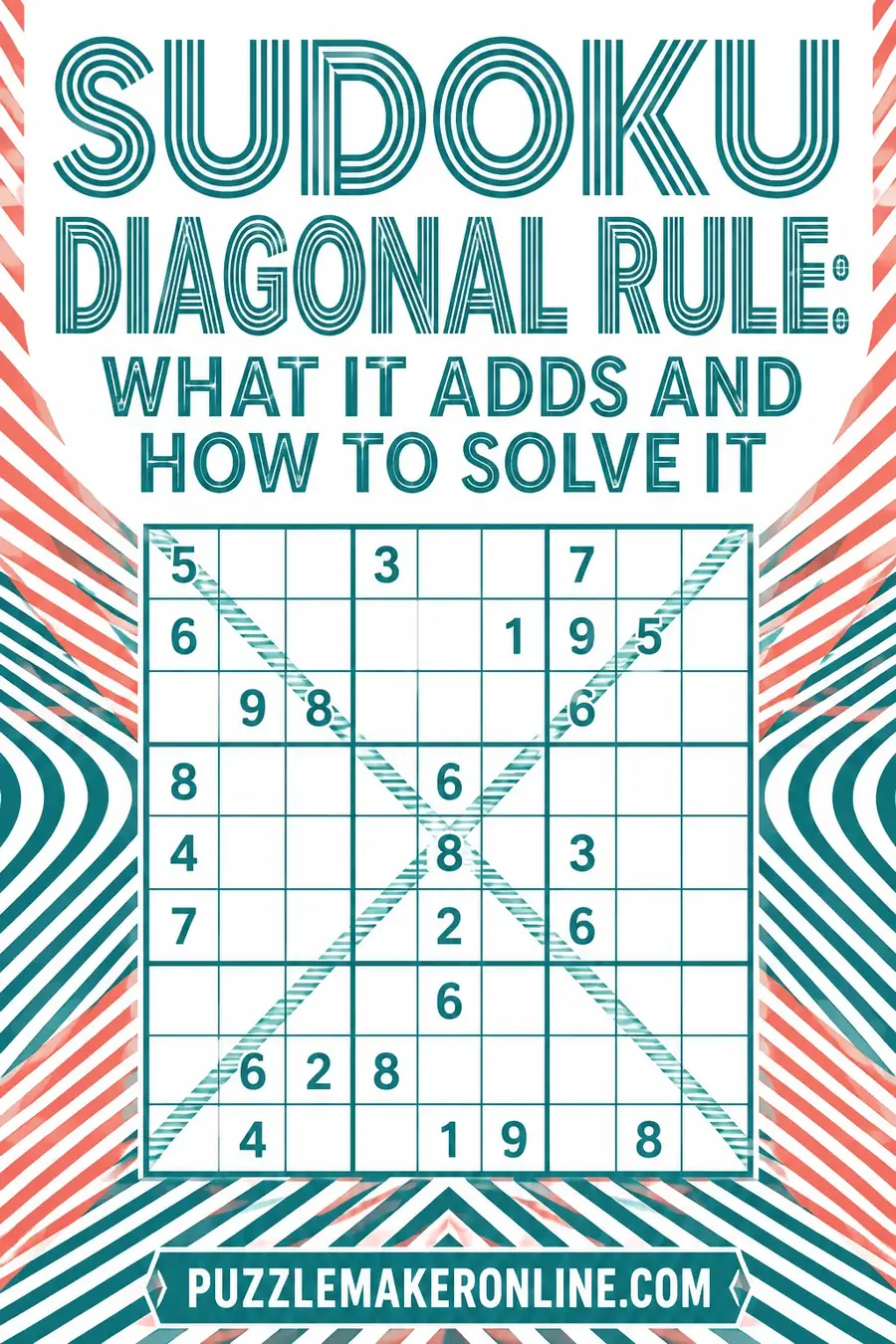
Diagonal sudoku (sometimes called "X sudoku") adds one extra rule on top of standard sudoku: both of the grid's two main diagonals — corner to corner — must also contain every digit 1 through 9 exactly once, just like every row, column, and 3x3 box. It's the same base puzzle with one meaningful extra constraint, which actually makes it a genuinely useful tool for solvers, not just a harder version of the same thing.
The Rule, Precisely
In a standard 9x9 sudoku, every row, every column, and every 3x3 box must contain the digits 1-9 exactly once. Diagonal sudoku adds two more regions with that same requirement: the diagonal running from the top-left corner to the bottom-right corner, and the diagonal running from the top-right corner to the bottom-left corner. Each of those nine-cell diagonal lines must also contain every digit 1-9 with no repeats.
Visually, most diagonal sudoku puzzles mark these two lines with a shaded background or a subtle line through the grid, so you always know which cells belong to a diagonal constraint as you're solving.
Why the Diagonal Rule Actually Helps You Solve Faster
It might seem like an extra rule should only make a puzzle harder, but diagonal sudoku often solves faster than a standard puzzle of similar starting-clue difficulty, because the diagonal constraint gives you two additional lines of elimination to work with. Any cell that sits on a diagonal is now subject to three overlapping rules (its row, column, and box) plus a fourth (the diagonal), which frequently narrows down candidates much faster than a standard puzzle would at the same stage.
The cell at the very center of the grid is a great example — it belongs to its row, its column, its box, and both diagonals simultaneously, giving it five overlapping constraints instead of the usual three. This makes the center cell (and the other diagonal cells) unusually powerful starting points for elimination.
How to Solve Diagonal Sudoku: What Changes From Standard Solving
Everything from standard solving still applies — scanning, pencil marks, naked and hidden singles, naked pairs, pointing pairs — none of that goes away. The diagonal rule is additive, not a replacement technique.
What's new: when pencil-marking or scanning, treat each diagonal exactly like you'd treat a row, column, or box. If a number already appears once on a diagonal, it can't appear again anywhere else on that same diagonal — cross it off as a candidate for every other diagonal cell, the same way you would for a completed row or column.
Prioritize diagonal cells when you're stuck. Since diagonal cells carry more overlapping constraints than regular cells, they're often the most productive place to focus when you're stuck — the extra rule frequently reveals a naked or hidden single there before it would show up elsewhere on the board.
Diagonal Sudoku Variants Worth Knowing
Standard 9x9 diagonal sudoku — the classic version described above, with both main diagonals constrained.
Single-diagonal variants — some puzzles only constrain one of the two diagonals rather than both, which is a slightly gentler version of the same idea.
Combined with other variant rules — diagonal constraints are sometimes layered with other sudoku variants (like killer sudoku's cage-sum rules) for an even more complex hybrid puzzle, though this is less common and mostly seen in advanced puzzle collections.
Getting Started With Diagonal Sudoku
If you're new to the variant, start with an easier difficulty than you'd normally choose for standard sudoku, since getting comfortable with tracking the diagonal constraint takes a little adjustment even for experienced standard-sudoku solvers. A sudoku puzzle maker that supports diagonal-style puzzles lets you generate and print them at whatever difficulty fits where you're starting from.
A Worked Example of Diagonal Elimination
To make the extra rule concrete: imagine the center cell of the grid (which sits on both diagonals simultaneously) already contains a 5. Because of the diagonal rule, no other cell on either diagonal can contain a 5 — in addition to the usual restriction that no other cell in its row, column, or box can contain a 5. If you're pencil-marking a cell elsewhere on one of the two diagonals, you can immediately cross 5 off its candidate list, even if that cell is nowhere near the center cell in terms of row or column position. This is exactly the kind of elimination that doesn't exist in standard sudoku and is easy to forget to check if you're used to solving without the diagonal rule in play.
Common Mistakes When Solving Diagonal Sudoku
Forgetting to check the diagonal rule at all, especially for solvers used to standard sudoku — old habits are strong, and it's genuinely easy to solve half a diagonal puzzle using only the standard row/column/box rules before remembering the extra constraint exists.
Misidentifying which cells actually belong to a diagonal, particularly on a grid without clear shading. Miscounting even one cell's diagonal membership can lead to an incorrect elimination that cascades into real errors later in the solve.
Applying the diagonal rule inconsistently — checking it for some placements but forgetting it for others. Since the diagonal rule applies to every single placement throughout the whole solve, not just at certain points, building the habit of checking all four regions (row, column, box, and diagonal where relevant) for every cell prevents this from becoming an issue.
Why Trying Diagonal Sudoku Is Worth It
Beyond just being a fun variation, diagonal sudoku is genuinely useful for sharpening general sudoku skills, since it forces more rigorous, complete pencil-marking habits than standard puzzles often require — skipping a region check in standard sudoku sometimes goes unpunished because there's enough redundant information elsewhere on the board, but the same sloppiness in diagonal sudoku tends to surface mistakes faster. Many experienced solvers who add diagonal puzzles into their regular rotation report it noticeably improves the thoroughness of their standard sudoku solving too, simply from the habit of checking one more region on every single placement.
How Diagonal Sudoku Compares to Other Popular Variants
Diagonal sudoku sits at a relatively gentle end of the variant spectrum compared to something like killer sudoku, which introduces genuinely new arithmetic reasoning, or hexadecimal sudoku, which scales the entire grid up dramatically. Diagonal sudoku adds exactly one clean, easy-to-understand extra rule without changing the scale or introducing new mechanics, which makes it a good first variant to try for solvers who are comfortable with standard sudoku but haven't yet branched into other variations. Many solvers specifically recommend diagonal sudoku as the natural "next step" after mastering standard puzzles, precisely because it extends familiar skills rather than requiring an entirely new skill set.
Printing and Marking Your Own Diagonal Grid
If you're working from a source that doesn't clearly shade the diagonal cells, it's worth marking them yourself before you start solving, rather than trying to mentally track which cells belong to each diagonal throughout the entire solve. A light pencil dot or a subtle shaded corner in each of the eighteen diagonal cells (nine per diagonal, with the center cell counted once despite belonging to both) takes under a minute and prevents the specific, easy-to-make error of forgetting a diagonal constraint applies to a particular cell partway through a long solving session.
Diagonal Sudoku in Puzzle Competitions
Diagonal sudoku appears regularly in competitive puzzle tournaments and championship events, often as one of several variant rounds alongside standard sudoku and other logic puzzle types. Competitive solvers specifically train on variant rules like the diagonal constraint because tournament formats frequently mix standard and variant puzzles within the same competition, rewarding solvers who can fluidly adapt their technique to whatever extra rule a given round introduces, rather than only being fast at one specific puzzle type.
Why It Is Also Called X-Sudoku
The same puzzle circulates under three names, which is worth knowing when you go looking for more of them. Diagonal sudoku describes the added rule. Sudoku X and X-sudoku describe how it looks: the two shaded diagonals cross in the middle of the grid and form an X. Competition programs and international puzzle collections almost always use the X naming, listing them as X sudoku puzzles, so a search for diagonal puzzles alone will miss a large share of what is available.
A few practical notes that follow from the naming. Puzzle books and apps rarely explain the rule when they use the X label, on the assumption that a solver who sought it out knows it — so if you open a grid with two shaded lines and no stated rule, apply the diagonal constraint. Some sources also shade only the cells rather than drawing lines, and a light gray fill can be easy to miss on a low-quality print, which is one reason it is worth marking the diagonals yourself before starting.
Be careful with one genuine ambiguity: a handful of publishers use "X-sudoku" for puzzles where an X shape marks something else entirely, such as extra irregular regions in the shape of an X, and a few use it for hyper sudoku, which adds four inner boxes rather than diagonals. Reading the stated rule takes five seconds and prevents an hour of wrong deductions.
Frequently Asked Questions
Is diagonal sudoku harder or easier than standard sudoku? It depends on the specific puzzle's clue difficulty, but the extra diagonal rule genuinely adds more elimination power to work with, which can make puzzles of a similar starting-clue count solve somewhat faster than an equivalent standard puzzle, once you're used to tracking the extra constraint.
Do both diagonals need to be exactly nine cells long? Yes — in a standard 9x9 diagonal sudoku, both main diagonals run the full length of the grid, corner to corner, and each must contain all nine digits exactly once, just like a row, column, or box.
Can diagonal sudoku have more than one valid solution if the diagonal rule is ignored? Sometimes, yes — this is actually part of why diagonal sudoku puzzles are specifically designed with the diagonal rule as a hard requirement. A grid that would have multiple valid solutions under standard sudoku rules alone can become uniquely solvable once the diagonal constraint is added, which is one of the reasons puzzle designers use the variant.
What's the fastest way to identify diagonal cells while solving on paper? Most printed diagonal sudoku puzzles shade or outline the diagonal cells directly on the grid so you don't have to count positions manually — if you're building your own grid without that shading, marking the diagonal cells lightly before you start solving saves time and prevents missed eliminations.
Can diagonal sudoku be combined with killer sudoku's cage-sum rules? Yes, though this hybrid combination is much less common and considerably harder, since it layers arithmetic cage-sum logic on top of the extra diagonal constraint — generally only found in advanced puzzle collections aimed at very experienced solvers.
Is diagonal sudoku popular in published puzzle books, or mostly found online? It appears in both — many mainstream puzzle books include diagonal sudoku sections, and it's also widely available through online generators, making it one of the more accessible sudoku variants to find in either format.
Do all diagonal sudoku puzzles shade the diagonal cells the same way? No — shading conventions vary by source; some use a light background tint, others a colored border or subtle pattern, so it's worth checking a new puzzle source's specific convention before assuming it matches one you've used before.
Does diagonal sudoku ever appear with only one diagonal constrained instead of both? Yes, some puzzle sources offer this single-diagonal variant as a gentler introduction to the concept before moving to the full two-diagonal version, though the standard, most common form constrains both diagonals.
Is there a specific term for the technique of using the center cell's five overlapping constraints? It doesn't have a formal separate name — it's simply an application of standard elimination logic, just unusually powerful at that one cell because it belongs to five constrained regions simultaneously instead of the usual three.
Do beginners ever accidentally create their own informal diagonal rule while solving standard sudoku? Occasionally new solvers notice diagonal patterns forming naturally and wonder if there's a rule involved — in standard sudoku there isn't, so it's worth confirming which ruleset you're actually working with before applying diagonal-specific logic that wouldn't apply.
Do most sudoku apps support diagonal sudoku, or is it mostly a print format? Many mainstream sudoku apps do support diagonal mode as a selectable variant, alongside print sources, so it's readily available in both formats depending on your preference.
What is the diagonal rule in sudoku? In addition to the usual requirement that each row, column, and 3x3 box holds 1 through 9 exactly once, both main diagonals — top-left to bottom-right and top-right to bottom-left — must also contain every digit exactly once.
Are X-sudoku and diagonal sudoku the same puzzle? In almost all cases, yes. The X name comes from the shape the two shaded diagonals make across the grid. Check the stated rule anyway, since a small number of publishers use the X label for other variants such as hyper sudoku.