
Sudoku Patterns: Symmetry, Shapes and What They Tell You
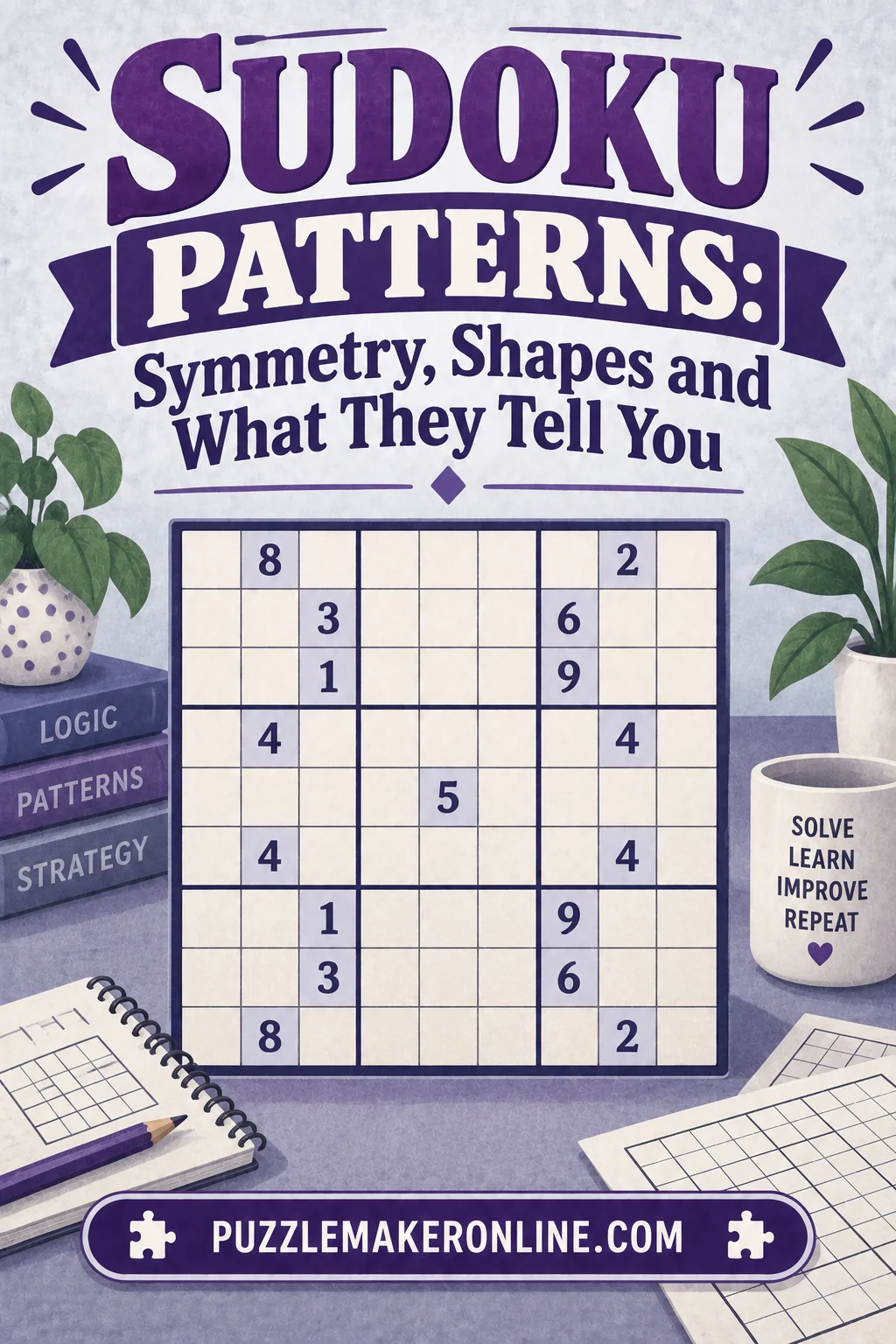
Sudoku patterns are the shapes made by the givens - the pre-filled clues - on an otherwise empty grid, and nearly every published puzzle uses 180-degree rotational symmetry, meaning that if you spin the grid halfway around, the filled cells land exactly where filled cells already were. That symmetry is an aesthetic convention inherited from crossword design, not a rule of the puzzle. It tells you something real about how the grid was built, and almost nothing about how hard it will be to solve.
This article is about the visual layer of sudoku: the arrangement of clues, the symmetry types setters use, what the shape of a grid does and does not predict, and how pattern recognition works as a solving skill in its own right. It is not a technique ladder. If you want the order to learn solving methods in, that is a different page.
The Two Kinds of Pattern in Sudoku
The word gets used for two completely different things, and untangling them first saves confusion.
Clue patterns are the arrangement of the givens - the black-and-white shape you see before you write anything. This is what a setter designs, what a puzzle's "look" refers to, and what symmetry describes.
Solving patterns are the recurring logical configurations you learn to spot inside a partly solved grid: a pair of cells in a row that can only hold two candidates between them, a candidate confined to one line inside a box, a rectangle of four cells sharing two candidates. These are shapes in the candidate space, not on the paper.
Both are legitimately called sudoku patterns. The first is about how a puzzle was made. The second is about how it gets solved. Most of this article is about the first, with a section at the end on why the second is the skill that actually improves your times.
Rotational Symmetry: The Standard
Take a finished sudoku grid, put a pin through the center cell, and rotate the whole thing 180 degrees. If every given lands on a cell that was already a given, the puzzle has 180-degree rotational symmetry.
In practice that means the givens come in mirrored pairs across the center. A clue at row 1 column 3 is matched by a clue at row 9 column 7. A clue at row 4 column 2 is matched by one at row 6 column 8. The center cell is its own partner, so it either holds a clue or does not, with nothing to balance.
This is the near-universal convention in newspapers and puzzle books, and it comes directly from the crossword tradition, where symmetric black-square patterns have been standard for over a century. The first widely published sudoku puzzles used it, and setters have followed ever since.
Three things follow from it that are worth knowing.
The clue count is almost always odd or even in a predictable way. Since clues come in pairs, a symmetric puzzle has an even number of givens unless the center cell is filled, in which case it is odd. If you count 26 clues, the center is empty. If you count 27, it is filled.
Symmetry constrains the setter, not the solver. Building a symmetric puzzle with a unique solution is harder than building an asymmetric one, because the setter cannot remove a clue without removing its partner. Sometimes the pair removal breaks uniqueness and the setter has to back up.
It has no bearing on difficulty. None. A symmetric grid can be trivial or brutal. The two properties are independent, and any sense that symmetric puzzles are easier is an artifact of most easy puzzles also being symmetric, because most published puzzles are.
The Other Symmetry Types
Rotational is the default, but it is not the only option, and specialty books use the others deliberately.
| Symmetry type | What maps to what | Visual effect |
|---|---|---|
| 180-degree rotational | Cell (r,c) pairs with (10-r, 10-c) | The standard; balanced but not mirror-like |
| Horizontal mirror | (r,c) pairs with (r, 10-c) | Left and right halves reflect |
| Vertical mirror | (r,c) pairs with (10-r, c) | Top and bottom halves reflect |
| Diagonal mirror | (r,c) pairs with (c,r) | Reflection across the main diagonal |
| 90-degree rotational | Four cells map in a cycle | Pinwheel look; clues come in fours |
| Full dihedral | All eight reflections and rotations | Strongly ornamental, hardest to construct |
| Asymmetric | No mapping | Scattered, often computer-generated |
Ninety-degree rotational symmetry is the striking one. Because clues cycle through four positions rather than pairing off, the clue count must be a multiple of four, plus one if the center is filled. That constraint is severe, which is why 90-degree puzzles are rarer and why they tend to look like pinwheels or snowflakes.
Full dihedral symmetry - symmetric under every reflection and rotation of the square - is the most restrictive of all. Clues effectively come in groups of eight, and finding an arrangement that still yields a unique solution takes real search effort. Puzzles built this way are usually presented as showpieces.
Asymmetric puzzles are common in apps and in free sudoku generated on demand, because the generator has no reason to impose a constraint that only exists for looks. If you have ever noticed that a phone puzzle looks messier than a newspaper one, this is why.
Picture Patterns and Themed Grids
Some setters go further and arrange the givens to form a recognizable image: a heart, a star, a letter, a number for a date, a snowflake in a winter collection. These are usually called picture sudoku or themed sudoku, and they show up in holiday books and puzzle magazines.
They are genuinely hard to construct. The setter starts with the shape rather than the logic, fills the shaped cells with a valid partial grid, and then tests whether the result has exactly one solution. Very often it does not, and the shape has to be adjusted - a cell added here, one shifted there - until uniqueness appears. The image constrains where clues may go, and uniqueness constrains what they may be, and the two constraints fight.
The practical result: picture puzzles are frequently easier than they look, because the setter has to be generous with clue counts to make the shape work at all. A heart-shaped grid with 34 givens is not a hard puzzle. It is a pretty one.
What the Clue Count Actually Tells You
This is the most persistent misreading of sudoku patterns, so it is worth being blunt about.
The minimum number of givens that can produce a unique solution is 17. That was proven by exhaustive computer search, and no valid 16-clue puzzle exists. It is a genuine mathematical result about the game.
But 17 is a floor, not a difficulty rating. A 17-clue puzzle can be moderate. A 30-clue puzzle can be genuinely difficult. What determines difficulty is not how many clues there are but which techniques the clue arrangement forces you to use, and that depends on the interaction between clues rather than their number.
Two grids with identical clue counts and identical symmetry can sit two full difficulty bands apart. A setter who tells you a puzzle is hard because it has few clues is describing the wrong variable.
| What you can read off the pattern | What you cannot |
|---|---|
| Whether it was human-set or generated | The difficulty rating |
| Roughly how constrained the setter was | Which techniques are required |
| Whether clue count is odd or even | How long it will take you |
| Whether a region is clue-starved | Whether the solution is unique |
That last row deserves a note. You cannot verify uniqueness by eye, ever. A grid can look perfectly reasonable and admit two solutions. This is the single most common defect in homemade puzzles and the reason any generator worth using checks uniqueness before it prints.
Reading the Grid Before You Start
There is one genuinely useful thing to do with the clue pattern before writing a digit, and it takes about fifteen seconds.
Find the densest band or stack. Scan the three horizontal bands of three rows each, and the three vertical stacks of three columns each. Count clues. Whichever band or stack is fullest is almost always where the puzzle opens, because the more constraints crowded into one region, the more likely a cell there has only one possibility.
Find the digit with the most givens. Count how many times each digit from 1 to 9 appears. The most frequent one is your first cross-hatching target, because with six or seven of a digit already placed, the remaining two or three are often forced.
Note the empty box. Some patterns leave one 3x3 box with very few clues, or none. That box will not be where you start, and knowing that stops you from staring at it.
None of that is a solving technique. It is triage - deciding where to point your attention - and it is the one practical payoff of looking at the pattern as a pattern.
Pattern Recognition as a Solving Skill
Here is where the second meaning of sudoku patterns matters, and where the actual improvement lives.
Strong solvers are not calculating faster than weak ones. They are recognizing configurations they have seen before, the way a chess player sees a familiar structure rather than sixteen individual pieces. The shapes they recognize are things like:
- A row where a digit can only go in two cells, and both are in the same box
- Two cells in a unit holding exactly the same two candidates
- Three cells in a unit that between them hold only three candidates
- A candidate appearing in a box only along one line
- Four cells at the corners of a rectangle sharing the same two candidates
Each of those has a name and a formal justification, but the improvement does not come from learning the name. It comes from having seen the shape often enough that your eye stops on it without being told to look.
That is why volume matters more than study for intermediate solvers. Twenty puzzles at a difficulty just above comfortable will build recognition faster than reading about ten techniques. The recognition is visual and it is trained by exposure.
Two habits speed it up considerably.
Keep your pencil marks honest. Stale candidates - ones you should have erased three moves ago - destroy pattern recognition, because the shapes you are looking for are shapes in the candidate marks. If the marks are wrong, you will see patterns that are not there and miss ones that are.
Solve the same puzzle twice. Once cold, then again a day later. The second pass makes the structure visible in a way the first cannot, because you are no longer spending attention on the search.
If you want a supply of grids to practice on, the sudoku generator will produce printable puzzles at a chosen difficulty, which is more useful for pattern training than working through a book in order.
Symmetry in Sudoku Variants
Variant grids change what symmetry even means, which is worth a paragraph.
In jigsaw sudoku, the nine regions are irregular shapes rather than 3x3 boxes, so the region boundaries themselves form a pattern - and setters usually make that boundary pattern symmetric, in addition to or instead of the clue pattern.
In diagonal sudoku, where the two main diagonals must also contain 1 through 9, diagonal mirror symmetry becomes structurally meaningful rather than merely decorative, because the constraint runs along the axis of reflection.
In hyper sudoku, with four extra shaded 3x3 regions, the shaded regions are placed symmetrically by definition, and the clue pattern usually follows them.
The general principle: in variants, symmetry stops being pure ornament and starts interacting with the rules. That is one of the reasons variant puzzles feel different even when the difficulty rating matches.
Where the Sudoku Online Search Terms Fit
A short practical note on finding practice grids, because the search phrasing is a mess. People type sudoku online, online sudoku, free sudoku, sudoku free, free online sudoku, sudoku online free and even online sudoku online, and they all mean roughly the same request: give me a grid to solve or print.
Two things separate the useful results from the rest. First, does the tool check that each puzzle has exactly one solution? If it does not, you will eventually hit a grid with two valid answers and lose an hour to it. Second, can you print? Pattern training is easier on paper, because you can see the whole clue arrangement at once without a cursor sitting in a cell. A phone screen shows you the grid; paper shows you the shape.
Frequently Asked Questions
Why are most sudoku puzzles symmetric? It is a design convention inherited from crossword construction, where symmetric black-square grids have been standard for over a century. The first widely published sudoku puzzles followed the same tradition, and setters have kept it since. It makes puzzles look deliberate rather than random, and it has no effect on solving.
Does a symmetric sudoku mean the puzzle is easier? No. Symmetry and difficulty are independent. A symmetric grid can be trivial or extremely hard, and the impression that symmetric puzzles are gentler comes only from the fact that most published puzzles at every level happen to be symmetric.
What is the smallest number of clues a sudoku can have? Seventeen. It was established by exhaustive computer search that no 16-clue grid has a unique solution, while many 17-clue grids do. Clue count is not a difficulty measure, though - a 17-clue puzzle can be moderate and a 30-clue puzzle can be hard.
Can I tell how hard a puzzle is by looking at the pattern? Not reliably. You can tell whether the setter was working under a symmetry constraint, roughly how the clues are distributed, and which region is densest, which is useful for deciding where to start. Difficulty depends on which logical techniques the arrangement forces, and that is invisible until you begin.