
Sudoku Printouts With Answers: Getting the Solution Key Right
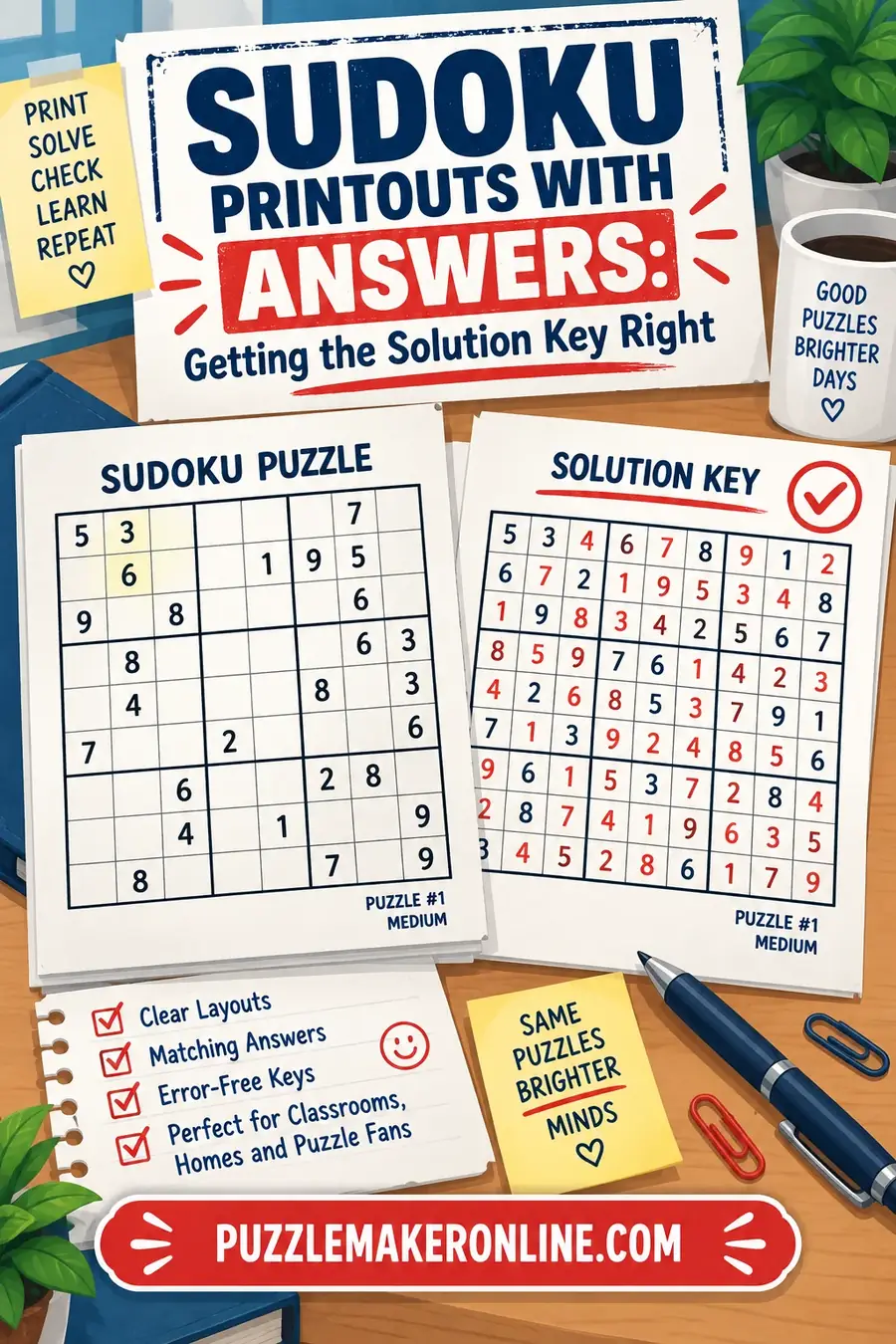
An answer key is only useful if you can find the right solution quickly and can't see it accidentally while solving. Those two requirements pull in opposite directions, and most printed sudoku sets get the balance wrong — either burying answers in an unnumbered block at the back, or printing them where they show through the page.
Where to Put the Answers
Separate section at the end. The standard for booklets and the safest default. Solutions are together, out of sight, and easy to check in one pass at the end of a session.
On the reverse of each sheet. Convenient for a classroom set where each pupil holds one puzzle. Only works on paper heavy enough that the grid doesn't show through — on standard copy paper it usually does, especially with a dark grid.
Bottom of the same page, small. Common in newspapers and generally the worst option for solving, because it's visible in peripheral vision the whole time. If you use it, print the solution rotated 180 degrees or in a very light gray so it takes deliberate effort to read.
A separate sheet entirely. Best for a teacher or organizer who holds the key while others solve. Keeps solvers' pages clean.
The Numbering Problem
The most common failure in a home-printed set: puzzles and answers with no matching numbers. Twenty solved grids and twenty solution grids, and no way to pair them without solving each one again.
Every puzzle needs a visible number, and every solution needs the same number. If you're building a set by hand, do this before printing, not after. It's the difference between a usable booklet and a pile of paper.
For a set spanning difficulties, a compound label works better than a plain count — "Hard 04" tells you both which puzzle and which section, so a page separated from the booklet can still be filed back.
When Answers Hurt
For a learner, an immediately available answer key is counterproductive. Sudoku's core value is persistence through a stuck point, and the moment checking becomes frictionless, most people check instead of thinking. The stuck period is where the learning is.
Two ways to keep the key useful without making it a crutch:
Print answers separately and physically put them elsewhere — another room, a drawer. The friction is the point.
Provide a partial key. For teaching, a key showing only the first few placements gives a nudge past a stuck opening without handing over the grid. Harder to produce, but far better pedagogically.
For a solver who already knows what they're doing, none of this applies — a key at the back is simply a verification tool, used once at the end.
Verification Without a Full Key
Worth knowing, because it removes the need to look at the answer at all:
Every row, column and box must sum to 45 (the total of 1 through 9). Adding a row and getting 44 or 46 tells you an error exists in that row, without revealing where — which is exactly the right amount of information. It confirms a mistake and still makes you find it.
This is also a fast way to check a finished grid: nine row sums, nine column sums. Any that miss 45 flag the problem area.
Practical Print Checklist
| Check | Why |
|---|---|
| Every puzzle numbered | Otherwise answers can't be matched |
| Answers in a separate section | Prevents accidental sight of the solution |
| Scaling at 100%, not fit-to-page | Prevents cropped grids |
| Heavier box borders than cell borders | Makes the 3x3 structure readable |
| Test-print one page first | Catches every problem above at a cost of one sheet |
| Difficulty labeled per puzzle | Lets solvers pick appropriately |
More on the print settings themselves in sudoku games PDF.
Answer Key Layout
Solutions can be printed much smaller than puzzles, since nobody writes in them. Nine or twelve solution grids per page is perfectly readable, which keeps the answers section from doubling the length of a booklet.
Keep the answer grids in the same order as the puzzles, and lay them out in a predictable reading order — left to right, top to bottom — so finding number 14 doesn't require scanning the whole page.
If your set spans several difficulty levels, break the answers into matching sections with headings, rather than one long run.
For Classroom and Group Use
A few things that come up repeatedly:
Print one extra copy of the key for yourself. Losing the only key mid-session is a genuine annoyance.
Laminate the key if it'll be reused. It'll be handled far more than the puzzle sheets.
Consider a checking station rather than distributing keys — one copy at the front of the room that pupils walk to. It slows down casual peeking and keeps the key from being copied.
A sudoku puzzle maker that outputs matched puzzle-and-solution sets handles the numbering automatically, which removes the single most common source of unusable home-printed sets.
Numbering Systems That Survive Contact
The numbering decision looks trivial and determines whether a set stays usable after a month of handling.
Sequential across the whole set. Puzzle 1 through 40, answers 1 through 40. Simplest, and fine for a set that stays bound together.
Compound by section. "Easy 07," "Hard 03." Better for anything that gets split up, because a loose page still tells you where it belongs. This is the format worth defaulting to.
Date-based. For a daily puzzle set — "Mar 14" — which works well for a calendar-style booklet and is self-sorting.
Coded. Some publishers use a short code combining difficulty, set and index. Useful at scale, unnecessary for a home or classroom set.
Whichever you choose, put the number in the same corner on every page, large enough to read without searching. The most common failure is a number printed small and centered at the bottom, where it's covered by a hand while solving and invisible when flicking through.
Verifying a Solution Without the Key
Worth teaching alongside the key itself, because it's a better skill than checking answers.
The 45 rule. Every row, column and box must sum to 45 — the total of 1 through 9. Add a completed row; if it comes to 44 or 46, there's an error in that row. This confirms a mistake exists without revealing where, which is exactly the right amount of help.
Scan for duplicates by digit. Take 1, and check it appears exactly once in every row, column and box. Then 2. Slower than summing but it localises the error rather than just detecting it.
Check the givens are unchanged. A surprisingly common error is overwriting a given number partway through a solve. Comparing your grid's givens against the original catches it.
Using these rather than the answer key preserves the part of the puzzle that builds skill. The key becomes a last resort rather than a reflex.
Storing and Reusing a Set
Keep answers physically separate if the set will be used by learners. Same folder, different envelope, or a stapled answers booklet kept elsewhere entirely.
Laminate reusable grids and use dry-erase markers. One laminated puzzle survives dozens of solves and is the standard approach for classroom and care-home use.
Photocopy rather than write on originals if you have a good master set. Cheaper than reprinting and keeps the master clean.
Keep a completed record. A simple tick-list of which puzzles have been done prevents the frustration of starting one already solved — genuinely common with sets of forty or more.
Answer Key Formats
How you lay out the solutions matters more than people expect, particularly for a set that gets used repeatedly.
Full grids, small. The standard. Nine to twelve solution grids per page stays legible since nobody writes in them, and it keeps the answers section compact.
Coordinate lists. Rather than a grid, a list of cell references and values. Compact and genuinely awful to use — verifying one cell means finding it in a list of fifty. Avoid.
Row strings. Each solution written as nine rows of nine digits. Very compact, and workable for checking a single row without seeing the whole solution, which is a nice property for a learner who only wants a partial hint.
Highlighted-difference keys. For teaching, a key showing only the cells a solver typically finds hardest. Considerable work to produce and excellent for classroom use.
For most sets, small full grids in puzzle order is the right answer. It's what solvers expect and it's fastest to check against.
Giving Hints Without Giving Answers
If the set is for someone learning, a tiered hint structure is far more useful than a binary answer key.
Tier 1: name the unit. "There's something available in the middle-left box." Enough to redirect attention without revealing anything.
Tier 2: name the technique. "Look for a hidden single." Tells them what kind of pattern to search for.
Tier 3: name the cell. "Row 4, column 7 can be resolved." Still requires them to work out the value.
Tier 4: give the value. The last resort.
Printing tiers 1 and 2 alongside each puzzle, with the full key at the back, produces a set that supports a learner without letting them shortcut the thinking. It's more work to build and it's the difference between a puzzle book and a teaching resource.
Checking a Set Before You Distribute It
If you're producing puzzles for other people, a few verification steps are worth the time.
Solve one puzzle from each difficulty tier yourself. Confirms the ratings are roughly right and that the answers match.
Spot-check three answer keys against their puzzles. Verify that the givens in the answer grid match the givens printed on the puzzle. A mismatched key is the single most frustrating error a set can contain.
Confirm every puzzle number appears exactly once in both the puzzle section and the answer section. Duplicates and gaps both happen when a set is assembled by hand.
Check the hardest puzzle is actually solvable by the techniques your audience knows. A set for beginners containing one extreme puzzle produces a person who concludes they're bad at sudoku.
Common Errors in Home-Printed Sets
Six problems account for nearly every unusable set, and all six are avoidable in the setup rather than after printing.
Answers that don't match the puzzles. Usually caused by regenerating puzzles after printing the key, or vice versa. Always produce both from the same generation run.
Solutions visible through the paper. Standard copy paper is thin enough that a dark grid on the reverse shows clearly. Either use heavier stock or keep answers in a separate section.
Unnumbered pages. Covered at length above, and still the single most common failure.
Difficulty labels that mean nothing. If "hard" and "expert" produce the same solving experience, drop one of them. Inconsistent labels are worse than no labels.
Keys printed at the same size as puzzles. Doubles the page count for no benefit. Solutions can be a third the size.
No record of what's been solved. For a set used over weeks, a simple checklist page at the front saves genuine frustration.
Where Daily Puzzle Answers Are Actually Published
For anyone solving a daily puzzle rather than a printed set, the answer usually exists somewhere — the question is where, and how long you have to wait.
In print, the convention is next-day publication. Most newspapers run today's solution alongside tomorrow's puzzle, which is why a daily solver who wants to check immediately is usually out of luck. A minority print the answer on the same page, rotated 180 degrees or set in a small box elsewhere in the section, which is a deliberate compromise: available, but not readable by accident while solving.
Syndicated puzzles often post answers online the same day, usually on the syndicate's own page rather than the newspaper's, and typically indexed by date rather than by puzzle number. That indexing is why the phrasing most people search — today sudoku answer — so often fails: the solution is filed under a date and a puzzle name, never under the word today.
Apps almost always check as you go, which is a genuinely different experience — the question shifts from "was I right" to "may I be told." Solvers who want the discipline of a printed daily should turn off live error checking, since it removes the entire skill of verifying your own work.
If today's answer is not available and you want to know whether you finished correctly, the arithmetic check works on any grid: every row, column, and box must total 45. Three quick sums prove a solve without needing anyone's key, and they take less time than searching for one.
Frequently Asked Questions
Where should answer keys go in a sudoku booklet? A separate section at the end is the standard and safest option. Printing on the reverse of each puzzle only works with paper heavy enough that the solution doesn't show through.
How do I check a sudoku without looking at the answer? Add each row, column and box — every one should total 45. Any that doesn't contains an error, which tells you a mistake exists and roughly where, without giving away the correct values.
Should beginners have access to answer keys? Sparingly. Immediate access tends to short-circuit the stuck-and-then-solving process that builds skill. Keeping the key physically inconvenient, or supplying only a few opening placements, works better for learners.
How small can answer grids be printed? Much smaller than puzzles, since nobody writes in them — nine to twelve solution grids per page stays perfectly legible, which keeps the answer section compact.
Where do I find today's sudoku answer? In print, most papers publish each day's solution in the following day's edition, and a few print it on the same page in a small rotated box. Syndicated puzzles frequently post same-day solutions on the syndicate's website, indexed by date.
How can I check today's puzzle if the answer has not been published yet? Add each row, column, and box. Every one must total 45 in a correct grid, so three or four sums will confirm a solve or locate an error without any key at all.