
Summer Sudoku: Free Printable Puzzles for the Break
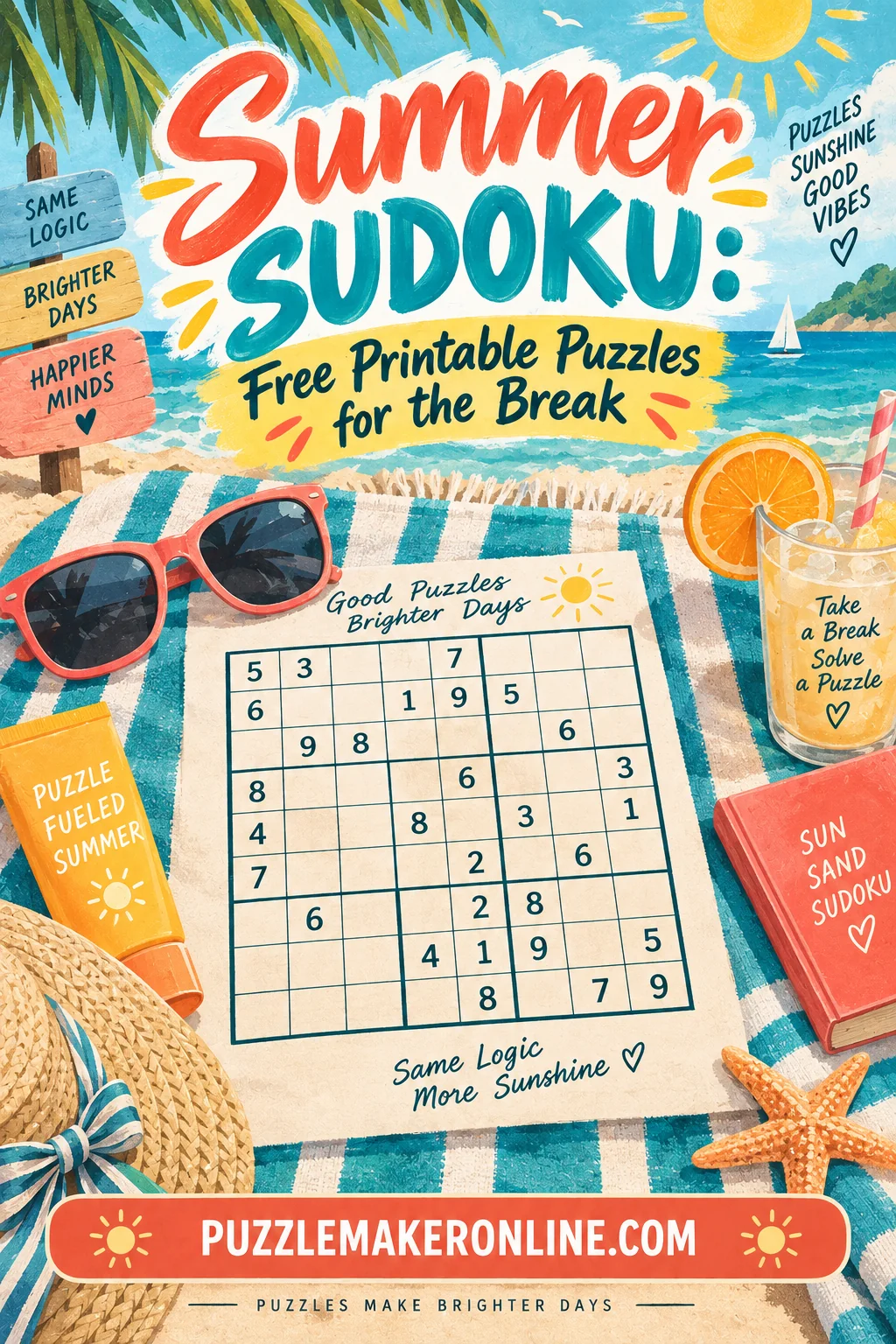
Summer sudoku is a standard sudoku puzzle dressed for the season: the same rules, the same logic, with summer artwork around the grid or beach and sunshine icons used in place of numbers. Nothing about the solving changes. What changes is that the page looks like it belongs in a camp folder, a road-trip binder, or a July activity packet rather than in a newspaper.
That sounds like a small thing, and for an adult solver it is. For a nine-year-old who has been told to sit quietly for twenty minutes, a page with a popsicle and a sailboat on it is a genuinely different proposition from a page of gray boxes. The theme is doing real work.
What Actually Changes, and What Doesn't
What changes: the border art, the background color, the header, and sometimes the symbol set. A summer sudoku might use nine icons (sun, beach ball, watermelon slice, flip-flop, ice cream cone, sailboat, seashell, palm tree, sunglasses) instead of the digits 1 through 9.
What does not change: the rule. Every row, every column, and every 3x3 box contains each symbol exactly once, with no repeats. There is no seasonal twist to the mechanic, no summer-only technique, and no difference in how a puzzle is generated or validated.
This matters practically. It means you are never limited to puzzles someone else labeled "summer." Any standard grid at the difficulty you want becomes a summer sudoku the moment you print it on a themed page or swap the symbols. If you cannot find a pre-made set at the size and difficulty you need, you are not stuck.
Where Summer Sudoku Actually Gets Used
Summer camps and day programs. Rainy-day boxes and quiet-hour folders need activities that need no equipment, no setup, and no supervision. A stack of sudoku pages at three difficulty levels covers a wide age spread with one photocopy run.
Road trips and flights. Sudoku is one of the few paper activities that works on a lap in a moving vehicle. It needs one pencil, no loose pieces, and no flat surface for pieces to slide off. Half-finished, it survives being shoved in a seat pocket.
Summer learning programs and school-year bridging. Teachers who send home summer packets often include logic puzzles alongside reading logs and math practice. Sudoku is the standard choice because it exercises reasoning without requiring a curriculum topic to be reviewed.
Public library summer reading events. Libraries running summer programs typically pair reading challenges with printable activity sheets, and a themed sudoku page slots into that without needing an instruction session.
Senior centers and care residences. Summer-themed activity pages mark the season for residents in the same way a bulletin board does, and sudoku is already a fixture in most activity programs.
Family vacation rentals and downtime. Household activity binders, cabin drawers, and beach-house game shelves all end up with a folder of printables. Puzzles that reset with a fresh photocopy beat board games with missing pieces.
Birthday parties and summer events. A themed sudoku page works as a table activity while guests arrive, particularly for the age range that is past coloring pages but not yet into anything requiring rules to be explained.
Themed Symbol Sets: When to Use Them
Replacing digits with pictures is the most common "summer" modification, and it is not purely decorative. It changes who can solve the puzzle.
Use icon symbols when the solver is young enough that reading numerals is still effortful, or when the puzzle is for a mixed-language group. Sudoku with pictures needs no reading at all, which is why picture sudoku is a staple in early-years classrooms and in ESL settings.
Use numbers when the solver is comfortable with digits, when the puzzle is above easy difficulty, or when the grid will be printed in black and white. Nine distinct icons at the size of a sudoku cell are hard to tell apart at a glance, and telling them apart is the entire scanning task. A hard puzzle with icon symbols is much slower than a hard puzzle with digits, and not in a rewarding way.
A middle option that works well: use icons on a 4x4 or 6x6 grid where you only need four or six distinguishable pictures, and switch to numbers at 9x9. Four icons at cell size stay clearly distinct; nine do not.
If you do use icons, pick shapes with different outlines rather than different details. A sun, a triangle sail, and a rectangular ice pop are distinguishable at a glance. A watermelon slice, an orange slice, and a lemon slice are not, because all three read as the same wedge silhouette.
Difficulty by Age and Setting
| Setting | Grid | Difficulty | Symbols | Time |
|---|---|---|---|---|
| Ages 4-6, first puzzle | 4x4 | easy | summer icons | 2-4 min |
| Ages 6-8, camp quiet hour | 6x6 | easy to medium | icons or numbers | 5-10 min |
| Ages 8-11, activity packet | 9x9 | easy | numbers | 10-20 min |
| Ages 11+, road trip | 9x9 | medium | numbers | 15-30 min |
| Adults, poolside | 9x9 | medium to hard | numbers | 20-45 min |
| Senior activity program | 6x6 or 9x9 large print | easy to medium | numbers | flexible |
The most common mistake in summer packets is difficulty that is too high, not too low. A packet is unsupervised by definition. Nobody is standing by to unstick a child who has made a wrong placement and cannot see why the grid stopped working. Erring easy means the page gets finished, and a finished page is the point.
For a camp or classroom group, the reliable structure is a ladder rather than a single level: one easy page, one medium page, and one harder page in the same packet, so fast finishers have somewhere to go and slower solvers still complete something.
Building a Summer Puzzle Packet That Gets Used
A packet that works has more structure than a stack of pages. Here is a shape that holds up across camps, classrooms, and home use.
Page one: a 4x4 or 6x6 warm-up with a summer icon set. Everyone finishes this, including the youngest solver in the room. It establishes the rule for anyone who has never played.
Pages two and three: two 9x9 grids at easy difficulty. These are the core of the packet. Easy difficulty on a 9x9 means the puzzle is solvable by scanning alone, without pencil marks or techniques.
Page four: one 9x9 at medium. The stretch page. Label it clearly as the hard one, which sounds obvious but prevents the discouragement of hitting a wall without warning.
Page five: a blank grid. Give solvers the option to build their own puzzle for someone else. This is the page that surprises people by getting used most, particularly with kids around ages nine to twelve, and it turns a solitary activity into a social one.
Last page: the answer key. Printed on its own sheet, not on the back of a puzzle. Standard copy paper is thin enough that a solution on the reverse shows through, and once one solver notices that, the packet is finished as a puzzle.
Print the packet single-sided if you can afford the paper. Double-sided packets get folded, and a folded crease down the middle of a 9x9 grid makes the center box hard to write in.
Generating the set yourself means every page comes at the difficulty you chose and every answer key matches. A sudoku puzzle maker will produce grids at the size and difficulty you set and print them straight from the browser, which is faster than assembling a packet from different sources and then discovering two of the pages have no solutions attached.
Printing Tips for Summer Conditions
Summer printables face a few practical problems that a January worksheet does not.
Heavy background art burns ink and hurts legibility. A full-bleed beach scene behind a sudoku grid looks great on screen and prints as a muddy field that pencil marks disappear into. Keep the theming to the border and the header, and keep the grid itself on white.
Check color pages on a black-and-white printer before you commit. Most camp and school printers are monochrome. A page designed around turquoise and coral prints as two nearly identical grays, and if the symbols were color-coded, the puzzle becomes unsolvable.
Laminate anything going near water. Pool decks, beach bags, and lake cabins are hostile to paper. A laminated grid with a dry-erase marker survives the whole summer and can be reused across a group, which also solves the "we only printed twelve and there are twenty kids" problem.
Print larger for outdoor use. Reading a grid in bright sun through sunglasses is harder than reading it at a kitchen table. One 9x9 per page with generous cell size is worth the paper.
Set margins to half an inch minimum. Grids that run close to the paper edge get clipped by most home printers, and a clipped border column makes a valid puzzle look broken.
Keep a folder of pre-printed pages rather than printing on demand. The moment you need a quiet activity is rarely the moment you want to be troubleshooting a printer. Twenty pages printed in June covers most of the season.
Summer Sudoku in the Classroom and Summer School
Sudoku earns its place in a summer learning program for reasons that go beyond keeping a room quiet, and it is worth being able to explain them to a parent or an administrator.
It is pure deductive reasoning with no prerequisites. A student who is behind in arithmetic is not behind in sudoku, because sudoku involves no arithmetic at all. The digits are just nine distinguishable labels. This makes it one of the few logic activities where a struggling math student can outperform a strong one, and that reversal is valuable in a summer setting where confidence is often the actual problem.
It has a self-checking structure. A correct sudoku is verifiably correct without an answer key, because a contradiction announces itself. Students learn to check their own work, which is a habit that transfers.
It scales without separate materials. The same activity covers a wide ability range by changing grid size and difficulty, so one activity plan serves a mixed group.
It builds attention span in measurable increments. A 4x4 takes two minutes; a 9x9 at medium takes twenty. Moving a student along that ladder over a summer is a concrete progression they can see.
For a station rotation, three grid sizes on the table with a simple rule (finish one, take the next size up) runs itself for a full period. For an early-finisher activity, a folder of easy 9x9 grids beside the desk needs no instruction at all after the first week.
Making Your Own Summer-Themed Page
If you want a themed page and cannot find one that matches your grid size and difficulty, the assembly is straightforward and takes about ten minutes.
Generate and print the plain grid you want at the difficulty you want. Print it with room at the top and sides. Then either add a themed border by hand, which younger kids will happily do themselves as part of the activity, or drop the grid image into a document with a summer header and border and print the combined page.
Letting students decorate their own puzzle page before solving it turns one activity into two and takes almost no preparation. It also sidesteps the color-printing problem entirely, since the decoration arrives in crayon rather than in ink.
For a seasonal collection, the same approach works across the calendar. The site's spring sudoku page covers the same idea for the earlier part of the year, and a folder with a themed set for each season keeps a puzzle habit from going stale.
A Note on Screen Time
One of the honest reasons summer sudoku printables get searched for in June is that a parent or teacher wants an absorbing activity that is not on a screen. Sudoku is unusually good at this because it holds attention through the mechanic rather than through stimulation. There is no reward loop, no timer, and nothing flashing. A solver stays with it because the puzzle is unfinished, which is a quieter kind of pull and one that does not leave a child agitated afterward.
It also has a natural stopping point, which most screen activities lack. A finished grid is finished. That makes it far easier to use as a bounded activity than anything with an endless feed, and it is the reason a stack of printed puzzles tends to outlast the tablet app that was supposed to replace it.
Frequently Asked Questions
What makes a sudoku a summer sudoku? Only the presentation. The border art, page colors, or the use of summer icons in place of digits. The solving rule is identical to any standard sudoku, so a summer sudoku is exactly as hard as a plain grid at the same difficulty setting.
What grid size is best for summer camp? 6x6 for younger campers and 9x9 at easy difficulty for ages eight and up. Include a range in the same packet rather than picking one level, because camp groups usually span several ages and abilities at once.
Can I use pictures instead of numbers? Yes, and it works well on 4x4 and 6x6 grids where you only need four or six distinct icons. On a 9x9 it becomes difficult, because nine picture symbols at cell size are hard to tell apart quickly and scanning is the whole task.
How do I stop kids getting stuck and giving up? Choose easier difficulties than you think you need, since packets are usually solved without anyone nearby to help, and include the answer key on a separate sheet. Giving a stuck solver two or three placements from the key is enough to restart most puzzles without spoiling them.