
Tips for Solving Sudoku: A Real Strategy Guide, Not Just "Look Harder"
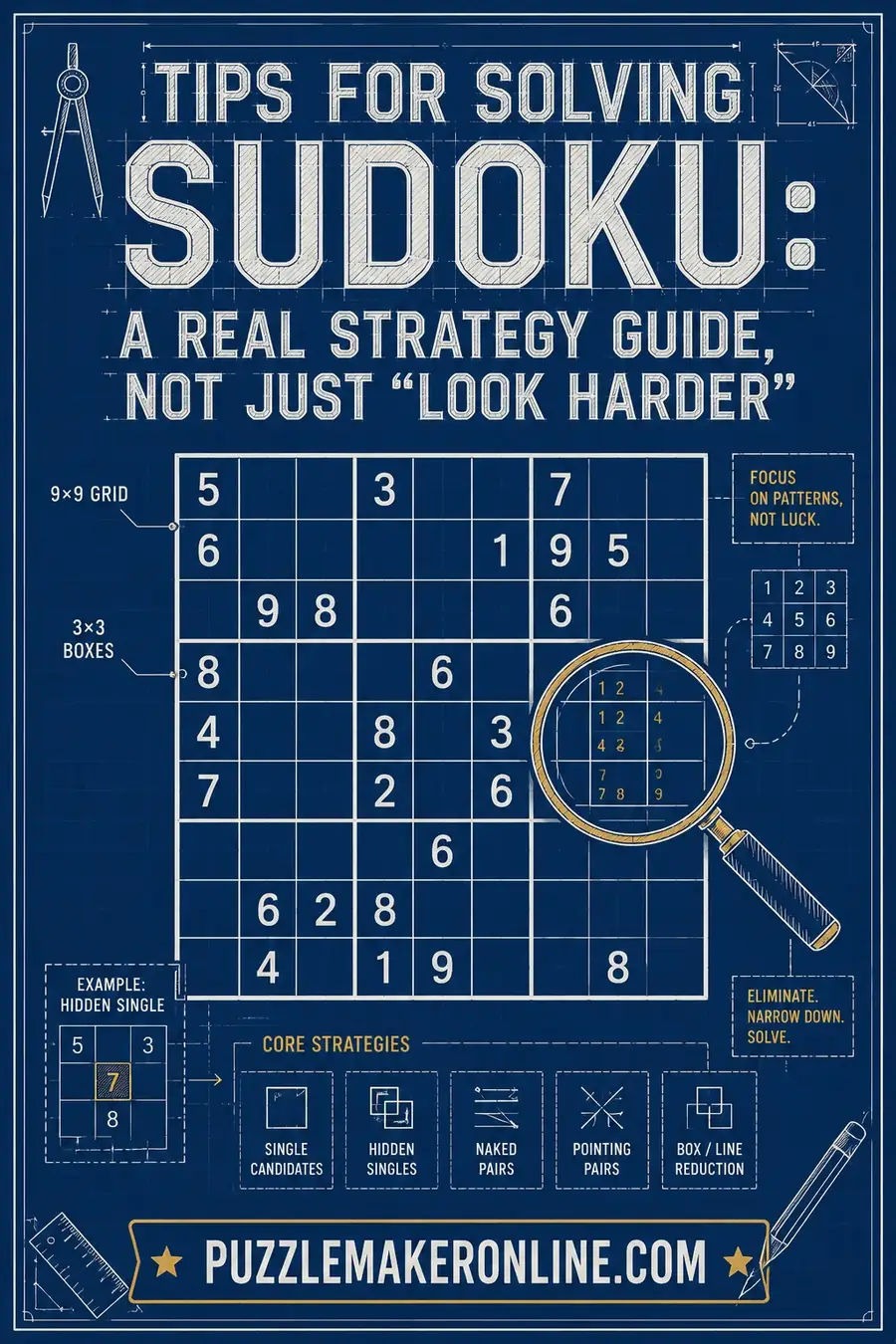
Most sudoku advice boils down to "look for the obvious number" and stops there — but genuinely getting faster and unstuck on harder puzzles requires a small set of real techniques, applied in a consistent order, not just staring harder at the same grid. Here's the actual method experienced solvers use, from basic scanning through the point where pencil marks become essential.
Start With Scanning, Not Guessing
Scanning means systematically checking which numbers are missing from a row, column, or 3x3 box, and where the only possible spot for that number is. This is the foundation of every sudoku solve, and it's where beginners should spend almost all their early effort before reaching for anything more advanced.
Row-column-box scanning: pick a number (start with whichever appears most often already on the board, since it has the fewest remaining spots to place), and check each row, column, and box to see where it's still missing and where it could still go.
Look for boxes that are nearly full first. A 3x3 box with 7 or 8 cells already filled has very few open spots left, making it much easier to deduce the remaining number(s) than scanning a mostly-empty box.
Use Pencil Marks Once Simple Scanning Stalls
Pencil marks (small candidate numbers written in the corner of empty cells) are not "cheating" — they're a memory aid, and virtually every experienced solver uses them on anything beyond an easy puzzle. Once basic scanning stops revealing obvious placements, write in every number that could legally go in each empty cell.
This does two things: it makes cells with only one possible candidate (a "naked single") immediately visible, and it sets up the more advanced techniques below, all of which depend on comparing candidate lists across cells.
The Core Intermediate Techniques
Naked singles: a cell where, after pencil-marking, only one candidate number remains possible. This is the simplest deduction and usually the first thing to look for once pencil marks are in.
Hidden singles: a number that can only go in one cell within a row, column, or box, even though that cell has multiple other candidates listed. These are easy to miss if you're only looking at individual cells rather than scanning where each number could go across a whole row, column, or box.
Naked pairs: two cells in the same row, column, or box that share the exact same two candidate numbers. Since those two numbers must go in those two cells (in some order), you can eliminate both numbers as candidates from every other cell in that same row, column, or box.
Pointing pairs/triples: when a candidate number within a box only appears in cells that all sit in the same row or column, that number can be eliminated as a candidate from the rest of that row or column outside the box.
When to Move to Advanced Techniques
If naked singles, hidden singles, naked pairs, and pointing pairs aren't unlocking any new cells, the puzzle has moved into genuinely advanced territory — this is typically where "expert" or "extreme" rated puzzles live. Techniques like X-Wing, Swordfish, and empty rectangle become necessary here; these work by finding patterns across multiple rows and columns simultaneously rather than within a single row, column, or box.
These techniques take real practice to spot reliably, and it's completely normal for even experienced solvers to need a break or a fresh look at a genuinely hard puzzle rather than forcing through it in one sitting.
Practical Habits That Speed Up Solving
Work in passes, not randomly. Do a full scanning pass for every number 1-9 before moving to pencil marks, then a full pencil-marking pass before hunting for pairs and pointing sets. Jumping between techniques haphazardly wastes time and causes you to miss things.
Update pencil marks immediately after every placement. The single biggest source of solving errors is placing a number and forgetting to remove it as a candidate from every cell that shares its row, column, and box — this single habit prevents a large share of avoidable mistakes.
Take a genuine break on a stuck puzzle rather than guessing. Guessing on a proper (uniquely-solvable) sudoku puzzle is never actually necessary — every legitimate sudoku has a logical path to the solution. If you're stuck, it usually means there's a technique you haven't applied yet, not that guessing is required.
Practice on progressively harder difficulty, rather than jumping straight to expert puzzles. Techniques build on each other — comfort with naked/hidden singles and pairs makes advanced techniques much easier to learn, since you're not trying to absorb everything at once.
If you want to practice without setting up your own grid, a sudoku puzzle maker lets you generate puzzles across a full range of difficulties, which is a much better way to build technique progressively than jumping straight into the hardest puzzles available.
Why Speed Comes From Process, Not Talent
A common misconception is that fast sudoku solvers are simply naturally better at spotting patterns. In reality, speed almost always comes down to a consistent, practiced process applied without hesitation, not raw pattern-recognition talent. Someone who always scans in the same order, always pencil-marks completely before hunting for pairs, and always double-checks eliminations after each placement will consistently outpace someone with sharper instincts but no consistent method — because the method prevents wasted time re-checking work or missing an already-visible deduction. If you're looking to genuinely improve, building a repeatable habit matters more than trying to "see" the board faster.
A Worked Example: Reading a Naked Pair
Since naked pairs trip up a lot of newer solvers, it helps to see one spelled out concretely. Imagine two cells in the same row, both showing only the candidates 4 and 7 after pencil-marking (and no other candidates in either cell). Since exactly one of those cells must be 4 and the other must be 7 — there's no third option for either — you know with certainty that no other cell in that same row can be a 4 or a 7, regardless of what other candidates those other cells currently show. Cross out 4 and 7 from every other cell's candidate list in that row, and you'll often immediately reveal a new naked or hidden single elsewhere in the row that wasn't visible before the elimination.
This is the core mechanic behind almost every intermediate and advanced technique: find a pattern that logically restricts where certain numbers can go, then use that restriction to eliminate candidates elsewhere, which in turn often reveals the next deduction in a chain reaction.
Building Speed Without Sacrificing Accuracy
Rushing through scanning to save time is almost always a false economy — a missed elimination early in the solve compounds into wasted time (or outright errors) much later, often at a point where it's hard to trace back to the original mistake. A more effective way to build genuine speed is to slow down deliberately during the pencil-marking phase, since that's the foundation everything else depends on, and let speed develop naturally from familiarity with the patterns rather than from rushing any individual step. Most experienced solvers report their solving speed improved gradually over dozens of puzzles, not from any single trick, but from the scanning and elimination process becoming close to automatic through repetition.
Common Mistakes Beginners Make (Beyond Just Not Knowing Techniques)
Beyond simply not yet knowing advanced techniques, a handful of process mistakes slow beginners down more than any single missing skill:
Erasing pencil marks instead of neatly crossing them out. Erasing a candidate you've ruled out, rather than lightly crossing it off, makes it much harder to spot-check your own work later if you suspect an error crept in — a crossed-out mark preserves the reasoning trail, while an erased one hides it.
Jumping between rows, columns, and boxes randomly rather than working through a consistent scan order. Random scanning genuinely misses more deductions than a systematic pass through the same sequence every time, simply because it's easy to accidentally skip a region without a fixed routine.
Not double-checking a placement against all three regions before writing it in. A number that satisfies its row and column but happens to already exist in its box is an easy mistake to make when working quickly, and it's one of the most common sources of a puzzle that seems to "break" later on for no apparent reason.
What to Do When You Suspect You've Made an Error
If a puzzle stops making logical sense partway through — no valid placements seem to work anywhere, or you're staring at a cell with zero legal candidates — this is almost always a sign an earlier placement was wrong, not that the puzzle itself is broken (assuming it came from a reliable, verified source). Rather than guessing forward to try to patch the problem, the most reliable fix is working backward through your recent placements, re-verifying each one against all three regions, until you find the actual error. This is tedious but far more reliable than trying to guess your way past a mistake you haven't actually located.
Tips and Tricks That Save the Most Time
Beyond the core techniques, a handful of sudoku tips and tricks reliably shave minutes off a solve.
Count to 45. Every completed row, column, and box sums to 45. On a nearly full unit, adding what is there and subtracting from 45 gives the missing digit instantly, and on a finished grid it is the fastest error check available.
Work bands and stacks, not single lines. A band is three boxes side by side. If a digit appears in two boxes of a band, its position in the third is constrained to a single row before you look at anything else. This one habit finds more placements per minute than any other scanning trick.
Start with the digit that already appears most often. A digit placed seven times has two homes left. A digit placed twice has seven. Working in descending order of frequency front-loads the easy placements.
Flag the two-candidate cells first. When you begin pencil marks, note bi-value cells with a light dot in the corner. Pairs, wings, and chains all begin from them, and having them pre-flagged turns a whole-grid search into a short list.
Turn the page. Rotating a printed grid ninety degrees makes column patterns read like row patterns. Solvers who are much better at spotting rows than columns — which is most people — often find a placement immediately after turning the sheet.
Cross out, do not erase. A crossed-out candidate preserves your reasoning; an erased one destroys the only record of why the elimination happened.
How to Beat a Puzzle That Has You Completely Stuck
The short answer to how to beat sudoku when a grid stops giving anything up: being stuck on a properly built puzzle means one of exactly three things — you have missed a deduction, your pencil marks are wrong, or the puzzle is broken. Work them in that order.
Re-verify before you re-search. Pick three or four filled cells and confirm each against its row, column, and box. Then pick two heavily marked cells and rebuild their candidate lists from scratch. If either check fails, no amount of technique will help — a single stale candidate makes every deduction downstream of it unreliable.
Change the axis you are scanning. If you have been working rows, work columns; if you have been working cells, work digits. Most missed deductions are hidden singles, and hidden singles are close to invisible to cell-first scanning.
Take the least-placed digit and chase it alone. Pick the digit with the fewest placements on the board and map every cell it could still occupy. Single-digit patterns — pointing pairs, X-Wing, skyscraper — only become visible when you look at one digit across the whole grid at once.
Walk away for ten minutes. This is not folklore. Coming back to a grid resets the visual fixation that keeps you re-scanning the same three boxes.
If all of that fails and the grid still resists, check whether the puzzle came from a source that validates uniqueness. A puzzle with two solutions cannot be solved by logic alone, and nothing inside the grid will ever tell you that.
Frequently Asked Questions
Is guessing ever actually required to solve a sudoku puzzle? No — every properly constructed sudoku (one with a single unique solution) can be solved through pure logical deduction. If you feel like you have to guess, it usually means there's a technique you haven't spotted yet, not that the puzzle genuinely requires guessing.
What's the difference between a naked single and a hidden single? A naked single is a cell where only one candidate number remains possible after eliminating all the others. A hidden single is a number that can only go in one specific cell within a row, column, or box, even though that cell itself might still show several candidates before you spot the pattern.
How long should pencil marks take on a hard puzzle? It varies by puzzle and experience level, but a full pencil-marking pass on a genuinely hard puzzle commonly takes several minutes — this upfront time investment usually pays off by making subsequent techniques much faster and more reliable to apply.
Should beginners learn advanced techniques like X-Wing right away? Not usually — it's more effective to build real comfort with basic scanning, naked/hidden singles, and naked pairs first, since advanced techniques depend on being fast and accurate at these fundamentals, and jumping ahead often just leads to frustration.
Is it better to solve sudoku on paper or digitally for building skill? Both work for building genuine skill, though digital tools with auto-updating candidates remove some manual bookkeeping burden, letting beginners focus more on the actual logic; paper solving builds strong manual pencil-mark discipline that transfers well if you later solve without digital assistance.
How many sudoku puzzles should I solve before trying a harder difficulty? There's no fixed number, but a reasonable benchmark is solving your current difficulty consistently and fairly quickly (without needing extensive pencil marks) before moving up — rushing the progression tends to produce more frustration than genuine skill growth.
Can watching someone else solve sudoku actually help me improve? Yes, to a real degree — watching an experienced solver narrate their scanning process and technique choices can reveal habits and shortcuts that are hard to pick up from written instructions alone, similar to how watching an expert in any skill can accelerate learning.
Does solving sudoku regularly improve general problem-solving skills? Many solvers and educators believe the systematic elimination and pattern-recognition habits built through sudoku transfer to other logic-based tasks, though it's best understood as one useful mental habit among several rather than a guaranteed cognitive upgrade on its own.
Should I time myself while practicing to track improvement? Yes, it's a simple and effective way to see genuine progress over weeks and months, though it's worth not letting the timer create unnecessary pressure — accuracy and technique matter more than speed while you're still actively learning.
What is the single most useful sudoku tip? Update your pencil marks the instant you place a digit, every time, without exception. Most failed hard puzzles are not failures of technique — they are one stale candidate that quietly poisoned every deduction after it.
How do you beat a hard sudoku without guessing? By working a fixed order — scan, mark, singles, pairs, pointing sets, then advanced patterns — and returning to the top of that order after every placement. Any correctly built puzzle has a logical path, so being stuck means a deduction was missed or a candidate is wrong.