Crosswordese: The Words That Only Show Up in Crosswords, and Why
Crosswordese is the nickname for short, vowel-heavy words that show up far more often in crossword puzzles than in everyday life. Think OLEO (an old word for margarine), ERNE (a sea eagle), ETUI (a little needle case), ANOA (a small wild buffalo) and ESNE (an Anglo-Saxon laborer). They exist because they're incredibly useful to puzzle makers: their friendly letter patterns fit into tight corners of a grid where nothing else will. Solvers learn them the way travelers learn a few key phrases, and once you know them, they turn from roadblocks into free letters.
This guide explains where crosswordese comes from, why grids practically demand it, and how the list has changed over the decades. You'll also get a field guide to the classic words, a table of common mix-ups, and tips for learning them quickly. All the example clues on this page are our own.
What Is Crosswordese?
Crosswordese is less a list than a type of word. A word counts as crosswordese when it has three features:
- It's short. Usually three to five letters.
- It's built from common letters. Lots of vowels, and consonants like R, S, T, L and N.
- It's rare outside puzzles. You'd almost never use it in conversation, but solvers see it again and again.
That third point is what separates crosswordese from ordinary short words. AREA, ERA and ORE show up constantly in crosswords too, but they're everyday English, so nobody calls them crosswordese. ESNE is different: the Dictionary.com entry for "esne" defines it as a member of the lowest class in Anglo-Saxon England, a laborer, from an Old English word dating before 950. Unless you study early English history, the only place you're likely to meet it is a crossword grid.
The term is a bit of a joke, built like "legalese" or "journalese," words for the special jargon of a particular world. And like any jargon, it's a little clubby. Experienced solvers fill in OLEO without a second thought, while newcomers stare at the clue wondering how anyone knows that.
The good news: the core list is fairly small. Learn a few dozen words and you'll recognize most of the crosswordese you meet.
Why Crosswordese Exists: The Math of a Grid
To understand crosswordese, you need to think like a constructor (the person who builds the puzzle). In an American-style crossword, every white square belongs to two answers, one Across and one Down. So every letter you place has to work in two words at once.
Common letters make easy crossings
Some letters are much easier to cross than others. A frequency table published by Cornell University's math department, based on a sample of 40,000 English words, shows how lopsided English is:
| Letter | Share of letters in English text | Letter | Share of letters in English text |
|---|---|---|---|
| E | 12.02% | U | 2.88% |
| T | 9.10% | K | 0.69% |
| A | 8.12% | X | 0.17% |
| O | 7.68% | Q | 0.11% |
| I | 7.31% | J | 0.10% |
| N | 6.95% | Z | 0.07% |
| S | 6.28% | ||
| R | 6.02% |
Add up the five vowels (A, E, I, O and U) and you get 8.12 + 12.02 + 7.31 + 7.68 + 2.88 = 38.01%. More than a third of all letters in ordinary English text are vowels, and E alone is more than one letter in nine.
Now picture a constructor filling a grid. Letters like E, A, R, S and T sit inside thousands of words, so almost any word can cross them. A letter like J or Z sits inside very few, so placing one forces the crossing word into a tiny set of options. When a constructor is boxed in, the easiest escape is a short word made of the friendliest letters. Many of those words, it turns out, are obscure ones like ERNE, ESNE and ETUI.
How friendly letters lock together
Here's a small word square we built to show how easily common letters interlock. Every row and every column is a real word:
| 1 | 2 | 3 | 4 | |
|---|---|---|---|---|
| 1 | A | R | E | A |
| 2 | R | E | A | L |
| 3 | E | A | S | E |
| 4 | A | L | E | S |
AREA, REAL, EASE and ALES read both across and down. Those four words use only five different letters, all from the top of the frequency table. Now try swapping the A in the top-left corner for a J. You'd need a four-letter word starting with J for row 1 and another for column 1, each fitting the other letters already there. The options collapse fast.
The squeeze in the corners
Real grids are bigger and use black squares, but the same squeeze happens wherever several answers meet. Picture a corner where the constructor has already placed a lively long answer, and the short words crossing it now need patterns like _L_O or E_N_. Common words may not fit. That's when OLEO and ERNE come to the rescue. Crosswordese is, in plain terms, the glue that holds a grid together when the interesting words have used up all the easy options.
A Field Guide to Classic Crosswordese
Here are some of the best-known examples. For each one we've added a plain meaning, the reason constructors love it, and a sample clue we wrote ourselves in the style you might see.
| Word | What it means | Why it's handy | A sample clue (ours) |
|---|---|---|---|
| OLEO | Margarine; a short form of oleomargarine | Three vowels in four letters | Butter stand-in at a 1950s diner |
| ERNE | A sea eagle | E-R-N-E is all top-tier letters | Coastal bird of prey |
| ETUI | A small, often decorative case for needles and the like | Three vowels, ends in I | Little sewing case |
| ANOA | A small wild buffalo from Sulawesi | Starts and ends with A | Pint-size Indonesian buffalo |
| ESNE | An Anglo-Saxon laborer of the lowest class | Begins and ends with E | Old English laborer |
| EPEE | A fencing sword | Three E's in four letters | Olympic fencing blade |
| ADIT | A roughly horizontal entrance tunnel into a mine | Two vowels, common consonants | Way into a mine |
| ALEE | On or toward the side away from the wind (sailing) | Ends in a double E | Sheltered, to a sailor |
| ORT | A scrap of food left after a meal | Three very common letters | Table scrap |
| STOA | A covered walkway in ancient Greece | S-T-O-A all common | Athenian colonnade |
| ERIE | A Great Lake, and a canal | Three vowels in four letters | Lake near Cleveland |
| ESTE | An Italian noble family (as in the Villa d'Este) | Begins and ends with E | Renaissance Ferrara family |
A few of these have interesting backstories. The Dictionary.com entry for "oleo" marks it as American and dates it to about 1880 to 1885, a clipped form of oleomargarine. That fits its crossword image: a word that sounds like a grandparent's kitchen. The anoa is a real animal, a small wild buffalo found on the Indonesian island of Sulawesi. And the "etui" entry traces the word through French back to a verb meaning "to keep."
Where Crosswordese Words Come From
Crosswordese can look like nonsense, but every one of these words has a real history, and some are very old. Dictionary.com's entries give a quick tour.
- ESNE comes from Old English and dates to before the year 950. Its relatives in Old High German and Gothic meant a day laborer or harvester, linked to a Gothic word for "harvest."
- ERNE goes back to Old English earn, recorded before the year 1000, and is related to Old High German arn and a Lithuanian word for eagle.
- ETUI came into English from French in about 1605 to 1615. It traces back through Old French to a verb meaning "to keep," which makes sense for a little case that keeps needles safe.
- ANOA was first recorded in English in about 1840 to 1850, borrowed through Indonesian Malay from the Makassarese language of Sulawesi.
- OLEO is the youngest of this group, recorded in about 1880 to 1885 as a clipped form of oleomargarine. It's built on the Latin oleum, "oil."
So crosswordese is a little like a museum of English. Old English farm workers, French needle cases, an Indonesian buffalo and a 19th-century American kitchen spread all end up side by side in the same grid. Once you see them that way, they're a lot more fun to learn.
There's also a pattern here. Words that survive as crosswordese tend to have dropped out of everyday use while staying in dictionaries. That's the sweet spot: obscure enough that people don't say them, but "real" enough that an editor can defend them as fair. A made-up word would be rejected. A dictionary word nobody uses is fair game.
Crosswordese by Category
Crosswordese tends to cluster in a few areas. Knowing the categories helps you guess even when you don't know the exact word.
Birds and animals
Short animal names with lots of vowels are crossword gold. The Dictionary.com entry for "erne" defines it as a sea eagle and notes it can also be spelled ERN, a useful variant when a puzzle needs three letters. Others in this family include ANOA, EMU, ELAND and the occasional EWE or ASP. If a clue says "Seabird" or "Eagle," try ERNE first.
Places, especially lakes, rivers and volcanoes
ERIE, ETNA (the Sicilian volcano), OSLO, ELBE, ARAL and URAL turn up again and again. Geography gives constructors short, vowel-friendly proper nouns with clear, checkable clues. If you see "European river" with four letters, it's worth testing ELBE, ODER and the like.
Foreign words
Simple words from Spanish, French, Italian and Latin fill grids constantly: ESTE, ETE (French for summer), AMI (French for friend), ERAT (Latin for "was"), ORO (Spanish for gold). Clues usually flag them with a place or a language: "Summer in Paris," "Gold, in Granada."
Old or specialized words
This is the "true" crosswordese, the words most people really don't know: ESNE, ORT, ADIT, ETUI, STOA, ALEE. They come from history, mining, sailing and architecture. You'll rarely need them anywhere else, which is exactly why they feel like a secret code.
Names and pop culture
Short names are flexible: ENO (the musician Brian Eno), ONO (Yoko Ono), ALDA (Alan Alda), AGEE (the writer James Agee). Will Shortz, writing in 2002, noted that modern puzzles increasingly lean on pop culture repeaters, giving examples like ANI DiFranco and REN of Ren and Stimpy. These are the "new crosswordese," and they change faster than the old kind.
Abbreviations and initialisms
Bands, organizations and acronyms offer easy letter strings. Shortz pointed out that a three-letter rock band in a crossword is almost always R.E.M. or E.L.O. (the Electric Light Orchestra). Others include NEA, ETA (estimated time of arrival) and SST (the old supersonic airliners).
How Crosswordese Has Changed Over the Decades
Crosswordese has always been around, but which words count, and how welcome they are, has shifted with each era of crossword editing.
The early years
Early crosswords were often heavy on dictionary words. Constructors filled grids by hand, and a small set of reliable short words made that possible. Over time, solvers came to know these words well, and they hardened into a shared vocabulary.
The learned, literary era
Eugene Maleska edited The New York Times crossword from 1977 until his death in 1993. A 1993 obituary reprinted by The Seattle Times describes his puzzles as full of literary references, opera characters and puns. Maleska had been a Latin and English teacher, and his taste ran classical. That style was much loved, but it also meant grids where obscure words like ESNE and literary references were common. For many solvers, this era is the golden age of crosswordese, for better or worse.
The fresh-fill era
Will Shortz became the Times crossword editor in 1993 and pushed in a different direction. In a 2002 interview with The Seattle Times, he described what makes a good grid: fresh vocabulary, rarer letters like J, Q, X and Z, and avoiding obscure filler and crosswordese. In other words, constructors are now judged partly on how little crosswordese they need.
That doesn't mean crosswordese vanished. In a 2002 piece for The New York Times that's reprinted by the American Crossword Puzzle Tournament, Shortz still advised solvers to learn frequent crosswordese, naming ESTE and ANOA as examples. The old words are used less, but they haven't gone away.
The computer era
Today many constructors use software and large word lists that score each possible entry. That makes it easier to avoid stale fill, because the program can test thousands of alternatives in seconds and show which corner needs ERNE and which can take something livelier. The result, in many modern puzzles, is less ESNE and more everyday phrases, brand names and slang. Crosswordese now tends to show up only when a constructor has no better option.
A quick comparison
| Era | Typical feel | Example crosswordese |
|---|---|---|
| Early and mid-century | Dictionary-heavy, built by hand | OLEO, ETUI, ADIT |
| Learned era (Maleska, 1977 to 1993) | Literary, classical, opera and puns | ESNE, ESTE, ARIA |
| Fresh-fill era (Shortz, 1993 on) | Everyday language, rarer letters, pop culture | Fewer old words; repeaters like ANI, ENO, ONO |
| Software-assisted today | Scored word lists; old crosswordese avoided when possible | Mostly used as a last resort |
Is Crosswordese Good or Bad?
Ask ten solvers and you'll get ten opinions. Here's the case on each side.
The case against it
- It's a barrier for beginners. A puzzle full of ESNE and ETUI feels like an exam you didn't study for.
- It's dull for experts. Writing ERNE for the five-hundredth time isn't a challenge. It's a chore.
- It can feel like a shortcut. Heavy crosswordese often means the constructor didn't work hard enough to find better fill.
The case for it
- It makes grids possible. Without a few utility words, many interesting long answers simply couldn't fit.
- It's learnable. Unlike obscure trivia, the list is finite. Once you've learned it, it's a reliable help.
- It's part of the culture. For many longtime solvers, OLEO and ALEE are old friends. There's a little in-group pleasure in knowing them.
- It can be clued cleverly. A good editor can make even a stale word fun with a fresh clue.
A middle path for solvers
If you're a solver rather than a constructor, the most useful attitude is somewhere in between. Treat crosswordese as a toolkit rather than a test. When you meet ETUI for the first time, it can feel like the puzzle is unfair. The second time, it's a free four letters that unlock a whole corner. By the tenth time, you may even feel a little fond of it. That shift, from frustration to familiarity, is one of the quiet pleasures of becoming a regular solver.
It also helps to remember who the puzzle is for. A puzzle meant for beginners should go easy on obscure words. A late-week puzzle aimed at experienced solvers can get away with a little more, as long as the crossings are fair. When a word is obscure, a good editor makes sure every letter can still be worked out from the answers that cross it.
The modern consensus, reflected in Shortz's comments, is moderation: a little crosswordese is fine if it lets a constructor include something exciting elsewhere, but a grid shouldn't lean on it.
How Constructors Avoid It
If you ever make your own puzzles, you'll feel the pull of crosswordese right away. Here's how good constructors keep it in check.
- Start with the best long answers. Place your favorite theme or long entries first, then build around them.
- Fill the hardest corners first. The spots with the most crossings and the fewest options are where crosswordese sneaks in. Tackle them early, while you still have flexibility.
- Move black squares. If a corner forces ESNE, try shifting a black square to change the word lengths. American grids are usually symmetrical, so moving one square means moving its partner too. Shortz described the standard as 180-degree rotational symmetry in his Seattle Times interview.
- Try a different letter. Sometimes swapping one letter in a long answer opens up a whole corner.
- Accept one, not five. If you need a single ERNE to keep a great long answer, that's a fair trade. Five in one corner is not.
- Clue it freshly. If crosswordese stays, give it a lively clue that teaches the solver something.
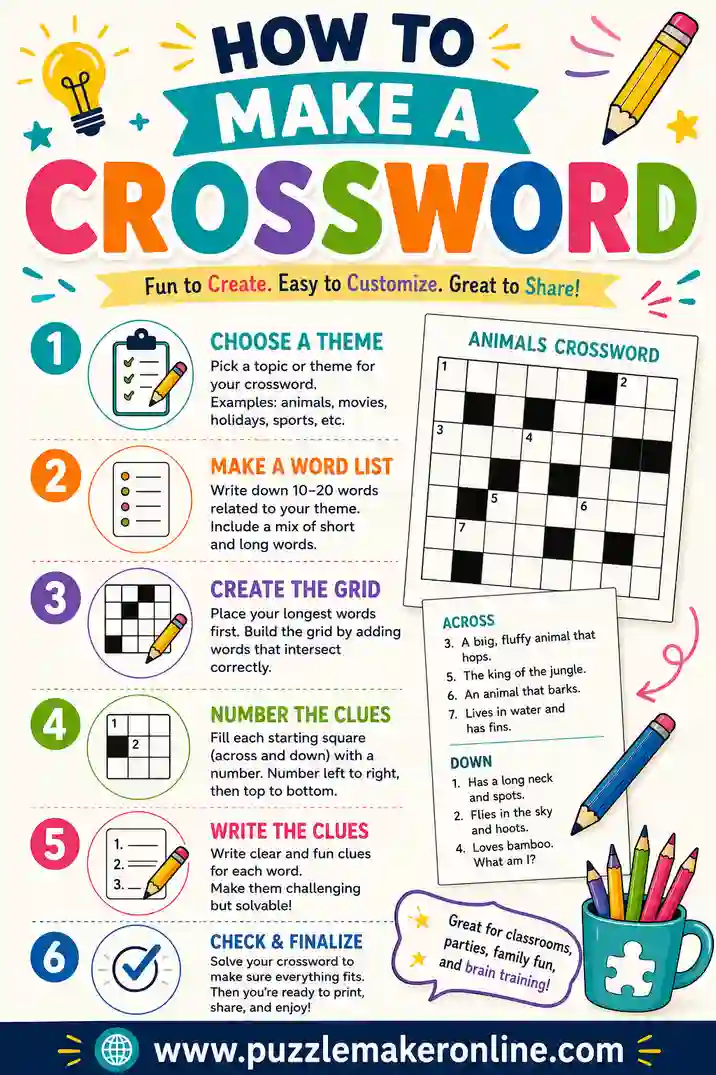
For a full walkthrough of grid building, see our guide on how to make a crossword.
One Word, Many Clues: How Difficulty Changes the Clue
Crosswordese doesn't always look the same from puzzle to puzzle, because editors change the clue to suit the difficulty. An easy puzzle gives you a direct definition. A hard one hides the same word behind a misleading or roundabout clue. Here are some examples we wrote to show the range.
| Answer | Easy-style clue | Medium-style clue | Hard-style clue |
|---|---|---|---|
| OLEO | Margarine | Butter alternative, once | It might be spread at a lunch counter |
| ERNE | Sea eagle | Bird with a hooked beak | Shoreline hunter |
| ETUI | Needle case | Small ornamental box | Holder of pins, perhaps |
| ERIE | Great Lake | Canal that opened up New York | Buffalo's waterfront |
| ALOE | Soothing plant | Gel source for a sunburn | Something to rub on after a day at the beach |
| EPEE | Fencing sword | Olympic blade | Point maker on a strip |
Notice the trick in the hard column. "Buffalo's waterfront" sounds like it's about the animal, but it's the city of Buffalo, New York, which sits on Lake Erie. "Point maker on a strip" sounds like a sports score, but fencers compete on a strip and score points with the tip of the sword. That kind of misdirection is how editors keep old words interesting for experienced solvers.
This is also why knowing crosswordese helps you on hard days. If you see a four-letter answer and a clue that's mysteriously about a "lunch counter," the letter pattern plus your crosswordese list can point you to OLEO long before you've worked out the joke.
A Mini Glossary of Crossword Terms
While we're talking about crossword jargon, here are a few more terms you'll see when solvers and constructors discuss crosswordese.
- Fill: all the answers in a grid, especially the shorter ones that aren't part of a theme. "Clean fill" means few obscure words.
- Entry: any single answer in the grid.
- Constructor: the person who builds the puzzle. In Britain, the usual word is "setter."
- Checked letter: a letter that belongs to both an Across and a Down answer. In American-style grids, every letter is checked.
- Theme: a shared idea linking several long answers, such as a pun or a hidden word.
- Themeless: a puzzle with no theme, usually full of long, lively answers.
- Repeater: any word that appears in puzzles again and again. All crosswordese is made of repeaters, but not every repeater is obscure.
- Partial: a fragment of a phrase used as an answer, such as A LOT or IN A, usually clued as a fill-in-the-blank. Editors tend to limit these, much like crosswordese.
- Natick: solver slang for a square where two obscure answers cross, so you can't work out the letter from either one. A grid with too much crosswordese is more likely to produce one.
Knowing these words won't fill any squares on its own, but it'll help you follow puzzle discussions and understand why editors make the choices they do.
Common Crosswordese Mix-Ups
Many crosswordese words come in look-alike sets. These are the ones that catch people most often.
| Easily confused | How to tell them apart |
|---|---|
| ERNE / ERN / TERN | ERNE and ERN are the sea eagle (two spellings of one word). A TERN is a different seabird. Count the squares and check the crossings. |
| OLEO / OREO / OLIO | OLEO is margarine. OREO is the cookie brand. OLIO is a hodgepodge or mixture. A clue about spreads means OLEO; about a mix, OLIO. |
| EPEE / FOIL / SABER | All are fencing swords. Use the letter count and crossings: EPEE and FOIL both have four letters, so you'll need a crossing letter to choose. |
| ARIA / AREA | An ARIA is a solo song in an opera. AREA is a space or region. Music clues mean ARIA. |
| ERIE / EIRE / ERIC | ERIE is the lake and canal. EIRE is an Irish name for Ireland. ERIC is a first name. Geography clues usually say which. |
| ADIT / EDIT | An ADIT is a tunnel into a mine. EDIT means to revise writing. Mining clues mean ADIT; anything about writing or film means EDIT. |
| ALEE / ALOE | ALEE is a sailing direction. ALOE is the plant used in skin gels. One letter, very different clues. |
| ETNA / ETTA | ETNA is the volcano in Sicily. ETTA is a first name (as in the singer Etta James). |
Myths About Crosswordese
A few common beliefs about crosswordese don't hold up. Clearing them away makes the whole topic less intimidating.
"Crosswordese words are made up"
They're not. Every classic crosswordese word is a real dictionary word with a real meaning and history, as the dictionary entries quoted in this guide show. Editors wouldn't accept invented words; the whole point is that the answer is fair, even if it's unfamiliar.
"You need a huge vocabulary to handle it"
You need a specific vocabulary, which is different. The core list is small, and the same words come back again and again. A solver who has learned a few dozen repeaters will often fill them faster than a professor who has never done a crossword.
"Only old puzzles use it"
Old puzzles used more of it, but modern ones still include some. Shortz's 2002 advice to learn words like ESTE and ANOA came almost a decade into his time as Times editor. What's changed is how much, not whether.
"Crosswordese means the puzzle is bad"
Not necessarily. One ERNE that lets a constructor fit a brilliant fifteen-letter answer is a smart trade. A grid stuffed with ESNE, ETUI and ADIT in one corner is a different story. Judge the puzzle on balance, not on a single word.
"Pop culture names don't count"
They do, in a newer way. When the same short name (ENO, ONO, ANI) appears again and again because its letters are convenient, it's playing exactly the role ESNE used to play. Some solvers call this the "new crosswordese."
How to Learn Crosswordese Fast
The quickest way to stop being stumped by crosswordese is to treat it like vocabulary practice for a trip. A few habits help a lot.
Notice the repeaters
Every time you meet a word you didn't know and it shows up again within a week or two, write it down. That second sighting is the sign of crosswordese. Within a month, you'll have a personal list of the words that matter most.
Learn by clue, not just by word
Crosswordese usually comes with a small set of standard clues. ERNE is nearly always some kind of eagle or seabird. ETUI is a needle case. ADIT is a mine entrance. Learning the word and its usual clue together is more useful than memorizing a definition on its own.
Use the letter patterns
When you have a few crossing letters, think about which crosswordese words fit. _L_O almost begs for OLEO. E_N_ is often ERNE. Shortz's 2002 tips include using common patterns this way, such as plurals ending in S and past tenses ending in -ED, to guess missing letters.
Solve easier puzzles regularly
Gentle puzzles repeat the classics often, which makes them great practice. Try our easy crossword puzzles for adults or the steady supply on our daily crossword puzzles page. Checking your work against crossword puzzles with answers is another quick way to lock new words in.
Make a crosswordese flash list
Put each word on one line and its typical clue next to it. Review it for a minute or two a day. Our vocabulary crossword page has ideas for turning word lists into practice puzzles, which works just as well for crosswordese as for school vocabulary.
Try It Yourself: Fill the Corner
Here's a quick exercise to feel the squeeze a constructor faces. Each line below gives a pattern of known letters (with blanks as underscores) and a plain clue we wrote. Fill in the word. Answers are below.
- _ L E _ : Margarine, old-style
- E _ N E : Coastal eagle
- _ T U I : Small decorative case
- A N _ A : Little buffalo of Sulawesi
- E _ E E : Sword for a fencer
- A _ I T : Mine opening
- _ R T : Leftover scrap
- S T _ A : Greek covered walkway
Answers: 1. OLEO, 2. ERNE, 3. ETUI, 4. ANOA, 5. EPEE, 6. ADIT, 7. ORT, 8. STOA.
Now try something harder. Take the 4-by-4 word square near the top of this page (AREA, REAL, EASE, ALES) and change one letter in the first row so that it's still a word. Then see whether you can fix the other rows and columns to keep every line a real word. You'll quickly find yourself reaching for words like ERNE or ALEE, and you'll understand exactly why crosswordese was born.
Crosswordese Beyond the New York Times
Crosswordese isn't just one newspaper's habit. Wherever American-style grids are built, the same pressures produce the same kinds of words. Puzzles in syndicated papers, puzzle books and apps all draw on the same pool of short, vowel-friendly entries.
Puzzle size matters too. Small grids, like 5-by-5 minis, have nowhere to hide, so constructors work hard to avoid obscure words there. Big Sunday grids have more room for lively long answers but also more corners where a short utility word can creep in. And themeless puzzles, which pack in lots of long answers, often need a few short glue words to make the crossings work.
The first New York Times crossword in 1942 gives a sense of how puzzles were built back then. According to Marketplace, it sat on a 23-by-23 grid with an average word length of 5.36 letters and fourteen nine-letter answers. Big grids like that need hundreds of answers, and every one of those answers has to cross others. That's a lot of opportunities for a reliable little word like ERNE or ETUI.
British cryptic crosswords are a bit different. Their grids leave many letters unchecked (each appears in only one answer), so constructors feel less of the squeeze, and you see fewer obscure fillers. Cryptics have their own shorthand instead, such as abbreviations like P for quiet. If you're curious, our separate guide to solving cryptic crosswords explains them.
Make Puzzles With Your Own Words
One nice thing about making your own puzzles is that you choose the words, so there's no need for ESNE unless you want it. Our free puzzle maker lets you type your own words or pick a theme, choose a puzzle type, and print it with an answer key. Try a crossword built from words your family actually uses, or sneak in a few classic crosswordese entries like OLEO and ERNE as a friendly test for the puzzle lovers in your life. For more ideas, browse our main crossword puzzles page.
Five Families of Crosswordese Compared
Crosswordese tends to cluster in a few areas. This table sets the families side by side with sample words and why each one shows up.
| Family | Sample words | Why it appears in grids |
|---|---|---|
| Birds and animals | ERNE, ANOA, EMU, ELAND | Short animal names with lots of vowels are crossword gold |
| Places | ERIE, ETNA, OSLO, ELBE, ARAL, URAL | Short, vowel-friendly proper nouns with clear, checkable clues |
| Foreign words | ESTE, ETE, AMI, ERAT, ORO | Simple Spanish, French, Italian and Latin words; clues usually flag the place or language |
| Old or specialized words | ESNE, ORT, ADIT, ETUI, STOA, ALEE | Drawn from history, mining, sailing and architecture, so you rarely need them anywhere else |
| Names and pop culture | ENO, ONO, ALDA, AGEE | Short names are flexible, and this "new crosswordese" changes faster than the old kind |
Frequently Asked Questions
What does crosswordese mean?
Crosswordese is the nickname for short words that appear far more often in crossword puzzles than in normal speech or writing. They're usually three to five letters long and full of vowels and common consonants, which makes them easy to fit into a grid. Classic examples include OLEO, ERNE, ETUI, ANOA and ESNE. The name works like legalese or journalese, a jokey label for the special vocabulary of one particular world.
Why do crosswords use so many weird short words?
Because every letter in an American-style grid belongs to two answers, constructors often get boxed into corners where only a few letter patterns will work. Common letters such as E, A, R, S and T fit into thousands of words, so short words made only of those letters are the easiest way out. Many of those short, friendly words happen to be obscure, like ERNE or ETUI, so they turn up again and again.
What are the most common crosswordese words?
There's no single official list, but solvers meet the same familiar group over and over: OLEO (margarine), ERNE (sea eagle), ETUI (needle case), ANOA (small buffalo), ESNE (Anglo-Saxon laborer), EPEE (fencing sword), ADIT (mine entrance), ALEE (sailing term), ORT (food scrap), STOA (Greek walkway), ERIE, ETNA and ESTE. Short names such as ENO and ONO and bands like REM and ELO are newer repeaters.
What does OLEO mean in a crossword?
OLEO means margarine. It's a shortened form of oleomargarine, and dictionaries mark it as an American word dating from the 1880s. You'll see it clued as a butter substitute, a spread, or with a nod to old diners and grandparents' kitchens, since the word itself feels old-fashioned. With three vowels in four letters, it's one of the easiest words for constructors to fit, which is why it's such a crossword regular.
What is an ERNE?
An ERNE is a sea eagle, particularly the European sea eagle. Dictionaries also list the spelling ERN, which gives constructors a handy three-letter version. In a crossword, ERNE is usually clued as a seabird, a coastal eagle or a bird of prey. Be careful not to confuse it with TERN, which is a different seabird altogether. When the crossing letters give you E, then a blank, then N and E, ERNE is a strong guess.
Is crosswordese less common than it used to be?
In many modern puzzles, yes. Editors and constructors increasingly judge a grid by how fresh its vocabulary is. Will Shortz, editor of The New York Times crossword since 1993, has said good grids use fresh words and rarer letters and avoid obscure filler. Software now helps constructors test thousands of options and choose livelier words. Still, crosswordese hasn't vanished; it's used more sparingly, often when a constructor needs it to make a great long answer fit.
How can I learn crosswordese quickly?
Keep a short list. Whenever you meet an unfamiliar word that shows up again within a week or two, write it down with its usual clue, such as ETUI next to needle case. Review the list for a minute a day. Solve easier puzzles often, because they repeat the classic words. And use letter patterns: when a pattern like _L_O appears, think OLEO. Within a few weeks, most crosswordese will start feeling like old friends.
Do cryptic crosswords use crosswordese too?
Much less. British-style cryptic grids leave many letters unchecked, meaning each one belongs to only one answer, so constructors don't get squeezed into corners the way American constructors do. You'll see fewer obscure filler words as a result. Cryptics have their own shorthand instead, such as single-letter abbreviations like P for quiet and N for north, and old words like TAR for sailor, which serve a similar role for experienced solvers.
Sources
We checked every source below while writing this guide. Last reviewed October 30, 2026, by Joan Ramos.
- esne (dictionary entry) (Dictionary.com)
- oleo (dictionary entry) (Dictionary.com)
- anoa (dictionary entry) (Dictionary.com)
- etui (dictionary entry) (Dictionary.com)
- erne (dictionary entry) (Dictionary.com)
- English Letter Frequency (based on a sample of 40,000 words) (Cornell University, Department of Mathematics)
- Crossword Ace Eugene Maleska Laced His Puzzles With Puckish Puns (The Seattle Times (from the Orlando Sentinel), August 5, 1993)
- Entering the mind of a crossword whiz (Mark Rahner, interview with Will Shortz, 2002) (The Seattle Times, reprinted by the American Crossword Puzzle Tournament)
- How to Be the Fastest Puzzler in Town (Will Shortz, 2002) (The New York Times, reprinted by the American Crossword Puzzle Tournament)
- The legacy of the crossword puzzle in times of crisis (Marketplace (American Public Media))