History Crossword: Free Printable Puzzles for Any Era
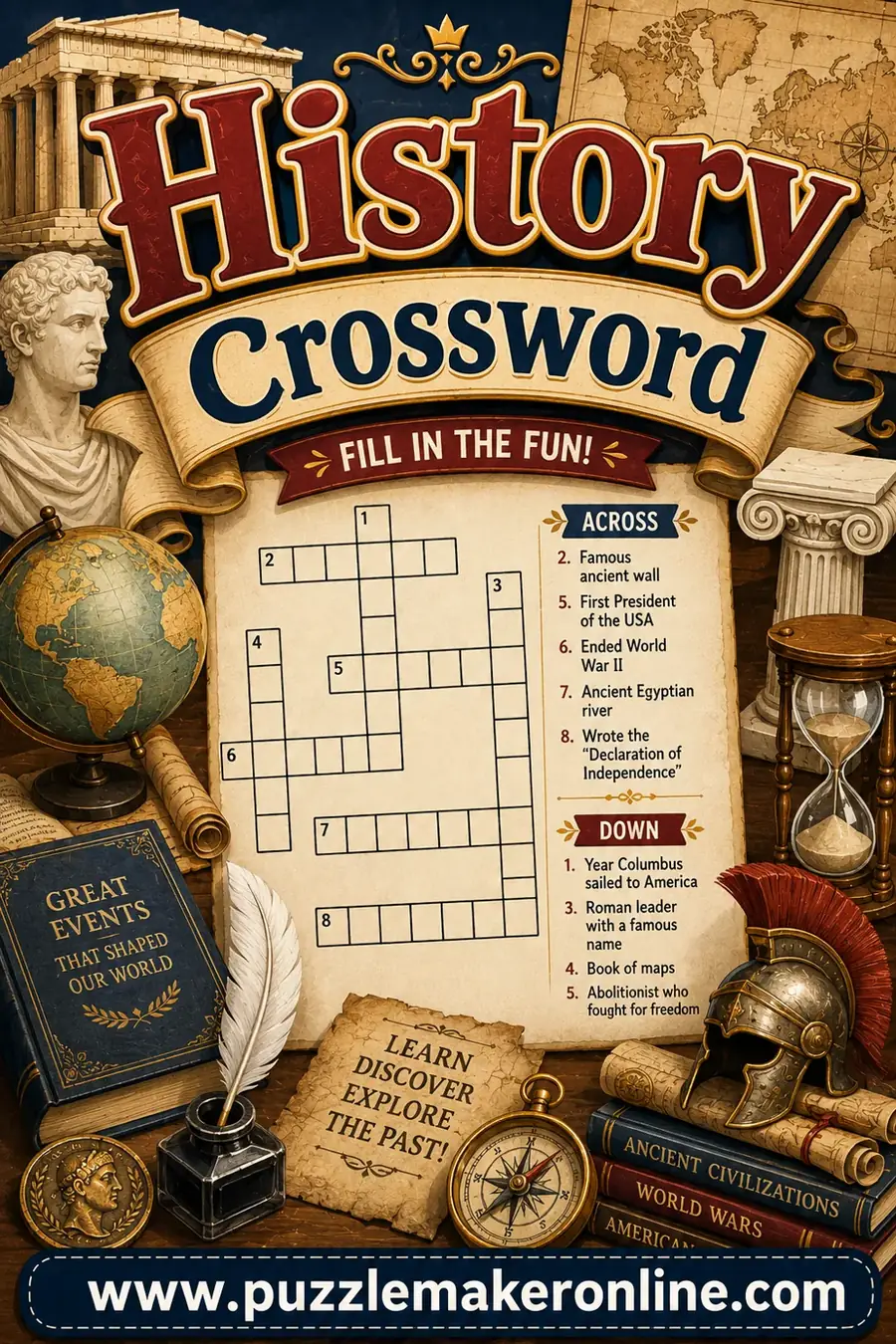
A history crossword is a printable grid where the clues are dates, people, places, and events, and the answers are the history terms students need to remember, like "PHARAOH," "REVOLUTION," or "TREATY." It turns dry review into a game your brain actually wants to play. The fastest way to make one is to drop your own word list into a free puzzle maker that builds the grid, numbers the clues, and prints a clean answer key for you.
Want to skip straight to building one? Open the free puzzle maker, paste in a list of history words (there's a ready-made one below), and print as many copies as your class or family needs. No sign-up, no software, no fee.
What Is a History Crossword?
Picture a normal crossword, then swap the trivia for history. Each clue points to a person, place, date, or idea from the past, and the answer is the term that fits. "Ancient Egyptian ruler" gives you PHARAOH. "1776 document" gives you DECLARATION. Players fill the grid by matching what they know to the boxes that fit.
The magic is that crosswords reward recall, not just recognition. A multiple-choice quiz lets you guess from a menu. A crossword makes you pull the word out of memory and check that the letters line up with the words crossing it. That extra step is exactly what helps facts stick.
You can build a history crossword around almost anything:
- A single era, like Ancient Rome, the Middle Ages, or World War II.
- A textbook chapter, using the bold vocabulary words from the unit.
- One country's story, like the founding of the United States.
- A theme across time, like inventions, explorers, or famous leaders.
Why a Crossword Beats a Plain Study Sheet
Re-reading notes feels productive, but it's one of the weakest ways to study. A crossword flips that. Here's why teachers and parents keep coming back to it.
- It forces active recall. Empty boxes make your brain do the work, which is what builds memory.
- It's self-checking. When a wrong answer breaks a crossing word, the puzzle tells you something's off.
- It's low-stress. A game doesn't feel like a test, so reluctant learners actually try.
- It's reusable. Print a class set, collect them, and use the same puzzle next year.
And it's quick to make. Most people go from "I need a review activity" to a printed stack in under ten minutes.
Free History Crossword Word List (Copy & Paste)
Here's a ready-to-use list of 30 history terms, grouped by era. Pick a column for a focused puzzle, or mix across columns for a broad review. Copy the words straight into the puzzle maker and add your own clues.
| Ancient World | Middle Ages & Early Modern | Modern History |
|---|---|---|
| Pharaoh | Knight | Revolution |
| Pyramid | Castle | Industrial |
| Empire | Crusade | Constitution |
| Senate | Plague | Suffrage |
| Gladiator | Monarchy | Treaty |
| Democracy | Cathedral | Independence |
| Hieroglyph | Feudalism | Migration |
| Colosseum | Explorer | Reform |
| Dynasty | Renaissance | Alliance |
| Philosopher | Conquest | Republic |
Aim for at least 15 words per puzzle so the grid has enough to interlock. The tool fits them together automatically, so you don't have to plan the layout.
Writing good history clues
The clue is where the learning happens. A few quick rules:
- Match the difficulty to your group. "First U.S. president" is easy. "Mount Vernon's most famous resident" makes them think.
- Use dates as clues. "1492 voyage leader" is a great prompt for EXPLORER or COLUMBUS.
- Keep answers single words when you can. Multi-word answers work, but single words fit the grid more cleanly.
How to Make a History Crossword in 4 Steps
You don't need any design skills. Here's the whole process.
- Pick your topic. One era, one chapter, or one theme keeps the puzzle focused.
- List your words. Type or paste 15 to 30 history terms. More words means a richer grid.
- Add a clue for each. Write a short hint that points to the answer. This is the part students actually read.
- Generate and print. The puzzle maker builds the grid, numbers everything, and prints an answer key automatically.
That's it. If you want to reuse the puzzle, print on cardstock or slide copies into sheet protectors so students can solve with dry-erase markers.
Who History Crosswords Are Great For
This works for almost any setting where someone's learning about the past.
Classrooms
Teachers use history crosswords for chapter review, sub-day busy work that's actually useful, and the day before a test. Hand out one per student, set a timer, and let them work alone or in pairs. It's quiet, focused, and grades itself against the answer key.
Homeschool and tutoring
A crossword is a gentle way to check what stuck after a reading. Build it from the week's lesson, and you've got an instant review activity. For tutors, it's a low-pressure way to find the gaps without a formal quiz.
Trivia nights and family game time
History buffs love a themed puzzle over coffee. Make one about a decade, a war, or a dynasty, and you've got a conversation starter that doubles as a brain workout.
Museum and library programs
Educators running a history exhibit or summer reading program can hand out a themed crossword as a take-home activity. It extends the visit and gives kids a reason to pay attention to the displays.
History Crossword Difficulty by Age and Level
The same topic can stretch from grade-schoolers to adults if you adjust the grid size and clue style. Use this as a starting point.
| Level | Grid size | Clue style | Tips |
|---|---|---|---|
| Grades 2–4 | 8x8 | Direct, simple | Use word-and-picture clues, short answers |
| Grades 5–8 | 11x11 | Definition-based | Mix dates and "who did this" clues |
| High school | 13x13 | Analytical | Add cause-and-effect and "why" clues |
| College / adult | 15x15 | Cryptic-leaning | Use obscure dates and indirect hints |
| Trivia buffs | 15x15 | Tricky | Lean on deep cuts and primary-source quotes |
Start smaller than you think for younger kids. A packed 15x15 grid can overwhelm a third grader, while a tidy 8x8 keeps them in the game.
Tips for a Clean, Printable Puzzle
A few small choices make the finished puzzle look sharp and read easily.
- Print a test copy first. Check the margins so no clues get cut off on a full stack.
- Use black and white to save ink. A crossword reads perfectly without color.
- Pick concrete answers. "Feudalism" works; "the general mood of the era" does not.
- Keep clue numbers visible. The tool handles numbering, but a quick scan before printing catches any oddities.
- Bundle the answer key separately. Print the key on its own page so you can hand out puzzles without spoilers.
Make it a unit, not a one-off
Once you've built one history crossword, you can spin off a whole set:
- A puzzle per chapter that builds toward a final-review mega grid.
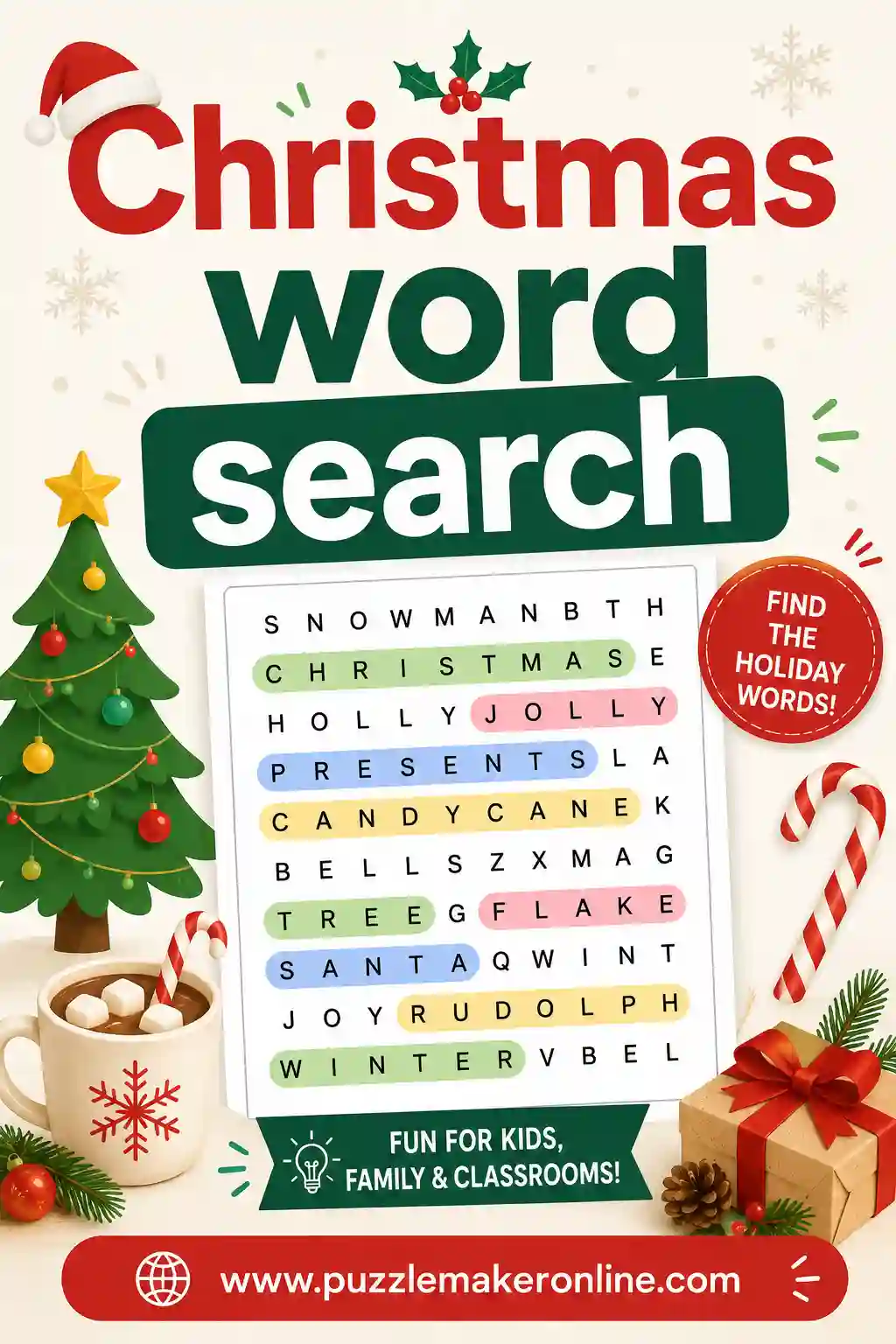
- A word search version of the same list for younger students.
- A scramble warm-up using the same terms (try the mini-tool above).
Crossword vs. Word Search vs. Scramble for History
A crossword is the deepest of the three printable puzzle types, but it's not always the right fit. Here's how to choose, since the same puzzle maker builds all three from one word list.
- Crossword. Best for real review. The clues do the teaching, so a history crossword tests whether students truly know the term, not just whether they can spot it. Use it before a test or as a graded activity.
- Word search. Best for younger kids or pure spelling practice. There are no clues, just the hunt, so it builds familiarity with how a term like REVOLUTION is spelled without demanding recall. Great for a calm-down activity.
- Word scramble. Best as a quick warm-up. One jumbled word per term, unscrambled against the clock, makes a fast bell-ringer at the start of class. Try the mini-tool above for a taste.
A smart move is to build all three from the same set of history words. Use the word search early in a unit to introduce the vocabulary, the scramble mid-unit as a warm-up, and the crossword at the end for review. The terms repeat across formats, which is exactly the kind of spaced repetition that locks facts into memory.
Fun Ways to Use a History Crossword
Once the basic worksheet gets stale, try these twists to keep your group engaged.
- Race the clock. First to finish a correct grid wins a small prize. Good for review days.
- Team relay. Split into teams; each member fills one clue, then passes the puzzle along.
- Open-book round. Let students use their notes. The hunt for each answer is its own review.
- Build-your-own. Have students write the clues for next week's puzzle. Writing a good clue means truly understanding the term.
You can also tie the theme to a reward, like choosing the next documentary or skipping one homework problem.
Frequently Asked Questions
What words should go on a history crossword?
Use the key terms from your topic: people, places, events, and vocabulary. The list above gives you 30 ready to copy across ancient, medieval, and modern history. Aim for at least 15 different words so the grid interlocks well.
How do I write good history crossword clues?
Point clearly to one answer and match the difficulty to your group. Dates make great clues ("1492 voyage leader"), and so do short definitions. Avoid vague hints that could fit several words, since those frustrate solvers.
Is the history crossword maker really free?
Yes. You build and print the puzzle yourself at no cost. There's no sign-up and no watermark, so a teacher can run a whole class or a parent can print one for game night on a single free word list.
Can I make a history crossword for young kids?
Absolutely. Use a smaller 8x8 grid, short single-word answers, and simple definition clues. For non-readers, pair each clue with a small picture so they can match without reading.
How big should the grid be?
It depends on your word count and audience. Fifteen words fit a tidy 8x8 to 11x11 grid; thirty words need a 13x13 or 15x15. The puzzle maker sizes the grid automatically to fit your list.
Can I print an answer key too?
Yes. The tool generates a filled-in answer key alongside the blank puzzle. Print the key on a separate page so you can hand out the puzzle first and check answers later.
Ready to Print Your History Crossword?
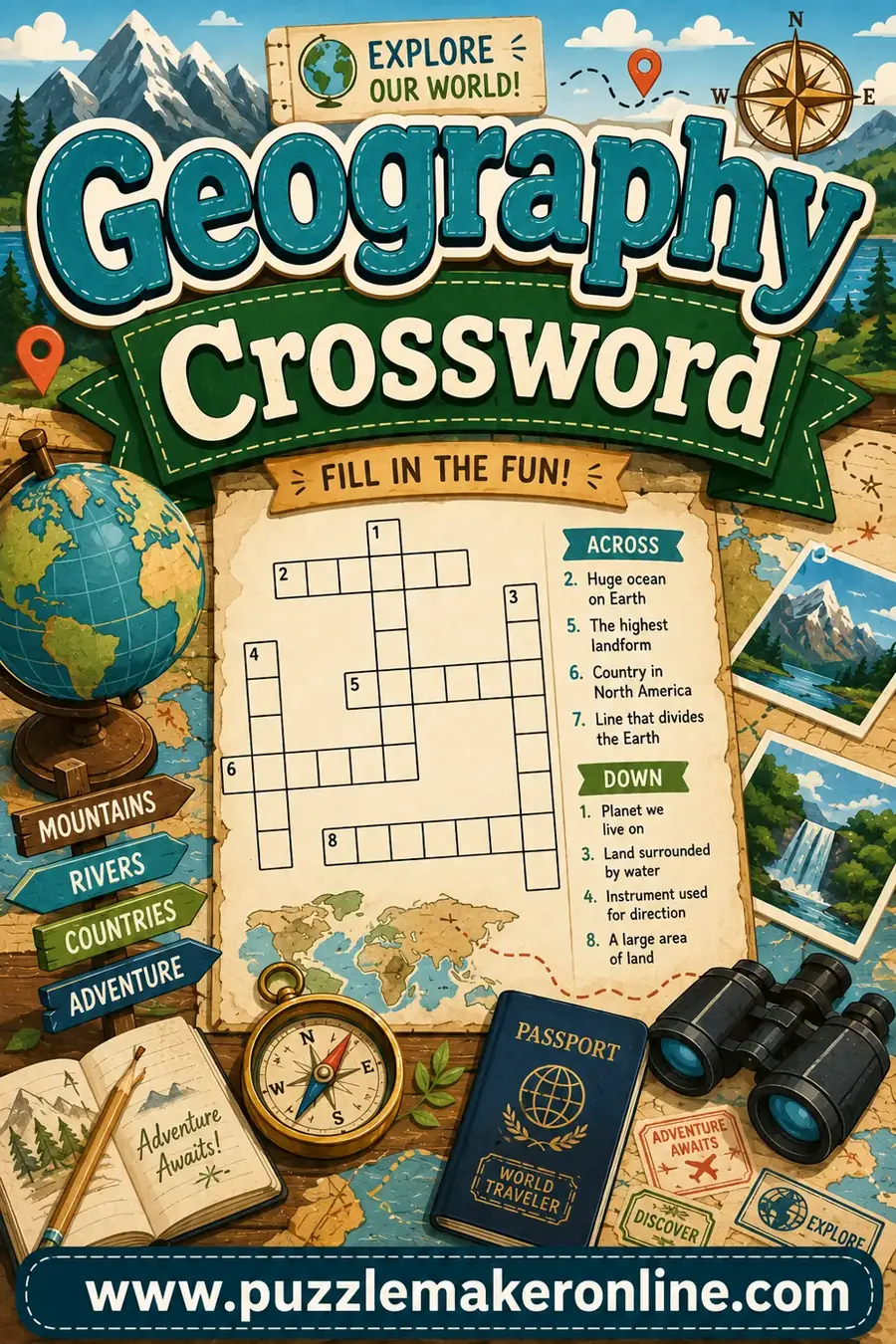
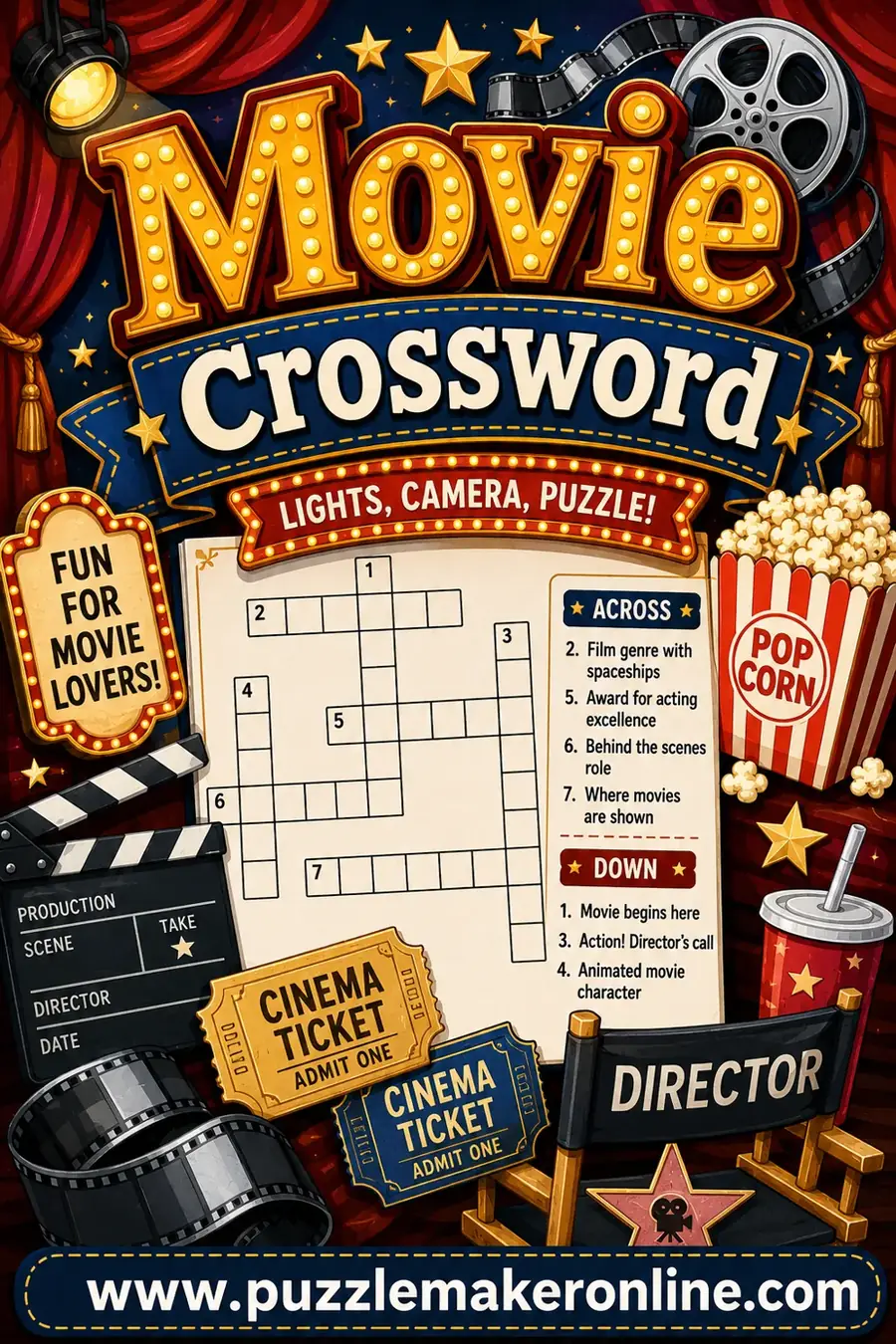
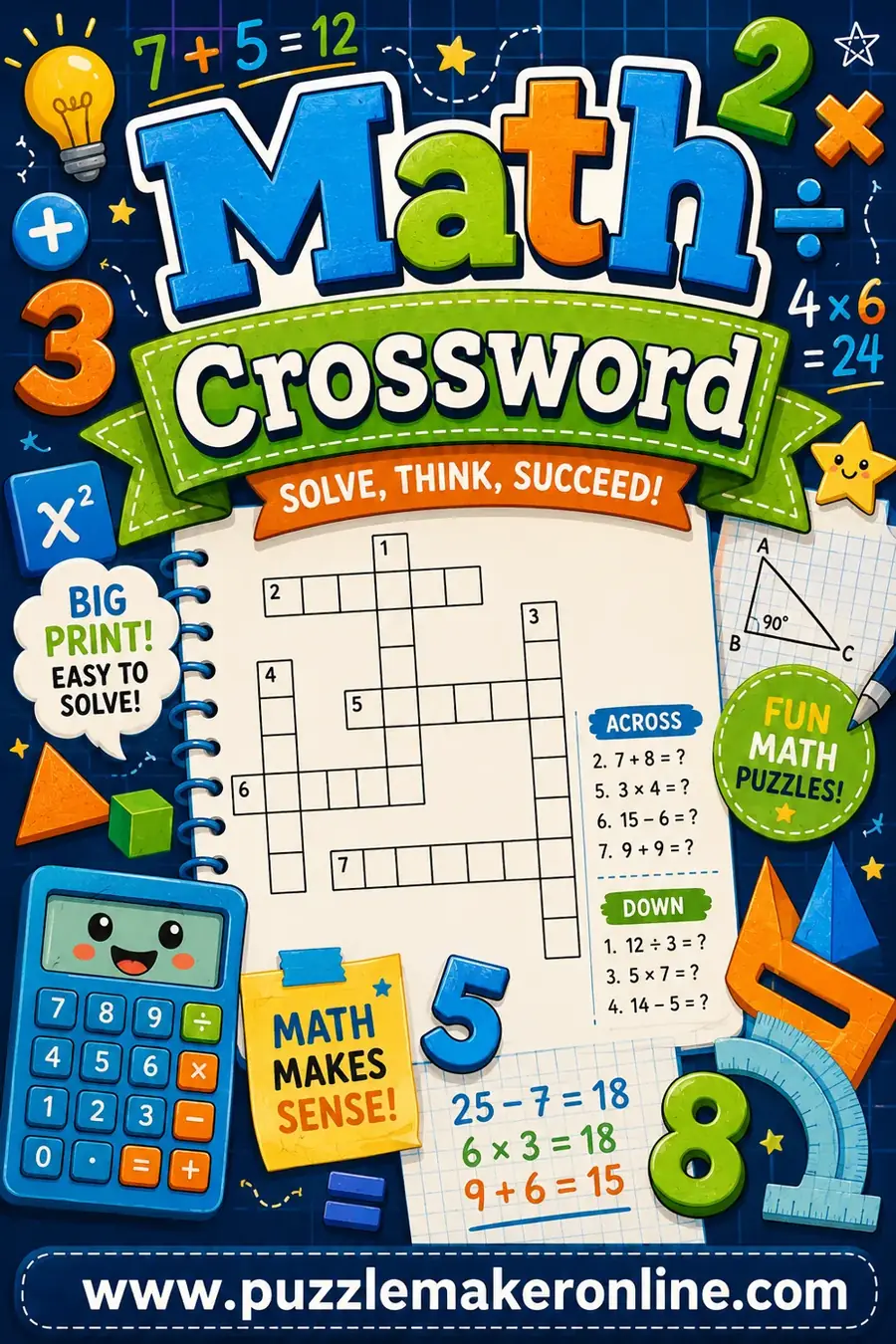
Grab the word list above, open the free puzzle maker, add your clues, and you'll have a clean, printable history crossword in minutes. It's free, there's no sign-up, and the answer key prints right alongside it, so your class or game night is ready to go. Want to branch out? Build a geography crossword, a movie crossword, or a math crossword from the same simple tool.