Math Crossword: Free Printable Puzzles for Every Grade
A math crossword is a printable grid where the clues are definitions, problems, or symbols, and the answers are math vocabulary like "FRACTION," "PERIMETER," or "QUOTIENT." It turns vocabulary drills into a puzzle kids will actually finish. The quickest way to build one is to drop your own word list into a free puzzle maker that lays out the grid, numbers the clues, and prints a matching answer key.
Want to jump straight to making one? Open the free puzzle maker, paste in a list of math terms (there's a ready-made one below), and print as many copies as your class or family needs. No sign-up, no software, no fee.
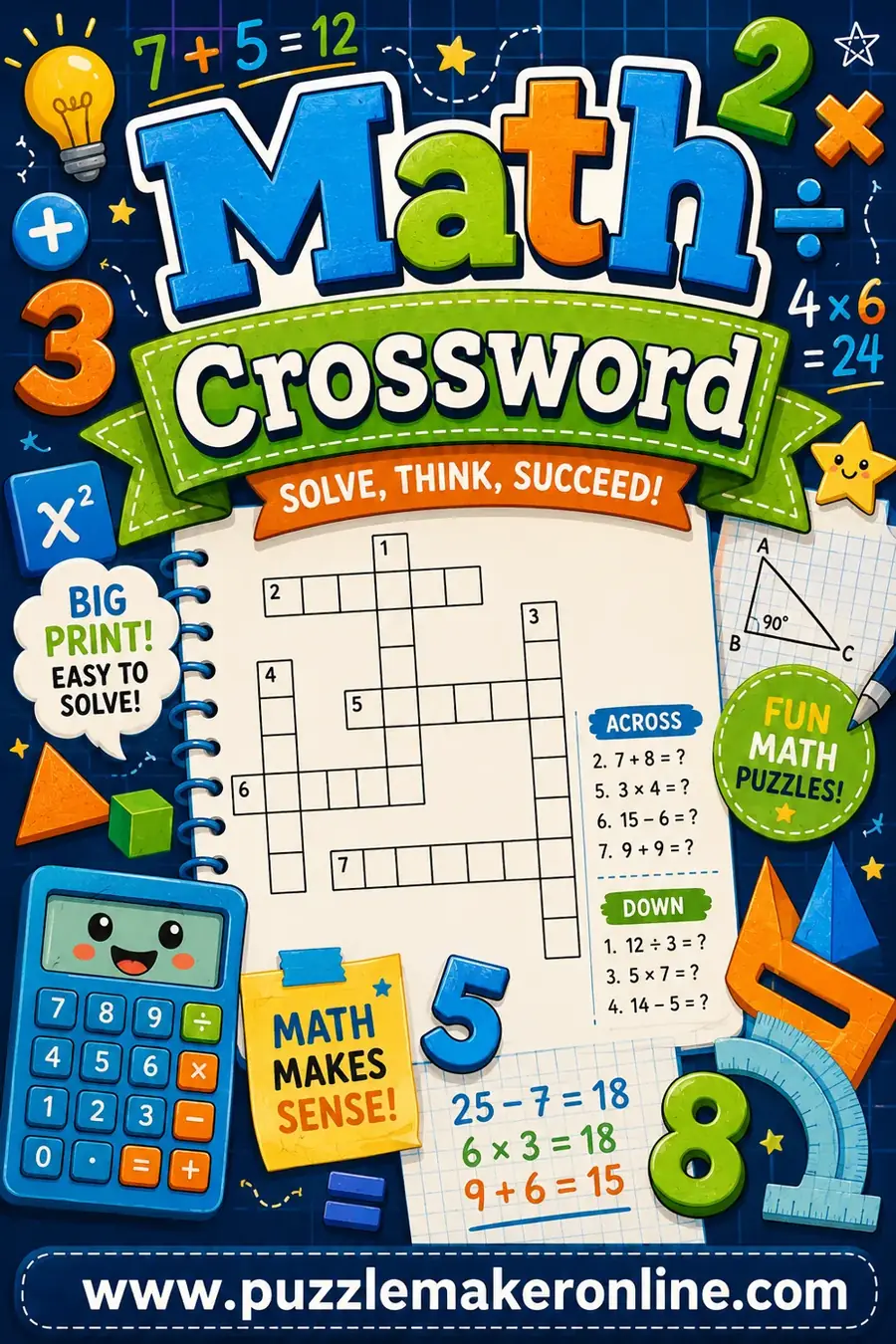
What Is a Math Crossword?
It's a regular crossword, but the answers are math words. Each clue is a definition, a tiny word problem, or a symbol description, and the answer is the term that fits the boxes. "Top number in a fraction" gives you NUMERATOR. "Distance around a shape" gives you PERIMETER. Solvers fill the grid by matching what they know to the squares that fit.
Here's the part that makes it work for math: it builds vocabulary without feeling like a worksheet. A lot of math struggles come from not knowing the words. When a student can't picture "quotient" or "denominator," word problems fall apart. A crossword drills those terms in a way that feels like a game, not a flashcard.
You can build a math crossword around almost anything:
- A single topic, like fractions, geometry, or measurement.
- A grade level's vocabulary, pulled straight from the unit.
- A skill review, like operations or place value.
- Symbols and notation, matching the symbol to its name.
Why a Crossword Beats a Plain Vocabulary List
Handing kids a list of terms to memorize rarely sticks. A crossword turns that same list into something they'll actually work through. Here's why it lands.
- It forces recall. Empty boxes make the brain retrieve the word, which is how memory forms.
- It self-checks. A wrong answer breaks the crossing word, so the puzzle flags mistakes for you.
- It lowers the stakes. A game feels safe, so math-anxious kids are willing to try.
- It reuses easily. Print a class set, collect them, and pull the same puzzle out next year.
And it's fast to make. Most teachers go from "I need a vocab review" to a printed stack in under ten minutes.
Free Math Crossword Word List (Copy & Paste)
Here's a ready-to-use list of 30 math terms, grouped by area. Pick a column for a focused puzzle, or mix across columns for a broad review. Copy the words straight into the puzzle maker and add your clues.
| Numbers & Operations | Geometry & Measurement | Advanced & Algebra |
|---|---|---|
| Fraction | Perimeter | Equation |
| Decimal | Triangle | Variable |
| Quotient | Diameter | Exponent |
| Product | Volume | Coefficient |
| Numerator | Angle | Integer |
| Remainder | Radius | Function |
| Multiple | Symmetry | Inequality |
| Factor | Polygon | Coordinate |
| Sum | Vertex | Slope |
| Average | Parallel | Ratio |
Aim for at least 15 words per puzzle so the grid interlocks nicely. The tool fits the words together for you, so you never have to plan the layout by hand.
Writing good math clues
The clue is where the learning lives. A few quick rules:
- Use definitions for vocabulary. "Distance around a circle" points cleanly to CIRCUMFERENCE.
- Turn small problems into clues. "12 divided by 3" can be the clue for FOUR if you want number answers.
- Keep answers single words when you can. They fit the grid more cleanly than phrases.
How to Make a Math Crossword in 4 Steps
You don't need design skills, and you don't even need to be a math person. Here's the whole thing.
- Pick your topic. One unit or skill keeps the puzzle focused and useful for review.
- List your words. Type or paste 15 to 30 math terms. More words means a richer grid.
- Add a clue for each. Write a short definition or mini-problem that points to the answer.
- Generate and print. The puzzle maker builds the grid, numbers it, and prints the answer key for you.
That's it. To reuse the puzzle, print on cardstock or slip copies into sheet protectors so kids can solve with dry-erase markers.
Who Math Crosswords Are Great For
This works anywhere someone's building math vocabulary or reviewing a unit.
Classrooms
Teachers use math crosswords for end-of-unit review, early-finisher work, and the day before a test. They're quiet, focused, and grade against the answer key. Hand out one per student and let them work solo or in pairs.
Homeschool and tutoring
A crossword is a low-key way to check which terms stuck after a lesson. Build it from the week's topic for an instant review. Tutors can use it to spot vocabulary gaps without giving a formal quiz.
Math clubs and enrichment
For kids who like math, a tricky crossword with notation and advanced terms is a fun challenge. Use it as a warm-up or a take-home brain-teaser.
Substitute and sick-day plans
A math crossword is the rare sub activity that's genuinely useful. Leave a stack with the answer key, and the lesson runs itself while still reinforcing real content.
Math Crossword Difficulty by Grade
The same idea stretches from early elementary to high school if you adjust the grid and clue style. Use this as a starting point.
| Level | Grid size | Clue style | Tips |
|---|---|---|---|
| Grades 1–2 | 8x8 | Picture + word | Use short answers like SUM and ADD |
| Grades 3–5 | 11x11 | Simple definitions | Mix vocab and easy "what is" clues |
| Grades 6–8 | 13x13 | Definition + problem | Add geometry and operation terms |
| High school | 15x15 | Algebra-leaning | Use notation, functions, and equations |
| Math club | 15x15 | Tricky | Lean on advanced terms and symbols |
Start smaller than you think for younger kids. A 15x15 grid overwhelms a second grader, while a tidy 8x8 keeps the win within reach.
Tips for a Clean, Printable Puzzle
A few small choices make the finished worksheet look sharp and easy to read.
- Print one test copy first. Check margins so no clues get cut off on a full stack.
- Use black and white to save ink. A crossword reads perfectly without color.
- Pick concrete answers. "Numerator" works; "the idea of dividing things up" does not.
- Double-check spelling. Math words like "isosceles" trip up the grid if they're typed wrong.
- Print the answer key separately. Keep it on its own page so you can hand out puzzles spoiler-free.
Build a whole review set
Once you've made one math crossword, you can spin up more from the same word lists:
- A puzzle per unit that builds toward a final-review mega grid.
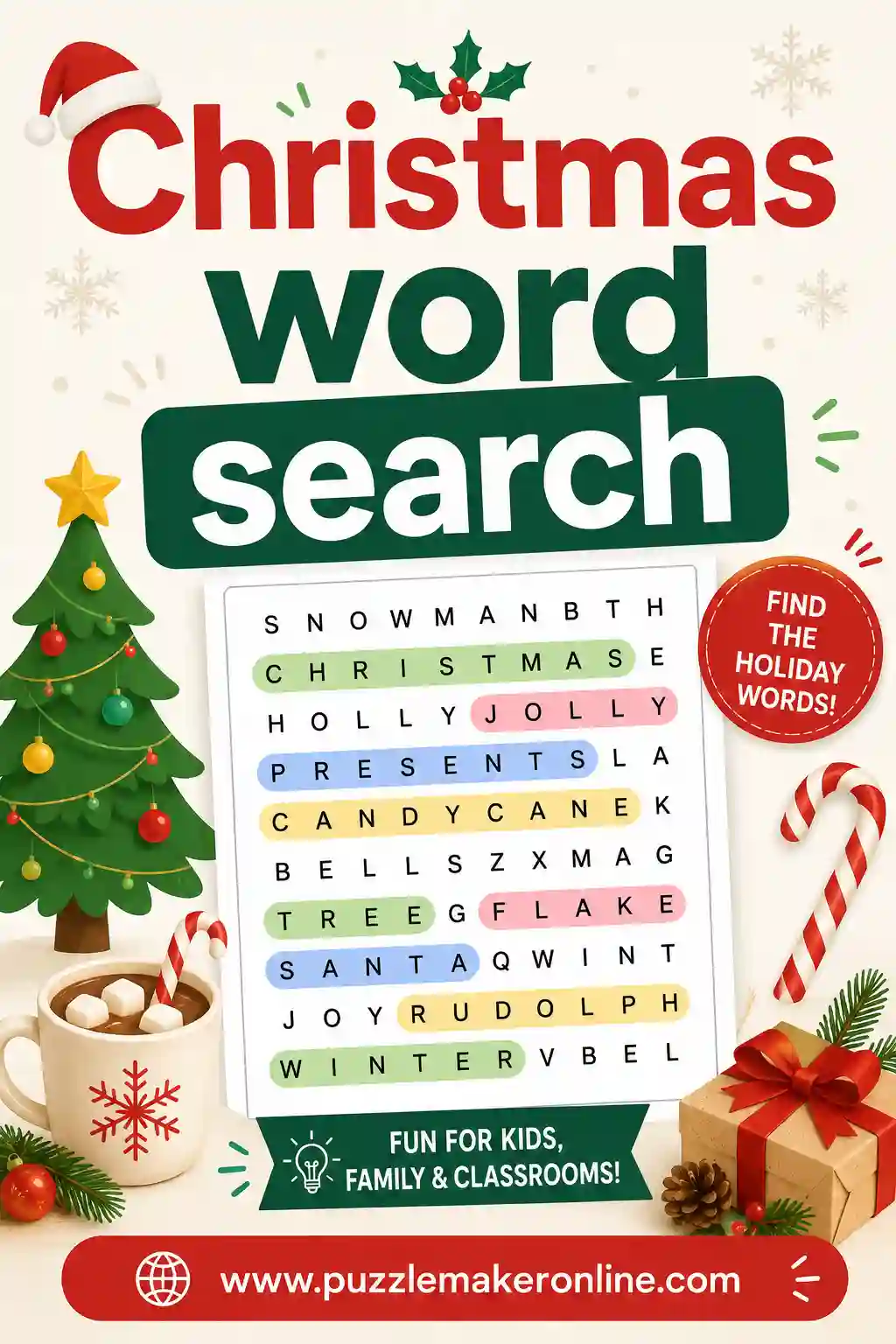
- A word search version of the same terms for younger grades.
- A scramble warm-up using the same words (try the mini-tool above).
Crossword vs. Word Search vs. Scramble for Math
A crossword is the deepest of the three printable puzzle types, but it's not always the best fit. Here's how to choose, since the same puzzle maker builds all three from one word list.
- Crossword. Best for real review. The definition clues do the teaching, so a math crossword checks whether a student actually understands what "quotient" means, not just whether they can find the word. Use it before a test.
- Word search. Best for younger grades or spelling practice. With no clues, it just builds familiarity with how a term like PERIMETER is spelled. It's a calm, low-pressure activity for early finishers.
- Word scramble. Best as a warm-up. One jumbled term unscrambled quickly makes a sharp bell-ringer to start math class. Try the mini-tool above to see how it feels.
The smart play is to build all three from the same math word list. Introduce the vocabulary with a word search, drill it mid-unit with a scramble, then test recall with the crossword at the end. The terms repeat across formats, which is exactly the spaced repetition that helps math vocabulary stick.
Fun Ways to Use a Math Crossword
Once a plain worksheet gets stale, try these twists to keep kids engaged.
- Beat the clock. First to finish a correct grid earns a small prize.
- Team relay. Split into teams; each member solves one clue, then passes it on.
- Notes allowed. Let students use their vocab list. Hunting for each answer is its own review.
- Student-made clues. Have kids write next week's clues. Writing a clear definition means they really know the term.
You can also tie the theme to a reward, like picking the next warm-up game or skipping one homework problem.
Frequently Asked Questions
What words should go on a math crossword?
Use the vocabulary from your topic: terms like fraction, perimeter, quotient, and angle. The list above gives you 30 ready to copy across numbers, geometry, and algebra. Aim for at least 15 different words so the grid interlocks well.
How do I write good math crossword clues?
Use a short definition or a tiny problem that points to one answer. "Distance around a shape" gives PERIMETER; "top of a fraction" gives NUMERATOR. Keep clues clear so solvers aren't guessing between several possible words.
Is the math crossword maker really free?
Yes. You build and print the puzzle yourself at no cost. There's no sign-up and no watermark, so a teacher can run a whole class or a parent can print one at home using a single free word list.
Can I make a math crossword for young kids?
Absolutely. Use a smaller 8x8 grid, short single-word answers like SUM and ADD, and simple picture-and-word clues so non-readers can still match the terms.
Can I use numbers as answers?
Yes. You can write clues like "7 plus 5" with the answer TWELVE spelled out, or use number-word answers. Just keep them consistent so the grid letters line up correctly.
Can I print an answer key too?
Yes. The puzzle maker generates a filled-in answer key alongside the blank puzzle. Print the key on its own page so you can hand out the puzzle first and check answers afterward.
Ready to Print Your Math Crossword?
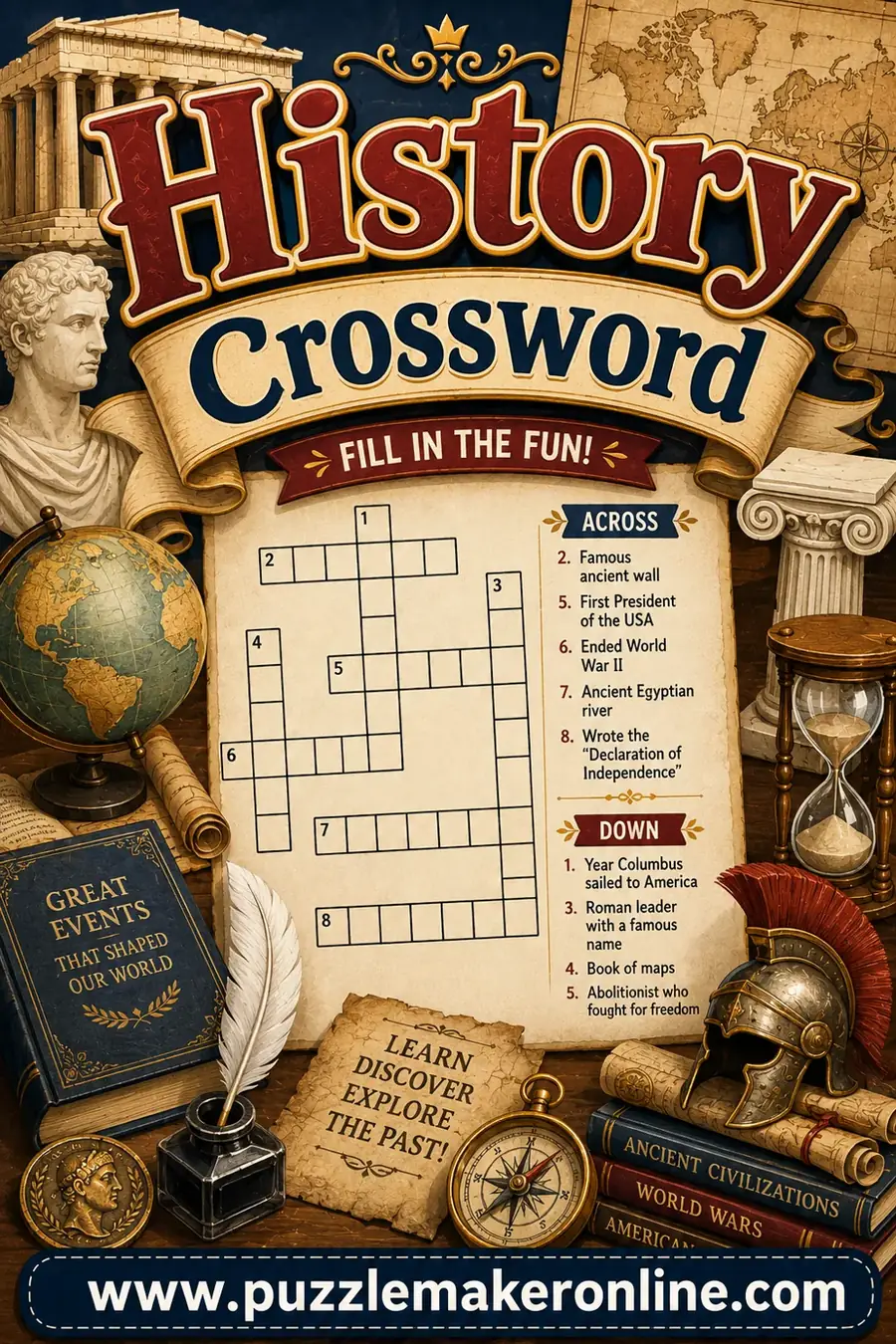
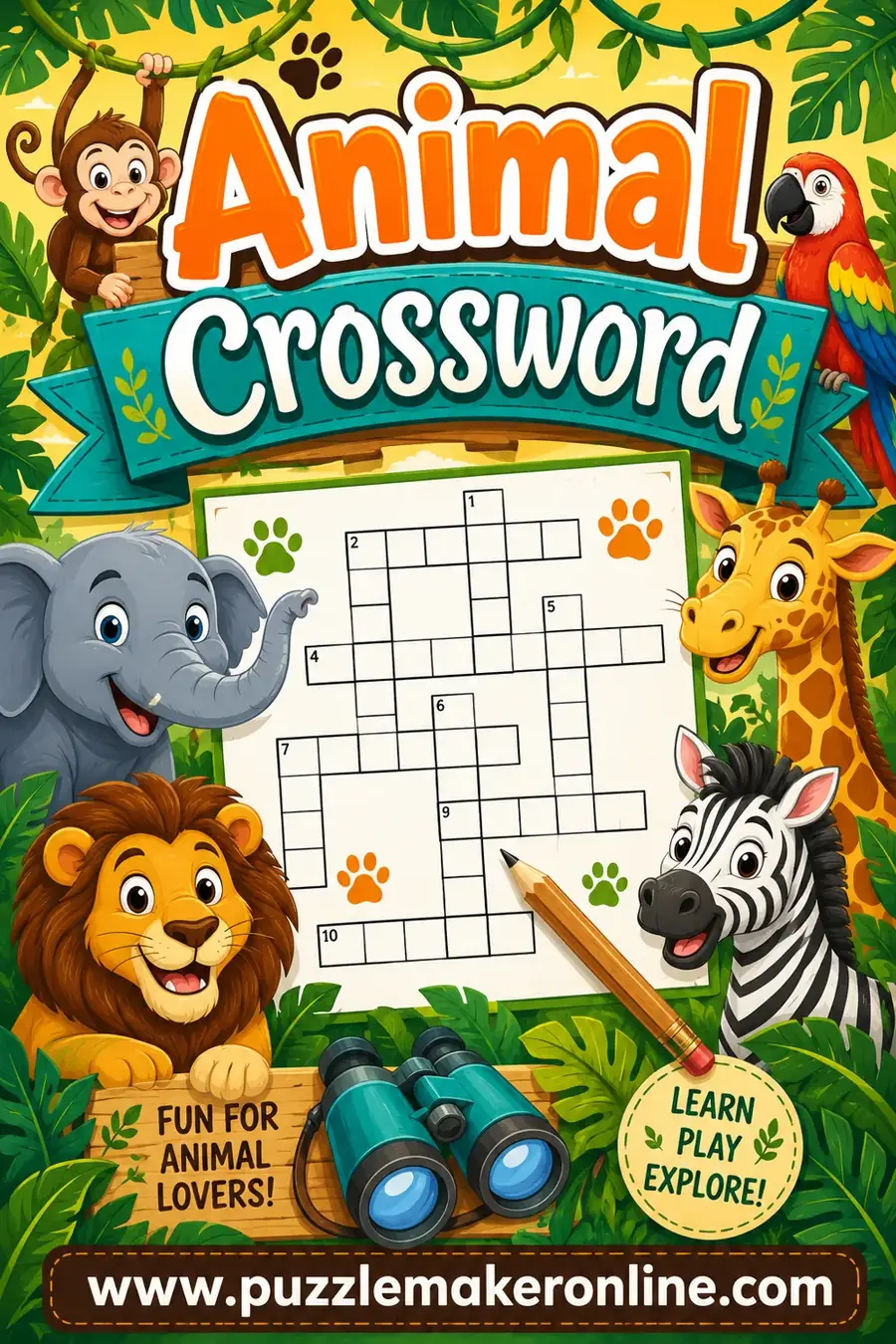
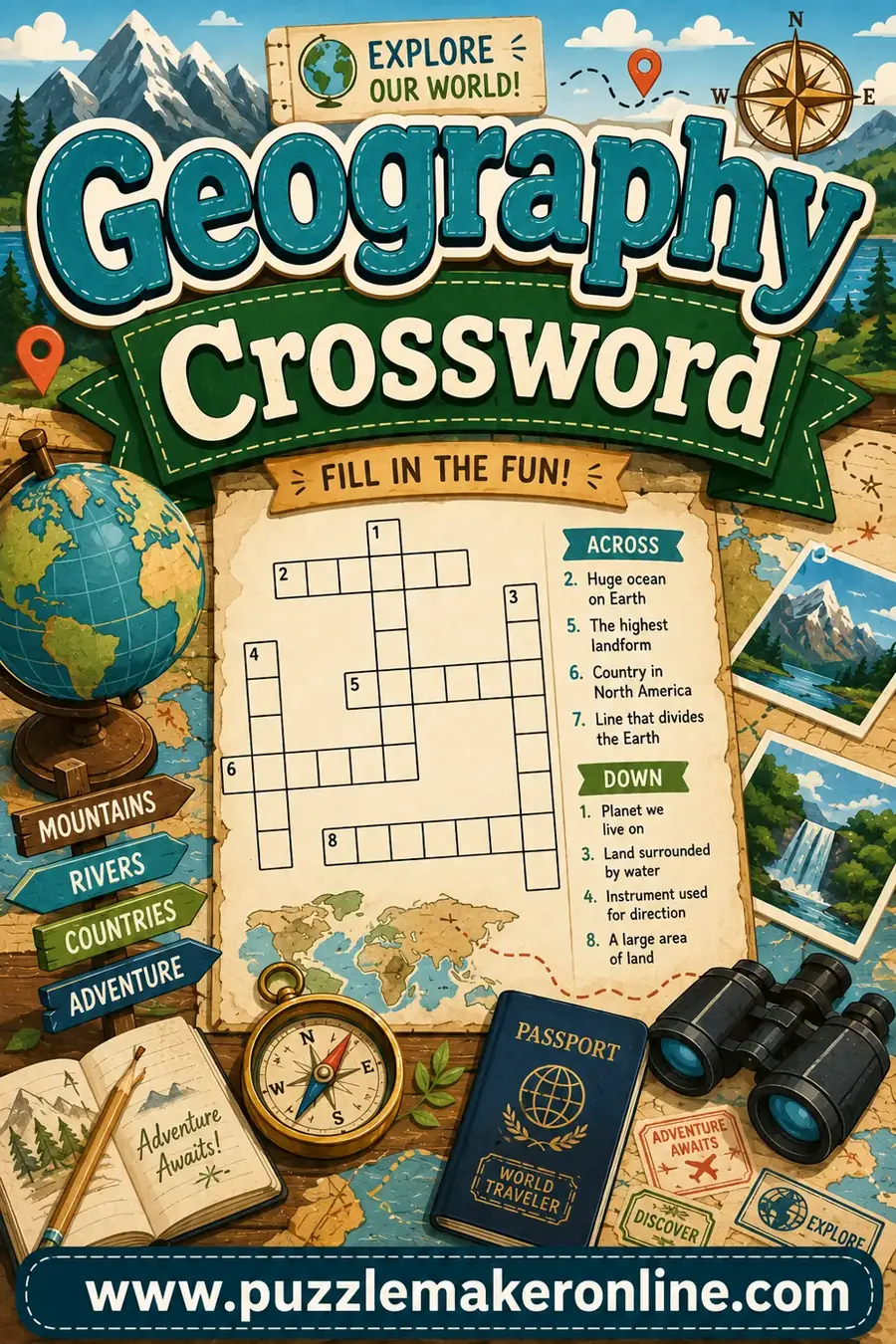
Grab the word list above, open the free puzzle maker, add your clues, and you'll have a clean, printable math crossword in minutes. It's free, there's no sign-up, and the answer key prints right alongside it, so your class or study session is ready to go. Want more? Build a history crossword, an animal crossword, or a geography crossword with the same simple tool.