How to Solve Kakuro: Rules, Sum Tables and Worked Examples
If you want to know how to solve kakuro, here's the short version: fill every white square with a digit from 1 to 9 so that each horizontal or vertical run adds up to the clue printed beside it, without repeating a digit inside that run. You solve it by spotting runs that only one set of digits can fill, then crossing those runs with the runs that intersect them until every square has just one possible digit.
That crossing step is the heart of the puzzle, and it's very learnable. Below you'll find the rules, the full table of "magic" sums with only one answer, the main solving techniques, a complete worked puzzle solved one square at a time, a practice puzzle with its answer, and a short history that runs from a 1950 American magazine to Japan and back again.
What kakuro is
Kakuro looks like a crossword, but with numbers instead of letters. The grid has white squares to fill and black squares that hold clues. Each clue is a sum. A clue sitting to the left of a row of white squares tells you what that row of squares adds up to. A clue sitting above a column of white squares tells you what that column adds up to. When a black square has two clues, it's split by a diagonal line: one number for the run going right and one for the run going down.
The Japanese publisher Nikoli, which also popularized sudoku, calls kakuro "the king of pencil puzzles" on its official kakuro page. Fans in the US may know it by its older American name, Cross Sums.
A few terms used in this guide
- Run (also called a block or entry): an unbroken line of white squares, across or down, that belongs to one clue.
- Clue: the sum printed in the black square at the start of a run.
- Combination: a set of different digits that adds up to a clue, ignoring order. For example, {1, 2, 4} is a combination for 7 in three squares.
- Unique sum (sometimes called a magic block): a clue and length that only one combination can satisfy.
- Crossing square: a white square that belongs to both an across run and a down run. Every white square in a proper kakuro is a crossing square.
The rules of kakuro
Nikoli's official rules are short, and every kakuro you'll meet follows them.
- Use only the digits 1 to 9. Zero isn't allowed.
- Each run must add up to its clue. The clue in a black square gives the total of the white squares to its right (across) or below it (down).
- No repeats within a run. A digit can appear only once in any single run. It can appear again in a different run, even in the same row, as long as a black square separates the two runs.
A well-made kakuro also has exactly one solution, which you can reach by logic without guessing. That's the promise that makes the puzzle fair.
What the "no repeats" rule really means
The no-repeat rule is what gives kakuro its logic. Without it, a run of two squares adding to 4 could be 2 + 2 or 1 + 3. With it, 2 + 2 is out, so the only answer is 1 and 3 in some order. The University of Queensland's Club Infinity math newsletter uses exactly this example to explain the puzzle: since the digits must be distinct, 4 can't be 2 + 2.
How to solve kakuro: the step-by-step method
Here's the loop that solves nearly every kakuro. Keep it next to you for your first few puzzles.
- Find the unique sums. Scan every clue and its run length. Short runs with very small or very large clues (like 3 in two squares or 24 in three) have only one combination. Mark their possible digits in pencil.
- Find the crossing squares of those runs. A square in a unique-sum run is limited to that run's digits. Now check which of those digits fits the other run through the same square.
- Use limits from the other direction. If a down run is 3 in two squares, both squares are 1 or 2. That means any across run that crosses it can only use 1 or 2 in that square, which may cut its options sharply.
- Eliminate combinations that repeat a known digit. Once a digit is placed in a run, any combination that needs it again is impossible.
- Check upper and lower bounds. Ask whether the remaining squares could possibly reach the remaining total using the biggest or smallest available digits.
- Fill by subtraction. When all but one square in a run is known, subtract to get the last one.
- Repeat. Every new digit tightens the runs that cross it.
These steps line up with the techniques in the Conceptis kakuro techniques guide, which walks through unique combinations, intersection logic, elimination by repetition, largest-sum checks and completion by subtraction on a sample grid.
The kakuro sum tables
The single most useful tool for kakuro is knowing which sums have only one answer. You can work them out yourself: for two squares, the smallest sum is 1 + 2 = 3 and the largest is 8 + 9 = 17. The sums just above the minimum and just below the maximum leave no room to choose. The table below lists every unique sum for runs of two to nine squares. We generated it by listing every set of distinct digits from 1 to 9 and checking which totals appear only once.
| Run length | Possible sums | Unique sums (and their digits) |
|---|---|---|
| 2 squares | 3 to 17 | 3 = 1+2; 4 = 1+3; 16 = 7+9; 17 = 8+9 |
| 3 squares | 6 to 24 | 6 = 1+2+3; 7 = 1+2+4; 23 = 6+8+9; 24 = 7+8+9 |
| 4 squares | 10 to 30 | 10 = 1+2+3+4; 11 = 1+2+3+5; 29 = 5+7+8+9; 30 = 6+7+8+9 |
| 5 squares | 15 to 35 | 15 = 1+2+3+4+5; 16 = 1+2+3+4+6; 34 = 4+6+7+8+9; 35 = 5+6+7+8+9 |
| 6 squares | 21 to 39 | 21 = 1 to 6; 22 = 1+2+3+4+5+7; 38 = 3+5+6+7+8+9; 39 = 4 to 9 |
| 7 squares | 28 to 42 | 28 = 1 to 7; 29 = 1+2+3+4+5+6+8; 41 = 2+4+5+6+7+8+9; 42 = 3 to 9 |
| 8 squares | 36 to 44 | Every sum is unique: the missing digit is 45 minus the sum |
| 9 squares | 45 only | 45 = all of 1 to 9 |
The UQ newsletter lists the two-, three- and four-square unique sums from this table and suggests keeping a list of them handy while you solve. Conceptis gives the same idea a nickname, "magic blocks," with examples like 24 in three (only 7 + 8 + 9) and 16 in five (only 1 + 2 + 3 + 4 + 6).
The eight-square shortcut
The eight-square row in the table is worth a second look. All nine digits add up to 1 + 2 + ... + 9 = 45. An eight-square run uses every digit but one, so the missing digit is always 45 minus the clue. A clue of 40 in eight squares means the missing digit is 5. That makes every eight-square run a unique sum.
Two- and three-square combinations
Most kakuro runs are short. These are the combinations you'll use most. Learning the ones with only two options (like 5 in two: {1, 4} or {2, 3}) is nearly as helpful as learning the true unique sums.
| Clue | Two squares | Three squares |
|---|---|---|
| 5 | 1+4, 2+3 | (not possible) |
| 6 | 1+5, 2+4 | 1+2+3 only |
| 7 | 1+6, 2+5, 3+4 | 1+2+4 only |
| 8 | 1+7, 2+6, 3+5 | 1+2+5, 1+3+4 |
| 9 | 1+8, 2+7, 3+6, 4+5 | 1+2+6, 1+3+5, 2+3+4 |
| 10 | 1+9, 2+8, 3+7, 4+6 | 1+2+7, 1+3+6, 1+4+5, 2+3+5 |
| 11 | 2+9, 3+8, 4+7, 5+6 | five sets (e.g., 1+2+8, 2+4+5) |
| 12 | 3+9, 4+8, 5+7 | seven sets |
| 13 | 4+9, 5+8, 6+7 | seven sets |
| 14 | 5+9, 6+8 | eight sets |
| 15 | 6+9, 7+8 | eight sets |
| 16 | 7+9 only | eight sets |
| 17 | 8+9 only | seven sets |
| 20 | (not possible) | 3+8+9, 4+7+9, 5+6+9, 5+7+8 |
| 21 | (not possible) | 4+8+9, 5+7+9, 6+7+8 |
| 22 | (not possible) | 5+8+9, 6+7+9 |
| 23 | (not possible) | 6+8+9 only |
| 24 | (not possible) | 7+8+9 only |
Notice the mirror pattern. Swap every digit d for 10 − d (1 becomes 9, 2 becomes 8, and so on), and a combination for one clue turns into a combination for its "mirror" clue. For a run of k squares, the mirror of a clue s is 10 × k − s. So 4 in two (1+3) mirrors 16 in two (9+7), because 20 − 4 = 16. And 6 in three (1+2+3) mirrors 24 in three (9+8+7), because 30 − 6 = 24. Learn the small sums, and you get the large ones for free.
Core kakuro techniques with examples
1. Intersect two unique sums
The fastest opening move in kakuro is a square where two tight runs cross. Suppose an across run is 16 in two squares (only 7 and 9) and a down run through its right-hand square is 17 in two squares (only 8 and 9). The shared square must be 9, because that's the only digit both runs allow. The other across square is then 7, and the other down square is 8. Three squares filled from two clues.
2. Use the crossing run to rule out options
Say an across run is 14 in two squares, so it's {5, 9} or {6, 8}. One of its squares sits in a down run of 9 in three squares, whose combinations ({1, 2, 6}, {1, 3, 5}, {2, 3, 4}) never use 8 or 9. So that crossing square can only be 5 or 6. That's a big cut from four options to two.
3. Bounds: too big or too small
Ask what the remaining squares could possibly add up to. Conceptis gives an example: in a 27-in-four run, a square can't be 2, because the other three squares could total at most 9 + 8 + 7 = 24, and 2 + 24 = 26 falls short of 27. Turn this around for small clues, too. In a 10-in-four run, no square can be bigger than 4, since the other three need at least 1 + 2 + 3 = 6.
4. Elimination by repetition
Once a digit is placed in a run, cross off every combination that needs that digit twice, and cross that digit off the run's other squares. This sounds obvious, but forgetting it is the most common cause of mistakes.
5. The area (cross-sum) method
This one is less obvious and very powerful. Pick a block of white squares that's fully covered by several across runs and also by several down runs, except for one square. Add the across clues, add the down clues, and the difference between the two totals is the value of the odd square out. The Conceptis guide shows a case where one region sums to 84 one way and 75 the other, so the leftover square is 84 − 75 = 9. It works because both totals count the same squares, except the one that only one direction includes.
6. Last square by subtraction
When only one square in a run is empty, subtract the known digits from the clue. It's the simplest technique, but it finishes every puzzle.
Quick drills: reading a single run
Before tackling a full grid, it helps to practice reading one run at a time. Try each of these, then check the answer underneath.
- A down run of 23 in three squares crosses an across run of 7 in three squares. What's the shared square? 23 in three is only {6, 8, 9}. 7 in three is only {1, 2, 4}. They share no digit, so a well-made puzzle would never cross these two runs. Spotting impossible pairings like this is a good way to catch a misread clue.
- An across run of 11 in two squares crosses a down run of 4 in two squares. What can the shared square be? 4 in two is {1, 3}. 11 in two is {2, 9}, {3, 8}, {4, 7} or {5, 6}. The only overlap is 3, so the shared square is 3, the rest of the across run is 8, and the rest of the down run is 1.
- A run of 29 in four squares already has a 5 in it. What are the other three digits? 29 in four is a unique sum, {5, 7, 8, 9}, so the other three are 7, 8 and 9 in some order.
- A run of 12 in three squares already has a 9 in it. What are the other two? They add to 3, so they must be 1 and 2. Placing one large digit often forces the rest of a short run.
- A run of 40 in eight squares. Which digit is missing? 45 − 40 = 5. So the run uses every digit except 5.
These drills cover the three moves that do most of the work in real puzzles: intersecting two runs, reading a unique sum, and subtracting what's known.
Worked example: a complete kakuro, step by step
Here's a full puzzle, solved from start to finish. Columns of white squares are lettered a to e, and rows are numbered 1 to 5, so "c2" means column c, row 2. In the clue squares, a number with ↓ is a down clue for the squares below it, and a number with → is an across clue for the squares to its right. A dot marks a white square to fill, and ■ marks an empty black square.
| (clues) | a | b | c | d | e | |
|---|---|---|---|---|---|---|
| top | ■ | 12↓ | 35↓ | ■ | 5↓ | 7↓ |
| 1 | 10→ | · | · | 9↓ 6→ | · | · |
| 2 | 25→ | · | · | · | · | · |
| 3 | ■ | 10↓ 14→ | · | · | 11↓ | 17↓ |
| 4 | 24→ | · | · | · | · | · |
| 5 | 11→ | · | · | 16→ | · | · |
Here's every run in words, so nothing depends on reading the grid perfectly:
- Across: a1–b1 = 10; d1–e1 = 6; a2–e2 = 25; b3–c3 = 14; a4–e4 = 24; a5–b5 = 11; d5–e5 = 16.
- Down: a1–a2 = 12; a4–a5 = 10; b1–b5 = 35; c2–c4 = 9; d1–d2 = 5; d4–d5 = 11; e1–e2 = 7; e4–e5 = 17.
Step 1: Two unique sums cross at e5
The down run e4–e5 is 17 in two squares, so it's 8 and 9. The across run d5–e5 is 16 in two squares, so it's 7 and 9. Square e5 is in both, and 9 is the only digit they share. So e5 = 9, which makes e4 = 8 and d5 = 7.
Step 2: Finish the d4–d5 run
The down run d4–d5 is 11, and d5 = 7. So d4 = 11 − 7 = 4.
Step 3: The 35-in-five column
Column b runs all five rows and adds to 35. Check the table: 35 in five squares is a unique sum, 5 + 6 + 7 + 8 + 9. So b1 through b5 use exactly the digits 5, 6, 7, 8 and 9, in some order. No square in column b can be smaller than 5. Keep that in mind; it powers the next three steps.
Step 4: Crack row 4
Row 4 adds to 24, and we know d4 = 4 and e4 = 8. So a4 + b4 + c4 = 24 − 4 − 8 = 12, using digits other than 4 and 8.
Now look at column a's bottom run: a4 + a5 = 10. And row 5's left run: a5 + b5 = 11. Since b5 is between 5 and 9, a5 = 11 − b5 is between 2 and 6, so a4 = 10 − a5 is between 4 and 8. Taking out the 4 and 8 already in row 4 leaves a4 = 5, 6 or 7. Test each one:
- a4 = 7: then b4 + c4 = 5. But b4 is at least 5, so c4 would have to be 0. Impossible.
- a4 = 5: then b4 + c4 = 7. With b4 at least 5, and 5 already used by a4, b4 must be 6 and c4 = 1. But then a5 = 10 − 5 = 5 and b5 = 11 − 5 = 6, putting a second 6 in column b. Impossible.
- a4 = 6: then a5 = 4 and b5 = 7. Row 4 needs b4 + c4 = 6 with b4 at least 5 and not 6, so b4 = 5 and c4 = 1. Everything fits.
So a4 = 6, a5 = 4, b5 = 7, b4 = 5, c4 = 1.
Step 5: The top-left corner
Column b still needs 6, 8 and 9 in b1, b2 and b3. Row 1's left run is a1 + b1 = 10, and column a's top run is a1 + a2 = 12. Since b1 is 6, 8 or 9, a1 would be 4, 2 or 1. But a2 = 12 − a1 can't be more than 9, so a1 must be at least 3. That leaves only a1 = 4 with b1 = 6. So a1 = 4 and a2 = 8.
Step 6: The middle of column b and column c
Column b now needs 8 and 9 in b2 and b3. Row 2 already has a2 = 8, so b2 = 9 and b3 = 8.
The across run b3–c3 is 14, so c3 = 14 − 8 = 6. The down run c2–c4 is 9, and c3 + c4 = 6 + 1 = 7, so c2 = 2.
Step 7: The top-right corner
Row 2 is 25 in total: 8 + 9 + 2 + d2 + e2 = 25, so d2 + e2 = 6.
Now the three little runs up there. The down run d1–d2 is 5, so it's {1, 4} or {2, 3}. The across run d1–e1 is 6, so it's {1, 5} or {2, 4}. Square d1 is in both, so d1 is 1, 2 or 4 (the digits both lists share). Then d2 = 5 − d1 is 4, 3 or 1. The down run e1–e2 is 7, and e1 = 6 − d1 is 5, 4 or 2, so e2 = 7 − e1 is 2, 3 or 5.
Which pair (d2, e2) adds to 6? The candidates are (4, 2), (3, 3) and (1, 5). The pair (3, 3) repeats a digit, and (4, 2) would put a second 2 in row 2 next to c2 = 2. Only (1, 5) works. So d2 = 1, e2 = 5, d1 = 4, e1 = 2.
Double-check: d1 + e1 = 4 + 2 = 6. d1 + d2 = 4 + 1 = 5. e1 + e2 = 2 + 5 = 7. Everything adds up.
The finished grid
| (clues) | a | b | c | d | e | |
|---|---|---|---|---|---|---|
| top | ■ | 12↓ | 35↓ | ■ | 5↓ | 7↓ |
| 1 | 10→ | 4 | 6 | 9↓ 6→ | 4 | 2 |
| 2 | 25→ | 8 | 9 | 2 | 1 | 5 |
| 3 | ■ | 10↓ 14→ | 8 | 6 | 11↓ | 17↓ |
| 4 | 24→ | 6 | 5 | 1 | 4 | 8 |
| 5 | 11→ | 4 | 7 | 16→ | 7 | 9 |
Check a few runs: row 2 is 8 + 9 + 2 + 1 + 5 = 25. Column b is 6 + 9 + 8 + 5 + 7 = 35. Row 4 is 6 + 5 + 1 + 4 + 8 = 24. Notice that the digit 4 appears four times (a1, d1, d4 and a5), which is perfectly legal because no single run repeats it.
The big lesson here is Step 4. When no single clue gives you an answer, follow a chain of runs (row 5 into column a into row 4) and test the few possibilities that remain. Each test was short, and two of the three broke immediately.
Try it yourself: a practice kakuro
Here's a smaller puzzle with exactly one solution. The same steps will crack it. The answer is underneath, so cover it before you start.
| (clues) | a | b | c | |
|---|---|---|---|---|
| top | ■ | 3↓ | 11↓ | ■ |
| 1 | 3→ | · | · | 13↓ |
| 2 | 8→ | · | · | · |
| 3 | ■ | 16→ | · | · |
Runs in words: across a1–b1 = 3, a2–c2 = 8, b3–c3 = 16; down a1–a2 = 3, b1–b3 = 11, c2–c3 = 13.
| Answer | (clues) | a | b | c |
|---|---|---|---|---|
| top | ■ | 3↓ | 11↓ | ■ |
| 1 | 3→ | 2 | 1 | 13↓ |
| 2 | 8→ | 1 | 3 | 4 |
| 3 | ■ | 16→ | 7 | 9 |
The logic in brief: 16 in two is 7 and 9. If b3 were 9, then b1 + b2 would be 2, which two different digits can't make, so b3 = 7 and c3 = 9. Then c2 = 13 − 9 = 4. Column b needs b1 + b2 = 4, which is 1 and 3, and b1 must also fit the 3-in-two run (1 or 2), so b1 = 1, b2 = 3, a1 = 2 and a2 = 1. Row 2 checks out: 1 + 3 + 4 = 8.
Common kakuro mistakes
- Repeating a digit in a run. It's easy to place a 5 in a long run and forget that the same run already has a 5 three squares away. Scan the whole run before writing.
- Treating a row as one run. A black square breaks a row into separate runs. Digits can repeat across that break. Our worked example has four 4s in it for exactly this reason.
- Forgetting zero isn't allowed. A two-square 9 can't be 9 + 0. The smallest digit is 1.
- Guessing too early. If you're stuck, look for a run with only two combinations and test each one for a few steps, like Step 4 above. That's logic, not a coin flip.
- Writing in ink. Use pencil marks for candidates in the corners of squares, and only write a big digit when you're sure.
The history of kakuro: from Cross Sums to Nikoli
Kakuro's story crosses the Pacific twice. The Conceptis kakuro history page lays out the timeline below.
| Year | What happened |
|---|---|
| 1950 | The earliest known form, called Cross Sums, appears in the April/May issue of Official Crossword Puzzles from Dell Publishing. Will Shortz has described it as the brainchild of a Canadian building constructor, Jacob E. Funk. |
| Mid-1960s | Cross Sums appear in every issue of every Dell puzzle magazine. |
| 1980 | Maki Kaji, president of Nikoli, brings Cross Sums to Japan and names them Kasan Kurosu, combining the Japanese word for "addition" with the Japanese pronunciation of "cross." |
| 1986 | Nikoli shortens the name to Kakuro and releases its first kakuro booklet. |
| 1992 | Sudoku overtakes kakuro as Nikoli's most popular puzzle. |
| September 2005 | The Western kakuro boom begins in the UK, when The Guardian and the Daily Mail start publishing daily kakuro puzzles. |
| 2006 | Sterling Publishing releases eight books of Conceptis kakuro puzzles in the US. |
Conceptis also reports that Nikoli has sold about a million kakuro books in total. The word-tracking site World Wide Words, in its 2005 note on "kakuro", adds that The Guardian launched the puzzle as part of its complete redesign into the smaller Berliner format, and that the name was first "kasan kurosu" before being shortened for marketing.
Nikoli's own page says kakuro first appeared in volume 11 of its puzzle magazine, and that Nikoli's version keeps the arithmetic light so newcomers can enjoy it. That fits the puzzle's reputation: you only need addition, and mostly small sums at that. The real work is logic.
Kakuro and sudoku are old rivals: both were championed by Nikoli, and as the timeline shows, sudoku took kakuro's top spot in Japan in 1992. Our page on the origin of sudoku tells that puzzle's side of the story.
The math behind kakuro
Kakuro is also a serious subject for computer scientists and mathematicians. A 2008 paper from the University of Glamorgan (now the University of South Wales), "Properties of, and Solutions to, Kakuro and Related Puzzles" by Ryan P. Davies, Stephanie Perkins and Paul Roach, measures how hard a kakuro is by counting the ways each run could be filled with digits. The authors note that published puzzles usually have a unique solution that logic can reach, while generalized versions often have several solutions and need search methods. That's a useful reminder: the unique-solution guarantee is something puzzle makers work hard to build in. It isn't automatic.
Counting combinations is something you can try at home, too. For two squares, there are 36 possible pairs of different digits (that's 9 × 8 ÷ 2), spread across sums from 3 to 17. Only four of those sums (3, 4, 16 and 17) have a single pair. The middle sums, 9, 10 and 11, have four pairs each, which is why they're the least helpful clues in a two-square run.
Kakuro compared with other number puzzles
| Puzzle | Clue type | Digits | Repeats allowed? |
|---|---|---|---|
| Kakuro | Sums of runs | 1 to 9 | No repeats within a run |
| Sudoku | Given digits | 1 to 9 | No repeats in a row, column or box |
| Killer sudoku | Sums of cages plus sudoku rules | 1 to 9 | No repeats in a cage, row, column or box |
| KenKen | Cage results with +, −, × or ÷ | 1 to N | No repeats in a row or column |
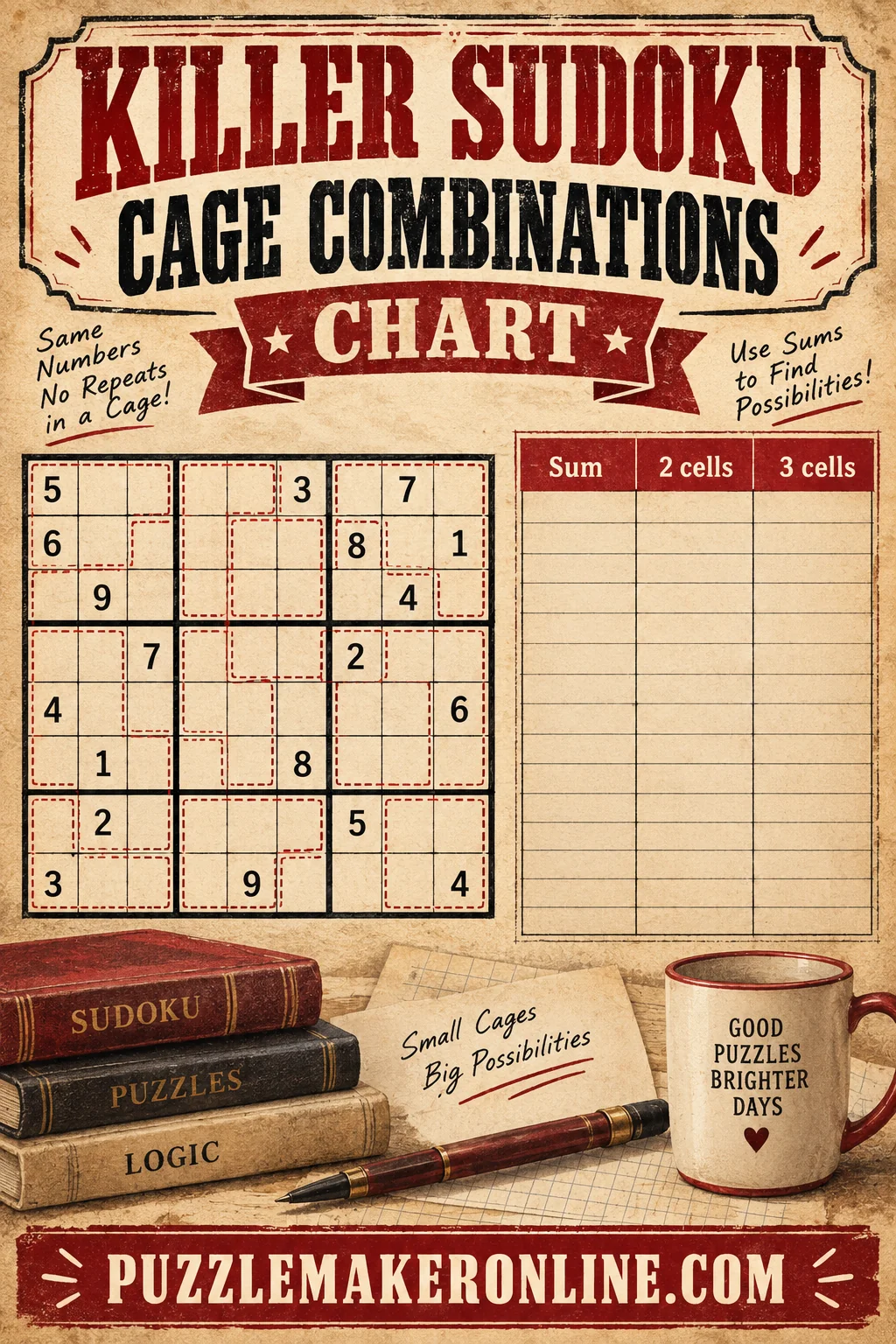
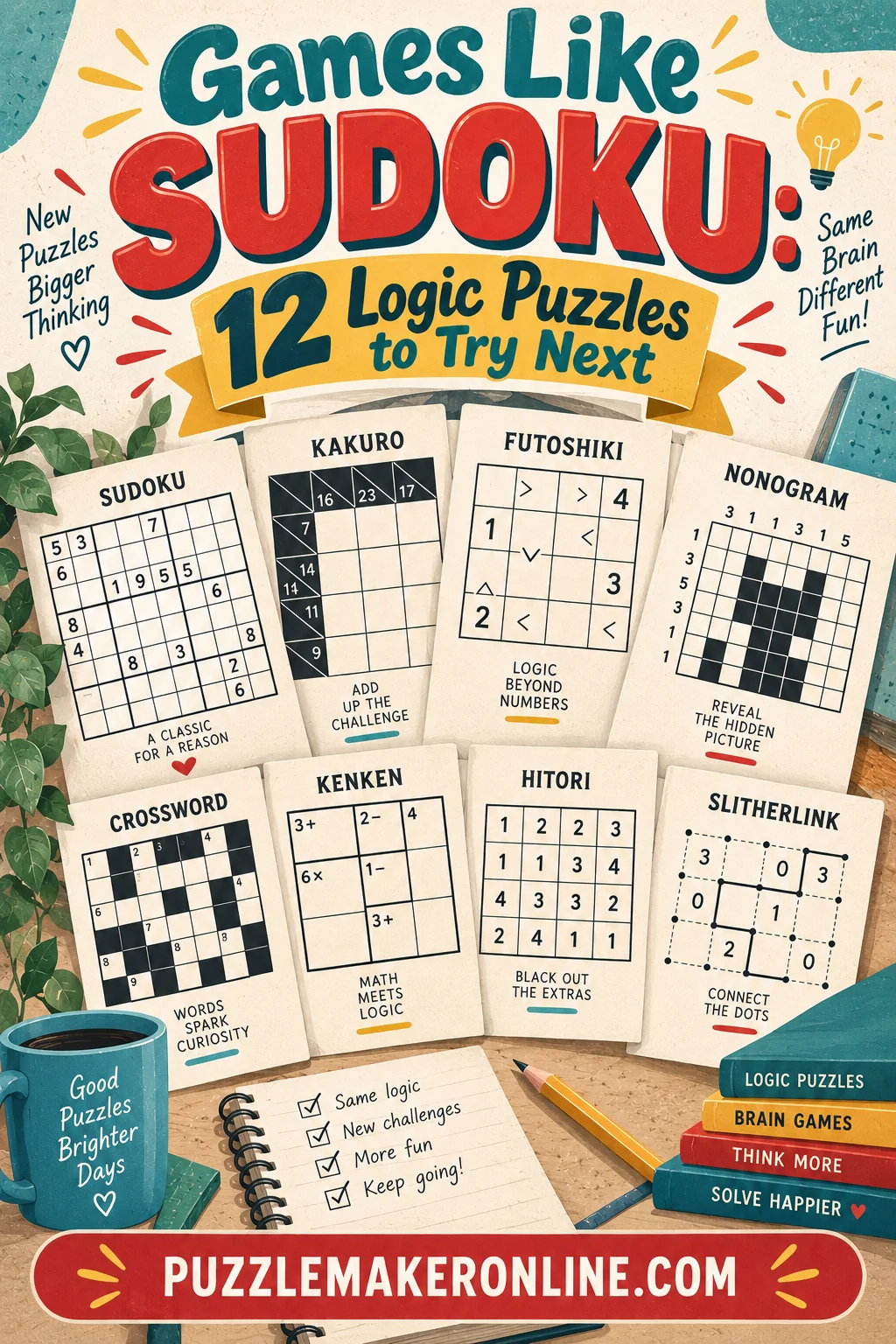
If you enjoy kakuro's sums, killer sudoku will feel like home. It uses the same combination logic inside sudoku's 9x9 grid, and our killer sudoku combinations table works for kakuro runs, too, since the rule against repeats is the same. For a tour of other number puzzles, see games like sudoku, and if you're brand new to sudoku-style logic, start with how to play sudoku. KenKen, which adds subtraction, multiplication and division, has its own guide in our solving series.
Tips for getting faster
- Memorize the two- and three-square unique sums first. That's just eight facts: 3, 4, 16 and 17 in two; 6, 7, 23 and 24 in three.
- Start at the corners and edges. Short runs cluster there, and short runs are the most restrictive.
- Look for very long runs. As our example showed, a long run with an extreme total (like 35 in five) can lock a whole column to five specific digits.
- Write combinations, not just digits. For a 14-in-two run, write "59/68" in the clue square. It keeps both options visible.
- Use the area method when stuck. Add up the across clues and down clues over a region; the difference often hands you a square.
- Solve a little every day. Like any pattern skill, the sums start jumping out at you with repetition. Our sudoku cheat sheet is a good model for making your own one-page kakuro reference card.
Keep practicing
Kakuro rewards a small set of facts (the unique sums) and a single habit (crossing every run with the runs that cut through it). Once those click, puzzles that looked impossible start falling one square at a time.
When you want something different between number puzzles, our free puzzle maker lets you type your own words or pick a theme, choose a puzzle type, and print it with an answer key. It's a quick way to put together a mixed puzzle set for a class, a club or a quiet evening.
Six Kakuro Techniques Compared
This table puts the core solving techniques side by side, with what each one does and a quick example.
| Technique | The idea | Example |
|---|---|---|
| Intersect two unique sums | Find a square where two tight runs cross and use the one digit both allow | 16 in two squares (7 and 9) crossing 17 in two squares (8 and 9) forces a 9 |
| Use the crossing run | Rule out options in one run using the digits the crossing run allows | 14 in two squares is {5, 9} or {6, 8}, but a crossing 9 in three squares never uses 8 or 9, so the square is 5 or 6 |
| Bounds | Ask what the remaining squares could possibly add up to | In a 27-in-four run a square can't be 2, and in a 10-in-four run no square can be bigger than 4 |
| Elimination by repetition | Once a digit is placed, cross off combinations that need it twice and remove it from the run's other squares | Forgetting this is the most common cause of mistakes |
| Area (cross-sum) method | Compare the across and down totals over a block of squares to find the odd square out | 84 one way and 75 the other leaves 84 − 75 = 9 |
| Last square by subtraction | When one square in a run is empty, subtract the known digits from the clue | The simplest technique, but it finishes every puzzle |
Frequently Asked Questions
What are the rules of kakuro?
Fill every white square with a digit from 1 to 9. Each clue in a black square gives the sum of the run of white squares to its right or below it, and the digits in that run must add up to the clue. No digit may repeat within a single run, although the same digit can appear in different runs. Zero is never used. A well-made kakuro has exactly one solution that you can reach by logic alone, without guessing.
How do I start a kakuro puzzle?
Look for unique sums first. These are clue and length pairs with only one possible set of digits, like 3 in two squares (1 and 2), 17 in two squares (8 and 9), 6 in three squares (1, 2 and 3) or 24 in three squares (7, 8 and 9). Then find where one of those runs crosses another tight run. The square they share can only hold a digit that both runs allow, and that often gives you your first placed number.
What does a unique sum mean in kakuro?
A unique sum is a clue that only one combination of different digits can make for a given run length. For example, 16 in two squares can only be 7 and 9, and 35 in five squares can only be 5, 6, 7, 8 and 9. The order is still unknown, but the set of digits is fixed. Unique sums always sit at the very low or very high end of what a run can total, which makes them easy to spot once you know the pattern.
Can a digit repeat in the same row in kakuro?
A digit cannot repeat within one run, but a row can contain more than one run if a black square breaks it up. Digits may repeat across that break. For example, a row might have a two-square run on the left and another two-square run on the right, and both could include a 4. What matters is the run attached to each clue, not the whole row or column of the grid.
What is the difference between kakuro and Cross Sums?
They are the same kind of puzzle under different names. Cross Sums first appeared in a Dell puzzle magazine in 1950, according to Conceptis. In 1980 Maki Kaji of Nikoli brought the puzzle to Japan as Kasan Kurosu, and in 1986 Nikoli shortened the name to Kakuro. When British newspapers began running the puzzle daily in 2005, they used the Japanese name, which is why most people know it as kakuro today.
Is kakuro harder than sudoku?
Kakuro feels harder to some people at first because it combines addition with logic and starts with no digits on the grid. But the arithmetic is light, since you are mostly adding two to five small numbers, and the logic is very consistent. Once you learn the unique sums, many solvers find small kakuro puzzles quicker than a medium sudoku. Large kakuro grids with long runs can be quite demanding, though, so difficulty depends heavily on the puzzle.
Do I need to be good at math to solve kakuro?
You only need to add small numbers and remember a handful of facts. The rest is logic. A short list of unique sums, such as 3 and 4 in two squares or 23 and 24 in three, does most of the heavy lifting. Many solvers keep a printed sum table next to the puzzle at first. After a few puzzles, the common combinations become familiar, and the table is rarely needed.
What should I do when I get stuck on a kakuro?
Look for a run with only two possible combinations and follow each one for a couple of steps through the runs that cross it. Often one choice quickly leads to a repeated digit or an impossible sum, which leaves the other. You can also try the area method: add the across clues and the down clues over a region that covers the same squares except one, and the difference gives that square. Double-check for a missed repeat, too.
How many combinations are there for a two-square kakuro run?
There are 36 different pairs of distinct digits from 1 to 9, which is 9 times 8 divided by 2. Their sums range from 3 to 17. Only four sums have a single pair: 3, 4, 16 and 17. The middle sums, 9, 10 and 11, each have four possible pairs, which makes them the least helpful two-square clues. Knowing this tells you where to look first on any grid.
Sources
We checked every source below while writing this guide. Last reviewed October 30, 2026, by Joan Ramos.
- Kakuro: Rules and Info (Nikoli)
- Kakuro History (Conceptis Puzzles)
- Kakuro Techniques (Conceptis Puzzles)
- Kakuro (Club Infinity Newsletter 21) (School of Mathematics and Physics, The University of Queensland)
- Properties of, and Solutions to, Kakuro and Related Puzzles (Davies, Perkins and Roach, 2008) (University of South Wales (University of Glamorgan))
- Kakuro (World Wide Words)