
Japanese Sudoku: The Puzzles Behind the Name
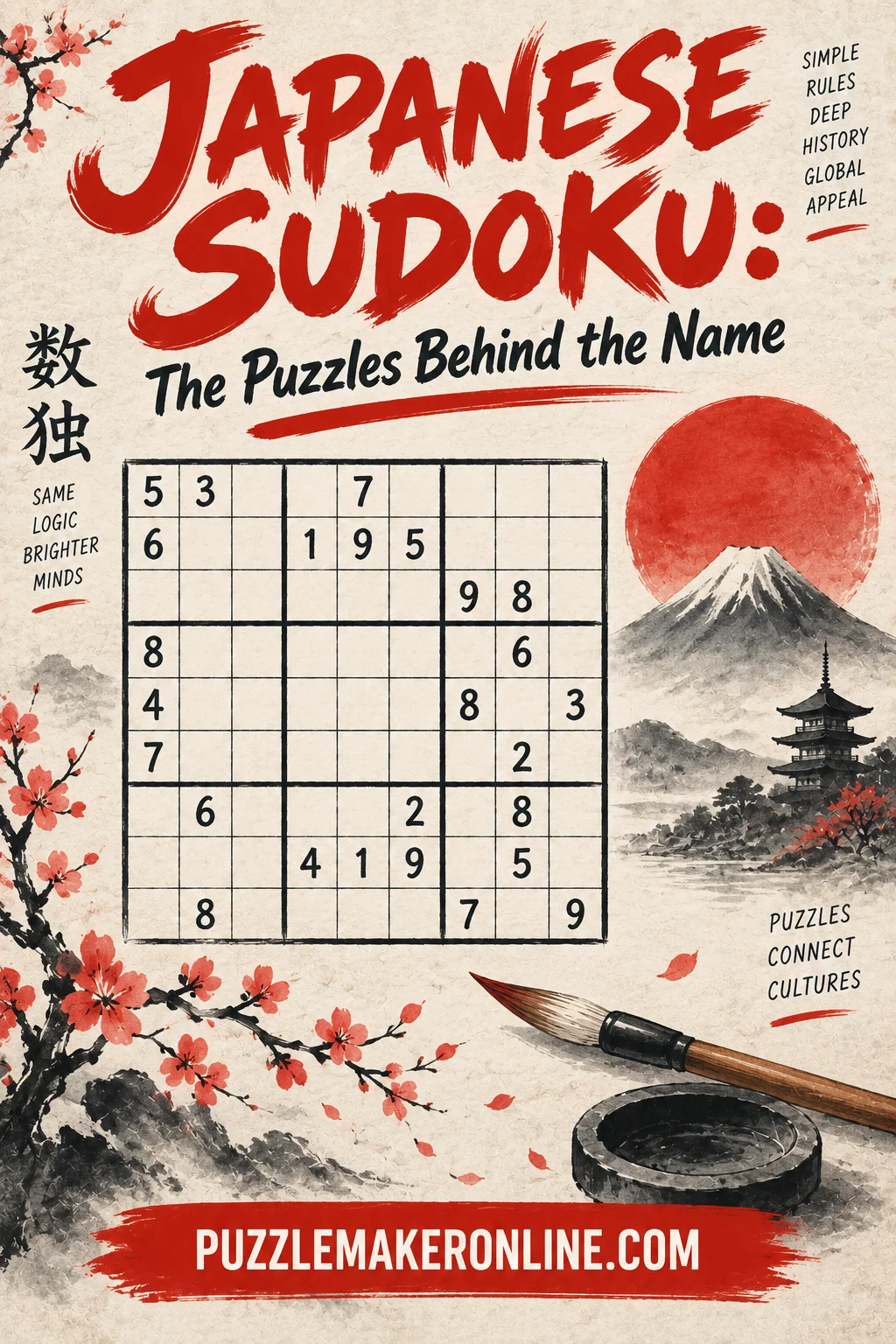
Japanese sudoku is a slightly misleading phrase: the puzzle was named in Japan but not invented there, and the word is a contraction of the Japanese phrase "suuji wa dokushin ni kagiru," meaning roughly that the digits must be single. The grid itself was published in an American magazine in 1979 as Number Place. What Japan contributed was the name, the editorial style, and an entire family of related logic puzzles that most solvers outside the country have never heard of.
That last part is the reason this article is worth reading. If you like sudoku, the puzzles it grew up alongside are the best recommendation engine available, and almost none of them use language either.
What the name actually means
The full Japanese phrase is "suuji wa dokushin ni kagiru." Broken down: suuji means numbers or digits, dokushin means single or unmarried, and kagiru means to be limited to. The sense is that each digit must remain single, appearing alone and unrepeated within its unit.
The publisher Nikoli shortened it to sudoku, taking the first character of suuji and the first of dokushin. Su-doku. It is a compact and slightly playful name, which is characteristic of how that publisher names its puzzles.
Two pronunciation notes, since they come up constantly. The first syllable is closer to "soo" than "sue," and the whole word carries even stress across three syllables rather than a strong accent on any one. Neither matters for solving, but they explain why the word is spelled the way it is rather than the way English speakers tend to say it.
Named in Japan, invented in America
The chronology is straightforward and frequently reported backward.
The modern grid, nine by nine with nine boxes and each symbol appearing once per row, column, and box, was published in an American puzzle magazine in 1979 under the name Number Place, credited to Howard Garns. Nikoli picked it up and published it in Japan in 1984, where it acquired the name that stuck. Two decades later it reached British newspapers and then the rest of the world, arriving under its Japanese name and carrying an assumption of Japanese origin with it.
So the phrase "Japanese sudoku" is accurate about the naming and the editorial tradition, and inaccurate about the invention. Our article on sudoku history traces the full sequence, including the Latin squares that supplied the underlying structure and the French newspaper grids of the 1890s that got there first and then vanished.
Why the puzzle thrived in Japan specifically
This is the interesting question, and the answer is a practical one about writing systems.
Crosswords work poorly in Japanese. The writing system combines two syllabaries with thousands of characters, so a letter-by-letter interlocking grid is awkward in a way it simply is not in English. Japanese puzzle publishers therefore had strong reason to develop puzzle formats that do not depend on spelling at all.
Sudoku is entirely language-free. So are the dozen or so puzzles that developed alongside it in the same magazines. That constraint produced a whole tradition of pure logic puzzles, and it is also exactly why sudoku traveled so easily when it eventually left. The property that made it suitable for a Japanese magazine made it printable in any newspaper on earth without a translator.
The editorial style that came with the name
Two conventions attached to the puzzle in Japan and are now global defaults, though neither is a rule.
Symmetric clue patterns. The given symbols are conventionally arranged so the pattern has rotational symmetry. Turn the grid 180 degrees and the clue positions match. This has no effect on solvability. It exists because a symmetric grid looks composed rather than randomly punched, and a puzzle that looks designed invites more engagement.
Handmade construction. The publisher's puzzles are traditionally built by human constructors rather than generated by software. A person builds a grid with a specific solving path in mind, so the deductions flow in a deliberate sequence. Generated puzzles are valid and correctly graded, but they can jump between unrelated regions of the grid in a way handmade ones rarely do.
You can feel the difference if you solve a lot of both. Neither is better; they are different experiences of the same rules.
The family: Japanese logic puzzles worth knowing
Here is the practical payoff. If sudoku suits you, these are its siblings, and every one of them is language-free.
| Puzzle | The grid asks you to | Closest to |
|---|---|---|
| Kakuro | Fill runs of cells that sum to a target, no repeats | Sudoku with arithmetic |
| Nonogram | Shade cells from row and column counts to reveal an image | Sudoku's deduction, visual payoff |
| Slitherlink | Draw one closed loop obeying numbered cell counts | Route logic |
| Hashiwokakero | Connect islands with bridges to a stated count | Network logic |
| Nurikabe | Shade a connected wall leaving numbered islands | Region logic |
| Masyu | Draw a loop obeying rules at white and black circles | Path constraints |
| Shikaku | Divide the grid into rectangles of stated area | Partition logic |
| Hitori | Black out cells so no number repeats in a row or column | Sudoku, inverted |
A few deserve more than a table row.
Kakuro is the closest relative and the natural next step. It looks like a crossword grid, but each run of white cells carries a target sum, digits within a run cannot repeat, and only 1 through 9 are available. The solving process blends arithmetic with the same elimination discipline sudoku uses. Crucially, certain sums have only one possible digit combination. A run of two cells summing to 17 must be 8 and 9, and learning those combinations is the kakuro equivalent of learning to crosshatch.
Nonograms give you counts along each row and column describing runs of shaded cells, and completing them reveals a picture. The deduction is unusually satisfying because progress is visible: the image starts to resolve before the puzzle is finished. They are also unforgiving. One wrong shaded cell and the picture stops making sense, with no easy way to find where you went wrong.
Hitori is the one to try if you want your sudoku instincts inverted. Instead of placing symbols so nothing repeats, you black out cells until nothing repeats, subject to two extra constraints: blacked-out cells cannot touch each other edge to edge, and the remaining white cells must all stay connected in a single group. The same deductive muscles, used backward.
Slitherlink abandons symbols entirely. Numbers in cells tell you how many of that cell's four edges are part of a single closed loop you are drawing. It takes a while to click, and once it does it is one of the most elegant puzzles in the family.
What "Japanese sudoku" means when you see it advertised
If a book or a site offers Japanese sudoku, it usually means one of three things, and it is worth knowing which.
Standard sudoku, marketed with the origin story. The most common case. The puzzles are ordinary 9x9 grids and the adjective is atmosphere.
Handmade puzzles in the traditional style. Occasionally genuine, and worth seeking out if you can confirm it. Symmetric clues and a flowing solving path are the markers.
A collection of the wider puzzle family. Sudoku alongside kakuro, nonograms, and the others. This is the most useful version of the label, because the variety is the point.
None of these is a variant with different rules. There is no separate Japanese ruleset. A sudoku is a sudoku everywhere.
Solving in the traditional style
If you want to solve the way the tradition assumes, three habits are worth adopting, and none is mystical.
Solve without a timer. The competitive speed culture around sudoku is a later, largely Western development. The magazine tradition treats a puzzle as something to sit with. Removing the clock changes what you notice.
Do not use error checking. Many digital versions will flag a wrong entry the moment you make it. Turning that off restores the actual stakes of a placement and, more importantly, forces you to verify your own reasoning rather than outsourcing it.
Finish the grid you started. Working through a stuck position, rather than generating a fresh puzzle, is where technique actually develops. The abandoned grid teaches nothing.
When you do want a fresh grid on demand, our sudoku puzzle maker will build one at a chosen size and difficulty, which is a fair substitute for the daily magazine puzzle the tradition was built around.
What the tradition gets right about difficulty
There is a specific idea buried in the Japanese magazine tradition that is worth extracting, because it contradicts how difficulty is usually marketed now.
In that tradition, a hard puzzle is one with a long and interesting solving path, not one that hides a single obscure move. The constructor is building an experience with a shape: an accessible opening that gives you a foothold, a middle where the obvious moves run out, and a late section where the earlier work pays off. Difficulty is a property of the journey.
The modern grading approach measures something different. A program solves the grid with a ranked list of techniques and reports the hardest one required, which produces a single number that is genuinely useful and completely blind to structure. Two puzzles rated identically can feel nothing alike: one flows, the other stalls at move six until you find a lone pointing pair and then collapses in five minutes.
Neither approach is wrong, and they answer different questions. The rating tells you whether you have the technique. The construction tells you whether the hour will be enjoyable.
Three practical consequences follow for anyone choosing puzzles.
A rating is a floor, not a description. Knowing a grid requires an X-Wing tells you it is beyond a beginner. It tells you nothing about whether the other seventy moves are interesting.
Frustration is usually structural. If a puzzle feels tedious rather than hard, the problem is almost always a solving path with a long flat stretch, not a deficiency in you.
Variety beats escalation. Chasing ever-higher difficulty ratings is the most common way people burn out on this puzzle. Solvers who last tend to rotate: an easy grid to warm up, a medium one for the pleasure of flow, an occasional hard one, and something from the wider puzzle family when the grid starts to feel automatic.
That rotation is close to what a traditional puzzle magazine actually delivered. A single issue carried a mix of types and difficulties by design, which is a more thoughtful curriculum than a stack of identically hard grids.
How people search for it
A small practical note. Search suggestion boxes append to text you have already typed, so query logs for this topic are full of duplicated phrasing, including doubled entries like sudoku sudoku online and even triple-stacked ones like sudoku online sudoku online sudoku online. These are artifacts of autocomplete, not different requests.
Whether someone types free sudoku, online sudoku, sudoku online free, or free online sudoku, the intent is identical: a grid to solve immediately without installing anything. That is the same intent a reader had picking up a puzzle magazine in Tokyo in the 1980s, which is a reasonable illustration of how little the appeal of this puzzle has changed in forty years.
Frequently Asked Questions
Is sudoku actually Japanese? The name is Japanese and the modern editorial style came from a Japanese publisher, but the grid was first published in an American magazine in 1979 as Number Place. Japan named it and popularized it rather than inventing it.
What does the word sudoku mean? It is a contraction of "suuji wa dokushin ni kagiru," which translates roughly as the digits must be single — a description of the rule that no symbol repeats within a row, column, or box.
Are there different rules for Japanese sudoku? No. The rules are identical worldwide, though the Japanese publishing tradition adds two conventions: rotationally symmetric clue patterns and a preference for handmade rather than generated puzzles.
What other Japanese puzzles are like sudoku? Kakuro is the closest, combining sums with placement logic, and nonograms offer the same deduction with a picture as the payoff. Slitherlink, hitori, nurikabe, and hashiwokakero are all language-free logic puzzles from the same publishing tradition.