Periodic Table Word Search: Free Printable Chemistry Puzzle
A periodic table word search is a printable letter grid with element names like "hydrogen," "oxygen," and "carbon" hidden inside, running across, down, and diagonally. Students circle each element as they find it. The fastest way to make one is to drop a list of elements into a free puzzle maker that hides your words in a fresh grid you can print for the whole class.
Want to skip ahead and build one now? Open the free puzzle maker, paste in an element word list (there's a ready-to-copy one below), and print as many copies as you need. No sign-up, no fee, nothing to install.
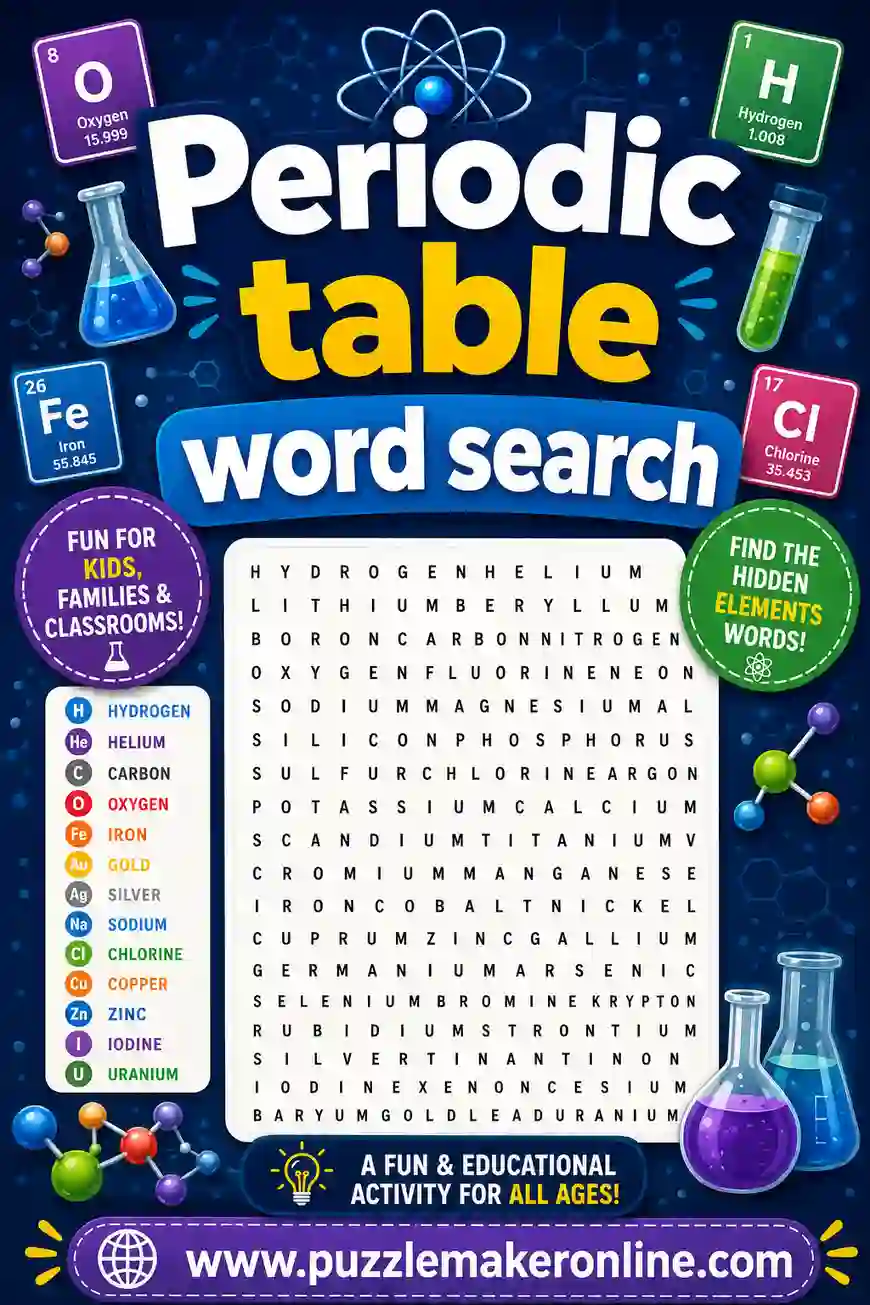
What Is a Periodic Table Word Search?
It's a grid of letters with the names of chemical elements hidden inside. Students hunt down each one and circle it. The words can run across, down, diagonally, and backward, depending on how tough you want it. A word bank under the grid lists the elements they're looking for.
The periodic table is a goldmine for word searches. There are 118 elements, and their names range from short ("iron," "gold," "neon") to long and satisfying ("molybdenum," "praseodymium"). That means you can build an easy puzzle for a first chemistry lesson or a brutal one for an honors review.
It also makes element names stick. Hunting for "potassium" letter by letter helps students recognize the spelling far better than just reading it on a slide. Pair it with element symbols, atomic numbers, or groups, and one puzzle reinforces a whole lesson. The generator handles the tedious bit of hiding the words and filling the grid.
Why Make Your Own Element Word Search
You could print a generic one, but making your own beats it for a few reasons.
- It's free. Print a copy for every student without paying a thing.
- You match it to your lesson. Hiding only the elements you covered this week keeps the puzzle relevant.
- Every copy can be unique. Need different grids so students can't share answers? A generator makes fresh ones in seconds.
It's also fast. From "I need a chemistry review activity" to a printed class set usually takes under ten minutes. No software, no design work.
Free Periodic Table Word List (Copy & Paste)
Here's a ready-to-use list of 30 element names. Pick 12 to 15 for an easy puzzle, or use the full list for a serious challenge. Copy the column you like straight into the puzzle maker.
| Common Elements | Metals | Tougher Names |
|---|---|---|
| Hydrogen | Iron | Magnesium |
| Helium | Gold | Potassium |
| Carbon | Silver | Phosphorus |
| Oxygen | Copper | Manganese |
| Nitrogen | Zinc | Chromium |
| Sodium | Nickel | Tungsten |
| Neon | Lead | Cobalt |
| Sulfur | Tin | Bromine |
| Calcium | Mercury | Argon |
| Chlorine | Aluminum | Krypton |
Want it really hard? Add the long ones: molybdenum, praseodymium, rutherfordium, and protactinium. They make a 17x17 or bigger grid feel like a true honors-level hunt.
Theme variations to try
- Element symbols puzzle. Hide two-letter symbols like FE, AU, NA, and CL instead of full names. Great for memorization.
- Group-by-group. Make a noble-gas puzzle (helium, neon, argon, krypton, xenon, radon) or an alkali-metals one (lithium, sodium, potassium, rubidium).
- Everyday elements. Stick to ones students recognize: oxygen, carbon, gold, iron, helium, calcium. Good for a first-day icebreaker.
How to Make a Periodic Table Word Search in 4 Steps
No special skills required. Here's the whole process.
- Pick your grid size. A 12x12 grid suits a basic puzzle. Go 15x15 or bigger for longer element names.
- Add your words. Paste 12 to 15 elements for an easy review, or 20+ for a tough one.
- Set the difficulty. Turn on diagonals and backward words for older students, off for beginners.
- Print. Hit print and hand out the stack.
That's it. To reuse the puzzles, print on cardstock or slip them into clear sleeves so students can solve with a dry-erase marker.
Periodic Table Word Search by Level
Chemistry shows up across a wide age range. Here's how to match the puzzle to the level.
| Level | Grid size | Word count | Settings |
|---|---|---|---|
| Intro / middle school | 10x10 or 12x12 | 8–12 common elements | Across and down only |
| Early high school | 13x13 | 12–16 elements | Add diagonals |
| Advanced high school | 15x15 | 16–24 elements | Diagonals + a few backward |
| Honors / college | 17x17 or bigger | 24–30 elements | All directions, long names |
The two biggest difficulty dials are word direction and grid size. Backward and diagonal placement makes a puzzle much harder. Long element names like "praseodymium" also raise the difficulty, since they're harder to spot than "gold" or "neon."
Fun Ways to Use an Element Word Search
A word search can do more than fill a worksheet slot. Here are some ways teachers use them.
As a lesson warm-up
Hand it out at the start of class while you set up. It gets students thinking about elements before the real lesson begins, and it settles a noisy room fast.
As a review or sub plan
A word search makes a great low-stress review before a quiz, or an easy activity to leave for a substitute. Pair it with a worksheet asking students to write the symbol and atomic number for five elements they found.
For science clubs and fairs
Running a chemistry club or a science-fair booth? A word search is a friendly, low-pressure activity that draws people in. Offer a small prize, like a sticker of the periodic table, for the first finished puzzle.
Printing Tips for Clean, Reusable Puzzles
A few small choices make your puzzles look sharp and last.
- Print in black and white. Word searches read perfectly without color and save ink.
- Use cardstock for a class set you'll reuse. It holds up to a busy lab room better than copy paper.
- Laminate or use sleeves. Then students solve with dry-erase markers and you wipe the sheets clean.
- Run one test copy. Confirm the grid and word bank fit on the page before printing thirty copies.
- Bump up the font for longer names. Bigger letters make "molybdenum" easier to track across the grid.
What to solve with
Nothing fancy needed:
- A pencil or pen to circle elements
- Highlighters for a colorful finish
- Dry-erase markers if the page is laminated
Common Mistakes to Avoid
A periodic table word search is easy to make, but watch for these snags.
- Long names in a small grid. "Praseodymium" won't fit in a 10x10. Match name length to grid size.
- No word bank. Always print the list of hidden elements, or students won't know what to hunt for.
- Difficulty mismatched to level. Backward diagonals will frustrate an intro class. Save them for advanced students.
- Mixing names and symbols by accident. Decide whether you're hiding full names or symbols, and keep the puzzle consistent so the word bank matches.
Turn the Word Search Into a Full Chemistry Review
One puzzle can carry a whole review session if you build around it. Here are a few easy ways to stretch it.
Add a matching crossword
After students find the elements in the word search, hand them a crossword using the same names with clues, like "Lightest element" for hydrogen or "Element in table salt" for sodium. Seeing each element twice cements both the spelling and the fact, and the same puzzle maker builds the crossword from your list. Two puzzles, one element set.
Pair each element with its symbol
Once the puzzle's done, have students write the symbol and atomic number for every element they found. Hydrogen becomes H, 1. Gold becomes Au, 79. It turns a letter hunt into real periodic-table practice and shows you who still needs to study the symbols.
Sort elements into groups
Have students classify the elements they found: metals, nonmetals, noble gases, halogens. You can draw the groups on the board and let students place each one. It connects the puzzle to the structure of the periodic table instead of treating the elements as a random list.
Build a symbols-only follow-up
For the next class, run a second puzzle that hides only the two-letter symbols of the same elements. Students who memorized the names now have to recognize FE, AU, and NA instead. It's an easy way to raise the difficulty while reusing the same vocabulary.
More Themed Word Searches to Try
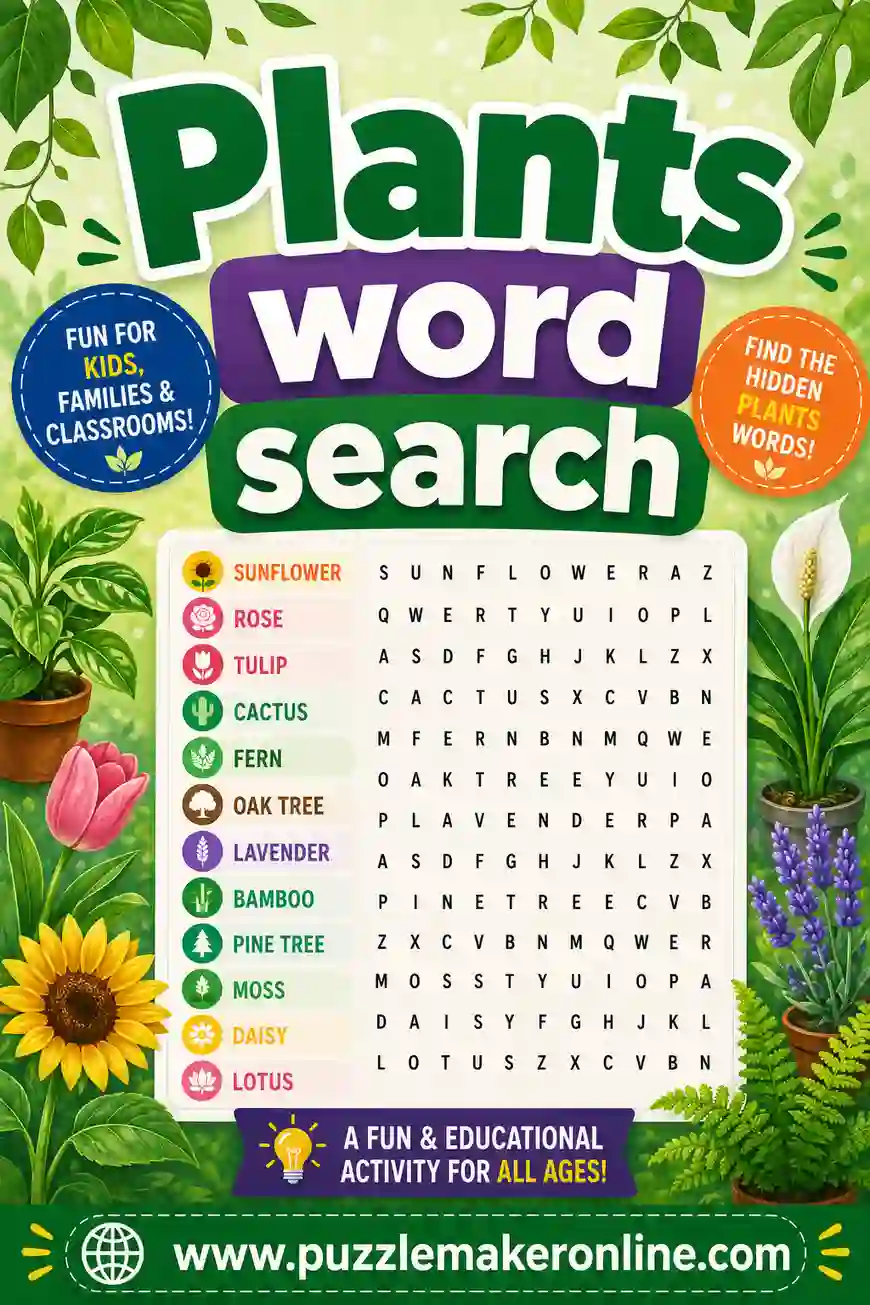
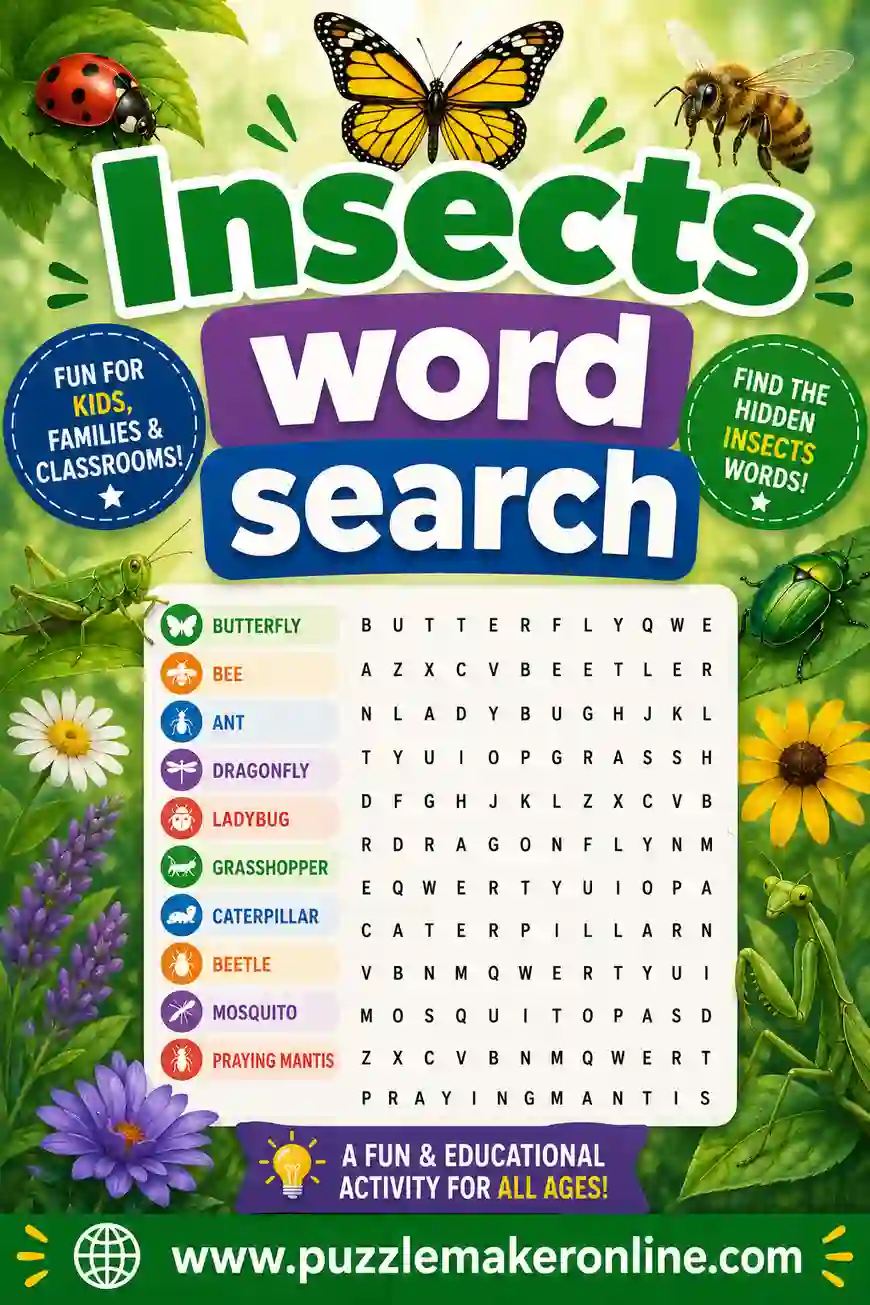
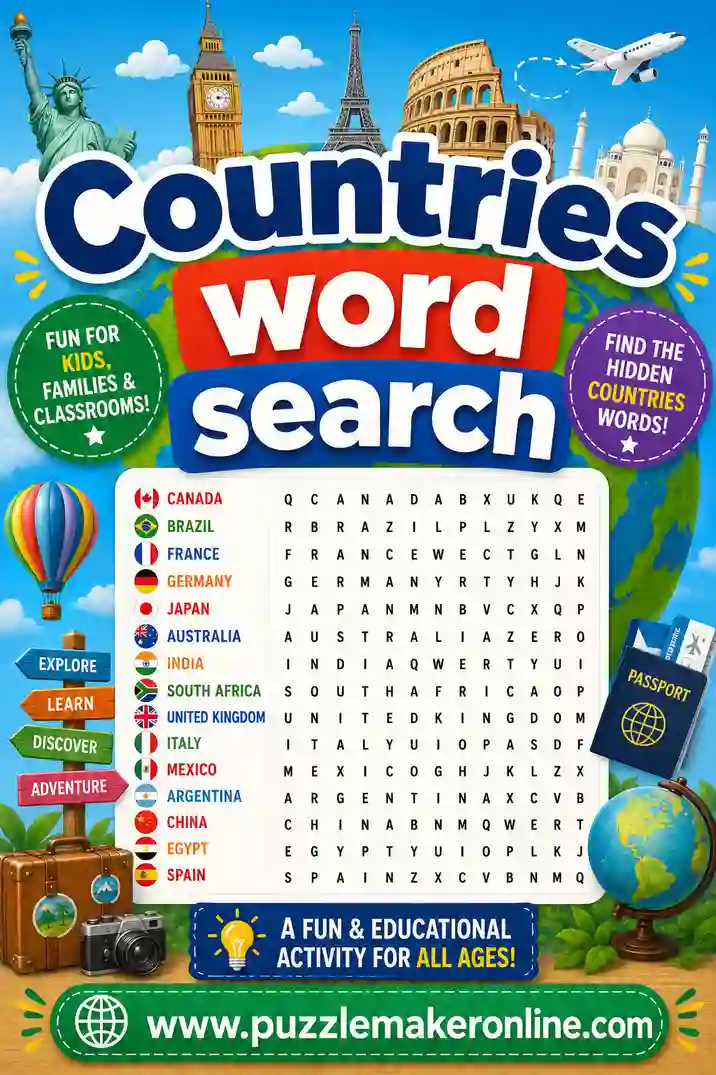
Once you've made a chemistry puzzle, the same tool builds plenty of others. For a biology unit, try a plants word search or an insects word search. For a social-studies tie-in, a countries word search works great. One tool, endless themes.
Frequently Asked Questions
What words should go on a periodic table word search?
Use real element names like hydrogen, oxygen, carbon, gold, iron, and sodium. The list above gives you 30 ready to copy. For beginners, stick to short, common elements; for advanced students, add long names like magnesium and tungsten.
Are these periodic table word search puzzles really free to print?
Yes. You make and print them yourself at no cost. There's no sign-up and no watermark, so you can print a copy for every student on a single free word list.
Can I hide element symbols instead of full names?
Yes. Just paste the two-letter symbols (FE, AU, NA, CL) into the puzzle maker as your word list. It's a great way to drill symbol memorization for a quiz.
How do I make the puzzle harder for advanced students?
Use a bigger grid, add more elements, include long names like molybdenum, and turn on diagonal and backward directions. Those four changes turn a quick warm-up into a real challenge.
Is this good for middle school chemistry?
Definitely. Use a 10x10 or 12x12 grid with 8 to 12 common elements, and keep words running across and down only. It's an easy, engaging way to introduce element names without overwhelming new students.
How many words should a word search have?
It depends on the level. Eight to 12 elements suit an intro class, 12 to 16 fit early high school, and 24 to 30 make a serious honors challenge. More words plus a bigger grid means a tougher puzzle.
Ready to Print Your Periodic Table Word Search?
Grab the element list above, open the free puzzle maker, and you'll have a printable periodic table word search in minutes. It's free, there's no sign-up, and you can print a unique copy for every student. Happy hunting, and may every element get found.