States & Capitals Word Search: Free Printable Puzzles
A states and capitals word search is a printable grid of hidden letters where the words tucked inside are U.S. states, their capital cities, or both. Kids hunt for "AUSTIN," "DENVER," or "OREGON," circle each one, and learn geography without even noticing they're studying. The quickest way to build one is to drop a list of states and capitals into a free puzzle maker that hides your words in a grid and prints a clean, ready-to-go worksheet.
Want to skip ahead and just make one? Open the free puzzle maker, paste in a list (there's a copy-and-paste one further down), and print as many unique puzzles as you need. No sign-up, no cost, nothing to install.
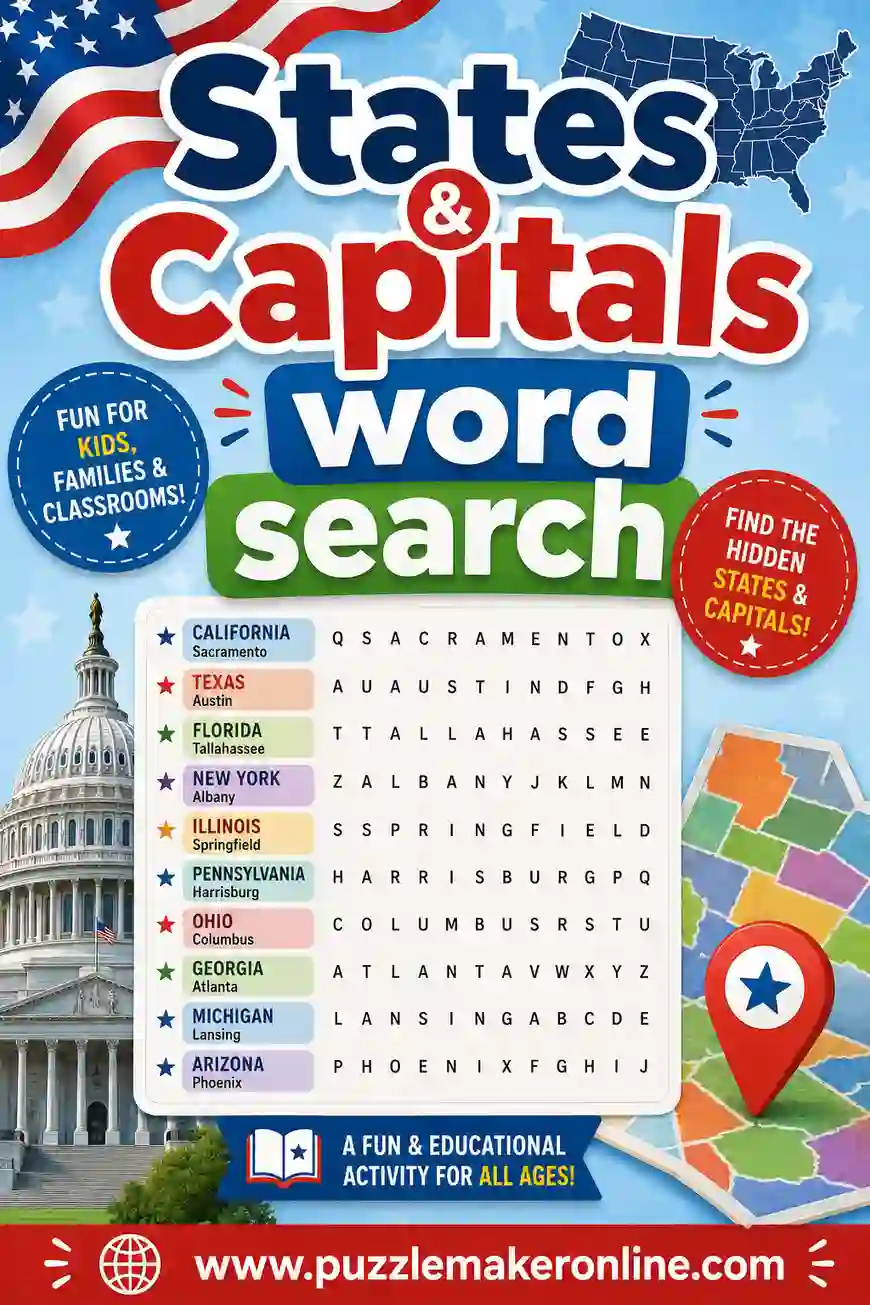
What Is a States and Capitals Word Search?
It's a regular word search, but every hidden word is a piece of U.S. geography. Picture a square of random letters. Buried in the rows, columns, and diagonals are real words like "FLORIDA," "JUNEAU," or "SANTA FE." A word bank sits to the side, and the player's job is to find each one and circle it.
You can build the puzzle three ways, depending on what you're teaching:
- States only. Hide all 50 state names. Great for younger kids learning the map.
- Capitals only. Hide the capital cities. A solid challenge for older students who already know the states.
- Matched pairs. Hide both, then ask students to draw a line connecting each capital to its state. This turns a simple find into a real study tool.
The grid does double duty. While players scan for the words, they're reading and re-reading the spellings, which is exactly how the names stick.
Why a Word Search Beats Plain Flashcards
Flashcards work, but they get boring fast. A puzzle hides the studying inside a game, and that small shift changes how long kids stay with it.
- It's active, not passive. Hunting for "MONTPELIER" forces a student to scan every letter instead of skimming a list.
- It rewards finishing. Circling the last word feels like winning. That little payoff keeps reluctant learners going.
- It's quiet and low-stress. No timer, no buzzer, no one watching. Perfect for a calm-down activity or independent work.
- It's reusable. Print a fresh grid with the same words and the puzzle feels brand new, because the letters are shuffled into a different layout.
And because you control the word list, you can match the puzzle to exactly what your class is covering this week, whether that's the Northeast, the West Coast, or a tricky cluster of capitals everyone keeps mixing up.
Free States & Capitals Word List (Copy & Paste)
Here's a ready-to-use bank of 30 state-and-capital entries. Copy any column straight into the puzzle maker. For a beginner-friendly puzzle, pick 12 to 15 words. For a real challenge, load 25 or more.
| States | Capitals | Trickier Capitals |
|---|---|---|
| Texas | Austin | Montpelier |
| Florida | Denver | Tallahassee |
| Oregon | Boston | Annapolis |
| Georgia | Atlanta | Pierre |
| Arizona | Phoenix | Bismarck |
| Nevada | Salem | Frankfort |
| Montana | Helena | Harrisburg |
| Kansas | Topeka | Sacramento |
| Alaska | Juneau | Baton Rouge |
| Hawaii | Boise | Cheyenne |
A quick tip: word searches don't love spaces, so a capital like "Santa Fe" or "Baton Rouge" usually goes in as one run of letters ("SANTAFE," "BATONROUGE"). The puzzle maker handles this for you, but it's good to know why the words look squished in the grid.
Group the list by region
If you're teaching one region at a time, build smaller themed puzzles:
- Northeast: Maine, Vermont, New Hampshire, plus capitals like Augusta and Concord.
- South: Texas, Florida, Georgia, with Austin, Tallahassee, and Atlanta.
- West: California, Oregon, Nevada, plus Sacramento, Salem, and Carson City.
- Midwest: Ohio, Illinois, Iowa, with Columbus, Springfield, and Des Moines.
Smaller, focused grids are less overwhelming for kids who are just starting to learn the map.
How to Make a States & Capitals Word Search in 4 Steps
You don't need any design skills. Here's the whole process from blank screen to printed worksheet.
- Pick your words. Choose states, capitals, or both. Paste 12 to 25 words into the generator.
- Set the grid size. A bigger grid hides more words and feels harder. Smaller grids suit younger kids.
- Choose your difficulty. Letting words run backward and diagonally makes the puzzle tougher. Forward-only is gentler for early grades.
- Print. Hit print and you've got a clean worksheet plus an answer key. Make a few copies and you're set for the whole class.
That's it. If you want to study from it more than once, print on regular paper for a one-time worksheet, or slip it into a sleeve and let kids solve with a dry-erase marker.
Word Search Difficulty by Grade Level
The same word list can be easy or brutal depending on how you set up the grid. Use this as a quick guide.
| Grade level | Grid size | Word count | Directions to allow |
|---|---|---|---|
| K–1 | 8x8 | 6–8 | Across and down only |
| 2–3 | 10x10 | 10–12 | Across, down, forward |
| 4–5 | 12x12 | 15–18 | Add diagonals |
| 6–8 | 15x15 | 20–25 | Add backward words |
| High school+ | 17x17 | 25–30 | All directions, capitals only |
When in doubt, start a notch easier than you think. A puzzle that's too hard gets abandoned; one that's a touch easy still teaches and leaves kids feeling smart.
Fun Ways to Use the Puzzle
A word search doesn't have to be a worksheet you hand out and forget. A few ideas that work well in real classrooms and at home:
Make it a race (gently)
Hand out the same puzzle and see who finds five words first. Keep it light, no real prizes needed, just bragging rights. The mild pressure helps kids who'd otherwise rush.
Pair it with a blank map
Have students find a capital in the grid, then place a sticker on that state on a blank U.S. map. Now the name and the location lock in together.
Turn it into homework that's actually fun
A geography word search is a homework win. Parents are happy because it's screen-free, and kids don't groan because it feels like a game, not a drill.
Build a 50-state challenge
Across a few weeks, work through every state and capital with one puzzle per region. By the end, students have seen all 100 names multiple times in a format they actually enjoy.
Printing Tips for Clean, Readable Puzzles
Small choices make the worksheet easier to use.
- Print in black and white. Word searches read perfectly in grayscale, and you save color ink for things that need it.
- Keep the font readable. If letters look cramped, drop a few words or bump up the grid spacing so kids aren't squinting.
- Print the answer key. You'll want it for grading, and a frustrated student who's stuck on one word will thank you.
- Test one page first. Run a single copy before printing 30 so you catch any margin issues early.
- Use sleeves for reuse. Slip the puzzle into a clear sleeve and kids can solve it with dry-erase markers, then you wipe and reuse.
Common Mistakes to Avoid
A few easy slip-ups can make a puzzle frustrating instead of fun.
- Too many long capitals at once. "TALLAHASSEE" and "MONTPELIER" in the same small grid eat up space fast. Mix long and short words.
- Forgetting spaces collapse. "NEW MEXICO" becomes "NEWMEXICO" in the grid. Warn students so they're not confused.
- Skipping the word bank. Without a list of what to find, a word search becomes guesswork. Always include the bank for younger kids.
- One grid for every age. A 15x15 grid overwhelms a first grader. Match the size to the learner.
Beyond the Word Search: Other Puzzle Types for the Same Words
A word search is the easiest place to start, but the same list of states and capitals works in two other printable puzzles. Mixing formats keeps practice from going stale, because each puzzle asks the brain to do something a little different.
Turn it into a crossword
A crossword flips the challenge around. Instead of finding a word you can already see, students have to recall it from a clue. A clue like "Capital of Texas" with five letter-boxes pushes a student to remember "AUSTIN" rather than just spot it. That recall step is harder, and it's a great next stage once the word search feels easy.
Good clues for a states-and-capitals crossword include:
- "Capital of the Sunshine State" for Tallahassee.
- "State shaped like a mitten" for Michigan.
- "Capital that shares its name with a famous Texas city" for Austin.
Try a word scramble for fast review
A word scramble is the quickest of the three to make and to solve. You take "DENVER," jumble it into "RVNEDE," and the student unscrambles it. It's perfect for a five-minute warm-up or an exit ticket at the end of class. Because it's so short, you can run a scramble of ten capitals in the time it takes to settle the room. The mini-tool near the top of this page is a taste of exactly that.
Running the same words through a word search, a crossword, and a scramble across one week means students see each state and capital many times, in three different ways. That spaced, varied repetition is what turns "I think Helena is in Montana?" into "Helena, Montana, no question."
Frequently Asked Questions
How many words should a states and capitals word search have?
For most classrooms, 12 to 20 words is the sweet spot. Younger kids do best with 6 to 10 in a small grid, while older students can handle 25 to 30. The puzzle maker lets you load any number and sizes the grid to fit.
Should I use states, capitals, or both?
It depends on your goal. Use states alone for beginners, capitals alone for a harder challenge, and both together when you want students to practice matching each capital to its state.
Are these word searches really free to print?
Yes. You build and print them yourself at no cost, with no sign-up and no watermark. One free word list can power a whole semester of geography practice.
How do I handle capital cities with two words?
Word searches hide words as a single run of letters, so "Santa Fe" goes in as "SANTAFE." The generator does this automatically. Just give students a heads-up so the squished spelling doesn't trip them up.
Can I make different versions for the same word list?
Absolutely. Print the same words again and the generator shuffles them into a brand-new grid layout. Great for retests, makeup work, or simply keeping a puzzle fresh.
What grade level is this best for?
It works from kindergarten through high school. You control the difficulty by adjusting grid size, word count, and whether words can run backward or diagonally. See the grade-level table above for a quick setup guide.
Ready to Print Your States & Capitals Word Search?
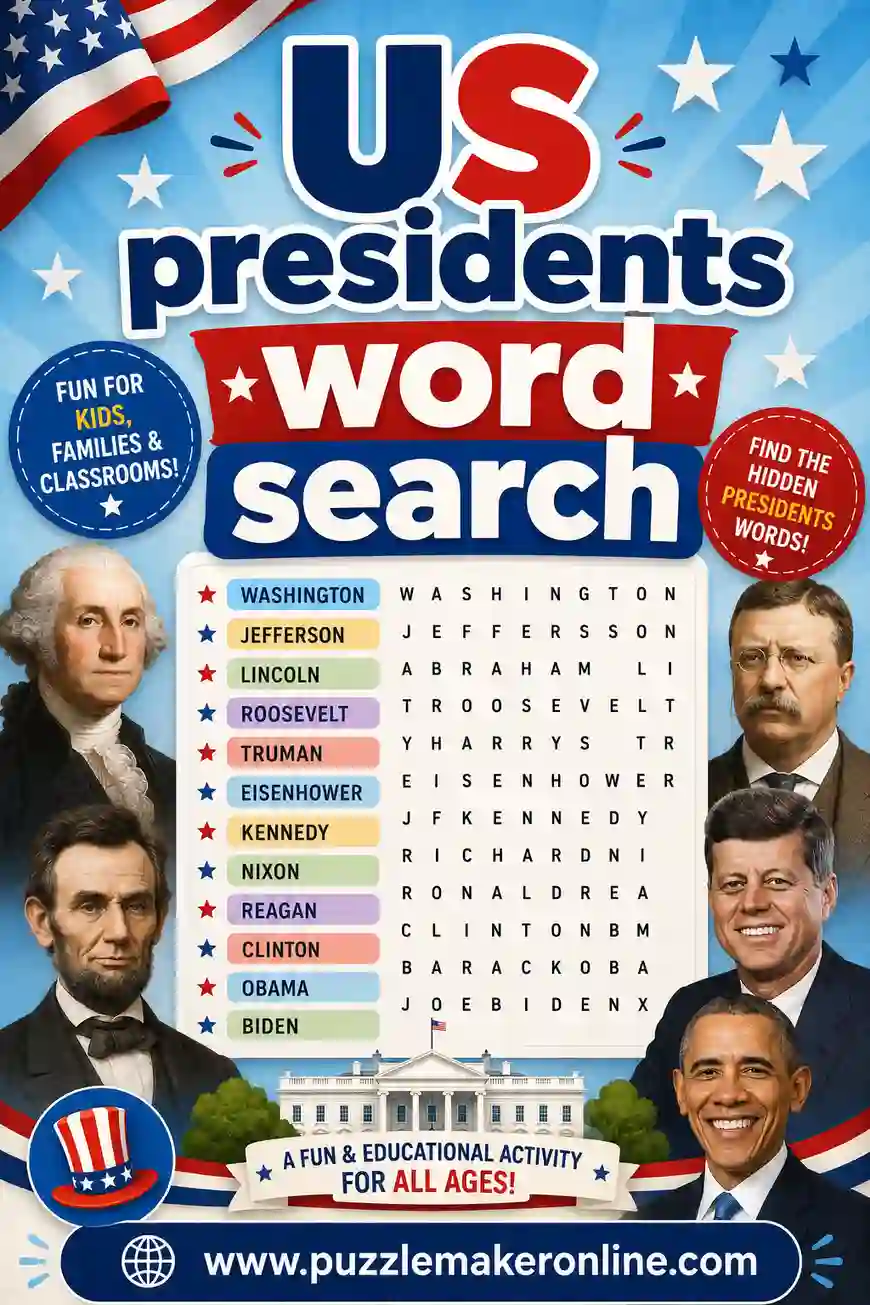
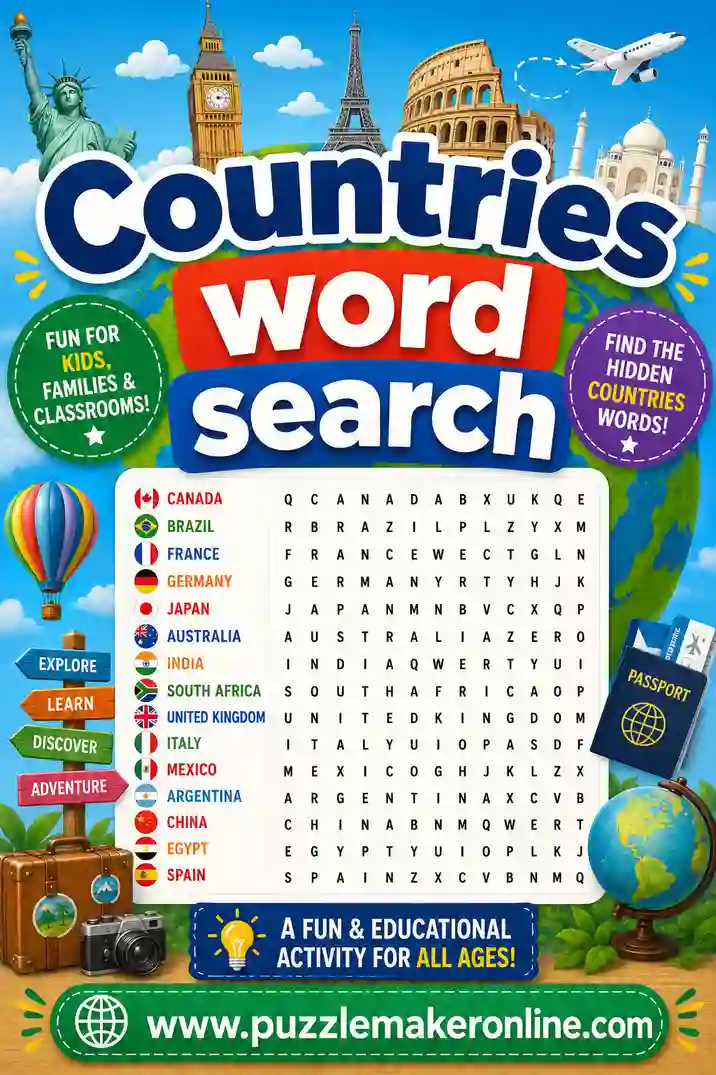
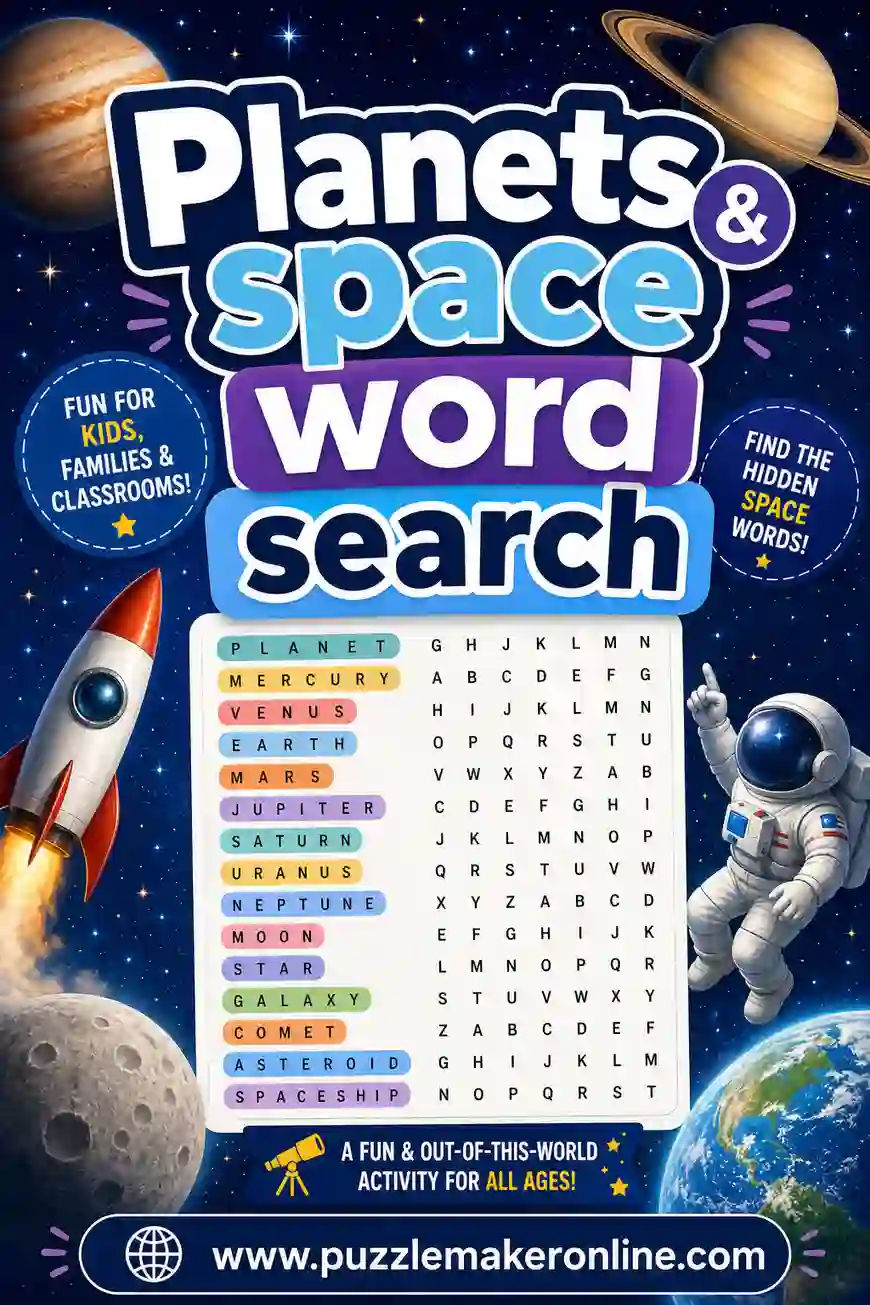
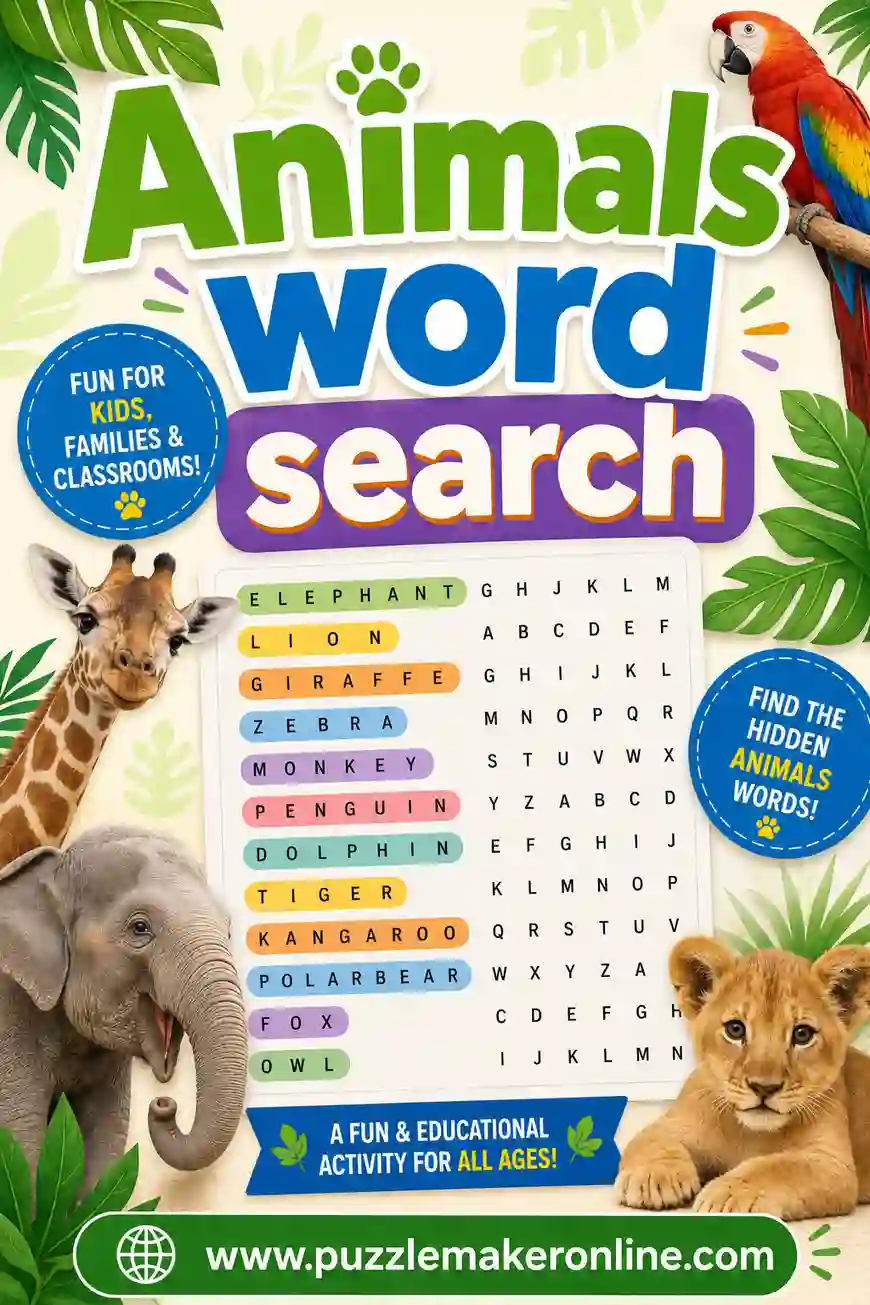
Grab the word list above, open the free puzzle maker, and you'll have a printable states and capitals word search in minutes. It's free, there's no sign-up, and every print can come out a little different, so it's perfect for retests and homework. Want more learning puzzles? Try our US presidents word search, countries word search, planets and space word search, or animals word search. Happy puzzling.