
Sudoku Variants: Every Type of Sudoku Explained
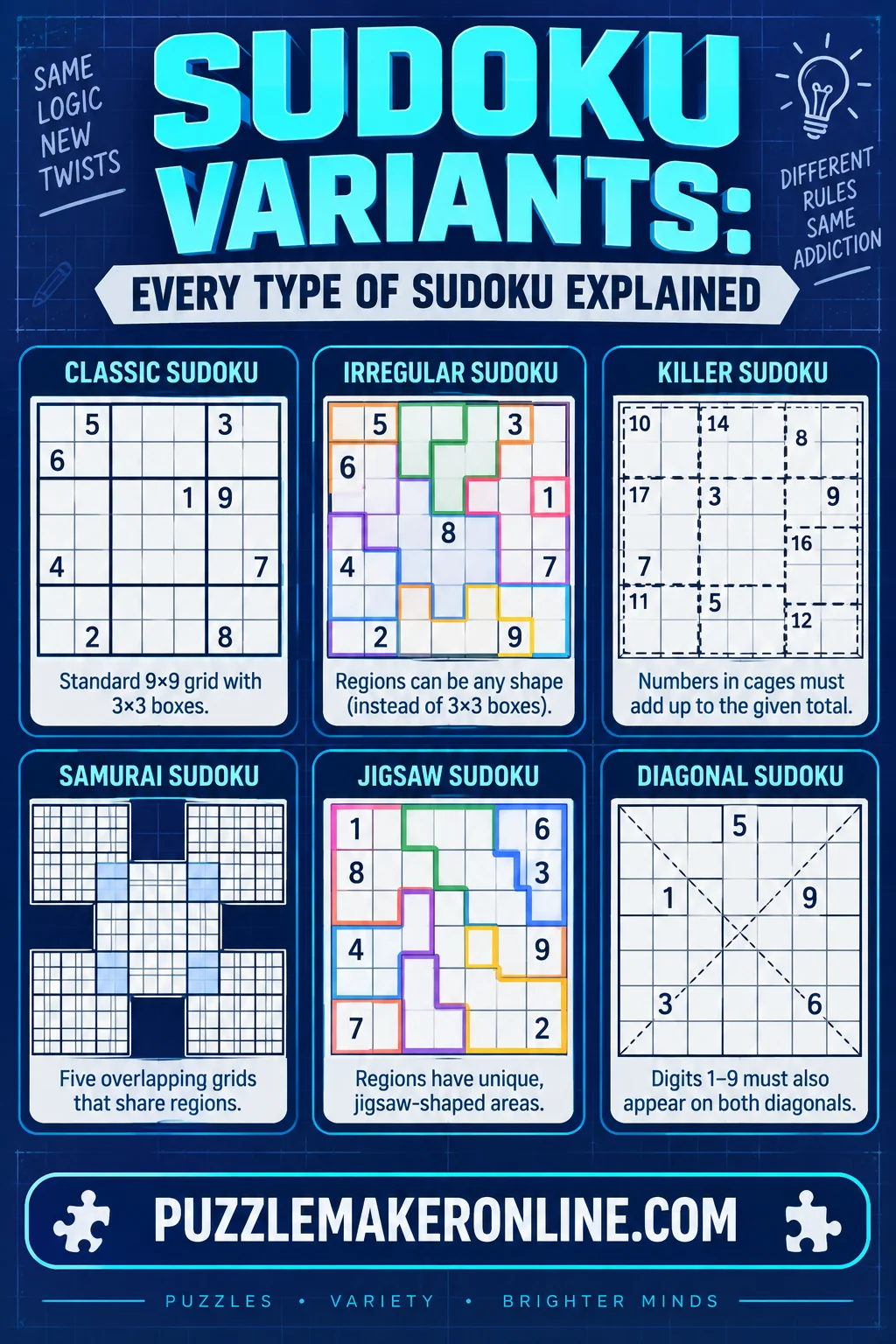
Almost every sudoku variant is standard sudoku with one thing changed: the size of the grid, the shape of the regions, the number of regions, or the kind of clue you get. Once you can name which of those four things a puzzle has changed, you can predict how it will solve before you place a digit.
There are dozens of named types of sudoku games, and lists that present them as dozens of separate puzzles make the field look far larger than it is. Grouped by family it collapses into eight ideas, and most named variants are combinations of two of them.
The families at a glance
| Family | What's added | Hardest new skill | Best for |
|---|---|---|---|
| Size variants (4x4, 6x6, 12x12, 16x16) | More or fewer cells, same logic | Holding a bigger candidate list in your head | Kids at the small end, marathon solvers at the large end |
| Region shape (jigsaw, squiggly, nonomino) | Irregular regions instead of 3x3 boxes | The law of leftovers | Solvers bored of automatic scanning |
| Extra regions (hyper, windoku, diagonal, X) | More units per cell | Spotting the regions nobody drew | Solvers who want faster, denser deductions |
| Arithmetic (killer, and cage puzzles generally) | Cage sums | Combination charts and the 45 rule | People who enjoy mental math |
| Comparison and outside clues (greater-than, skyscraper, thermo) | Relationships between cells | Reasoning about order and range, not value | Spatial thinkers |
| Symbol variants (letter, hexadecimal, colored, picture) | Different symbols, same rules | Reading unfamiliar symbols at speed | Pre-readers, learners, accessibility needs |
| Compound grids (samurai, butterfly, sohei) | Several overlapping grids | Carrying information across a shared box | Long sessions, not quick breaks |
| 3d sudoku | A cube, layers, or an isometric drawing | Tracking lines that turn a corner | Solvers who like spatial puzzles |
Each family is covered below: what changes, what it does to your solving, and who it suits.
1. Size variants
Nothing about the logic changes when the grid changes size. A 6x6 grid and a 16x16 grid use exactly the same techniques as a 9x9. What changes is the search space and, much more importantly, how much you hold in working memory.
The small end is genuinely useful. A 4x4 grid uses digits 1 to 4 in four 2x2 boxes; a 6x6 grid uses 1 to 6 in six 3x2 boxes. Both are short enough that a child, or an adult learning the rules, sees the whole logic of the puzzle in minutes. Mini sudoku is the general name for anything below 9x9, and the 4x4 grid is the standard teaching format because a single cross-hatch usually solves a cell outright.
The large end is a different experience rather than a harder one. A 12x12 grid uses 1 to 12 in 4x3 boxes, a 16x16 grid uses 1 to 16 or the hexadecimal digits 0 to F in 4x4 boxes, and giant grids run to 25x25 and beyond. The deductions are no more advanced, but a candidate list for one cell can run to a dozen entries, and a single misread digit forty moves back quietly poisons an hour's work. Large grids reward neat pencil marks far more than clever technique.
One thing catches people out: when a box dimension is even, the boxes are rectangles rather than squares. A 6x6 grid's boxes are three wide and two tall, so cross-hatching sweeps three columns against two rows.
2. Region-shape variants
Jigsaw sudoku keeps every rule and replaces the nine 3x3 boxes with nine irregular connected shapes of nine cells each. You will also see it called squiggly, nonomino, or geometry sudoku.
This is a bigger change than it sounds. Standard solvers stop consciously reading box borders after a few dozen puzzles; the 3x3 grouping becomes part of how the grid looks. Jigsaw takes that away, so every deduction needs a check of which region a cell belongs to, and that lookup tax is where most of the added difficulty comes from.
It also strengthens box and line interactions, since a region can span five rows instead of three, and it unlocks the law of leftovers, a deduction standard sudoku does not have: when a set of rows is almost exactly covered by a set of regions, the cells sticking out on each side must hold the same digits. Solvers who know it find jigsaw fair; solvers who do not find it unreasonable.
3. Extra-region variants
These variants keep the 3x3 boxes and add more regions on top, so some cells belong to four units instead of three.
Hyper sudoku, also called windoku, adds four shaded 3x3 windows at rows 2 to 4 and 6 to 8, crossed with columns 2 to 4 and 6 to 8, each holding 1 to 9 once. Because every window straddles four different boxes, the interaction between windows and boxes produces early placements constantly. The windows also force several extra complete nine-cell regions that the puzzle never draws, and finding them turns hyper from fiddly into fast.
Diagonal sudoku, usually called X-sudoku, adds two constrained regions along the main diagonals. It is the gentlest step outside standard sudoku there is: the rule takes one sentence, and you get two more places to hunt for hidden singles from the first move. Both variants tend to ship with fewer givens than a standard puzzle of the same rating, precisely because the extra constraints do so much work.
4. Arithmetic variants
Killer sudoku is standard sudoku plus dotted cages, each carrying a target sum, with no repeated digit inside a cage.
The structural difference is that killer grids frequently start with no given digits at all, so every opening move comes from arithmetic rather than scanning. A two-cell cage summing to 17 can only be 8 and 9; a three-cell cage summing to 7 can only be 1, 2 and 4. Those forced combinations are the equivalent of givens.
The second tool is the 45 rule. Every row, column and box contains 1 to 9, so it sums to 45. If cages cover a box completely except for one cell, that cell equals 45 minus the cage totals; if cages spill one cell outside a box, the spilled cell equals the cage totals minus 45. Chains of that reasoning open most killer puzzles before any conventional sudoku technique is needed.
Kakuro is cage sums without the 9x9 structure, and KenKen-style puzzles use all four operations and allow repeats inside a cage. Both are close relatives rather than sudoku variants proper.
5. Comparison and clue-outside variants
In this family the constraint is not "this cell contains a value" but "this cell relates to that one" or "this line looks like this from outside."
Greater-than sudoku, and the closely related futoshiki, put inequality signs between adjacent cells. You reason about order rather than value, and the key technique is chain length: four cells linked by less-than signs means the first is at most 6 and the last at least 4.
Skyscraper sudoku puts a number outside the grid saying how many "buildings" are visible along that line, where a taller digit hides every shorter one behind it. A clue of 1 means the nearest cell is the largest digit; a clue of 9 means the line ascends in perfect order. Everything between is a counting argument about where the tall digits sit.
Thermometer sudoku draws thermometer shapes across the grid; digits must increase from the bulb along the tube, so a thermometer of length five cannot start above 5 or end below 5. These are the variants that feel least like sudoku while still being sudoku.
6. Symbol variants
Sudoku is not a number puzzle. Replace the digits with nine letters, nine colors, or nine little pictures and the puzzle is mathematically identical.
What changes is the reading load. Letter sudoku, which often spells a word down a diagonal, is fractionally slower for most people because letters have no natural order, so "which one is missing" is a harder scan than it is with 1 to 9. Hexadecimal sudoku uses 0 to F for 16x16 grids and suits anyone who already thinks in hex.
Colored sudoku and picture sudoku matter most for accessibility and for young children. A pre-reader can solve a 4x4 grid of animal pictures long before they can reliably read digits, and the logic is exactly that of the adult game. The one caution is color vision and print quality: a set relying on similar hues fails for some solvers and fails again on a grayscale printer, so good color puzzles pair each color with a distinct shape.
7. Compound and overlapping grids
Samurai sudoku is five 9x9 grids arranged in an X, where the four outer grids each share one corner box with the central grid. Butterfly, sohei, and various flower and gattai layouts do the same thing with different numbers of grids and different overlaps.
The shared boxes are the entire point. A digit placed in the central grid is simultaneously a placement in an outer grid, so information flows between puzzles that would otherwise be independent, and well-made samurai puzzles are designed so no grid can be finished alone.
The experience is less about difficulty than stamina. Each grid may be rated easy or medium, but a samurai layout has 369 cells and a session runs long. They are also awkward on screen, so this family most rewards a large printed sheet.
8. 3d sudoku
The term "3d sudoku" is used for two genuinely different things, and it is worth knowing which one you are looking at before you buy a book or download an app.
The first is a real three-dimensional puzzle. Cube sudoku wraps grids around the faces of a cube so lines continue across an edge onto the next face, which means a row can turn a corner and a cell can belong to units on two faces. Layered versions stack several grids and add a constraint through the stack, so a cell is also unique among the cells directly above and below it. The hard part is not the logic but tracking which cells see which, since your eyes cannot take in the whole constraint set at once, and most published puzzles of this kind are gently rated to compensate.
The second use is purely cosmetic. Plenty of apps and books label a flat sudoku as 3d sudoku because the grid is drawn in isometric projection, with cells rendered as raised tiles or the faces of a stack of blocks. Nothing about the solving changes. That explains why one person's 3d sudoku is a genuine head-scratcher and another's is Tuesday's newspaper puzzle in a fancy skin. If you want the real thing, check whether the description mentions lines continuing across faces or through layers.
Extra constraints often make a puzzle easier
This is the most common misconception about variants, and correcting it changes how people choose puzzles.
Adding a constraint removes candidates. A cell on a main diagonal has four units eliminating candidates from it instead of three, so it resolves sooner, not later. That is why hyper and diagonal puzzles ship with fewer givens: the setter has to remove clues to stop the puzzle collapsing on the first pass.
So a variant is harder for one of two reasons. Either the setter stripped clues until the extra constraint was fully consumed, or the variant adds reading and bookkeeping load rather than logical constraint. Jigsaw, samurai and 3d puzzles are mostly the second kind, hyper and diagonal mostly the first, and killer is both.
The consequence is that clue count means nothing across variants. Twenty-two clues in a hyper grid is not comparable to twenty-two in a standard grid, so the puzzle's own difficulty label is the only rating worth trusting.
Which variant should you try next
Pick by what you already enjoy rather than by what sounds impressive.
If you like the scanning phase and want more of it, try 12x12 or 16x16. The technique is identical and the scanning simply lasts longer.
If scanning has become automatic and you miss the effort, try jigsaw. It breaks the visual habit without asking you to learn new logic.
If you want faster, denser deductions, try diagonal first, then hyper.
If you enjoy mental arithmetic, go straight to killer, then kakuro if you want the arithmetic without the rest.
If you like spatial reasoning more than number work, try skyscraper or thermo, then real cube-style 3d puzzles.
If you are teaching a child, start with a 4x4 picture or color grid, move to 4x4 digits, then 6x6, then an easy 9x9.
If you want a long weekend session, samurai.
Whatever you pick, the fastest way to learn a variant is a run of five or six easy puzzles rather than one hard one, because most of the adjustment is reading the grid rather than the logic. A sudoku generator that lets you set size and difficulty is a gentler way in than an expert-rated puzzle from a variant book.
Frequently Asked Questions
How many sudoku variants are there? There is no fixed number, since setters invent new constraints constantly and most published variants combine two existing ideas. Grouped by what actually changes, nearly all fall into the eight families above.
Do standard sudoku techniques work on variants? Almost always. Naked and hidden singles, pairs, triples, pointing sets, X-Wing and swordfish all operate on generic units, so they transfer to any variant that still uses rows, columns and regions. Variants add techniques on top rather than replacing what you know.
Which sudoku variant is the hardest? For pure logical difficulty, expert killer sudoku and heavily stripped jigsaw grids are usually the toughest widely published types. Samurai and 3d layouts take the longest to finish, but that is stamina rather than harder deductions.
Is 3d sudoku a real puzzle or just a visual style? Both, depending on the product. Genuine 3d sudoku wraps grids around a cube or stacks them in layers so constraints run between faces or levels. Many apps and books also use the label for flat puzzles drawn in isometric perspective, where solving is unchanged, so check the rules rather than the picture.