How to Solve KenKen: Rules, Cage Math and Strategies by Grid Size
Here's how to solve KenKen in one breath: fill the grid so every row and every column holds each number exactly once, then use the math clue in each outlined "cage" to work out which numbers can go where. Start with single-cell cages, then cages that only one set of numbers can satisfy, and keep crossing that cage logic with the row and column rule until every square is fixed.
That's the whole idea, and it's simpler than it looks. This guide walks through the rules, the arithmetic behind each of the four operations, a table of cages that only have one possible answer, and two complete worked puzzles (a 4x4 and a 6x6) solved step by step. There's also a practice puzzle with its answer at the end. If you already know sudoku, you'll find a lot that feels familiar, and a few new tricks that only KenKen has.
What KenKen is and where it came from
KenKen is a number-placement puzzle invented in 2004 by Tetsuya Miyamoto, a Japanese mathematics instructor. According to the official KenKen "About" page, Miyamoto wanted a puzzle that would build students' math and logic skills by encouraging independent thinking, trial and error, concentration and perseverance. His approach is summed up as "The Art of Teaching Without Teaching." In other words, the puzzle does the teaching, and the teacher mostly stays out of the way.
The same page says KenKen came to the United States in 2008 through Nextoy LLC and soon appeared in The New York Times, where it was described as the first daily feature since the crossword. The official site also says the puzzles appear on the website of the National Council of Teachers of Mathematics, which tells you how strongly it's tied to classroom math.
And the name? The KenKen FAQ explains that "ken" is the Japanese word for "wisdom," so KenKen is meant to suggest "wisdom squared." That's a cute nod to the square grid, too.
The official site lists grid sizes from 3x3 up to 9x9, and it says that mixing grid size with different combinations of operations produces five difficulty levels. Most newspaper and app puzzles you'll meet are 4x4, 5x5 or 6x6, with 7x7 and up reserved for people who already love the game.
The rules of KenKen
There are only a few rules, and they fit on a sticky note.
- Use the numbers 1 to N. In a grid that's N squares wide, you use the numbers 1 through N. A 4x4 grid uses 1, 2, 3 and 4. A 6x6 grid uses 1 through 6.
- No repeats in a row or column. The official beginner tutorial puts it plainly: a number can't be repeated within any row or column. So every row and every column ends up holding each number exactly once.
- Each cage must hit its target. The grid is split into heavy-outlined groups of squares called cages. Each cage has a target number and an operation sign (+, −, × or ÷) in its top-left corner. The numbers inside the cage must produce the target using that operation.
- Single-square cages are gifts. A cage with just one square shows only a number. That number goes straight into the square.
- Numbers can repeat inside a cage, as long as the repeats aren't in the same row or column. This is the rule people forget most often, and it matters for bigger, bent cages.
Every proper KenKen has exactly one solution. The FAQ says the company builds each puzzle so there's only one possible way to place the numbers, and it uses a computer program it calls the "Kenerator" to check. The beginner tutorial adds a nice point: even though there's only one solution, there are many different paths to it. You don't have to solve it the way anyone else does.
How subtraction and division cages work
Subtraction and division cages almost always have exactly two squares. Order doesn't matter. A "1−" cage means the bigger number minus the smaller number equals 1, so 3 and 2 work in either order. A "2÷" cage means the bigger number divided by the smaller one equals 2, so 2 and 1, 4 and 2, or 6 and 3 all fit (depending on the grid size). Addition and multiplication cages can have two, three or more squares.
A quick vocabulary list
These terms come up throughout the guide, so here they are in one place.
| Term | What it means |
|---|---|
| Cage | A heavy-outlined group of squares with one target and one operation. |
| Target | The number in the cage's corner (for example, the 12 in "12×"). |
| Candidate | A number that could still go in a square. Many solvers pencil these in small. |
| Single (or freebie) | A one-square cage. Its number is the answer. |
| Combination | A set of numbers that satisfies a cage, ignoring order. For a 3+ cage, the only combination is {1, 2}. |
| Naked pair | Two squares in one row or column that can only hold the same two numbers. Those numbers can't appear anywhere else in that line. |
| Line total | The sum of a full row or column. It's 10 in a 4x4 (1+2+3+4) and 21 in a 6x6 (1+2+3+4+5+6). |
How to solve KenKen: the core method
Every KenKen solve, no matter the size, comes down to the same loop. Here it is as a checklist you can keep next to you.
- Fill in every single-square cage. These are free numbers, and they immediately remove that number from the rest of its row and column.
- List the combinations for each cage. For each cage, ask "which sets of numbers can make this target in this grid size?" Write the possible numbers in the corner of each square as small pencil marks. Sudoku players call this candidate mode, and our page on candidate mode in sudoku explains the habit in more detail.
- Start with cages that have only one combination. A 3+ cage with two squares must be 1 and 2. In a 4x4, a 7+ cage with two squares must be 3 and 4. These "one-answer" cages are your anchors.
- Cross each cage with its row and column. If a row already has a 4, no square in that row can be 4. Remove it from your pencil marks.
- Look for the last number in a line. When a row or column has only one empty square, the missing number goes there. When a number can only go in one square of a line, it goes there too.
- Use pairs. If two squares in a row can only be {1, 3}, then 1 and 3 can't go anywhere else in that row.
- Use line totals and products for big puzzles. The official expert tutorial points out that each row or column of 1 to 6 adds to 21, so you can find a missing square by subtraction.
- Repeat. Every new number unlocks others. Keep looping until the grid is full.
That's it. Everything else in this guide is a sharper version of one of those eight steps.
Cage math: one-answer cages to memorize
The fastest KenKen solvers aren't faster at arithmetic. They just recognize cages that have only one possible set of numbers. The official solving tips page gives a list of these, and the table below collects the most useful ones. "Two squares" means a two-square cage; "three in a line" means three squares in a straight row or column, so none of the numbers can repeat.
| Cage | Grid size | Only possible numbers |
|---|---|---|
| 3+ or 2× (two squares) | Any | 1, 2 |
| 4+ or 3× (two squares) | Any | 1, 3 |
| 5× or 5÷ (two squares) | 5x5 and up | 1, 5 |
| 15× (two squares) | 5x5 and up | 3, 5 |
| 20× (two squares) | 5x5 and up | 4, 5 |
| 6+ or 6× (three in a line) | Any | 1, 2, 3 |
| 7+ (three in a line) | Any | 1, 2, 4 |
| 10× (three in a line) | 5x5 and up | 1, 2, 5 |
| 3−, 4× or 4÷ (two squares) | 4x4 | 1, 4 |
| 6+ or 8× (two squares) | 4x4 | 2, 4 |
| 7+ (two squares) | 4x4 | 3, 4 |
| 6× (two squares) | 4x4 | 2, 3 |
| 12× (two squares) | 4x4 and 5x5 | 3, 4 |
| 9+ (two squares) | 5x5 | 4, 5 |
| 5− (two squares) | 6x6 | 1, 6 |
| 11+ (two squares) | 6x6 | 5, 6 |
| 18× (two squares) | 6x6 | 3, 6 |
| 15+ or 120× (three in a line) | 6x6 | 4, 5, 6 |
You don't need to memorize the whole table on day one. Learn the two-square cages first. They show up in almost every puzzle, and the logic behind them is easy to rebuild: for a two-square addition cage, list the pairs of different numbers that add to the target and cross off any that use a number bigger than the grid allows.
Why 12× is special
A two-square 12× cage is 3 and 4 in any grid up to 6x6. You might think 2 × 6 also works in a 6x6, and you'd be right. So in a 6x6, a two-square 12× cage could be {3, 4} or {2, 6}. That's why the table limits it to 4x4 and 5x5 grids, where it's only {3, 4}. Always check the grid size before trusting a shortcut.
Reading cages by operation
- Addition: Small and large targets are the most restrictive. A two-square 3+ can only be 1+2. In a 6x6, a two-square 11+ can only be 5+6. Middle targets like 7+ have many options.
- Subtraction: Big differences are restrictive. In a 6x6, a 5− cage must be 6 and 1. A 1− cage is the weakest clue in the game, because any two neighboring numbers work.
- Multiplication: Look at the prime factors. A target with a factor of 5 needs a 5 in the cage. A product of 45 is 3 × 3 × 5, so a 45× cage must contain two 3s and a 5. A prime target like 3× or 5× in two squares must be 1 and the prime.
- Division: The bigger number is exactly the target times the smaller one. In a 6x6, a 3÷ cage is {1, 3} or {2, 6}. A 2÷ cage is {1, 2}, {2, 4} or {3, 6}.
Worked example 1: a complete 4x4 KenKen
Let's solve a full 4x4 puzzle together. Each letter below marks a cage, and the first square of each cage shows its clue. Rows are numbered 1 to 4 from top to bottom, and columns are numbered 1 to 4 from left to right, so "r2c3" means row 2, column 3.
| Col 1 | Col 2 | Col 3 | Col 4 | |
|---|---|---|---|---|
| Row 1 | A: 6× | A | A | B: 4 |
| Row 2 | C: 12× | C | D: 1− | D |
| Row 3 | E: 3+ | F: 6+ | G: 3÷ | G |
| Row 4 | E | F | H: 12× | H |
Here are the cages in words, so there's no confusion about shapes:
- A (6×): r1c1, r1c2, r1c3
- B (4): r1c4, a single square
- C (12×): r2c1, r2c2
- D (1−): r2c3, r2c4
- E (3+): r3c1, r4c1
- F (6+): r3c2, r4c2
- G (3÷): r3c3, r3c4
- H (12×): r4c3, r4c4
Try it yourself first if you like. Then follow along.
Step 1: The freebie
Cage B is a single square with a 4. So r1c4 = 4. That means the other three squares in row 1 hold 1, 2 and 3, and 1 × 2 × 3 = 6, which matches cage A's 6×. Good, everything agrees.
Step 2: List the one-answer cages
- E (3+, two squares) must be {1, 2}.
- F (6+, two squares in a column) can't be 3+3 because the 3s would share a column, and 1+5 is too big for a 4x4. So F must be {2, 4}.
- C and H (12×, two squares) must each be {3, 4}.
- G (3÷, two squares) must be {1, 3}.
Step 3: Crack row 4
Row 4 contains r4c1 (from E, so 1 or 2), r4c2 (from F, so 2 or 4), and r4c3 and r4c4 (from H, so 3 and 4 between them). Because cage H already uses the 4 in row 4, r4c2 can't be 4. So r4c2 = 2. That forces r4c1 = 1, since E is {1, 2} and the 2 is taken.
Now cage E's other square, r3c1, must be 2, and cage F's other square, r3c2, must be 4.
Step 4: Column 2 and cage C
Column 2 now has 4 (r3c2) and 2 (r4c2). The empty squares r1c2 and r2c2 must hold 1 and 3. Cage C is {3, 4}, so r2c2 can't be 1. That makes r2c2 = 3, and cage C's other square, r2c1, = 4.
Step 5: Finish column 1 and row 1
Column 1 has 4, 2 and 1 in rows 2, 3 and 4, so r1c1 = 3. Column 2 has 3, 4 and 2, so r1c2 = 1. Row 1 then needs a 2 in r1c3. Check cage A: 3 × 1 × 2 = 6. Correct.
Step 6: Row 2 and cage D
Row 2 has 4 and 3, so cage D's squares hold 1 and 2 (and 2 − 1 = 1, which matches 1−). Column 3 already has a 2 in r1c3, so r2c3 = 1 and r2c4 = 2.
Step 7: The last four squares
Column 4 has 4 and 2, so r3c4 and r4c4 hold 1 and 3. Cage H is {3, 4}, so r4c4 = 3, which makes r4c3 = 4. Then r3c4 = 1, and cage G's other square, r3c3, = 3. Check G: 3 ÷ 1 = 3. Done.
| Solution | Col 1 | Col 2 | Col 3 | Col 4 |
|---|---|---|---|---|
| Row 1 | 3 | 1 | 2 | 4 |
| Row 2 | 4 | 3 | 1 | 2 |
| Row 3 | 2 | 4 | 3 | 1 |
| Row 4 | 1 | 2 | 4 | 3 |
Every row and column has 1 to 4 once, and every cage checks out. Notice how row 4 was the key. Three cages crossed it, and comparing them told us everything. That "find the crowded line" habit is the single most useful skill in KenKen.
Worked example 2: a complete 6x6 KenKen
Six-by-six is where KenKen gets interesting. There are more combinations per cage, and multiplication targets start to have several factorizations. Here's a full puzzle. As before, each letter is a cage, and the clue sits in its first square.
| C1 | C2 | C3 | C4 | C5 | C6 | |
|---|---|---|---|---|---|---|
| R1 | A: 6÷ | A | B: 7+ | B | C: 72× | C |
| R2 | D: 3− | D | E: 1 | F: 1− | F | C |
| R3 | G: 5+ | G | H: 10+ | H | I: 1− | I |
| R4 | J: 8× | K: 2÷ | K | H | L: 10× | L |
| R5 | J | M: 45× | N: 10+ | N | L | O: 5+ |
| R6 | M | M | P: 12× | P | P | O |
The cage list, for clarity:
- A (6÷): r1c1, r1c2
- B (7+): r1c3, r1c4
- C (72×): r1c5, r1c6, r2c6
- D (3−): r2c1, r2c2
- E (1): r2c3
- F (1−): r2c4, r2c5
- G (5+): r3c1, r3c2
- H (10+): r3c3, r3c4, r4c4
- I (1−): r3c5, r3c6
- J (8×): r4c1, r5c1
- K (2÷): r4c2, r4c3
- L (10×): r4c5, r4c6, r5c5
- M (45×): r5c2, r6c1, r6c2
- N (10+): r5c3, r5c4
- O (5+): r5c6, r6c6
- P (12×): r6c3, r6c4, r6c5
Step 1: The freebie and the tight cages
Cage E gives r2c3 = 1 right away.
Cage A is 6÷ in a 6x6. The only pair where one number is six times the other is 6 and 1. So r1c1 and r1c2 are {1, 6} in some order.
Cage J is 8× in two squares. In a 6x6, the only way is 2 × 4 (1 × 8 needs an 8). So r4c1 and r5c1 are {2, 4}.
Cage N is 10+ in two squares in the same row. It can't be 5+5, so it must be 4+6. So r5c3 and r5c4 are {4, 6}.
Step 2: The 45× cage, a lesson in repeats
This is the cage that trips people up. Break 45 into factors from 1 to 6: 45 = 3 × 3 × 5. There's no other way (9 and 15 are too big). So cage M holds two 3s and a 5.
Can two 3s live in one cage? Yes, as long as they don't share a row or column. Cage M is an L shape: r5c2, r6c1 and r6c2. Squares r6c1 and r6c2 share row 6. Squares r5c2 and r6c2 share column 2. The only two squares that share nothing are r5c2 and r6c1. So both 3s go there: r5c2 = 3 and r6c1 = 3. That leaves r6c2 = 5.
Step 3: Row 5 settles column 1
Row 5 now has r5c2 = 3, and cage N puts 4 and 6 in r5c3 and r5c4. Cage J says r5c1 is 2 or 4. The 4 is already used in row 5, so r5c1 = 2, and r4c1 = 4.
Look at column 1: 4 (r4), 2 (r5), 3 (r6). The top three squares need 1, 5 and 6.
Cage G (5+) has pairs {1, 4} or {2, 3}. In column 1, r3c1 can't be 2, 3 or 4 anymore, so r3c1 = 1, and r3c2 = 4.
Now r1c1 must be 6 (cage A is {1, 6}, and 1 is gone from column 1). So r1c2 = 1. That leaves r2c1 = 5. Cage D is 3−, so r2c2 is 2 or 8, and 8 is impossible. So r2c2 = 2.
Step 4: The 72× cage
Factor 72 into three numbers from 1 to 6. The options are 3 × 4 × 6 and 2 × 6 × 6. The two-6s option is legal only if the 6s don't share a line, and here r1c5 and r2c6 don't. So we have to think.
Row 1 already has a 6 in r1c1. So neither r1c5 nor r1c6 can be 6. That means the only 6 in cage C is r2c6, which rules out 2 × 6 × 6 (it needs two 6s). So r2c6 = 6, and r1c5 × r1c6 = 12. In row 1, that has to be {3, 4} (2 × 6 would need a second 6).
Row 1 so far: 6, 1, then cage B, then 3 and 4 in some order. Cage B (7+) could be {1, 6}, {2, 5} or {3, 4}. The 1, 6, 3 and 4 are all taken in this row, so cage B = {2, 5}.
Step 5: Row 2 and column 2
Row 2 has 5, 2, 1 and 6. So r2c4 and r2c5 hold 3 and 4, which fits cage F (1−).
Column 2 has 1, 2, 4, 3 and 5 in rows 1, 2, 3, 5 and 6. The only number missing is 6, so r4c2 = 6. Cage K (2÷) then needs r4c3 = 3.
Step 6: Cages L and O
Cage L is 10× in three squares, so it's 1 × 2 × 5. Row 5's remaining squares (c5 and c6) must hold 1 and 5, because row 5 already has 2, 3, 4 and 6. Cage O (5+) is {1, 4} or {2, 3}, so r5c6 can only be 1. Then r6c6 = 4 and r5c5 = 5. Cage L's other two squares, r4c5 and r4c6, must multiply to 2, so they're {1, 2}.
Row 4 now has 4, 6, 3, then 1 and 2 in c5 and c6. The only number left is 5, so r4c4 = 5.
Step 7: Cage H and cage I
Cage H is 10+ and r4c4 = 5, so r3c3 + r3c4 = 5. Row 3 already has 1 and 4, so the pair must be 2 and 3. Column 3 already has a 3 (r4c3), so r3c3 = 2 and r3c4 = 3.
Row 3 is now 1, 4, 2, 3, so cage I holds 5 and 6. Column 6 already has a 6 (r2c6), so r3c6 = 5 and r3c5 = 6.
Step 8: Mop up
- Column 4 has 3 in r3c4, so r2c4 = 4 and r2c5 = 3.
- Column 4 has 5 in r4c4, so cage B's r1c4 = 2 and r1c3 = 5.
- Column 5 has 3 in r2c5, so r1c5 = 4 and r1c6 = 3.
- Row 6 already has 3, 5 and 4, so cage P's three squares hold 1, 2 and 6 (and 1 × 2 × 6 = 12, as required). Column 3 has 5, 1, 2 and 3, so its last two squares, r5c3 and r6c3, hold 4 and 6. The only one of those that cage P allows is 6, so r6c3 = 6. That makes r5c3 = 4 and r5c4 = 6.
- Column 4 is missing only 1, so r6c4 = 1, and r6c5 = 2.
- Column 5 is missing only 1, so r4c5 = 1, and r4c6 = 2.
| Solution | C1 | C2 | C3 | C4 | C5 | C6 |
|---|---|---|---|---|---|---|
| R1 | 6 | 1 | 5 | 2 | 4 | 3 |
| R2 | 5 | 2 | 1 | 4 | 3 | 6 |
| R3 | 1 | 4 | 2 | 3 | 6 | 5 |
| R4 | 4 | 6 | 3 | 5 | 1 | 2 |
| R5 | 2 | 3 | 4 | 6 | 5 | 1 |
| R6 | 3 | 5 | 6 | 1 | 2 | 4 |
Spot-check a few cages: C is 4 × 3 × 6 = 72. H is 2 + 3 + 5 = 10. P is 6 × 1 × 2 = 12. M is 3 × 5 × 3 = 45. Every row and column holds 1 to 6 once.
The two big lessons from this puzzle: cages can repeat a number when the repeats don't share a line (cage M), and a row that's already "used up" a number can eliminate whole factorizations (cage C). Those two ideas will carry you through most 6x6 puzzles.
Strategies by grid size
The method doesn't change with size, but the emphasis does. Here's what to focus on as the grids grow.
| Grid | Numbers | Line total | What to focus on |
|---|---|---|---|
| 3x3 | 1 to 3 | 6 | Learning the rules. Nearly every cage has one answer. |
| 4x4 | 1 to 4 | 10 | Two-square cages and "find the crowded row." Most puzzles fall without pencil marks. |
| 5x5 | 1 to 5 | 15 | Any cage with 5× or a multiple of 5 must contain a 5. Start pencil-marking candidates. |
| 6x6 | 1 to 6 | 21 | Multiple factorizations (12× can be 3×4 or 2×6). Repeats in bent cages. Line totals. |
| 7x7 | 1 to 7 | 28 | Any target divisible by 7 needs a 7. Products get large, so factor carefully. |
| 8x8 and 9x9 | 1 to 8 or 9 | 36 or 45 | Patience. Use line totals across several cages, pairs and triples, and keep your pencil marks tidy. |
The line totals are just 1 + 2 + ... + N. You can get them with the shortcut N × (N + 1) ÷ 2. For a 6x6, that's 6 × 7 ÷ 2 = 21.
3x3 and 4x4: build the habit
At this size, the main skill is spotting where two or three cages cross one row or column and comparing them, just like row 4 in our first example. Try solving without pencil marks to train your eye, then switch to pencil marks when you move up.
5x5: the 5 is your friend
Five is prime, so any multiplication target divisible by 5 must include a 5 in that cage. And since each row and column has exactly one 5, tracking the 5s across the grid often cracks a 5x5 open. Do the same for 7 in a 7x7.
6x6 and up: totals and factor trees
Here, the expert tutorial recommends using row and column totals, focusing on cages with few combinations, keeping candidates updated, and testing the largest candidate in a cage first because big values constrain other squares the most. We'd add one more: write out the factor tree for every multiplication target. For 72, 120 or 144, there may be three or four ways to make it, and each one should be checked against what the row already holds.
Advanced techniques
Once you're comfortable with 6x6 puzzles, these techniques will help on harder grids.
Line totals across several cages
If a row is fully covered by addition cages plus a few known squares, add up the cage targets and subtract from the line total. Suppose a row in a 6x6 contains a whole 8+ cage and a whole 9+ cage, plus one square from a cage that spills into the next row. Since the row adds to 21, that lone square must be 21 − 8 − 9 = 4. This works for columns too, and you can extend it to two or three rows at once.
Naked pairs and triples
This one comes straight from sudoku. The official tips describe it this way: if two squares in a line can only hold the same two numbers, those numbers can't appear anywhere else in that line. Triples work the same way with three squares and three numbers. Our guide to naked pairs in sudoku walks through the idea with diagrams, and it transfers to KenKen almost unchanged.
Counting combinations in bent cages
Straight cages and bent cages behave differently, and it pays to list both cases. Take a three-square 9+ cage in a 4x4. If the three squares sit in a straight line, no number can repeat, so the only set is {2, 3, 4}. But if the cage is an L shape, its two end squares don't share a row or column, so they're allowed to match. Now {1, 4, 4} also works, with the 4s at the two ends and the 1 in the corner. (Three 3s won't work, because the corner square shares a line with both ends.) So an L-shaped 9+ has two possible sets while a straight one has only one. Checking shape before listing combinations saves a lot of erasing.
Odd and even checks
Parity, meaning whether a number is odd or even, gives quick eliminations in addition cages. An odd target needs an odd count of odd numbers inside the cage. A two-square 7+ cage, for example, always pairs one odd number with one even number, so if one square is already known to be even, the other must be odd. It's a small trick, but it often removes half the candidates in one glance.
The "hidden single"
Sometimes a number has only one possible home in a row, even if that square still has several candidates. When that happens, the number goes there. A close relative is the "last square in a line," which is what happened in the 6x6 above: column 2 was missing only a 6, so r4c2 had to be 6, and that unlocked the bottom half.
Testing extreme values
When stuck, pick a cage and ask, "What if the biggest candidate goes here?" Follow it a step or two. If you hit a contradiction, cross that candidate off. The expert tutorial calls this testing extreme values first. It's not guessing as long as you keep the reasoning short and undo it cleanly.
Common mistakes and how to avoid them
- Forgetting that cages can repeat numbers. Only rows and columns forbid repeats. An L-shaped or square cage can hold the same number twice if the copies don't share a line. Cage M in our 6x6 depended on this.
- Applying a shortcut from the wrong grid size. A two-square 12× is {3, 4} in a 4x4 but {3, 4} or {2, 6} in a 6x6. Check the size first.
- Subtracting or dividing in a fixed order. Order doesn't matter in − and ÷ cages. A 2÷ cage could be 4 then 2, or 2 then 4.
- Not writing down candidates on bigger grids. Mental notes vanish. Small pencil marks in the corners are faster in the long run.
- Erasing too much after a mistake. If a contradiction shows up, go back to the last square you're sure of rather than wiping the whole grid. This is easier if you fill in pencil first and ink only when certain.
- Ignoring 1− and 2÷ cages. They're weak alone, but combined with a row that's nearly full they become strong. Don't skip them; just do them later.
KenKen vs. sudoku vs. killer sudoku
KenKen is often grouped with sudoku, and for good reason. Here's how they compare.
| Feature | KenKen | Sudoku | Killer sudoku |
|---|---|---|---|
| Grid sizes | 3x3 to 9x9 (official range) | Usually 9x9 | Usually 9x9 |
| Starting numbers | Usually none, except single-square cages | Many givens | Usually none |
| Boxes | No 3x3 boxes | 3x3 boxes must hold 1 to 9 | 3x3 boxes must hold 1 to 9 |
| Cage math | +, −, ×, ÷ | None | Addition only |
| Repeats in a cage | Allowed if not in the same line | Not applicable | Not allowed |
| Main skill | Arithmetic plus row and column logic | Pure placement logic | Addition combos plus box logic |
The completed KenKen grid is what mathematicians call a Latin square. Wolfram MathWorld defines it as an n × n grid filled with n symbols, each appearing exactly once in every row and every column. MathWorld lists 576 Latin squares of order 4. For order 6, it gives a "reduced" count of 9,408 and the formula that turns it into the total: 6! × 5! × 9,408 = 720 × 120 × 9,408 = 812,851,200. Our 6x6 example picks out one of those hundreds of millions of grids using nothing but 16 cages. That's a lot of work for a handful of small clues.
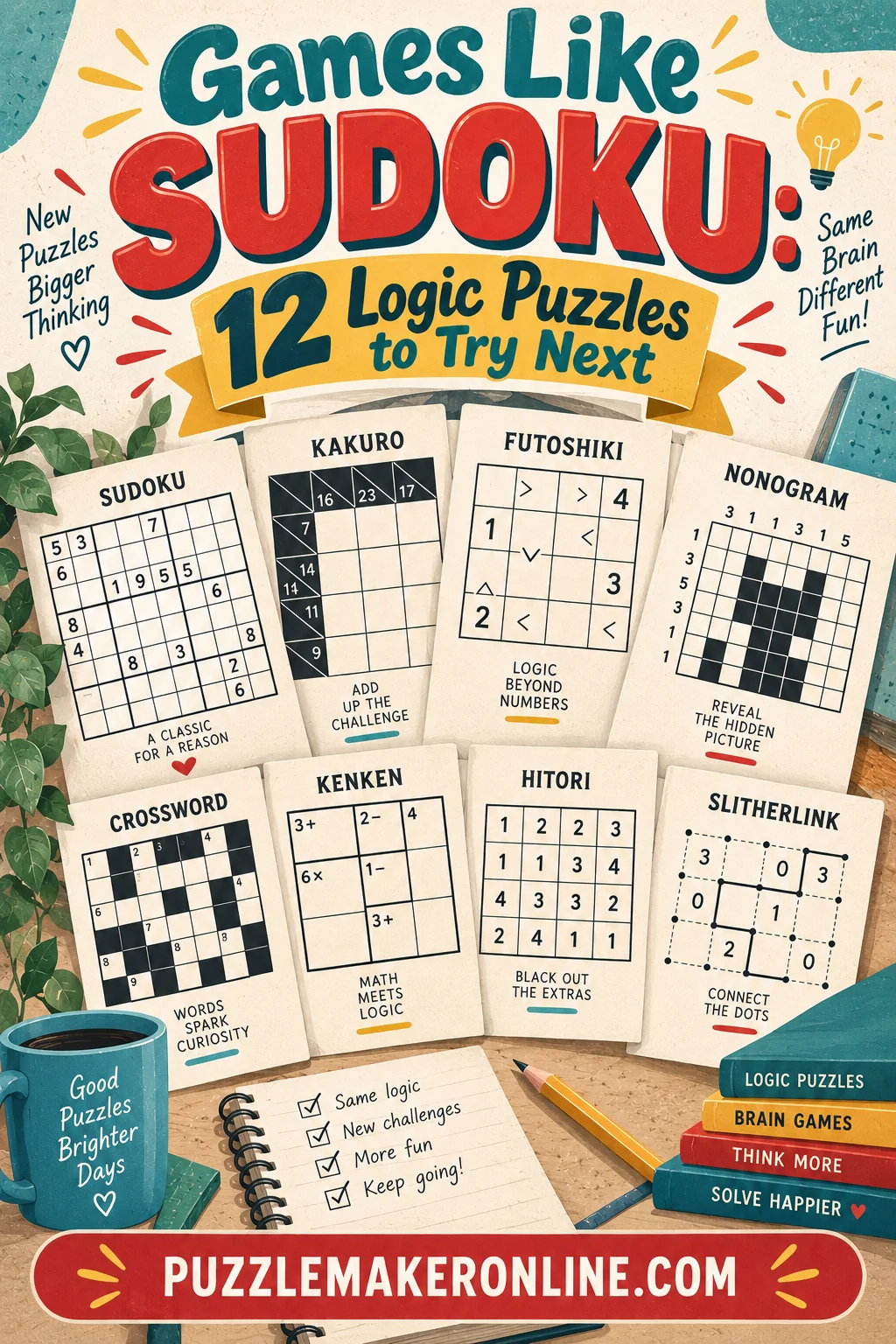
If you like the sum-only cages of killer sudoku, our killer sudoku combinations table is a handy companion, and the games like sudoku roundup covers other number puzzles worth trying. Kakuro is another close cousin, with sum clues and no repeats in a run, and it's covered in our separate guide to solving kakuro.
Why KenKen works so well for learning math
Miyamoto designed the puzzle as a teaching tool, and it shows. A single 6x6 puzzle asks you to factor numbers, recall addition facts, think about odd and even, and reason about what's impossible. The KenKen page for teachers says the puzzles help students build math and logical thinking skills, and it describes a free weekly classroom program that emails teachers a set of puzzles every Friday, with difficulty rising gradually.
A few ideas if you're using KenKen with a group:
- Start at 3x3 with addition only. The official beginner tutorial does exactly this, and it removes the fear factor.
- Ask "how do you know?" Have solvers explain each placement out loud. The explanation matters more than speed.
- Solve the same puzzle twice from different starting cages. The beginner tutorial recommends this to show there are many paths to the one solution.
- Let solvers make their own. Fill a 4x4 Latin square, draw cages around it, and compute the targets. Then swap with a partner. Checking that a homemade puzzle has only one solution is a great lesson in itself.
For more classroom ideas, see our page on puzzles for teachers. If you're curious about what the research says about puzzles and thinking in general, our article asking are puzzles good for the brain looks at the evidence with care.
Try it yourself: a practice 4x4
Here's one more 4x4 to practice on. It has exactly one solution, and you can solve it with the same steps as the first example. The answer is right below, so cover it up before you start.
| Col 1 | Col 2 | Col 3 | Col 4 | |
|---|---|---|---|---|
| Row 1 | A: 5+ | A | B: 4÷ | B |
| Row 2 | C: 8× | C | D: 2÷ | E: 4+ |
| Row 3 | F: 3÷ | C | D | E |
| Row 4 | F | G: 1− | G | H: 2 |
Cage C is an L shape: r2c1, r2c2 and r3c2. A hint to get going: cage B (4÷) can only be 4 and 1, and cage E (4+ in a column) can only be 1 and 3.
| Answer | Col 1 | Col 2 | Col 3 | Col 4 |
|---|---|---|---|---|
| Row 1 | 2 | 3 | 1 | 4 |
| Row 2 | 4 | 1 | 2 | 3 |
| Row 3 | 3 | 2 | 4 | 1 |
| Row 4 | 1 | 4 | 3 | 2 |
A sketch of the logic: H gives r4c4 = 2. Column 4 then has E = {1, 3} in rows 2 and 3, so r1c4 = 4 (it's the only number left that also fits B), and r1c3 = 1. Row 1's cage A needs 5 from the remaining 2 and 3. From there, cage F (3÷ in column 1) is {1, 3}, and the rest falls into place.
Make and print your own puzzles
KenKen rewards practice more than talent. Start with 4x4 grids until the two-square cages feel automatic, move up to 6x6 when you can finish a 4x4 without pencil marks, and remember the three big ideas: crowded lines, one-answer cages and legal repeats in bent cages.
When you want a change of pace between number puzzles, our free puzzle maker lets you type your own words or pick a theme, choose a puzzle type, and print it with an answer key. It's handy for building a mixed puzzle packet for a class, a family game night or your own warm-up before a tough grid.
KenKen's Four Operations Compared
This table shows how to read a cage for each operation, with a quick example of the kind of clue that gives you the most to work with.
| Operation | What to look for | Example |
|---|---|---|
| Addition | Small and large targets are the most restrictive, and middle targets have many options | A two-square 3+ can only be 1+2, and in a 6x6 a two-square 11+ can only be 5+6 |
| Subtraction | Big differences are restrictive, while a difference of 1 is the weakest clue in the game | In a 6x6, a 5− cage must be 6 and 1 |
| Multiplication | Look at the prime factors, since a target with a factor of 5 needs a 5 in the cage | A 45× cage must contain two 3s and a 5 |
| Division | The bigger number is exactly the target times the smaller one | In a 6x6, a 3÷ cage is {1, 3} or {2, 6} |
Frequently Asked Questions
What are the basic rules of KenKen?
In a grid that is N squares wide, you place the numbers 1 to N so that no number repeats in any row or column. The grid is divided into outlined groups called cages. Each cage shows a target number and an operation, and the numbers inside the cage must produce that target using that operation. A cage with one square simply gives you its number. Numbers may repeat inside a cage only if the copies are not in the same row or column. Every proper puzzle has exactly one solution.
Where should I start when solving a KenKen puzzle?
Start with the single-square cages, because their numbers are given. Next, look for cages that have only one possible set of numbers, such as a two-square 3+ cage, which must be 1 and 2. Then find a row or column crossed by several of those tight cages and compare them. Usually one cage blocks a number from another, and that forces your first real placement. From there, keep crossing cage options with the row and column rule until the grid fills in.
Does the order matter in subtraction and division cages?
No. In a subtraction cage, you take the larger number minus the smaller one, and in a division cage you divide the larger number by the smaller one. The two numbers can sit in either square. So a 2÷ cage could hold 4 in the left square and 2 in the right, or the other way around. This is why subtraction and division cages almost always have exactly two squares, since order would get confusing with three or more.
Can a number repeat inside a KenKen cage?
Yes, as long as the repeated numbers do not share a row or column. Straight cages can never repeat a number, because all their squares are in one line. Bent cages, such as L shapes, can. For example, a three-square 45x cage in a 6x6 must hold 3, 3 and 5, and the two 3s have to go in the two squares that share no row or column. Forgetting this rule is one of the most common reasons people get stuck.
Who invented KenKen and what does the name mean?
KenKen was invented in 2004 by Tetsuya Miyamoto, a Japanese mathematics instructor who wanted a puzzle that would build students' math and logic skills through independent thinking. The official KenKen site says the word ken means wisdom in Japanese, so the name is meant to suggest wisdom squared. The puzzle reached the United States in 2008 and soon began running in The New York Times, according to the official site.
Is KenKen harder than sudoku?
It depends on the size and the solver. A 4x4 KenKen is far easier than a typical 9x9 sudoku, and many beginners finish one in a few minutes. Larger KenKen grids add arithmetic on top of placement logic, so they can feel harder to people who are less comfortable with multiplication and factoring. KenKen has no 3x3 boxes, which removes one source of clues, but the cage math adds a different kind of information. Many people enjoy alternating between the two.
What is the line total trick in KenKen?
Every full row or column adds up to the same number, which is 1 plus 2 plus every number up to N. For a 4x4 that is 10, and for a 6x6 it is 21. You can calculate it with N times N plus 1, divided by 2. If a row is mostly covered by complete addition cages and known squares, subtract their totals from the line total to find the missing square. This works across several rows at once on larger grids, too.
Do I need to guess to solve KenKen?
A well-made KenKen can always be solved with logic alone, since it has exactly one solution. On harder grids, you may test a candidate by following its consequences a step or two to see whether it causes a conflict. That is still reasoning, not random guessing, as long as you keep track of what you assumed. Pencil marks help a lot here, because you can see every remaining option and undo a test cleanly if it fails.
Is KenKen good for kids learning math?
KenKen was created as a teaching tool, and many teachers use it to practice arithmetic facts, factoring and logical reasoning in one activity. Small 3x3 and 4x4 grids with addition only are a gentle starting point, and the official site offers a free weekly classroom program with gradually rising difficulty. Asking students to explain how they know each number is often more valuable than timing them, because the reasoning is where most of the learning happens.
Sources
We checked every source below while writing this guide. Last reviewed October 30, 2026, by Joan Ramos.
- About KenKen (KenKen Puzzle (Nextoy LLC))
- KenKen FAQ (KenKen Puzzle (Nextoy LLC))
- How to Play: Tutorial (Beginner) (KenKen Puzzle (Nextoy LLC))
- How to Play: Tutorial (Expert) (KenKen Puzzle (Nextoy LLC))
- Solving Tips (KenKen Puzzle (Nextoy LLC))
- KenKen for Teachers (KenKen Puzzle (Nextoy LLC))
- Latin Square (Wolfram MathWorld)