
Keep the Kids Table Busy Until Christmas Dinner: Placemat Puzzles Kids Finish
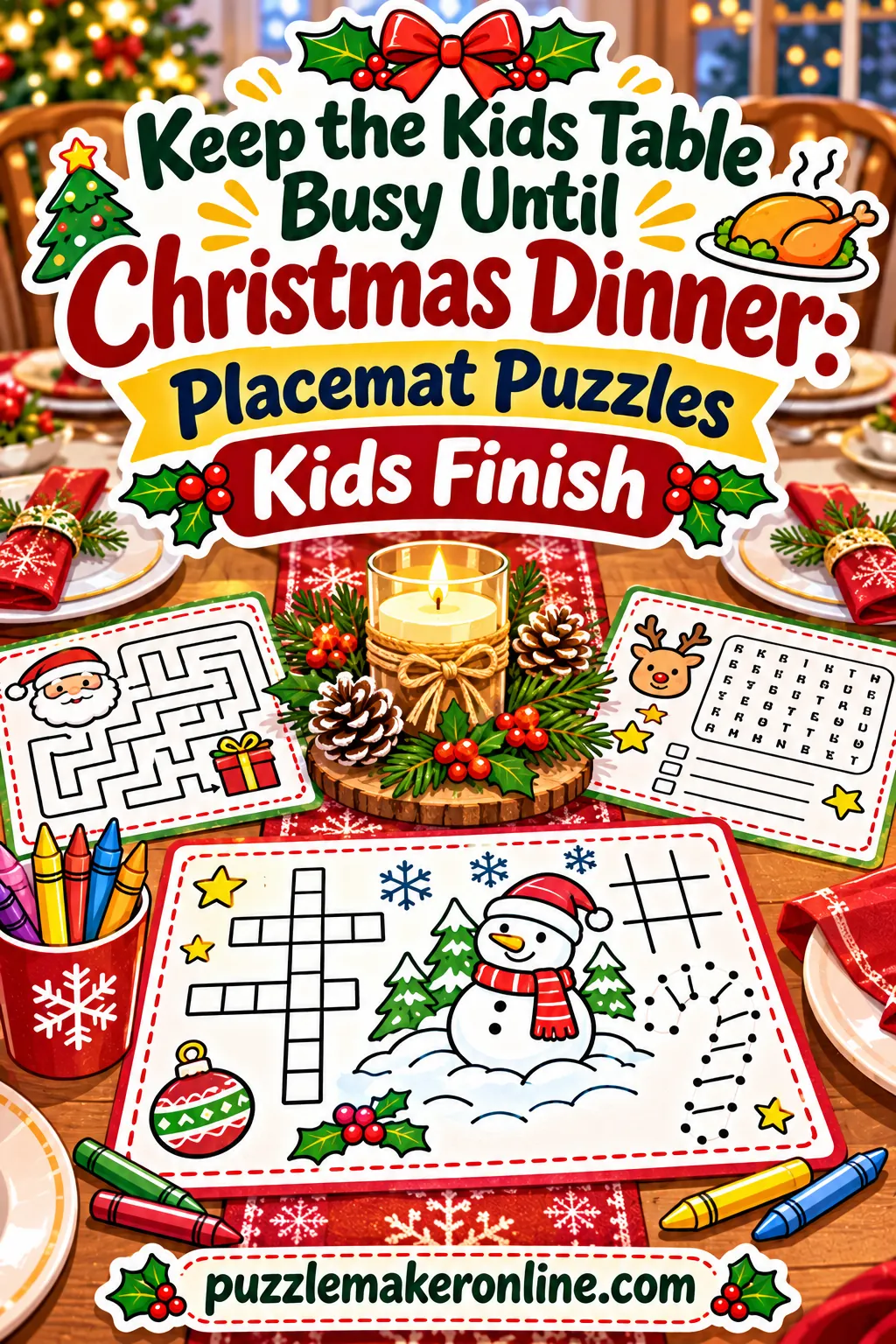
The easiest way to keep the kids table busy until Christmas dinner is to set one printed placemat puzzle at every child's spot before they sit down: an easy word search or maze with their own name, their cousins' names and the food on the table, sized to each kid's age so they can actually finish it. You can make a whole table's worth in about 20 minutes with the free puzzle maker, and every sheet comes with an answer key for the grown-up on duty.
Christmas dinner almost never lands on time. The turkey needs another half hour, the rolls are still rising, Aunt Linda's flight was late, and somebody forgot the gravy is still on the stove. Grown-ups can handle that with a snack and a chat. Kids can't. Ten minutes into the wait, someone is under the table, someone is crying, and someone has eaten all the olives.
A puzzle at each place setting gives them something to do with their hands and heads right where you want them: sitting down. This guide shows you exactly what to print for each age, the settings to use, word lists you can paste in, a timeline for the day, little games that stretch one sheet into 30 minutes, and what to do when it all goes sideways.
Why Placemat Puzzles Work While Dinner Runs Late
Lots of hosts try crayons and a blank page, or a tablet on the side table. Those can work, but a puzzle at each seat solves a few problems at once.
- It keeps kids in their seats. A puzzle lives on the table, not on the floor. Kids who are working on something are kids who aren't running laps around the kitchen.
- It has an end. Coloring can go on forever or get abandoned in two minutes. A word search has 8 words. Kids know when they're done, and finishing feels good.
- It's personal. When a 6-year-old finds her own name hidden in the grid, she's hooked. Add Grandma, Grandpa and the cousins, and the puzzle turns into a "who's here today" game.
- It's quiet. Not silent, but a table full of kids hunting for words is a lot calmer than a table full of kids with nothing to do.
- It works for every age at once. A 4-year-old gets an easy maze, a 9-year-old gets a word search, a 12-year-old gets a mini crossword. Same table, same "special placemat" feeling.
- It's screen-free. Many families like Christmas dinner to be a no-device meal. A paper puzzle fits right in.
- It's cheap and fast. A few sheets of paper, a pencil or crayon per kid, and 20 minutes of prep the night before.
What "a puzzle kids finish" really means
The title says kids finish these puzzles, and that's on purpose. The most common mistake is making the puzzle too hard. A frustrated kid is louder than a bored one. For a dinner wait, you want each puzzle to take about 5 to 15 minutes, with a quick win early.
Here's the rule of thumb: make the puzzle one step easier than you think. If your 8-year-old breezes through 12 × 12 word searches at home, give her a 10 × 10 with 8 words at the table. She's excited, hungry and surrounded by cousins. Her focus is not at its best. An easy finish followed by a second sheet beats a hard puzzle she gives up on.
How to Make Placemat Puzzles With the Free Tool
You'll make one main puzzle per child plus one "bonus" sheet for fast finishers. Open the free puzzle maker on a laptop or desktop. The tabs across the top are Word Search, Crossword, Word Scramble, Sudoku, Maze, Cryptogram and Fill-In. You don't need an account, and nothing you type is stored on a server, so you can use real family names without worry.
The main placemat: an easy word search
This is the star of the kids table for ages 5 to 11.
- Click the Word Search tab.
- In Puzzle title (optional), type something personal, like "Ava's Christmas Dinner Puzzle" or "The Cousins Table." A kid's own name in the title makes it feel like a place card.
- In Word list, type one word per line. Start with the child's own name, then 5 to 9 more: relatives at dinner and foods on the table. The word lists later in this guide are ready to paste.
- Set Grid size. Choose 10 × 10 for ages 5 to 7 and 12 × 12 for ages 8 to 11. Auto-fit also works if you're not sure.
- Set Letter case to UPPERCASE. Capital letters are much easier for young kids to spot.
- Click Easy under Difficulty, then look at Directions and keep only Horizontal and Vertical checked for kids under 8. Add Diagonal for ages 8 and up. Leave Backwards off for the kids table. It's the setting that turns a fun puzzle into a frustrating one.
- Turn on 🔍 Large print (bigger letters) for ages 4 to 6. Bigger cells are easier to circle with a chunky crayon.
- Leave 🎨 Add matching pictures on. The little pictures around the grid make the sheet look festive, which is half the fun of a placemat.
- Click Generate puzzle.
- If the words cluster in one corner, click 🔀 New layout for a fresh arrangement.
- Check that Paper says US Letter, then click 🖨 Print or 📄 Save PDF.
The puzzle prints on the first page and the answer key on the second. For the kids table, print only page 1 for each child and keep one answer key for the grown-up in charge.
A full US Letter sheet is 8.5 by 11 inches, which is close to the size of a regular placemat. It fits nicely to the left of the plate, or under the plate if you want the puzzle to "turn into" the placemat once food arrives.
The little-kid placemat: an easy maze
Kids who aren't reading yet, roughly ages 3 to 5, do best with a maze. There are no words to read, just a path to follow from Start to Finish.
- Click the Maze tab.
- Add a title, like "Help Leo Find the Christmas Tree."
- Click Easy. Difficulty sets the maze size, and Easy is the smallest and simplest.
- In Theme, choose Christmas 🎄 or Winter ⛄ for a festive border.
- Click Generate maze, then print.
Print two or three different easy mazes per little one. Click Generate maze again for a new one each time. A 4-year-old can finish an easy maze in a couple of minutes, and then they'll want another. If you'd like some ready-made backups too, the Christmas maze page has a printable set.
The big-kid placemat: a mini crossword about the family
Kids 10 and up often find easy word searches babyish. Give them a crossword where every answer is someone at dinner.
- Click the Crossword tab.
- Add a title like "Who's at Christmas Dinner?"
- In Words & clues, type one entry per line as WORD : clue, like GRANDPA : Falls asleep in his chair after pie or MILO : The cousin who just lost a front tooth.
- Use 6 to 10 entries. Crosswords need answers that share letters, so mix in a few words with common letters like E, A, R, S and T.
- Click Generate crossword. The grid builds itself on shared letters and numbers the clues across and down.
- If a word won't fit, swap it for a word with more common letters and generate again.
- Print page 1 for the kids and keep the answer key.
The family crossword often becomes the hit of the kids table, because the clues get read out loud and the grown-ups start laughing at their own descriptions.
A quick bonus page: the word scramble
A scramble is the perfect "I'm done, what now?" sheet.
- Click the Word Scramble tab.
- Title it "Bonus Round" or "Unscramble the Dinner."
- Type 6 to 8 food or family words, one per line.
- Leave Print answer blanks on, so kids can see how many letters each word has.
- Click Generate scramble. If a word barely looks mixed up, click 🔀 New layout.
- Print.
Settings at a glance
| Placemat | Tab | Ages | Words | Key settings | Time to finish |
|---|---|---|---|---|---|
| Easy maze | Maze | 3 to 5 | None | Easy, Christmas or Winter theme | 2 to 5 minutes each |
| Picture word search | Word Search | 4 to 6 | 5 to 6 | 10 × 10, UPPERCASE, Easy, Horizontal only, Large print on | 5 to 10 minutes |
| Easy word search | Word Search | 6 to 8 | 7 to 9 | 10 × 10, UPPERCASE, Easy, Horizontal and Vertical | 8 to 12 minutes |
| Bigger word search | Word Search | 8 to 11 | 10 to 12 | 12 × 12, UPPERCASE, add Diagonal | 10 to 15 minutes |
| Family crossword | Crossword | 10 and up | 6 to 10 WORD : clue lines | Pictures on | 10 to 20 minutes |
| Bonus scramble | Word Scramble | 7 and up | 6 to 8 | Print answer blanks on | 5 to 8 minutes |
If you're not sure which level fits a child you don't see often, like a cousin from out of town, aim for the younger row. The guide to puzzle difficulty by age has a longer breakdown.
Ready-to-Use Word Lists for the Kids Table
These lists are ready to paste into the Word list box, one word per line. Use them as a base, then swap in your own family's names and the actual dishes on your table. The more a puzzle sounds like this dinner, the faster kids dive in.
Ages 4 to 6: five or six short words
Keep words short, and put the child's own name first so you can point to it and say, "Your name is hiding in there. Can you find it?"
| List | Words |
|---|---|
| Table things | CUP, PLATE, FORK, BOWL, PIE, NAME |
| Christmas things | STAR, TREE, BELL, GIFT, SNOW, NAME |
| Who's here | MOM, DAD, NANA, PAPA, NAME, DOG |
Replace NAME with the child's real name. A 5-year-old named Jo gets JO, MOM, DAD, NANA, PAPA and STAR. That's six words in a 10 × 10 grid with large print. Most kids that age will need a grown-up to read the word bank with them for the first two or three words, and then they're off.
Ages 6 to 8: seven to nine words
| List | Words |
|---|---|
| The dinner table | TURKEY, GRAVY, ROLLS, CANDLE, NAPKIN, PLATE, DESSERT, PIE |
| Our family (fill in) | GRANDMA, GRANDPA, AUNT, UNCLE, COUSIN, plus 3 or 4 real first names |
| Christmas Day | TREE, GIFTS, STOCKING, WREATH, SNOWMAN, COOKIES, BOW, HOLLY |
Ages 8 to 11: ten to twelve words
| List | Words |
|---|---|
| The whole feast | TURKEY, HAM, GRAVY, STUFFING, POTATOES, CRANBERRY, ROLLS, GREEN BEANS, CARROTS, PIE, COOKIES, DESSERT |
| Family tree | GRANDMA, GRANDPA, GREAT AUNT, UNCLE, COUSIN, NEPHEW, NIECE, plus 4 or 5 real names |
| Around the house | FIREPLACE, GARLAND, ORNAMENT, LIGHTS, WRAPPING, RIBBON, MITTENS, SLEIGH, REINDEER, CAROLS |
Two-word entries like GREEN BEANS are fine. The puzzle maker drops the space and hides the letters as one word, GREENBEANS. Older kids handle that easily, but skip two-word entries for kids under 8.
Make it about this dinner
The best list is a mix of three things: the child's name, the people at the table, and the food they can smell from the kitchen. Here's a worked example for one family.
The Garcia family has five kids at the kids table: Mia (4), Lucas (6), Sofia (8), Mateo (10) and Elena (12). Grandma and Grandpa are hosting, Uncle Ray and Aunt Jo are visiting, and dinner is turkey, mashed potatoes, gravy, rolls, corn and pumpkin pie.
| Child | Puzzle | Settings | Word list |
|---|---|---|---|
| Mia, 4 | Two easy mazes | Easy, Christmas theme | None |
| Lucas, 6 | Word search | 10 × 10, Large print, Horizontal only | LUCAS, MIA, CORN, PIE, ROLLS, RAY |
| Sofia, 8 | Word search | 10 × 10, Horizontal and Vertical | SOFIA, LUCAS, MATEO, GRANDMA, GRANDPA, TURKEY, GRAVY, CORN, PIE |
| Mateo, 10 | Word search | 12 × 12, add Diagonal | MATEO, ELENA, SOFIA, LUCAS, MIA, GRANDMA, GRANDPA, UNCLE RAY, AUNT JO, TURKEY, POTATOES, PUMPKIN |
| Elena, 12 | Family crossword | 8 clues | GRANDPA : Carves the turkey every year; RAY : Uncle who tells the corniest jokes; JO : Aunt who drove the farthest; MIA : Youngest one at the table; GRAVY : Brown sauce in the boat-shaped dish; PUMPKIN : Orange pie filling; ROLLS : Soft bread in the basket; CANDLE : Glows in the middle of the table |
Add one bonus scramble for everyone 7 and up: TURKEY, GRAVY, ROLLS, CORN, PIE, CANDLE, PLATE.
Making all of that takes about 20 minutes once the lists are written. Notice that every kid finds a sibling or cousin's name in their puzzle. That's what gets them talking to each other instead of poking each other.
Hide a secret message in the main puzzle
The Word Search tab has a Secret message (optional) box. Type a short phrase, up to 80 characters, and the leftover letters in the grid, the ones not used by any word, spell it out in reading order once every word is found. The answer key shows the message decoded, so you can check.
For the kids table, short messages work best:
- DINNER IS ALMOST READY
- PIE IS COMING SOON
- GRANDMA LOVES YOU
- YOU ARE THE BEST COUSINS
- ASK FOR SECOND DESSERT
That last one gets a big reaction. Just make sure the grown-ups are in on the joke. For kids under 8, skip the secret message. Copying leftover letters is fiddly, and it can turn a quick win into a long, tearful job.
Setting Up the Kids Table
The puzzles do the heavy lifting, but a little setup makes them work better. Think of each sheet as a place card, a placemat and an activity all in one.
What goes at each spot
- The puzzle sheet, with the child's name in the title, set to the left of the plate or under it.
- One writing tool. Crayons for kids under 6, since they're easy to grip. Pencils or thin markers for older kids. Highlighters are great for word searches because they mark words without hiding the letters.
- Something firm to lean on, if your tablecloth is soft. A clipboard or a piece of cardboard under the sheet keeps the pencil from poking through.
- Optional: a sticker or a small candy cane on the sheet as a "welcome to your seat" surprise.
Keep the bonus sheets and the answer key in a folder with the grown-up who's watching the table, not on the table. If bonus sheets sit out, the fastest kid grabs them all.
How many sheets to print
Here's a simple formula: 2 sheets per kid, plus 2 spares. That covers the main puzzle, one bonus page, and a couple of extras for the surprise neighbor kid or the sheet that ends up with gravy on it.
| Kids at the table | Main puzzles | Bonus sheets | Spares | Total sheets |
|---|---|---|---|---|
| 3 | 3 | 3 | 2 | 8 |
| 5 | 5 | 5 | 2 | 12 |
| 8 | 8 | 8 | 2 | 18 |
| 12 | 12 | 12 | 3 | 27 |
Add one answer key page for each different puzzle, not for each copy. If six kids get the same "Cousins Table" word search, you only need one key.
For the little ones, double the maze count. A 4-year-old who finishes a maze in three minutes will happily do three more.
One puzzle for everyone, or one per kid?
Both work. Here's how to choose.
- One per kid, each with their own name in the title, feels the most special. It takes about 2 minutes per puzzle, and kids love seeing their name at the top of the page.
- One shared puzzle for kids of similar ages is faster. Make "The Cousins Table Puzzle" once, print copies, and you're done. Put each child's name somewhere in the word list so everyone still finds themselves.
- A mix is what most families end up doing: one shared word search for the 6-to-10 crowd, mazes for the littles, and a crossword for the oldest.
A big shared placemat for a long table
If you have a long kids table, try this: print 3 or 4 different word searches, tape them end to end down the center of the table, and let the kids work on them together. It turns into a team game, and they shuffle around to reach the next puzzle. Put a few highlighters in a cup in the middle. This works best with ages 6 and up. Younger kids tend to scribble on everyone else's section.
The Christmas Day Timeline
The secret to a calm kids table is having the puzzles in place before the kids sit down. Here's a timeline that works for most families.
The week before
- Find out who's coming and how old each child is. Get the spelling of every name right. Kids notice when their name is wrong.
- Find out the menu. Food words on the puzzle should match what's actually on the table.
- Write the word lists. A notes app or a scrap of paper is fine.
Two or three days before
- Make the puzzles in the free puzzle maker. Save each one as a PDF with the child's name in the file name, like "kids-table-sofia.pdf." Puzzles aren't saved on the site, so the PDF is your copy.
- Print everything, including bonus sheets, spares and one answer key per puzzle.
- Put the printed sheets in a folder with crayons, pencils and a few highlighters, and leave it by your coat or in the car if you're traveling to someone else's house.
If you're traveling, don't count on the host having a printer. Print at home and pack the folder flat so the sheets don't crease.
Christmas Day
| When | What to do |
|---|---|
| Morning | Hand the folder to whoever will set the table, or tuck it next to the plates |
| While setting the table | Place each main puzzle and a writing tool at each spot |
| When dinner is 20 to 40 minutes away | Call the kids to the table to find their names and start their puzzles |
| 10 to 15 minutes in | Hand out bonus scrambles or second mazes to anyone who's done |
| 20 to 30 minutes in | Start a table game (next section) to stretch the wait |
| Food arrives | Slide puzzles to the side or under the plate, or collect them for later |
| After dinner | Bring the puzzles back out while grown-ups linger over dessert |
Timing matters more than you'd think. If you seat kids an hour early, even great puzzles won't hold them. Aim to call them to the table when dinner is 20 to 40 minutes away. If dinner keeps slipping, that's what the bonus sheets and table games are for.
Table Games That Stretch One Sheet Into 30 Minutes
A puzzle on its own buys you 10 to 15 minutes. If the turkey needs longer, turn the sheets into a game. These need nothing but the puzzles and one grown-up or older cousin running things from the end of the table.
The name hunt
Before anyone starts, the table helper says: "Everybody find your own name first. Hands up when you've got it." Then: "Now find the name of the person sitting to your left." Kids look up, check who's next to them and dive back in. It gets them talking to each other, and the youngest kids get a quick win right away.
Race the gravy
Pick a real kitchen milestone and race it. "Can you finish your puzzle before the gravy is done?" Then send a runner to the kitchen every few minutes for an update. Kids love the running report, and the cook gets a little cheering section. Keep it a race against the kitchen, not against each other, so the younger kids don't lose to a 12-year-old.
Swap and check
When two kids finish, have them swap sheets and check each other's work against the word bank. It takes a few minutes, and checking someone else's puzzle feels very grown-up to a 7-year-old. For crosswords, the oldest kid can be the "judge" with the answer key.
Who wrote that clue?
This one is for the family crossword. The helper reads a clue out loud, like "Uncle who tells the corniest jokes," and the kids shout the answer. Then they have to go tell that relative what the clue said. Grown-ups laugh, kids get a quick stretch, and everybody comes back to the table.
Add a word
Give each kid a blank spot at the bottom of their sheet. Their job is to write one more Christmas dinner word that could have been in the puzzle. Then they read their words out loud and the table votes on the best one. No grid needed, just a few more minutes of happy thinking.
Scripts for the table helper
An older cousin, 12 to 16, makes a great kids table helper, and most of them like being asked. Give them the folder and a few lines to use.
| Moment | What the helper can say |
|---|---|
| Kids arrive at the table | "Find your seat. Your name is on your placemat. And your name is also hiding inside the puzzle." |
| Someone is stuck | "Which word are you looking for? Let's look for its first letter together." |
| Someone finished fast | "Nice! Want a bonus round? This one has scrambled dinner words." |
| Kids start getting loud | "New game: first one to find GRAVY gets to tell the cook it's time." |
| Food is coming | "Puzzles go under your plate now. You can finish after dinner." |
| Someone is sad they didn't finish | "That's okay. It's yours to keep, so you can finish it in the car." |
Hand the helper the answer key so they can settle arguments fast. If they're running the table well, a thank-you from the grown-ups or the first slice of pie goes a long way.
Variations by Family Size and Age Mix
Every kids table is different. Here's how to adjust the plan.
Just one or two kids
With only one or two kids, the puzzle doesn't need to keep a whole table calm. It just needs to give them something to do while the grown-ups are busy. Make one main puzzle each, print two bonus sheets, and let them sit at the big table. Put their sheets right next to Grandma or another grown-up who likes puzzles, and they'll end up solving together.
A big crowd of cousins
With 10 or more kids, don't make 10 custom puzzles. Make three: one easy maze for the littles, one shared word search for the middle group with every kid's name in the list, and one family crossword for the oldest. Print copies. That's 15 minutes of prep for a crowd. Set up two helpers, one at each end of the table.
Mostly toddlers and preschoolers
Under age 4, puzzles are more about holding a crayon than solving anything. Print easy mazes and let them scribble along the path, with a grown-up tracing it with a finger first. Keep expectations low and the crayons chunky. A few stickers stuck on the maze path, like little stops along the way, make it feel like a game.
Mostly tweens and teens
Kids 11 and up may roll their eyes at the "kids table." Lean into it with something that feels like a challenge. A family crossword with funny clues, a harder word search with all four directions on, or a cryptogram with a family message all work. In the Cryptogram tab, type a short sentence up to 200 characters, leave 💡 Give 2 free letters on, and generate. A sentence like "The first one to solve this gets the biggest slice of pie" gets solved fast.
Kids who don't speak much English, or who are just learning to read
Mazes need no reading at all. For word searches, keep words short and use picture-friendly words like PIE, TREE, STAR and CAT. Turning on 🎨 Add matching pictures gives them little visual hints around the grid. A cousin who reads well can also be a "word buddy" and read the word bank aloud.
Kids with different needs
For a child who gets overwhelmed easily, fewer words is better. Four or five words in a large-print 10 × 10 grid is plenty. For a child who needs to move, give them a job that goes with the puzzle, like being the runner who checks on the gravy. You know your family's kids best. The goal is a calm, happy wait, not a perfect puzzle.
Troubleshooting the Kids Table
| Problem | What it looks like | Easy fix |
|---|---|---|
| Puzzle too hard | Frustration, tears, "I can't find any" | Point to the first letter of a word in the grid, or switch to a maze; next year, go down a grid size |
| Puzzle too easy | Done in 90 seconds | Hand over the bonus scramble, then start a table game |
| Kids seated too early | Restless before they even start | Hold the puzzles until dinner is 20 to 40 minutes away |
| Dinner is very late | Puzzles done, food still not ready | Run the name hunt or "who wrote that clue" game, then pull out spares |
| Not enough sheets | Surprise extra kids | Keep two spares in the folder; a maze works for any age |
| Fighting over crayons | Grabbing and arguing | One writing tool per kid, set out before anyone sits |
| Spilled drink on a sheet | Soggy puzzle | Grab a spare; keep cups on the right side and puzzles on the left |
| A word is missing from the grid | "It's not in there!" | Check the answer key; it's in there, often vertically |
| Name spelled wrong | A hurt kid | Double-check spellings the week before; if it happens, laugh it off and fix it with a pen |
| Pages print cut off | Missing edges | Check the Paper setting matches your paper, and print at 100 percent scale |
If the printer gives you trouble, the guide on how to print puzzles walks through settings that keep the whole grid on the page.
A few things to skip
- Skip backwards words at the kids table. They're the fastest way to turn fun into frustration.
- Skip timed races between kids of different ages. The youngest always loses, and then everyone hears about it.
- Skip long secret messages for kids under 8.
- Skip markers that bleed through if the puzzle is sitting on Grandma's good tablecloth. Use crayons, pencils or highlighters.
Ready-made backups
If Christmas Eve gets away from you and you don't have time to make custom puzzles, print a few sheets from the Christmas word search collection and some easy mazes, and add each kid's name to the top in pen. It's not quite as personal, but kids still love finding a puzzle at their seat.
Print Your Placemat Puzzles Tonight
You have the settings, the word lists, the timeline and a stack of table games. All that's left is about 20 minutes of making and printing. Open the free puzzle maker, start with an easy word search that has your youngest reader's name in the title, and build the rest of the table from there. When Christmas dinner runs late, and it will, the kids will be bent over their placemats hunting for GRAVY instead of hunting for trouble.
Frequently Asked Questions
What are good Christmas dinner kids table activities?
Printed placemat puzzles are one of the easiest. Put an easy word search, maze or mini crossword at each child's seat, with their own name and family names inside. Add a writing tool per child and a bonus sheet for fast finishers, and the kids table stays busy for 20 to 30 minutes.
How long will a placemat puzzle keep kids busy?
Most easy word searches take 5 to 15 minutes, and easy mazes take 2 to 5 minutes each. With a bonus sheet and a simple table game like the name hunt, you can stretch the wait to about 30 minutes. Seat kids when dinner is 20 to 40 minutes away for the best results.
What size should the puzzle be to fit at a place setting?
A regular US Letter sheet, 8.5 by 11 inches, works well. It's close to placemat size and fits to the left of the plate or underneath it. Choose a 10 × 10 grid for young kids and 12 × 12 for older ones so the letters stay big and easy to circle.
How do I put my family's names in the puzzle?
Type each name on its own line in the Word list box in the Word Search tab, along with a few food and Christmas words. The puzzle maker hides them in the grid and lists them in the word bank. For a crossword, type each name as WORD : clue, like GRANDPA : Carves the turkey every year.
What should little kids who can't read do?
Give them easy mazes. They have no words to read, just a path from Start to Finish. Print two or three per child, pick the Christmas or Winter theme, and hand them chunky crayons.
Do the puzzles come with answer keys?
Yes. Every puzzle prints with the answer key on its own page right after the puzzle. Print only the first page for each child, and keep one key per puzzle in a folder for the grown-up or older cousin running the kids table.
Can I make the puzzles on my phone?
The puzzle maker runs in a web browser, so you can try it on a phone, but a laptop or desktop is easier for typing word lists and printing. Make the puzzles a few days ahead and save each one as a PDF so they're ready to print.
Should the puzzles stay on the table during dinner?
Most families slide them under the plate or to the side when food arrives, then bring them back out during dessert. If you're worried about spills, collect them in the folder and hand them back after the meal. Kids are often happy to finish them in the car on the way home.