Surprise Your Kids With a Trip: A Puzzle Reveal They Solve on Christmas Morning
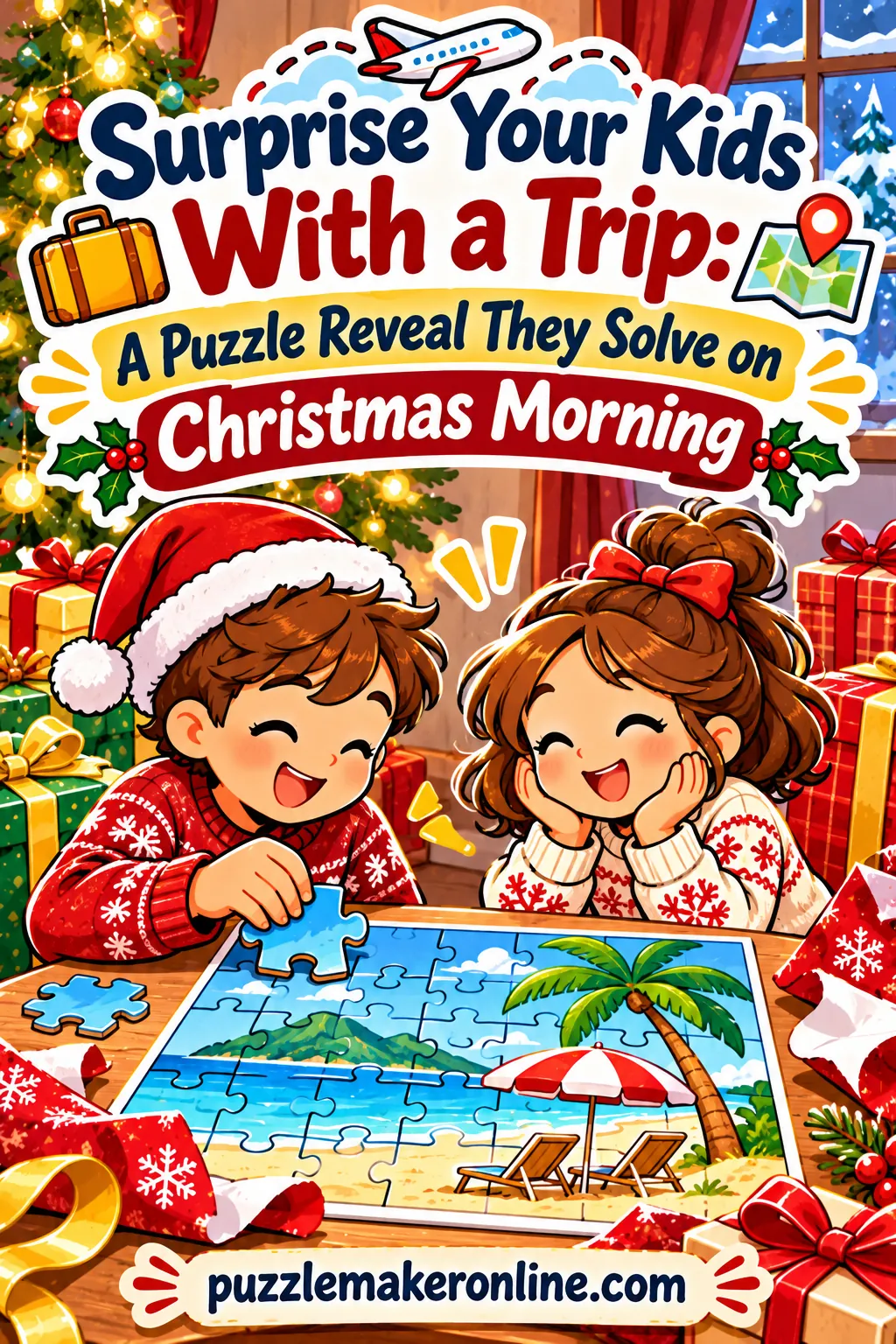
The simplest way to reveal a surprise trip on Christmas morning is a printed puzzle whose answer is the destination: a word search whose leftover letters spell "WE ARE GOING TO THE BEACH," or a word scramble where the last word they untangle is the place you booked. Your kids do the discovering themselves, so the big moment happens in their own hands instead of in a speech. You can build either one in about 15 minutes with the free puzzle maker, print it, and tuck it into a stocking or the very last gift under the tree.
Most Christmas surprise trip reveal ideas you'll find are a list of concepts: a scavenger hunt, a riddle, a wrapped suitcase, tickets in a box. They sound great, but nobody tells you how to actually make the puzzle part. This guide does. You'll get exact word lists, the precise settings to use, scripts for what to say, a Christmas morning timeline, versions for every age, and fixes for the things that go wrong.
Why a Puzzle Makes the Best Trip Reveal
A trip is a strange gift for a kid. There's nothing to unwrap, nothing to hold, and the fun part might be months away. Handing a child an envelope with a printout of a reservation usually gets a polite "Oh. Cool." A puzzle fixes that problem in a few ways.
It gives them something to do. Kids love the hunt more than the answer. Searching a grid, unscrambling letters, or cracking a code turns a piece of paper into an activity, and the reveal arrives at the end like a prize.
The news lands slowly. When letters start forming "WE ARE GOING TO," you'll see your child slow down, read it again, and look up at you. That half-second of "Wait... is this real?" is the moment you'll want on video.
It stretches the excitement. A reveal that takes five to fifteen minutes feels bigger than one that takes five seconds. It also gives siblings time to crowd around and help.
It works for any trip. A week at the beach, a cabin in the snow, a road trip to see cousins, a first plane ride, or a long weekend at a theme park all fit. The puzzle doesn't care where you're going.
It becomes a keepsake. The solved puzzle, with your kid's wobbly circles on it, is the thing you'll pin to the fridge, pack in the suitcase, or save in a memory box.
Here's how the main reveal styles compare.
| Reveal style | What kids do | Time to solve | Best ages | Effort to make |
|---|---|---|---|---|
| Word search with secret message | Find all the words, then read the leftover letters | 10 to 20 minutes | 6 to 12 | About 15 minutes |
| Word scramble with a final mystery word | Unscramble trip words, the last one is the place | 5 to 15 minutes | 6 to 12 | About 10 minutes |
| Crossword with trip clues | Answer clues, one answer is the destination | 15 to 30 minutes | 9 and up | About 20 minutes |
| Cryptogram of your announcement | Crack a letter code to read a sentence | 15 to 30 minutes | 10 and up, teens | About 10 minutes |
| Holiday maze to a hidden envelope | Trace a path, then find the envelope it points to | 3 to 10 minutes | 3 to 6 | About 5 minutes |
| Multi-puzzle hunt | Solve each puzzle to find the next one | 20 to 45 minutes | Mixed ages, siblings | About 45 minutes |
If you only have time for one, the word search with a secret message is the crowd favorite. It looks like an ordinary holiday puzzle until the very last step.
How to Do It With the Free Tool (Exact Settings)
You'll use the same free tool for every version in this guide. It runs in your browser, needs no account, and prints each puzzle on one page with the answer key on the next. Here are the two most popular builds, step by step.
Build 1: The secret-message word search
This is the classic. Your kids find a list of travel words, and when every word is circled, the letters nobody used spell out your announcement.
- Open the free puzzle maker and stay on the 🔎 Word Search tab, which opens first.
- Type a title that doesn't give it away. "Christmas Morning Word Search" or "A Puzzle From Mom and Dad" keeps the secret. A title like "Guess Where We're Going" is fun too, but it tips them off early.
- Enter your word list, one word per line. Use 8 to 12 words. Mix in some holiday words so it doesn't scream "vacation" right away. A good mix: SUITCASE, SUNSCREEN, SANDALS, PACK, SNACKS, MAP, WINDOW, PILLOW, STAR, COCOA, RIBBON, GIFT.
- Type your announcement in the Secret message box. For example: WE ARE GOING TO THE BEACH. Spaces and punctuation get dropped, so the tool hides the 20 letters W-E-A-R-E-G-O-I-N-G-T-O-T-H-E-B-E-A-C-H.
- Pick a grid size. For a 20-letter message and 10 to 12 words, choose 12 × 12 or 14 × 14. Auto-fit can work too, but picking the size yourself makes sure there's room for the message.
- Choose UPPERCASE. It's easier for kids to read leftover letters in capitals.
- Click a difficulty. Easy turns on Horizontal and Vertical only. Medium adds Diagonal. For most kids ages 6 to 10, Easy or Medium is right. Leave Backwards off unless you have a puzzle-loving older kid.
- Turn on 🔍 Large print for kids under 8, so the letters are bigger and easier to track.
- Click Generate puzzle. Look at the preview. If it looks crowded or you'd like a different arrangement, click 🔀 New layout.
- Check the answer key with the Show answer key toggle. The key shows every word and prints the decoded secret message, so you can confirm it reads correctly.
- Pick your Paper size (US Letter or A4), then click 🖨 Print or 📄 Save PDF.
One detail matters a lot here. The tool fills the leftover squares with your message first, in reading order (left to right, top to bottom), and then fills any remaining empty squares with random letters. So your kids read the unused letters from the top row down, and once the sentence is complete, the rest is just filler. Tell them: "Write down every letter you didn't circle, starting at the top left, until it makes sense."
A handy trick is to end your message with a stop signal, like WE ARE GOING TO THE BEACH YAY or PACK YOUR BAGS THE END. Then kids know exactly where the real message stops and the filler begins.
If your message is too long for the grid, the tool tells you right on screen. It shows how many empty squares the message needs and how many the grid has, and fills the leftovers with random letters instead. Pick a bigger grid or shorten the message, then generate again.
Build 2: The final-word scramble
This version is quicker to solve and great for kids who get restless with big grids. Every line is a scrambled travel word, and the final line is the destination itself.
- Open the puzzle maker and click the 🔤 Word Scramble tab.
- Type a title, such as Unscramble Our Surprise!
- Enter one word or short phrase per line. Put the destination last. For example: PACK, BAGS, PLANE, SUNSHINE, ADVENTURE, then BEACH. The scramble tab accepts short phrases, so the last line can be two words, like SNOW CABIN or GRANDMAS HOUSE.
- Leave Print answer blanks checked so each scrambled word gets a row of blanks for the answer.
- Click Generate scramble, check the answer key, and print.
The scrambled destination sits at the bottom of the page, looking just like the others. Kids work their way down, and the last answer is the surprise.
Want to see a working version first? The sample at the top of this page uses exactly that list, and the Christmas word scramble page has more seasonal words you can mix in so the puzzle looks like an ordinary holiday activity.
Word Lists for Every Kind of Trip
The words you hide set the mood and, if you're careful, keep the secret until the end. Use mostly "packing" words, a couple of holiday words as camouflage, and save the giveaway word for the message or the final line.
Keep most words between 3 and 10 letters. Long words like SUNSCREEN are fine in a 14 × 14 grid but crowd a small one.
Beach or warm-weather trip
SUITCASE, SUNSCREEN, SANDALS, TOWEL, SHELLS, WAVES, SNORKEL, BUCKET, SHOVEL, SUNHAT, POOL, SWIM
Secret message ideas: WE ARE GOING TO THE BEACH. PACK YOUR SWIMSUIT. SUNSHINE HERE WE COME.
Snow trip or mountain cabin
MITTENS, BOOTS, SLED, SKIS, COCOA, CABIN, FIREPLACE, SNOWBALL, GOGGLES, SCARF, LODGE, TRAIL
Secret message ideas: WE ARE GOING TO THE MOUNTAINS. SNOW TRIP IN JANUARY. GET YOUR SLED READY.
Road trip to family
MAP, SNACKS, PILLOW, CAR, PLAYLIST, MILES, STOPS, MOTEL, WINDOW, BLANKET, COUSINS, HUGS
Secret message ideas: ROAD TRIP TO SEE GRANDMA. WE ARE DRIVING TO TEXAS. COUSINS HERE WE COME.
First plane ride
PLANE, WINGS, CLOUDS, TICKETS, GATE, PILOT, SEATBELT, RUNWAY, LUGGAGE, WINDOW, TAKEOFF, LANDING
Secret message ideas: YOUR FIRST PLANE RIDE. WE FLY IN MARCH. BUCKLE UP WE ARE FLYING.
Theme park or big city weekend
RIDES, PARADE, TICKETS, MAP, HOTEL, CASTLE, FIREWORKS, ROLLERCOASTER, SNACKS, CAMERA, LINES, HATS
Keep park and character names out of the puzzle if you'd rather stay generic, and let the message do the work: WE ARE GOING TO A THEME PARK or a simple city name like WE ARE GOING TO CHICAGO.
Camping or national park trip
TENT, LANTERN, CAMPFIRE, HIKING, BOOTS, TRAIL, CANOE, STARS, COMPASS, MARSHMALLOW, BACKPACK, OWL
Secret message ideas: WE ARE GOING CAMPING. PACK YOUR HIKING BOOTS. TENTS AND STARS IN JUNE.
Camouflage holiday words
Mix two to four of these into any list so the puzzle looks like a normal Christmas activity at first glance: STAR, BELL, GIFT, COCOA, RIBBON, WREATH, SNOW, CANDLE, MITTEN, SLEIGH. The Christmas word search page has a much longer list if you'd like more.
More Puzzle Reveal Ideas: Crossword, Code, Maze and Clue Hunt
The word search and scramble cover most families. If your kids are older, younger, or already suspicious, one of these may fit better.
The trip crossword (ages 9 and up)
A crossword lets you write clues that hint at the trip without saying it. Most answers are travel words. One answer, usually the longest, is the destination.
Open the 🧩 Crossword tab and type one entry per line as WORD : clue. The grid arranges itself on shared letters and numbers the clues for you. Here's a sample list for a snow trip:
- MITTENS : Keep your fingers warm outside
- SLED : Ride it down a snowy hill
- COCOA : Warm drink with marshmallows on top
- SUITCASE : You'll need to pack this soon
- CABIN : Where we'll be sleeping in January
- MOUNTAINS : Where we're going (yes, really)
Clues like "You'll need to pack this soon" are the fun part. Kids start to notice that the clues are about them, and the realization builds one answer at a time.
If a word can't connect to any of the others, the tool skips it and shows a note. Swap that word for one with more common letters, or add another word that shares a letter with it. Turn on 🔍 Large print if the grid looks small.
The cryptogram announcement (ages 10 and up, and teens)
Teens can be hard to impress, and a straight word search may feel babyish to them. A cryptogram turns your announcement into a secret code. Every letter is swapped for a different letter, and they have to crack the code to read the sentence.
Open the 🔐 Cryptogram tab and type your announcement as the sentence, for example: WE LEAVE FOR THE MOUNTAINS ON JANUARY TENTH. Check 💡 Give 2 free letters for a gentler start. The answer key shows the full code alphabet and the decoded sentence.
Short cryptograms are hard because there are fewer letter patterns to work with. A sentence of 8 to 12 words gives them enough to crack. Words like THE, AND and WE are the usual first breakthroughs, so leave a few in. The guide on how to solve cryptograms is a good thing to have open if your teen asks for a hint.
The holiday maze (ages 3 to 6)
Little kids can't read a secret message yet, but they can trace a path. Open the 🌀 Maze tab, pick Easy, and set the theme to Christmas 🎄 so the start and finish get festive pictures. Generate it, then draw or tape a small picture at the finish: a beach ball, a snowflake, an airplane, or a photo of grandma.
When your child reaches the end, the picture is the clue. Have the real reveal ready: a beach towel wrapped in tissue, a pair of mittens, or a toy plane that leads into "Guess what? We're going on a plane!" If they need a warm-up first, the Christmas maze page has more festive mazes to try.
The multi-puzzle clue hunt (siblings and mixed ages)
A hunt chains puzzles together. Each answer tells them where to find the next envelope, and the last envelope holds the reveal. It takes longer to set up, but it's the one kids talk about for years.
A simple three-stage hunt:
- Stage 1, in the stocking: A word scramble whose last word is a place in your house, like FREEZER, DRYER or PIANO.
- Stage 2, at that spot: A word search with the secret message LOOK UNDER YOUR PILLOW.
- Stage 3, under the pillow: The final puzzle, with the destination as the secret message or the last scrambled word, plus something they can hold, like a printed photo of the place.
Keep each stage short. Three stages of 5 to 10 minutes each feels exciting. Six stages of 15 minutes each feels like homework, especially before breakfast.
Pick the Right Puzzle by Age
Age matters more than anything else. A puzzle that's too easy is over before the excitement builds, and one that's too hard turns the magic into frustration. Use this as a starting point and adjust for your kids.
| Age | Best puzzle | Settings | Words | What to watch for |
|---|---|---|---|---|
| 3 to 5 | Holiday maze plus a picture clue | Maze, Easy, Christmas theme | None | Have a grown-up read the final clue out loud |
| 5 to 6 | Short word scramble or easy word search | Easy, Large print, 10 × 10 | 5 to 6 short words | Use 3 to 5 letter words they can sound out |
| 7 to 9 | Word search with secret message | Easy or Medium, 12 × 12, Large print | 8 to 10 | Help them copy the leftover letters in order |
| 10 to 12 | Secret-message word search or crossword | Medium, 14 × 14 | 10 to 14 | Clues can be cheeky and a little tricky |
| 13 and up | Cryptogram or Hard word search | Hard, or cryptogram with 2 free letters | 12 to 16 | A teen may want to solve it alone first |
| Mixed siblings | One puzzle each, or a clue hunt | Match each child's level | Varies | Make sure the youngest gets a real role |
When you have kids of different ages
Siblings of different ages are the trickiest part of any reveal. The 10-year-old solves everything in two minutes and blurts out the answer before the 6-year-old finds a single word. Here are three ways around it.
Split the message. Give each child their own puzzle with part of the announcement. The older child's word search hides WE ARE GOING TO THE. The younger child's easy scramble ends with BEACH. Neither can finish the news alone, so they have to put their answers together. It turns competition into teamwork.
Give each kid a different puzzle type. The teen gets a cryptogram, the middle kid gets a word search, and the preschooler gets a maze that leads to a picture. Let everyone finish, then read the answers out loud in order.
Make the youngest the revealer. Older kids solve the puzzle and find out it says OPEN THE BOX ON THE TABLE. Only the youngest is allowed to open it. Everyone gets a moment.
When you have one child
An only child gets your full attention, which is a gift in itself. You can go a bit harder on the puzzle because nobody will steal the answer. Sit next to them, cheer them on, and let them finish without help unless they ask for it.
A Christmas Morning Plan That Saves the Best for Last
Timing makes or breaks the reveal. Kids opening twelve presents in a blur won't notice a piece of paper. Here's a plan that keeps the puzzle from getting lost.
The week before
- Make and print the puzzle. Print one test copy and solve it yourself first. Check the secret message by toggling the answer key.
- Keep the answer key away from the kids. The second page of the printout shows every answer and the decoded message, so don't leave it sitting in the printer tray where a curious kid can find it. Print only page 1 for them, or recycle page 2 right away.
- Gather props. A pencil, a highlighter, a clipboard, and something physical that ties to the trip: sunglasses, a guidebook, a stuffed animal from the place, or a printed photo.
- Plan your camera. If you want video, decide who's filming and where they'll stand. Prop a phone against a stack of books if you're the only grown-up.
Christmas Eve
- Hide the puzzle. Put it in an envelope, roll it like a scroll with a ribbon, or tuck it into a small box. Write "Open Last" or "Open With Mom and Dad" on the outside.
- Charge the phone that's filming.
- Set out pencils where you'll do the reveal so you aren't hunting for one at the big moment.
Christmas morning
- Open everything else first. Let stockings and regular presents happen as usual.
- Take a short break. Breakfast, a snack, or ten minutes of playing with new toys lets the pace slow down.
- Bring out the final gift. Gather everyone at the table or on the couch with good light.
- Hand over the puzzle with a simple line, like "There's one more present, but you have to solve it first."
- Start filming before they get close to the end. With a word search, start when they've found about half the words. With a scramble, start when they reach the last few lines.
- Let them read the answer out loud. Resist the urge to say it for them. Then bring out the physical prop.
A mid-morning reveal has another bonus: kids aren't as overloaded as they are in the first frantic half hour, so they'll focus on the puzzle and actually take in the news.
Where to hide the puzzle
| Hiding spot | Why it works | Watch out for |
|---|---|---|
| Last gift under the tree | Builds suspense when it's the only box left | Kids may shake it and guess it's paper |
| Toe of the stocking | Feels like a little bonus | Easy to miss among candy and small toys |
| Inside a bigger box, wrapped twice | The size throws them off | Don't make it too frustrating for little kids |
| Taped under the breakfast plate | Fun surprise mid-meal | Food spills on the paper |
| Inside a new backpack or suitcase | The suitcase is a hint all by itself | Older kids may guess before solving |
| With a wrapped travel item, like sunglasses | Gives them something to hold after solving | Choose an item that doesn't give it away |
What to Say: Short Scripts for the Big Moment
You don't need a speech. A few simple lines keep the energy up without giving anything away. Pick the ones that sound like you.
Handing it over: - "We saved one more present. It's a puzzle, and you have to solve it to find out what it is." - "This gift is a secret. The puzzle knows the answer, and now you get to find it." - "No peeking at the end. Start at the top and see what it says."
When they get stuck: - "You've got almost all of them. Which words are left?" - "Try reading the leftover letters out loud, starting in the top corner." - "Look at the last word on the list. What could those letters spell?"
When they figure it out: - "Read it out loud for everybody." - "Yep. It's real. We're really going." - "You want to see where we're staying?" (Then bring out the photo or prop.)
If they're confused or quiet:
Some kids go silent when news is big, especially if they've never traveled before. That's normal. Explain the plan in simple terms: when you're going, how you'll get there, how many nights you'll sleep there, and one fun thing you'll do. A child who seems unsure at 10 a.m. may be telling grandma all about it by lunch.
If the trip is months away:
A trip in June can feel unreal to a 6-year-old on December 25. Give them a way to hold on to it. Hang the solved puzzle on their bedroom door, or let them pick one thing to pack today and put it in a "trip box." Counting down by months, then weeks, keeps the excitement alive without asking about it every single day.
A Complete Worked Example
Here's how one made-up family put the whole thing together, from word list to reveal.
The family: Two kids, Maya (9) and Leo (6). The trip is four nights at a beach in April, with Leo's first plane ride.
Maya's puzzle (word search):
- Title: A Puzzle for Maya
- Words (10): SUITCASE, SANDALS, SHELLS, TOWEL, WAVES, BUCKET, STAR, COCOA, RIBBON, GIFT
- Secret message: WE ARE GOING TO THE (14 letters)
- Settings: 12 × 12 grid, UPPERCASE, Medium (Horizontal, Vertical, Diagonal), Large print off
A 12 × 12 grid has 144 squares. The ten words use 56 letters in total, and some of them share squares where they cross, so the grid has plenty of empty squares for a 14-letter message. The tool fills the first 14 leftover squares with W-E-A-R-E-G-O-I-N-G-T-O-T-H-E and the rest with random letters.
Leo's puzzle (word scramble):
- Title: Leo's Surprise
- Words (5): SUN, SAND, PLANE, FISH, BEACH
- Settings: Print answer blanks on
Leo's words are short, 3 to 5 letters, so he can sound them out. The last one, BEACH, finishes his sister's sentence.
The reveal: After breakfast, Mom hands each kid an envelope marked "Open Together." Maya solves her grid in about 12 minutes and reads "WE ARE GOING TO THE..." and then everybody turns to Leo. With a little help from Dad, he unscrambles BEACH, and Maya shouts the whole sentence. Then Dad pulls out two pairs of kid sunglasses wrapped in tissue paper and a printed photo of the beach.
Total making time: About 25 minutes for both puzzles, including a test print.
You can copy this exactly and swap in your own names, words and destination.
Troubleshooting, Tips and What Comes After
A few things tend to go wrong. Most are easy to fix ahead of time if you do a test solve.
| Problem | Likely cause | Fix |
|---|---|---|
| A "message too long" note appears | Not enough empty squares for your message | Pick a bigger grid, use fewer words, or shorten the message |
| Kids can't tell where the message ends | Random filler letters follow the message | End the message with YAY or THE END, and tell them to read from the top left |
| The message reads wrong | Kids skipped a row or read up and down | Have them write leftovers on a lined card, one row at a time |
| They guess the trip from the word list | Too many obvious travel words | Swap in camouflage words like STAR, BELL and RIBBON |
| A crossword word is left out | It didn't share letters with the others | Replace it with a word that has common letters, or add a connecting word |
| The puzzle is too hard for a younger child | Diagonal and Backwards are on | Set difficulty to Easy, turn on Large print, use fewer words |
| An older kid finishes too fast | Puzzle is too easy | Use Hard, a bigger grid, or a cryptogram instead |
| Kids found the answer key | Page 2 of the printout was left out | Print only page 1, or turn off the answer key before printing |
| The printout cuts off at the edges | Printer margins or paper size | Pick the right Paper size and check the guide on how to print puzzles |
| You want the exact same puzzle again | Each Generate makes a new layout | Save the PDF once and reprint from that file |
That last one matters if you print a test copy, find a typo, and regenerate. The new layout has different letter positions, so a key printed earlier won't match. Always print the kid copy and your own copy of the key from the same final version.
A few more tips
- Do a full test solve. Circle every word yourself and read the leftover letters. It takes five minutes and catches most problems before they happen.
- Use words your child can spell. A 6-year-old who can't read SUNSCREEN won't find it in a grid. Stick to words they know.
- Keep the message simple. Short words read best: WE ARE GOING TO THE BEACH beats OUR FAMILY WILL BE VACATIONING ON THE COAST.
- Watch your spelling. Names and places are easy to mistype. Read the list out loud before you print.
- Have a backup. Print two copies. If a sibling scribbles on one or a drink spills, you aren't stuck.
After the reveal: turn the puzzle into a keepsake
The puzzle doesn't have to end when the news is out. A few easy ideas let it keep working for you right up until the trip.
Frame it. A solved puzzle in a simple frame makes a sweet bedroom decoration and a reminder of the trip that's coming.
Pack it. Fold it into the suitcase and pull it out on the first night of the trip. Kids love seeing the puzzle that started it all.
Make a travel puzzle pack. Use the same tool to make a few more puzzles for the plane or car ride, using words from the destination. A short word search about the beach, a maze, and a crossword about the place keep kids busy while you travel.
Make it a tradition. Some families reveal every big plan this way: a new puppy, a family reunion, a new sibling. Once kids know "the puzzle means news," every printed grid feels like a gift.
Ready to build yours?
Pick your trip, write your word list, and open the free puzzle maker to make your reveal tonight. Do one test solve, print a clean copy, and hide it somewhere they'll find it last on Christmas morning.
Frequently Asked Questions
What's the easiest Christmas surprise trip reveal for young kids?
For kids ages 3 to 5, an easy holiday maze that leads to a picture of the place works best, since they don't need to read. For ages 5 to 7, a short word scramble where the last word is the destination is quick and clear. Keep the puzzle under 10 minutes so the excitement doesn't fade.
How do I hide the destination in a word search?
Type your announcement, like WE ARE GOING TO THE BEACH, into the Secret message box on the Word Search tab. The leftover letters, read left to right and top to bottom, spell the message. Any squares left after the message get random letters, so end it with a word like YAY to mark the end.
What size grid do I need for a secret message?
It depends on your message length and word list. A 20-letter message with 10 to 12 short words usually fits well in a 12 × 12 or 14 × 14 grid. If the message doesn't fit, the tool shows a note telling you how many empty squares you need, so pick a bigger grid or shorten the message.
Will my kids see the answer if I print it?
The printout puts the puzzle on page 1 and the answer key on page 2. Print only the first page for the kids, or turn off the answer key before printing. Keep your own key copy somewhere they won't look.
Can I make the puzzle a riddle about our trip?
Yes. The Crossword tab lets you write your own clue for every answer, so you can use hints like "You'll need to pack this soon" or "Where we'll sleep in January." The destination can be one of the answers. This works best for kids 9 and older who like clues.
How do I reveal a trip to kids of different ages at once?
Split the message between their puzzles so they have to work together. The older child's word search might spell WE ARE GOING TO THE, while the younger one unscrambles the last word, like BEACH. Each child gets a moment, and nobody spoils it for the others.
What if the trip is months away?
Reveal it on Christmas anyway, and give them something to hold on to. Hang the solved puzzle in their room, start a trip box, or count down by months. Holding the news for a long time can be part of the fun.
Is the puzzle maker free, and do I need an account?
It's free with no sign-up. Everything runs in your browser, and your word list and secret message are not stored on a server, so the surprise stays private. Print the puzzle or save it as a PDF or image when you're done.