How to Solve Cryptograms: Letter Frequency, Patterns and a Worked Example
If you want to know how to solve cryptograms, here's the short answer: start with the short words, use letter frequency to make a first guess, look for repeated-letter patterns in longer words, and let every letter you place help with the next one. A cryptogram is a short message in which every letter has been swapped for a different letter, and the same swap is used the whole way through. Once you crack a handful of letters, the rest of the puzzle usually falls quickly.
This guide walks through the whole process. You'll get the English letter frequency table, the short words that crack most puzzles, how to use pattern words and apostrophes, a full solve of a real cryptogram from scratch, a practice puzzle with its answer, and a bit of history, from Edgar Allan Poe's newspaper challenges to the club that still publishes cryptograms today.
What a Cryptogram Is (and the One Rule That Makes It Solvable)
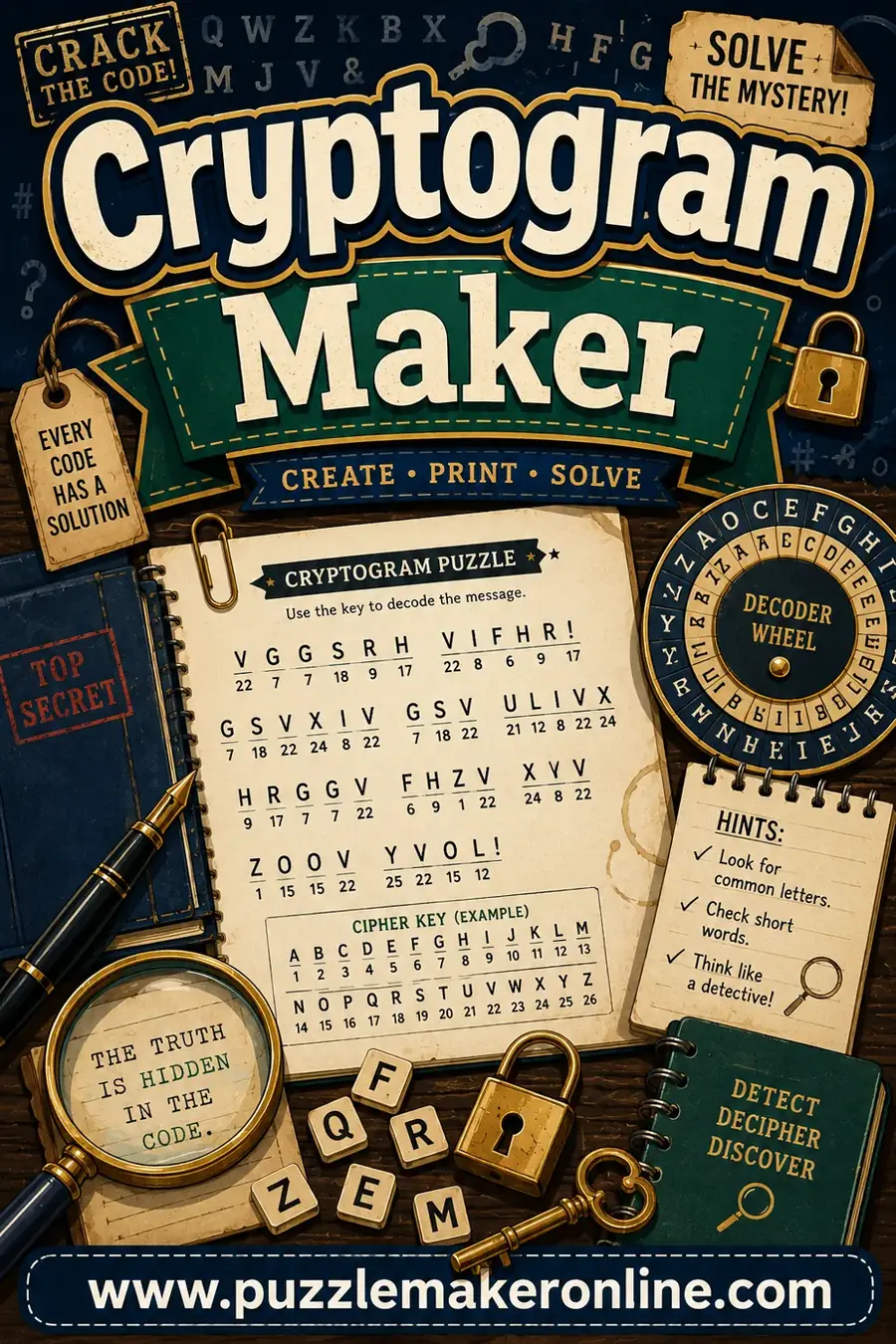
In puzzle books and newspapers, a "cryptogram" almost always means a simple substitution cipher. Each letter of the original message (the plaintext) is replaced by another letter, and the scrambled version you see is the ciphertext. If E becomes Q once, E becomes Q every time. Spaces and punctuation usually stay where they were, so you can see the word lengths.
The American Cryptogram Association's long-running solving course, the Classical Cryptography Course by LANAKI (Lecture 1, Simple Substitution), describes its "Aristocrat" puzzles in exactly these terms: each plaintext letter, in all of its occurrences, is replaced by one unique ciphertext letter. The same lecture adds the convention that matters most for solvers: a letter is never allowed to stand for itself. If you see a ciphertext R, the answer letter is not R.
That one-to-one rule is what makes the puzzle solvable by logic instead of luck. Every decision you make in one word has to hold in every other word. A wrong guess quickly produces nonsense somewhere else, and a right guess quickly produces real words.
Why you can't just try every key
There are 26 ways to choose what A becomes, then 25 left for B, then 24 for C, and so on. That's 26 × 25 × 24 × … × 1, written 26!, which works out to about 4.03 × 10 to the 26th power. (The exact figure is 403,291,461,126,605,635,584,000,000.) Even if you drop every key where some letter maps to itself, about 36.8% of them remain, which is still roughly 1.48 × 10 to the 26th power. Nobody solves a cryptogram by brute force. You solve it by noticing things.
How to Solve Cryptograms: The Method in Seven Steps
Here's the whole method in one place. The sections after this explain each step in detail, and then we'll use all of it on a real puzzle.
- Read the whole puzzle first. Note one-letter words, apostrophes, repeated words and long words with repeated letters.
- Count the letters. Jot down how many times each ciphertext letter appears. The top few are probably E, T, A, O, I, N or S.
- Crack the one-letter words. In English, a lone letter is almost always A or I.
- Crack the common three-letter words. A three-letter word that repeats and ends in your most common letter is very likely THE.
- Use apostrophes and two-letter words. Endings like 'T, 'S and 'LL limit the options, and two-letter words such as OF, TO, IN, IT, IS and BE are full of high-frequency letters.
- Use patterns in longer words. A word whose letters repeat in a particular pattern, like the double letters in LETTER or the repeats in PEOPLE, can only be a few real words.
- Fill in every occurrence, check, and erase freely. Each time you place a letter, write it everywhere it appears. If a word turns into nonsense, back up.
The ACA course frames the work in a similar way: arrange the data so non-random features show up (frequency counts, repetitions, patterns), recognize those features, and then explain them. It also gives the most practical advice in the hobby: keep an eraser handy and persevere.
English Letter Frequency: Your Starting Map
Letters in ordinary English aren't used equally. E is by far the most common, and Q, J, X and Z are rare. A table on Cornell University's math department site, English Letter Frequency (based on a sample of 40,000 words), gives these figures:
| Letter | Frequency | Letter | Frequency |
|---|---|---|---|
| E | 12.02% | M | 2.61% |
| T | 9.10% | F | 2.30% |
| A | 8.12% | Y | 2.11% |
| O | 7.68% | W | 2.09% |
| I | 7.31% | G | 2.03% |
| N | 6.95% | P | 1.82% |
| S | 6.28% | B | 1.49% |
| R | 6.02% | V | 1.11% |
| H | 5.92% | K | 0.69% |
| D | 4.32% | X | 0.17% |
| L | 3.98% | Q | 0.11% |
| U | 2.88% | J | 0.10% |
| C | 2.71% | Z | 0.07% |
Add up the top nine (E, T, A, O, I, N, S, R, H) and you get 12.02 + 9.10 + 8.12 + 7.68 + 7.31 + 6.95 + 6.28 + 6.02 + 5.92 = 69.40%. In other words, about seven out of every ten letters in a typical passage come from just nine letters. That's why counting is worth the minute it takes.
The big caution: short puzzles aren't average
A frequency table describes thousands of words. A newspaper cryptogram might have 80 to 150 letters, and a quote about sisters or success can skew the counts badly. Treat frequency as a hint about which letters are probably common, not as an answer key. The most common ciphertext letter is E more often than not, but T, A, O or S at the top is normal too.
That's why experienced solvers use frequency to make the first guess and then switch to word shapes, which are far more reliable.
Letter pairs help too
Cornell's companion page on common English digraphs (two-letter pairs) lists TH, HE, IN, ER, AN, RE, ND, AT and ON as the most common pairs, in that order. If two ciphertext letters keep showing up side by side, think TH or HE first.
Short Words That Crack Most Cryptograms
Cornell's page of hints for solving substitution ciphers says to start with short words, because English has only two one-letter words and a limited set of two-letter words, and every word needs a vowel. Here are the ones to know by heart.
| Word length | Most likely words | What it gives you |
|---|---|---|
| 1 letter | A, I | A vowel right away. If the puzzle has two different one-letter words, one is A and the other is I. |
| 2 letters | OF, TO, IN, IT, IS, BE, AS, AT, SO, WE, HE, BY, OR, ON, DO, IF, ME, MY, UP, AN, GO, NO, US, AM | Almost every one contains O, I, E or A, and many pair a vowel with T, N, S or H. |
| 3 letters | THE, AND, FOR, ARE, BUT, NOT, YOU, ALL, ANY, CAN, HAD, HER, WAS, ONE, OUR, OUT | THE and AND alone often give you T, H, E, A, N and D. |
| 4 letters | THAT, WITH, HAVE, THIS, WILL, YOUR, FROM, THEY, BEEN, WERE | THAT has a built-in repeat (first and last letter match), so it's easy to spot. |
The THE test
If a three-letter word appears two or more times, and its last letter is one of the most common letters in the puzzle, write in THE and see what happens. This works so often that it's the classic first move. Edgar Allan Poe used it in his 1843 story "The Gold-Bug," as we'll see in the history section.
Apostrophes are gifts
An apostrophe near the end of a word narrows things down dramatically:
- One letter after the apostrophe: almost always 'S (possessive or "is") or 'T (DON'T, CAN'T, WON'T, ISN'T). Occasionally 'D or 'M (I'D, I'M).
- Two letters after: 'LL, 'RE or 'VE (WE'LL, THEY'RE, I'VE).
- 'T contractions nearly always end in N'T, so the letter before the apostrophe is very likely N.
Pattern Words: The Most Powerful Tool
A pattern word is a word whose letters repeat in a recognizable way. The ACA course defines them as words in which one or more letters repeat, giving examples like AWKWARD, SUCCESSFUL, INTERESTING and UNUSUALLY, and it calls them a quick wedge into the puzzle. Because the cipher keeps the same swap throughout, a word's repeat pattern survives encryption. LETTER is still "first, second, third, third, second, fourth" no matter what letters it's disguised as.
Solvers write patterns with numbers: the first new letter is 1, the next new letter is 2, and so on, reusing a number when a letter repeats. We checked each of these with a short script.
| Word | Pattern | What to look for |
|---|---|---|
| THAT | 1-2-3-1 | Four letters, first and last the same (also HIGH, ELSE) |
| GOOD | 1-2-2-3 | Double letter in the middle (also BOOK, SEEN, FEEL) |
| THERE / THESE | 1-2-3-4-3 | Third and fifth letters match |
| EVERY | 1-2-1-3-4 | First and third letters match |
| NEVER | 1-2-3-2-4 | Second and fourth letters match |
| PEOPLE | 1-2-3-1-4-2 | Two different repeats in six letters |
| LITTLE | 1-2-3-3-1-4 | Double letter plus a repeat of the first letter |
| LETTER | 1-2-3-3-2-4 | Double T framed by the same vowel |
| BETWEEN | 1-2-3-4-2-2-5 | A double letter that also appears earlier |
| SUCCESS | 1-2-3-3-4-1-1 | Three uses of the first letter |
| REMEMBER | 1-2-3-2-3-4-2-1 | Almost every letter repeats |
| NONSENSE | 1-2-1-3-4-1-3-4 | A pattern so unusual it can only be one word |
When you find a long ciphertext word with a striking pattern, test it against words you know with that shape. If one fits and also agrees with letters you've already placed, you've likely cracked four or five letters at once.
Double letters
Cornell's hints list SS, LL, OO, EE, NN and PP as common doubles, with AA and YY rare. A doubled ciphertext letter at the end of a short word (like the end of a five-letter word) points strongly to LL or SS: SMALL, STILL, GUESS, CLASS.
Vowel clues
The ACA course lists rules of thumb for telling vowels from consonants. A few of the most useful: letters that touch a wide variety of other letters are usually vowels, vowels don't often sit next to each other, and long runs of consonants are unusual. In a pair that appears both ways round (like ER and RE), one of the two letters is usually a vowel.
A Full Worked Example, Step by Step
Let's solve one from scratch. We wrote this message and enciphered it ourselves, so it's an illustrative example, and we checked every step with a script. Here's the ciphertext:
MPO'W KI CTUCEM WP HXIVV. C HPPM VPJYIU NCGIV C VNCJJ KIW, SDISGV EW CHCEOVW WDI PWDIU ZPUMV, COM IUCVIV EW WDI NPNIOW EW JICMV WP OPOVIOVI.
Before reading on, give it a try. Then follow along.
Step 1: Count
The puzzle has 109 letters. The most common ciphertext letters are I (15 times), V (13), W (12), C (11) and P (10). Then come O (7), M (6), E and U (5 each), and D, J and N (4 each). Everything else appears three times or fewer.
Our first hunch: I is probably E, since it leads by a little.
Step 2: The one-letter word
C stands alone twice ("C HPPM" and "C VNCJJ"). It must be A or I. C is also the fourth most common letter, which fits A well. We'll pencil in C = a.
Step 3: THE
WDI appears twice, and it ends in our top letter, I. That's the THE test, and it passes: W = t, D = h, I = e. W is the third most common letter, which fits T nicely.
Step 4: The apostrophe
The first word is MPO'W. We now know W = t, so this ends in 'T, and 'T contractions almost always end in N'T. So O = n, and the word looks like ? ? n't.
Step 5: Two-letter words
EW appears three times. It's ?t. With A already used for C, the best fit is IT, so E = i. WP appears twice: t?. The obvious answer is TO, so P = o. P is the fifth most common letter, and O is the fourth most common in English, so that's comfortable.
Now the first word reads ?on't. That could be DON'T or WON'T.
Step 6: AND settles it
COM reads an?. The likely answers are AND, ANY and ANT. If M were D, the first word would be DON'T and this word would be AND, which both make sense. If M were W, we'd get WON'T and "ANW," which isn't a word. So M = d.
Step 7: Use a pattern word
Look at IUCVIV. With what we know, it reads e?a?e?, and its pattern is 1-2-3-4-1-4: the fourth and sixth letters match. ERASES fits that shape exactly. That gives U = r and V = s, and V is our second most common letter, so S makes sense.
Check it against another word: HXIVV now reads ?ess. That's a five-letter word ending in -ESS, like GUESS, BLESS or DRESS. We'll come back to it.
Step 8: Snowball
Now things move quickly.
- VPJYIU reads so??er. SOLVER fits: J = l and Y = v.
- VNCJJ now reads s?all. H and T are already taken (D = h, W = t), which rules out SHALL and STALL. SMALL fits: N = m.
- NPNIOW reads moment, so MOMENT fits. That confirms N = m.
- OPOVIOVI reads nonsense. NONSENSE, with its unusual 1-2-1-3-4-1-3-4 pattern, confirms almost everything at once.
- CHCEOVW reads a?ainst. That's AGAINST, so H = g.
- With H = g, HPPM reads good (GOOD) and HXIVV reads g?ess, which is GUESS, so X = u.
- ZPUMV reads ?ords. WORDS is the best fit: Z = w.
- KI reads ?e and KIW reads ?et. H, M and W are taken, so BE and BET fit: K = b.
- SDISGV reads ?he??s. CHECKS fits: S = c and G = k. Then NCGIV reads makes (MAKES).
- CTUCEM reads a?raid. That's AFRAID, so T = f. JICMV reads leads (LEADS).
The answer
DON'T BE AFRAID TO GUESS. A GOOD SOLVER MAKES A SMALL BET, CHECKS IT AGAINST THE OTHER WORDS, AND ERASES IT THE MOMENT IT LEADS TO NONSENSE.
Notice what happened. Frequency gave us a starting point (I = e), but the real progress came from word shapes: a one-letter word, a repeated THE, an apostrophe, two-letter words, and then pattern words like ERASES and NONSENSE. Also notice that the counts weren't "textbook." S came second here because the message happens to use GUESS, ERASES and NONSENSE. That's the short-puzzle effect in action.
Bonus Step: Recovering the Keyword
Many cryptograms are built from a keyword alphabet. The constructor writes a keyword, drops any repeated letters, and follows it with the rest of the alphabet in order. The ACA course describes four standard ways of doing this, labeled K1 through K4: the keyword can scramble the plaintext alphabet (K1), the ciphertext alphabet (K2, the most popular), both with the same keyword (K3), or both with different keywords (K4).
Once you've solved a puzzle, you can sometimes find the keyword for fun. Here's the full key from our example, sorted by plaintext letter. Letters that didn't appear in the message are filled in from the keyword alphabet.
| Plain | A | B | C | D | E | F | G | H | I | J | K | L | M |
|---|---|---|---|---|---|---|---|---|---|---|---|---|---|
| Cipher | C | K | S | M | I | T | H | D | E | F | G | J | N |
| Plain | N | O | P | Q | R | S | T | U | V | W | X | Y | Z |
|---|---|---|---|---|---|---|---|---|---|---|---|---|---|
| Cipher | O | P | Q | R | U | V | W | X | Y | Z | B | L | A |
Read the cipher row starting from plaintext X and wrapping around: X, Y, Z, A, B, C, D, E, F, G give B, L, A, C, K, S, M, I, T, H. The keyword is BLACKSMITH, followed by the unused letters in alphabetical order. We started the alphabet at a different point so that no letter would stand for itself. If you'd spotted part of BLACKSMITH halfway through the solve, you could have filled in the remaining letters straight from the alphabet.
Common Mistakes and How to Fix Them
Most stuck solvers are stuck for one of a few reasons.
- Trusting frequency too much. If your "E" won't fit any short words, it probably isn't E. Try T, A, O or S instead.
- Forgetting the no-self rule. In standard puzzles, a ciphertext letter never stands for itself. If your answer has ciphertext K decoding as plaintext K, something's wrong.
- Filling in only one spot. Every time you decide a letter, write it above every occurrence. Missing one hides the clue it would have given you.
- Using the same answer letter twice. Keep a running alphabet strip at the bottom of the page and cross off plaintext letters as you use them. If you're about to write a second "t," stop.
- Getting attached to a guess. The ACA course says to always look for confirmation and to be ready to back up a step. A guess that hasn't been confirmed by at least one other word is still a guess.
- Ignoring the author line. Many newspaper cryptograms are quotations followed by a name. A short final word group after a dash is often a surname, which can break the usual frequency patterns.
When you're truly stuck
Go back to the longest word you haven't solved and write out its pattern with the letters you know. Then list every real word with that shape. Even two or three candidates can be tested one at a time against the rest of the puzzle. It also helps to look for Q: Cornell's hints point out that Q is always followed by U, so a rare letter that's always followed by the same letter may be Q.
A Short History: From Poe to the Puzzle Page
Ancient roots
Counting letters to break a cipher is very old. The ACA's course notes credit the Arab scholar al-Kindi with a book on deciphering cryptographic messages that described statistical methods, and it calls that book far older than other surviving references on the subject. The same course (Lecture 6) also traces the English word "cipher" back through European languages to the Arabic sifr, meaning zero.
Poe's newspaper challenge, 1839 to 1841
Edgar Allan Poe did more than anyone to make cryptograms a popular American pastime. According to Clarence S. Brigham's 1943 study, reproduced by the Edgar Allan Poe Society of Baltimore as the introduction to Edgar Allan Poe's Contributions to Alexander's Weekly Messenger, Poe announced in the Philadelphia paper's December 18, 1839 issue that he could solve any simple substitution cipher a reader sent in. Brigham counted 36 ciphers received; Poe printed the text and solution of nine, printed only the solutions of fourteen more, said he'd solved three others, and declined six.
In July 1841, Poe wrote "A Few Words on Secret Writing" for Graham's Magazine. He said he'd received about a hundred ciphers after the challenge, and claimed only one stumped him, which he judged to be meaningless. Brigham's assessment was that most of the ciphers were fairly simple and that Poe's claims mostly held up.
"The Gold-Bug," 1843
Poe then put the method into fiction. In "The Gold-Bug," published in a Philadelphia newspaper in two installments in June 1843 (the Poe Society's text of the second installment gives the June 28, 1843 date), the hero Legrand solves a pirate's cipher written in numbers and symbols. His steps are the ones in this guide:
- He counts the symbols and finds that 8 appears 33 times, so he guesses 8 is E.
- He looks for THE, the most common English word, as a repeated three-symbol group ending in 8. The group ;48 appears seven times, giving T, H and E.
- From there he reads partial words like "t ee" as TREE and "thirteen," adding letters as he goes.
The story's popularity helped turn code-breaking into a parlor game, and its solution is still one of the clearest explanations of frequency analysis in print.
The American Cryptogram Association, 1930 to today
According to the ACA's own history page, the American Cryptogram Association was founded on September 1, 1930, by Dr. C. B. Warner and friends who'd been inspired by M. E. Ohaver's cryptography feature in Detective Fiction Weekly in the 1920s. At first the group focused on simple substitution puzzles, which it called "The Aristocrat of Puzzles." It borrowed the National Puzzlers' League custom of pen names (members still sign with a "nom"), and the first issue of its journal, The Cryptogram, came out in February 1932.
Today's newspaper cryptograms, often printed as encoded quotations, are the same puzzle in a friendlier form: word breaks kept, punctuation kept, and an author's name at the end. The ACA's harder versions include puzzles with the word breaks removed, which take away the short-word clues and force you to work from frequency and letter contacts alone. Poe's correspondents tried that trick on him too, sending ciphers with run-together words.
Try It Yourself: A Practice Cryptogram
Here's a second puzzle we wrote and enciphered with a different keyword. It's illustrative and we've checked that it decodes cleanly. Use the method: one-letter word first, then THE, then pattern words.
BZBVA SYPPMB FHW H GBHL WSQX. CJOE XFB WFQVX GQVEW CJVWX, HOE XFB MQOD QOBW GJMM QSBO YS MJLB H EQQV.
Hints, if you want them:
- H stands alone, and XFB appears twice.
- BZBVA has the pattern 1-2-1-3-4. Look back at the pattern table.
- SYPPMB has a double letter in the middle, and so does EQQV.
- GJMM ends in a double letter, like many four-letter words that end in LL.
The answer is at the end of this section, so cover it up if you're solving.
Answer: EVERY PUZZLE HAS A WEAK SPOT. FIND THE SHORT WORDS FIRST, AND THE LONG ONES WILL OPEN UP LIKE A DOOR. (The keyword was GRAPHITE.)
Cryptograms for Groups, Classrooms and Escape Rooms
Cryptograms are easy to adapt for different people because you control the message. A few ideas:
- Make it easier for beginners. Reveal two or three letters at the start ("G = e"). Most newspaper puzzles give one hint letter for the same reason. Short, familiar sayings are easier than unusual quotes.
- Make it harder for experts. Choose messages without THE or one-letter words, or remove the word breaks entirely.
- Use them as a team activity. Cornell's hints point out that splitting up the counting work speeds things up, which makes cryptograms a natural group puzzle.
- Use them as a lock. A decoded message can reveal the next clue, a location or a combination, which is why they're a staple of puzzles for escape rooms.
If you'd like to build one yourself rather than solve one, our cryptogram maker page covers making your own. Teachers looking for more classroom ideas can browse puzzles for teachers, and if you enjoy letter-shuffling puzzles in general, see the word jumble maker and our guide to anagram solver uses. When you're ready to put a puzzle on paper, how to print puzzles has tips on getting clean, readable copies.
Are cryptograms good for your brain?
They certainly exercise vocabulary, pattern recognition and the habit of testing a guess before committing to it. For what research does and doesn't say about puzzles and thinking skills, see are puzzles good for the brain.
Setting Up Your Worksheet
A tidy page saves a surprising amount of time. Here's a simple setup that works on paper or on a printout.
- Leave room above each line. Copy the puzzle with a blank line above every row of ciphertext, so you can write answer letters directly over the coded ones. Pencil is best.
- Make a frequency strip. Write A to Z across the bottom of the page and put a tally mark under each ciphertext letter as you count. Circle the top five.
- Make a key strip. Under the frequency strip, write the plaintext letter you've decided for each ciphertext letter. This keeps you from using one answer letter twice.
- Mark guesses differently. Some solvers write confirmed letters in capitals and guesses in lowercase, or put a small dot next to anything unconfirmed. When you need to back up, you'll know exactly which letters to erase.
- Note contacts. For a stubborn letter, jot down which letters appear just before and after it. A letter that touches many different neighbors is probably a vowel, and one that keeps pairing with the same partner may be part of TH, HE or QU.
This is the same idea the ACA course describes as preparing a work sheet: lay the data out so the patterns can show themselves. It feels slow for the first minute and saves ten minutes later.
Quick Reference: How to Solve Cryptograms at a Glance
| Clue in the puzzle | Try first | Why |
|---|---|---|
| Most common letter | E, then T, A, O | E is about 12% of English letters |
| One-letter word | A, then I | The only common one-letter words |
| Repeated 3-letter word ending in a common letter | THE | The most common English word |
| Word ending in an apostrophe plus one letter | 'S or 'T | Possessives and N'T contractions |
| Word ending in an apostrophe plus two letters | 'LL, 'RE, 'VE | Common contractions |
| Double letter at the end of a word | LL, SS | Common English doubles |
| Four-letter word, first and last letters match | THAT | Pattern 1-2-3-1 |
| Two letters often side by side | TH, HE | The two most common pairs |
| Rare letter always followed by the same letter | Q, then U | Q is almost always followed by U |
Make Your Own Puzzle
Once you've solved a few cryptograms, making puzzles for friends, students or a puzzle night is half the fun. Our free puzzle maker lets you type your own words or pick a theme, choose a puzzle type, and print it with an answer key. It's a quick way to put together a themed puzzle page to sit alongside a homemade cryptogram.
Four Ways to Tailor a Cryptogram
You control the message, so a cryptogram is easy to adapt. This table compares four common uses and what to change for each.
| Use | What to change | Why it helps |
|---|---|---|
| Beginners | Reveal two or three letters at the start and pick short, familiar sayings | Most newspaper puzzles give one hint letter for the same reason, and familiar sayings are easier than unusual quotes |
| Experts | Choose messages without THE or one-letter words, or remove the word breaks entirely | It takes away the usual first moves |
| Teams | Split up the counting work | Splitting the work speeds things up, which makes cryptograms a natural group puzzle |
| Escape rooms | Let the decoded message reveal the next clue, a location or a combination | It makes the puzzle work like a lock |
Frequently Asked Questions
What is the easiest way to start a cryptogram?
Start with the shortest words. A one-letter word is almost always A or I, and a three-letter word that shows up more than once is very often THE, especially if it ends in the most common letter in the puzzle. Those two moves usually give you four letters within a minute. Write each letter above every place it appears, not just the word you're working on. Then look at two-letter words and any word with an apostrophe, since those have very few possible answers. Once you have five or six letters, longer words start to read like fill-in-the-blank puzzles.
What are the most common letters in English?
In a Cornell University table based on a 40,000-word sample, the most common letters are E (about 12.0%), T (9.1%), A (8.1%), O (7.7%), I (7.3%), N (7.0%), S (6.3%), R (6.0%) and H (5.9%). Those nine letters make up roughly 69% of ordinary English text. The rarest are K, X, Q, J and Z, each under 1%. Keep in mind that a short puzzle doesn't always follow the averages. A quote that happens to use lots of S words can push S to the top, so use frequency as a first hint and confirm with word shapes.
Can a letter stand for itself in a cryptogram?
Not in a standard puzzle. The American Cryptogram Association's solving course treats it as a firm convention that a ciphertext letter is never used for the same plaintext letter. That's handy, because it rules out one option for every letter you look at. If your finished answer has, say, a ciphertext M decoding to plaintext M, recheck that word. Some homemade or app-generated puzzles may not follow the rule, so if a puzzle seems impossible, it's worth asking whether the maker allowed self-matches. Published puzzle books and newspapers almost always follow it.
What is a pattern word in a cryptogram?
A pattern word is a word whose letters repeat in a distinctive way, like LETTER, PEOPLE, SUCCESS or NONSENSE. Because a cryptogram swaps each letter the same way every time, those repeats survive encryption. Solvers write the pattern as numbers, so LETTER is 1-2-3-3-2-4 and THAT is 1-2-3-1. If a long ciphertext word has an unusual pattern, only a handful of real words can match it. Testing those candidates against the letters you already know often cracks four or five new letters in one step, which is why pattern words are the strongest tool after short words.
What should I do when I get stuck on a cryptogram?
First, check your work. Make sure each decided letter is written above every occurrence and that you haven't used the same answer letter twice. Next, pick the longest unsolved word, write in the letters you know, and list every real word with that shape. Test each candidate against the rest of the puzzle. If nothing fits, one of your earlier guesses is probably wrong, so erase the least-confirmed letter and try its next most likely option. Taking a short break also helps more than you'd expect. Fresh eyes often spot a word instantly.
How did Edgar Allan Poe solve ciphers?
Poe used frequency and common-word analysis, the same tools in this guide. In his 1843 story The Gold-Bug, the hero counts the symbols, finds that one appears 33 times and guesses it stands for E, then looks for THE as a repeated three-symbol group ending in that symbol. Partial words like TREE and THIRTEEN then reveal more letters. In real life, Poe challenged readers of a Philadelphia weekly paper in 1839 and 1840 to send him simple substitution ciphers, and later wrote about the results in Graham's Magazine in 1841.
Is a cryptogram the same as a cryptoquote?
They're closely related. A cryptoquote is a cryptogram whose hidden message is a famous quotation, usually followed by the name of the person who said it. The solving method is identical: one-letter words, THE, apostrophes, pattern words and frequency. The author line is a useful extra clue, since it's often a recognizable name, but surnames can also throw off letter counts because they contain unusual letters. Some newspaper versions give you one decoded letter as a starting hint, which makes them a good place for beginners to practice.
How long does it take to solve a cryptogram?
It varies a lot with length, the message and your experience. A newspaper-sized puzzle of a sentence or two can take a beginner fifteen minutes or more and an experienced solver a few minutes. Puzzles get faster with practice because you start recognizing common short words and patterns on sight. Messages without THE or one-letter words take longer, and puzzles printed without word breaks are much harder because you lose the word-length clues entirely. Don't worry about speed at first; focus on confirming each guess before moving on.
Are cryptograms good for kids and beginners?
They can be, with a little adjustment. Short, familiar sayings are much easier than unusual quotes, and revealing two or three letters at the start gives beginners a foothold. Letting kids work in pairs, with one counting letters and one testing words, also helps. Cryptograms practice spelling, vocabulary and careful checking, which makes them a good fit for word-loving students. If someone gets frustrated, show them the THE trick on a puzzle that uses THE several times. That first breakthrough tends to make the method click.
Sources
We checked every source below while writing this guide. Last reviewed October 30, 2026, by Joan Ramos.
- English Letter Frequency (based on a sample of 40,000 words) (Cornell University, Department of Mathematics)
- Hints for Solving Substitution Ciphers (Cornell University, Department of Mathematics)
- Digraph Frequency (based on a sample of 40,000 words) (Cornell University, Department of Mathematics)
- Classical Cryptography Course, Lecture 1: Simple Substitution (LANAKI) (American Cryptogram Association)
- Classical Cryptography Course, Lecture 6: Xenocrypt Morphology Part II (LANAKI) (American Cryptogram Association)
- History of the ACA (American Cryptogram Association)
- The Gold-Bug (second installment, June 28, 1843) (Edgar Allan Poe Society of Baltimore)
- Introduction to Edgar Allan Poe's Contributions to Alexander's Weekly Messenger (Clarence S. Brigham, 1943) (Edgar Allan Poe Society of Baltimore)