Difficult Crossword Puzzles Printable: Make One That Fights Back
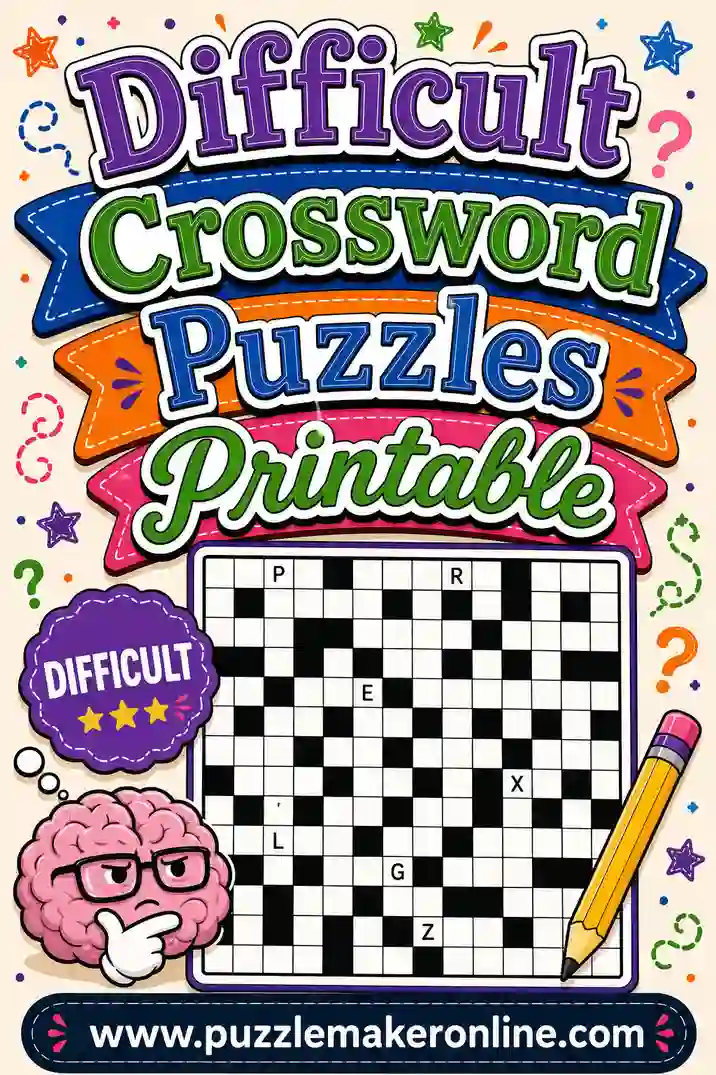
Difficult crossword puzzles printable on demand — that's what you get when you learn one liberating fact: crossword difficulty is written, not built. The grid doesn't make a puzzle hard; the clues do. Which means a free puzzle maker can produce a genuinely brutal crossword the moment you feed it devious clues, and this guide teaches you the five misdirection techniques that professional constructors use to make solvers suffer beautifully — plus how to solve the tough grids someone else made for you.
Fair warning defines everything here: a difficult clue makes you groan at yourself when you see the answer. A bad clue makes you groan at the constructor. We're building the first kind.
What Makes a Crossword Genuinely Difficult
Strip away the mystique and hard crosswords rest on three pillars:
- Misdirection. The clue is accurate but steers your brain toward the wrong reading. "Pen sound" wants you thinking ballpoints; the answer is OINK.
- Vagueness. "It may be pitched" could be TENT, IDEA, BALL, or VOICE. You need crossing letters before you can commit.
- Withheld category. Easy clues tell you what kind of thing you're looking for ("Citrus fruit"). Hard clues make you deduce even that.
Notice what's not on the list: obscurity. Cluing QUOKKA or a 1970s bureaucrat isn't difficulty, it's a trivia paywall. The best difficult crossword puzzles use words you absolutely know, clued so you can't see them. When the answer is TOWEL and you still needed five crossings — that's craft.
The Five Misdirection Techniques
Here's the constructor's toolkit. Learn these and you can turn any word list into a monster.
1. The part-of-speech switch
Clue a word as the wrong part of speech. "Duck" reads as a noun; clue DUCK as "Avoid, as a question" and solvers picture ponds for a full minute. Works with FLAG (droop), STOMACH (tolerate), TABLE (postpone).
2. The hidden context
Choose a word with a strong default meaning, then clue its weak meaning. "Pen sound" (pig pen), "Current events?" (ocean currents), "Bank deposit?" (river silt). The solver's brain autocompletes wrongly and stays wrong.
3. The question mark
In crossword convention, "?" warns of wordplay — and a warned solver still falls for it. "One with a big head at breakfast?" for BEER. Use two or three per puzzle; more and the trick dulls.
4. The vague verb
"It may be drawn" — sword? bath? conclusion? curtain? The answer BLINDS only emerges from crossings. Vague clues force solvers to work the grid instead of the clue, which is exactly what makes hard puzzles slow.
5. The definition by consequence
Describe what the answer does, never what it is. "It can be cast but never caught" for SHADOW. "It shrinks as it works" for CANDLE. These read like riddles and reward the lateral thinkers in your group.
A Difficult Starter Set (Copy & Paste)
Paste this into the crossword generator as-is — every clue uses one of the five techniques:
```
OINK : Pen sound
TIDES : Current events?
BLINDS : They may be drawn at dusk
SHADOW : It can be cast but never caught
STOMACH : Tolerate, as bad news
TABLE : Postpone, parliamentary-style
BEER : One with a big head at breakfast?
CANDLE : It shrinks as it works
WALLET : Bill collector?
ANCHOR : Newsdesk fixture or harbor fixture
SPRING : Season, coil, or leap
LETTER : Man of few words?
DRAFT : Beer, breeze, or first attempt
SCALE : Fish feature or kitchen gadget
```
Fourteen entries of concentrated meanness, every answer a household word. Add a couple of merciful fill-in-the-blanks if your solver is new to this level — even the hardest published puzzles leave a foothold or two.
How to Build and Print It in 4 Steps
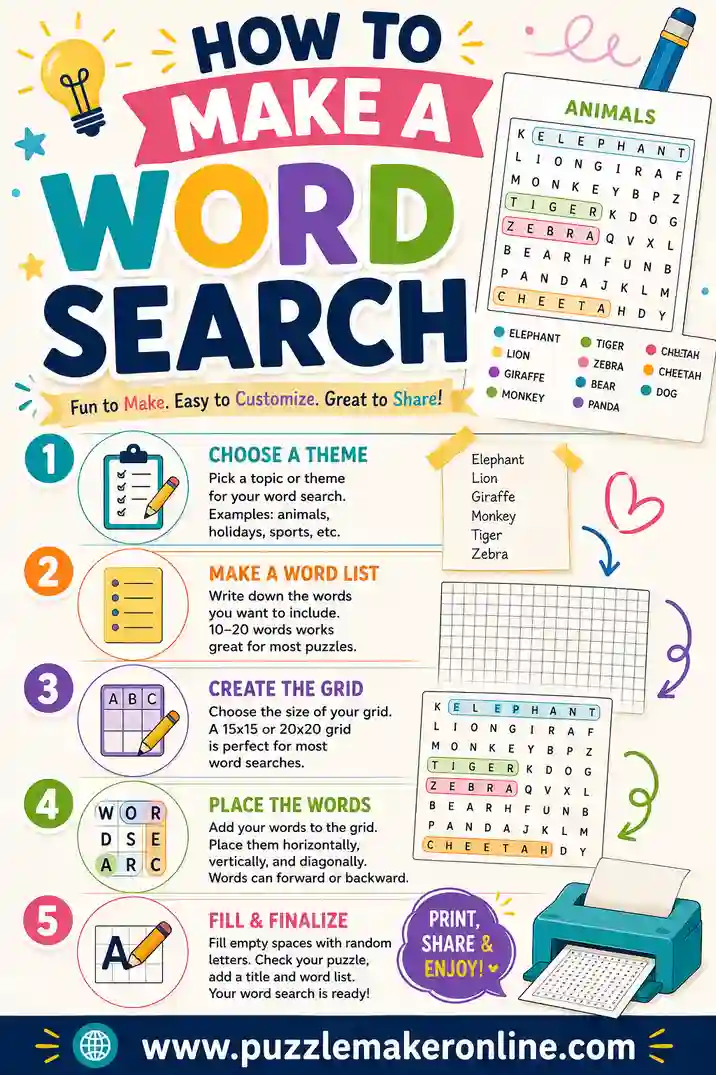
- Open the Crossword tab on the free puzzle maker.
- Paste your entries as `WORD : clue`, one per line. Twelve to eighteen entries suits a difficult grid — enough crossings to be solvable, few enough that each clue carries weight.
- Generate. The tool interlocks the words on shared letters and numbers everything. Regenerate until you like the shape.
- Print / Save PDF. Puzzle on one page, completed answer key on the next. Printable difficult crossword puzzles, zero cost, no sign-up, and your clue list never leaves your browser.
How to Solve Difficult Crosswords (When You're on the Receiving End)
Making them is half this guide; surviving them is the other half. Tough grids yield to method:
- First pass, no shame. Read every clue once, filling only what you're sure of. Even brutal puzzles hide two or three gimmes — find them and you have anchor letters.
- Work crossings, not clues. On a hard puzzle the clue alone rarely cracks; three crossing letters plus the clue almost always does. Prioritize answers that intersect your solved ones.
- Re-read stuck clues as a different part of speech. The single most powerful unsticking move. "Flag" is a verb. "Duck" is a verb. "Number" might be more numb.
- Respect the question mark. It's telling you the surface reading is wrong. Ask what else each word in the clue could mean.
- Abandon and return. Stuck corners unlock after ten minutes away — your brain drops its wrong assumption when you stop staring. Serious solvers treat a hard crossword as an all-day companion, not a sprint.
- Verify with the key, one letter at a time. A homemade puzzle prints its answer key on a separate page. Checking a single disputed square costs less pride than revealing a whole word.
Calibrating: Hard, Not Hostile
The line between difficult and miserable is fairness, and you can test for it:
- The nod test. For every clue, imagine the solver seeing the answer. "Ohh, pen — pig pen!" is a nod. "How was I supposed to know that?" is a fail. Rewrite fails.
- Count your footholds. Two easy clues minimum, even in a monster. Zero footholds means most solvers never start.
- Check the crossings on your cruelest entries. Every vague clue should intersect at least two gettable answers. Difficulty should slow the solve, never wall it off.
- Watch one victim. Hand a printed copy to your sharpest friend. Where they smile, you succeeded; where they quit, soften one crossing clue and reprint. Iterating costs nothing — that's the point of making your own.
If your test solver cruises through, don't be discouraged — take the same grid and re-clue harder. If they drown, the same words re-clued gentler become a medium difficulty puzzle. One word list, full dial.
Who Wants Puzzles This Mean
- Veteran solvers. People who finish the newspaper puzzle before the coffee cools and miss being challenged.
- Puzzle-night rivals. A difficult grid turns a couples' puzzle night into a genuine event — print two copies and race, or solve one grid together out loud.
- Gift makers. A hard custom crossword about the recipient's life is a legendary birthday card. Clue their dog's name deviously and watch them struggle with information they know.
- Escape-room builders and quiz masters. A difficult mini-crossword makes a great gate puzzle — solvers extract a keyword from shaded squares.
- Teachers of gifted classes. Misdirection clues teach flexible thinking better than any worksheet; students learn every word has more than one reading. For broader adult sets, see our crosswords for adults guide.
Theme Ideas That Play Hard
Some subjects lend themselves to difficulty because their vocabulary is rich in double meanings:
- Money words: BANK, CHECK, INTEREST, BOND, CHANGE — practically pre-misdirected.
- Body parts as verbs: SHOULDER (push through), ELBOW (jostle), FOOT (pay), FACE (confront).
- Weather with attitude: FRONT, DEPRESSION, FAIR — each clueable far from the forecast.
- Sports doubles: PITCH, DRIVE, COURT, RACKET — sports terms live triple lives.
- The personal monster: the hardest puzzle anyone can receive is about their own life, clued deviously. "Where you were mysteriously late, April 2019?" is devastating in a way no dictionary word can match.
Pick a theme, list fifteen double-lived words, and clue every one against its obvious meaning. That's a difficult puzzle with a personality — much more memorable than generic hard fill.
Printing Tips for a Serious Puzzle
- One puzzle per page, generous margins. Hard solves mean penciled guesses and erasures; give the grid room.
- Print the answer key separately and hide it. Difficult puzzles die the moment the key sits face-up on the table. Fold it into an envelope for true ceremony.
- Pencil, not pen. At this level everyone erases. Provide good erasers and you provide mercy.
- Black and white draft mode. The grid needs no ink flexing.
- Date and keep your best grids. Save the PDF; a collection of your finest difficult crossword puzzles printable on demand becomes the house puzzle archive.
Frequently Asked Questions
Where can I find difficult crossword puzzles to print for free?
Make them with a free crossword maker: paste hard-clued entries (starter set above), generate, and print with an answer key. No account, no watermark, and you control exactly how cruel the clues get.
What makes a crossword difficult — the grid or the clues?
The clues, almost entirely. The same grid plays easy or brutal depending on how each answer is clued. That's why re-cluing an old word list is the fastest way to make a new hard puzzle.
How do I make a hard puzzle that's still fair?
Use common words with misdirecting clues, keep at least two easy footholds, and make sure every vague clue crosses gettable answers. If seeing the answer makes solvers nod rather than groan at you, it's fair.
How long should a difficult crossword take?
For a 12–18 entry homemade grid with genuinely hard clues, 30–60 minutes with pauses is normal — and stepping away mid-solve is part of the game, not failure.
Do printable difficult crosswords come with answers?
Yes — every puzzle from the generator prints a completed answer key on its own page, so a stuck solver can verify one square instead of surrendering the whole grid.
What if my puzzle turns out too hard for my group?
Keep the words, soften a third of the clues, and regenerate — five minutes of editing turns a wall into a challenge. The reverse works too when your group gets stronger.
Ready to Build Something Brutal?
Open the free crossword maker, paste the difficult starter set, and print a puzzle that fights back — answer key included for the moment pride runs out. Warm up with our medium difficulty crosswords if you want a running start, or go full weekend-warrior with a big Sunday-style puzzle. Clue kindly. Or don't.