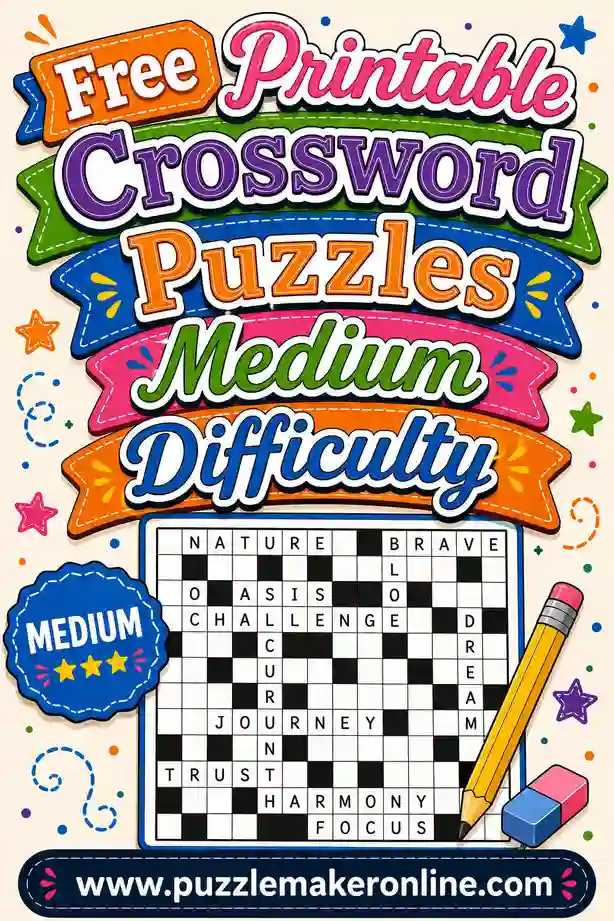
Free Printable Crossword Puzzles: Medium Difficulty
Free printable crossword puzzles medium difficulty — that's the search of someone who's outgrown gentle grids but isn't in the mood to be humiliated by a Saturday stumper. Medium is the everyday level: you'll fill some answers on sight, earn others through crossings, and hit two or three clues that make you put the pen down and think. You can print exactly that level, for free, by building the puzzle yourself with a puzzle maker — because in crosswords, difficulty lives entirely in the clues, and you control the clues.
This guide gives you the medium formula (70/30, explained below), a copy-paste starter set already pitched at medium, and the calibration tricks that keep a puzzle satisfying instead of frustrating.
What Medium Difficulty Actually Means
Every crossword lives somewhere on a dial that runs from "read the clue, write the answer" to "stare at the clue, question your education." Medium sits in the productive middle. A well-pitched medium puzzle has:
- Footholds. A handful of clues you answer on first read — fill-in-the-blanks and straight definitions that get letters on the page.
- Crossing-solvable clues. The bulk of the puzzle: clues you couldn't answer cold, but crack once two or three letters appear from crossing words.
- A few thinkers. Two or three clues with light wordplay or a vaguer angle. Not cruel — just clues that reward a second reading.
The result is a specific rhythm: quick start, steady middle, one satisfying "ohhh" near the end. If a puzzle never slows you down, it's easy. If you stall for minutes with no letters going in, it's hard. Medium keeps the pen moving with occasional resistance — which is why it's the level most people actually want on a lunch break.
The Clue Dial: One Answer, Three Difficulties
Here's the whole secret of crossword difficulty in one table. Same answers, three clue treatments:
| Answer | Easy clue | Medium clue | Hard clue |
|---|---|---|---|
| PIANO | Instrument with 88 keys | It has keys but opens no doors | Grand thing in a parlor? |
| TOWEL | Bathroom drying cloth | It gets wetter as it dries | One thrown in defeat |
| MOSS | Green growth on rocks | What a rolling stone gathers none of | Rolling Stones' opposite? |
| TEA | Hot leaf drink | Coffee alternative with a spot of milk | Spot of trouble in Boston, once |
Read down the medium column: each clue is honest, but it approaches sideways — a riddle angle, a familiar saying, a small indirection. That's the register you're writing in. Nothing requires trivia knowledge or a groan-worthy pun; everything yields to a moment's thought.
The 70/30 Formula for a True Medium Puzzle
When you build your own, pitch it like this:
- 70% straightforward. Clean definitions and fill-in-the-blanks. These carry the solve and feed letters into everything else.
- 30% sideways. Familiar-saying clues ("What a rolling stone gathers none of"), riddle angles ("It gets wetter as it dries"), and definition-by-consequence ("It whistles when it's ready" for TEAPOT).
- Zero unfair. No obscure trivia, no abbreviations nobody uses, no clue that's still baffling after the answer is revealed.
For a 15-entry puzzle, that's roughly ten friendly clues and five thinkers. Scatter the thinkers — if they cluster in one corner, that corner becomes a wall.
How to Make and Print One in 4 Steps
- Open the Crossword tab on the free puzzle maker.
- Enter 12–18 words with clues, one per line as `WORD : clue`. Apply the 70/30 mix as you write.
- Generate. The grid builds itself, interlocking words on shared letters and numbering across and down clues. Regenerate for a different layout anytime.
- Print / Save PDF. The puzzle prints on one page, the completed answer key on the next — so a free printable crossword puzzles medium difficulty PDF is two clicks away.
No account, no watermark, nothing stored on a server. Your clue list disappears when you close the tab, so save a copy in a note if you want to reuse it.
A Medium Starter Set (Copy & Paste)
This 14-entry set is already pitched at medium — paste it straight in, then swap entries to suit your solver:
```
PIANO : It has keys but opens no doors
TOWEL : It gets wetter as it dries
MOSS : What a rolling stone gathers none of
ECHO : It answers without being asked
TEAPOT : It whistles when it's ready
SHADOW : It follows you on sunny days
ANCHOR : It keeps a ship from wandering
COMPASS : Needle that always knows north
UMBRELLA : Bought on the way, useless once home dry
LADDER : Its steps go nowhere without a wall
CANDLE : It shrinks as it works
STAMP : It travels the world in a corner
CLOCK : Its hands never clap
RIVER : It runs but never walks
```
Notice most of these are riddle-flavored — that's deliberate for a demo set. For a longer puzzle, dilute with plain definitions (SKILLET : Pan for frying eggs) to land back at 70/30.
Calibrate Before You Commit
The one step most homemade puzzles skip: test your difficulty. Three quick checks —
- The cold read. A day after writing, read your clues fresh. Any clue you can't crack yourself gets softened.
- The victim test. Hand one printed copy to a friend. If they finish without ever pausing, you've made an easy puzzle; if they abandon a corner, too hard. Aim for one or two visible "hmm" moments.
- The reveal test. For every tricky clue, ask: when they see the answer, will they nod or will they groan? Nod = fair medium. Groan = rewrite.
Adjusting is cheap: edit the clue text, regenerate, reprint. That's the advantage over downloaded puzzles — a puzzle that tested too hard becomes medium with three softened clues, no other work.
Who Medium Puzzles Fit Best
- Daily solvers. Medium is the sustainable everyday level — challenging enough to be worth doing, quick enough to actually finish. It's the backbone of a good printable crossword habit.
- Couples and coffee shops. Two heads over one grid want clues worth discussing. Straight definitions leave nothing to talk about; medium clues create the fun argument.
- Classrooms, upper grades. For middle and high school, medium clues teach inference — students reason toward answers instead of recalling them.
- Puzzle-night hosts. Print copies of the same medium grid and race. Easy puzzles end in a typing contest; hard ones end in silence. Medium ends in trash talk, which is the point.
- Graduates of easy. If you've been solving our easy adult crosswords and finishing on autopilot, medium is your next room.
Build a Weekly Ladder Around Medium
Newspapers ramp difficulty across the week for a reason: variety keeps a daily habit alive. You can build the same ladder at home with medium as the anchor:
- Monday–Tuesday: easy grids to warm up — straight clues, quick wins.
- Wednesday–Thursday: true 70/30 medium, the heart of the week.
- Friday: medium words, but re-clue five entries one notch trickier.
- Weekend: a bigger grid with your hardest fair clues, coffee-pot length.
The beauty of writing your own is that the ladder adjusts to you: if Thursday's puzzle fell too fast, next week's Thursday borrows two clue styles from Friday. Batch the whole week in one sitting — seven puzzles takes under an hour once you have word lists banked — and print it as a stapled packet. Solvers with a packet finish more puzzles than solvers with a someday plan.
Printing Tips
- One puzzle per page. Medium solves involve rewriting; give the squares room for corrections.
- Black and white, always. The grid is designed for it — use draft mode and save ink.
- Print the answer key, keep it apart. It prints on its own page automatically. Fold it. A medium puzzle deserves an honest attempt before peeking.
- Batch your week. Generate five medium puzzles Sunday night, staple, done — a homemade week of lunch-break solving.
- Save PDFs of your best. Puzzles that tested perfectly become a personal collection you can reprint for guests.
Common Mistakes to Avoid
- All riddles, no footholds. A puzzle that's 100% clever stalls immediately. The 70% friendly clues aren't filler — they're the engine.
- Difficulty by obscurity. ANODYNE with a dictionary definition isn't medium, it's a vocabulary quiz. Use common words with uncommon angles.
- Clustered hard clues. Spread your thinkers across the grid so every region has entry points.
- Skipping the test solve. You are the worst judge of your own clues' difficulty. One test solver fixes that.
- Never graduating. When medium puzzles stop slowing you down, don't plateau — our difficult crossword guide shows how to climb the next step without falling off.
Frequently Asked Questions
Where can I get free printable crossword puzzles at medium difficulty?
Build them free with a crossword maker: enter words with clues pitched at the 70/30 mix above, generate, and print. No sign-up, no watermark, unlimited puzzles, answer key included.
Can I download them as a PDF?
Yes — click Print / Save PDF and choose "Save as PDF" in the print dialog. You get a free printable crossword puzzles medium difficulty PDF with the puzzle on page one and the filled-in answers on page two.
What makes a crossword medium instead of easy or hard?
The clues. Easy clues define directly; hard clues misdirect aggressively; medium clues approach sideways but stay fair — riddle angles, familiar sayings, light indirection. Same words, different clue register.
How long should a medium crossword take to solve?
Roughly 15–30 minutes for a 12–18 entry homemade grid. Faster with no pauses means you've built an easy puzzle; a stall with zero progress for five minutes means a clue crossed into hard.
How many tricky clues should one puzzle have?
About 30% — five thinkers in a 15-entry puzzle, spread across the grid. Fewer and it plays easy; more and solvers lose footholds.
Do the puzzles include answers?
Yes, every puzzle prints with a completed answer key on a separate page — check a single crossing when you're stuck, or the whole grid when you're done.
Ready for a Just-Right Puzzle?
Open the free crossword maker, paste the medium starter set, and print — you're minutes from a puzzle that starts quick, pushes back in the middle, and lands one good "ohhh" before the end. Too spicy? Step back to easy crosswords for adults. Not spicy enough? Difficult crosswords are one clue-rewrite away. The dial is yours now — that's the fun of making them.