Hard Mazes Printable: Free Challenging Mazes with Solutions
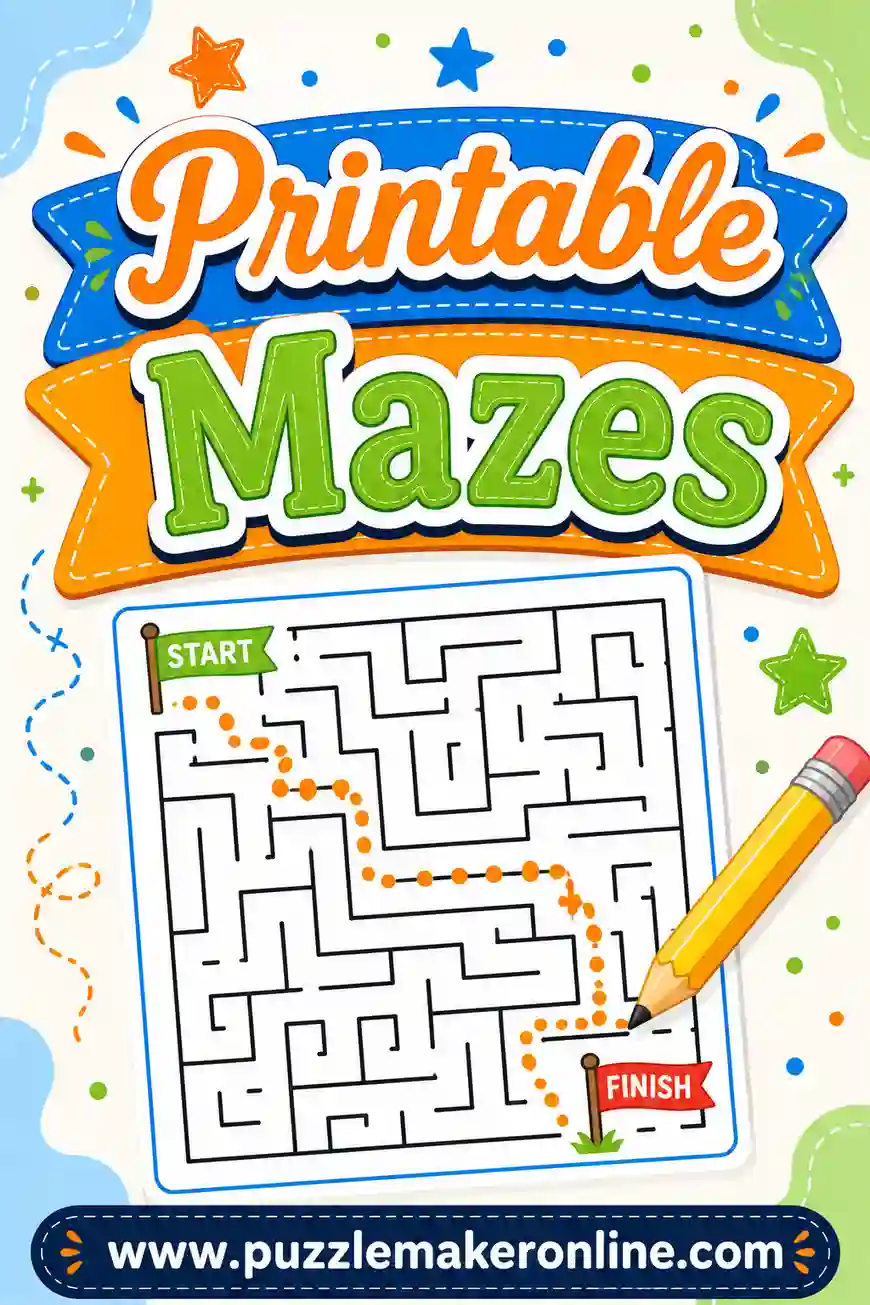
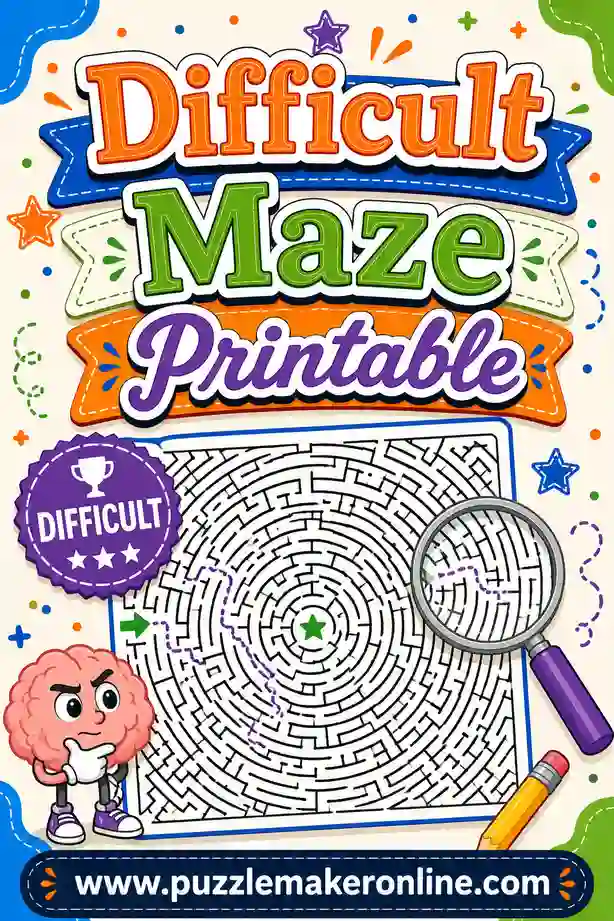
Hard mazes printable on demand — that's what a free puzzle maker with a Maze tab gives you: a big, dense maze with one true path from Start to Finish, generated fresh every time, with the solution drawn out on its own answer-key page. No hunting through recycled PDF packs for the two genuinely tough ones; just click Hard, generate, and print.
Want to skip ahead? Open the free maze maker, click the Maze tab, choose the Hard difficulty chip, hit Generate maze, then Print / Save PDF. The empty maze prints for solving and the solution path prints on the next page.
What Makes a Maze Hard?
Every maze has one job — hide the path — and hard mazes do it with three tools:
- Size. More cells means more corridor to search. The Hard setting generates a noticeably bigger maze than Easy or Medium, so there's simply more wrong turns available.
- Branching. Easy mazes offer a fork here and there; hard mazes fork constantly, and every junction multiplies the ways to be wrong.
- Deep false paths. This is the real villain. In an easy maze, a wrong turn dead-ends in a few cells and you back out. In a hard maze, a false branch can wind convincingly for a long stretch — sprouting its own sub-branches — before it finally walls off. You invest, and the maze takes your investment.
The mazes from our maze generator are what puzzle folks call perfect mazes: there's exactly one path from Start (top-left) to Finish (bottom-right), no loops, no shortcuts. That guarantee is what makes them satisfying — the path exists, it's unique, and the answer key proves it.
How to Print Hard Mazes in 4 Steps
- Open the maze maker and click the Maze tab.
- Choose Hard. The difficulty chips set the maze size — Hard is the big one.
- Pick a theme if you like. The theme dropdown swaps in festive Start and Finish markers (Christmas, Halloween, summer, and more). Classic works fine for serious solvers.
- Generate and print. Hit Generate maze, check it looks suitably mean, then Print / Save PDF. The puzzle prints clean on one page, and the answer key prints the same maze with the solution path drawn straight through the corridors.
Every click of Generate builds a brand-new maze, so a ten-maze challenge pack takes about two minutes to produce. Give each one a title ("Level 7 — Abandon Hope") in the title box for extra flavor.
Strategies That Crack Hard Mazes
Hard mazes reward technique over luck. These are the four that matter, roughly in order of usefulness:
1. Dead-end filling (the pro move)
Instead of tracing from Start, scan the whole maze for dead ends — corridors that terminate. Lightly shade each dead end back to its junction. Every cell you shade is provably not on the solution path. Keep going and the true path gradually reveals itself as the unshaded route. It feels like cheating; it's just logic.
2. Look before you draw
Trace ahead with your eyes (or a fingertip held above the page) before committing pencil. On hard mazes, a five-second look-ahead kills most false branches before they cost you an eraser session.
3. Work backwards
Paths leaving the Finish are usually fewer than paths leaving the Start — maze makers pour their trickery near the entrance, where solvers begin. Solve from 🏁 toward 🟢 and you often slip past the worst traps from behind. Meeting in the middle from both ends is faster still.
4. Mark your junctions
On a genuinely big maze, put a small dot at each junction where you chose a branch. When you hit a dead end, backtrack to your last dot instead of re-deciphering your whole route. This one habit turns rage-quits into steady progress.
One classic method to skip: the "always follow the right-hand wall" rule does eventually work on perfect mazes like these, but it's painfully slow on a big grid — it explores almost everything. Dead-end filling beats it every time you're solving on paper.
Make a Hard Maze Even Harder
The Hard setting is the top chip, but house rules can push difficulty as far as you want:
- Pen, one line. Solve in ink, and every wrong turn stays on the page for all to see. Fewest visible mistakes wins.
- No-lift rule. The pencil may not leave the paper from Start to Finish. Backtracking means retracing, which is its own punishment.
- The countdown. Set a five-minute timer. Hard mazes without time pressure are a puzzle; with it, they're a sport.
- Memory solve. Study the maze for thirty seconds, flip it face-down, then flip it back and solve immediately. Your half-remembered map fights your eyes the whole way.
- Backwards only. Finish to Start, using the strategy above — except now it's mandatory.
For the theory of what separates hard from truly evil, we've gone deeper in our difficult maze guide.
Who Hard Mazes Are For
Tweens and teens who've outgrown kid mazes
Around age 9 or 10, standard mazes stop being interesting. A Hard-setting maze restores the challenge, and the one-more-try pull of a nearly-solved maze is strong screen-free entertainment. (Younger solvers should start with our mazes for kids instead.)
Adults who like puzzles with a finish line
A hard maze is a 10–20 minute burst of pure focus with a definite end — a nice contrast to open-ended puzzles. Great for coffee breaks, waiting rooms, and flights.
Teachers and youth leaders
Print a stack for early finishers, brain breaks, or rainy-day recess. A hard maze absorbs a fast kid for a satisfying stretch, and the answer key means any adult can adjudicate "it's impossible!" claims instantly. It's planning and problem-solving practice disguised as fun.
Puzzle-pack builders
Making an activity book, a party challenge, or a care package? Generate ten hard mazes, title them Level 1 through 10, and staple. Fresh mazes every time means no two packs repeat.
Run a Maze Challenge
Hard mazes shine as events. Three formats that work:
- The relay. Teams of two: first player solves to roughly the middle, then hands off. Communication counts, because player two inherits player one's route.
- The gauntlet. Five mazes, escalating difficulty (generate at Easy, Medium, Medium, Hard, Hard). First to finish all five wins. Total prep time: three minutes.
- The head-to-head. Print the same hard maze twice, two solvers race. Since the generator makes a new maze each time, nobody's ever seen the layout — perfectly fair.
Bring the answer key. Someone always demands proof the maze is solvable, and drawing the solution path from the key onto their sheet is the referee's power move.
Printing Tips for Dense Mazes
- One maze per page. Hard mazes are dense; shrinking them makes corridors ambiguous and pencils clumsy. Full page, always.
- Check the line weight on a test print. Low ink turns thin walls into suggestions. One test page saves ten arguments about whether that was a wall.
- Fine-tip pencils or pens. A thick marker fills a narrow corridor and hides the very walls you're navigating. Sharp point, light touch.
- Print the solution page separately. It's the same maze with the path drawn through it — keep it face-down until surrender is official.
- Save the PDF for repeat events. A maze your group loved can rerun for the next group, since every generated maze is unique to you.
Common Mistakes to Avoid
- Giving a hard maze to a young kid. A 6-year-old doesn't experience a hard maze as exciting; they experience it as unfair. Match difficulty to solver — the easy setting exists for a reason.
- Solving with a fat marker. Half of all "this maze is broken" complaints are ink covering a wall.
- No strategy, pure wandering. Random tracing on a hard maze can take four times longer than dead-end filling. Teach the technique; it's more fun, not less.
- Skipping the answer key. The key is your proof of solvability and your referee. It prints automatically — keep it.
- Printing one maze for a group. Generate several; they're free and each is unique. A stack prevents the fast solver from spoiling the layout for everyone.
Frequently Asked Questions
Are these hard mazes printable for free?
Yes. Generate and print as many as you like from the free maze maker — no sign-up, no watermark, no limit. A fifty-maze challenge pack costs you nothing but paper.
Does every hard maze have a solution?
Yes — exactly one. Each maze is generated as a perfect maze: a single path from Start in the top-left to Finish in the bottom-right, no loops, no dead grid. The answer key prints the same maze with the solution path drawn through it.
How long does a hard printable maze take to solve?
Most adults take 10–20 minutes wandering, or well under that using dead-end filling. Kids 10 and up land somewhere between five minutes and dramatic sighing, depending on temperament.
What ages are hard mazes right for?
Roughly 10 and up, including adults. For younger solvers, print the Easy or Medium size instead — our mazes for kids guide covers age-matching in detail.
Can I get a new hard maze every time?
Yes. Every click of Generate maze builds a fresh layout, so you can print a different hard maze every day forever, or print five different ones for a competition where nobody has an advantage.
What's the best strategy for a really hard maze?
Dead-end filling: shade every dead-end corridor back to its junction, and the true path emerges as what's left. Working backwards from the Finish is the runner-up. Both beat wandering by a mile.
Ready for a Maze That Fights Back?
Open the free maze maker, click Hard, and print a challenge — solution key on the next page for when pride runs out. Free hard mazes, printable in seconds, different every single time.
Want the full range? Start with the overview of printable mazes, go deeper on what makes a difficult maze tick, or grab gentler grids from mazes for kids for the younger crowd. Happy backtracking.