Difficult Maze Printable: What Makes a Maze Truly Hard
A difficult maze printable is more than a big tangle of lines — real maze difficulty is engineered from branching corridors, deep false paths, and sheer territory, and once you understand the machinery, you get better at solving and better at choosing puzzles. This guide breaks down what makes mazes genuinely hard, the techniques experts use to dismantle them, and how to print an endless supply with a free puzzle maker — each one brand new, each with the solution drawn out on its own answer-key page.
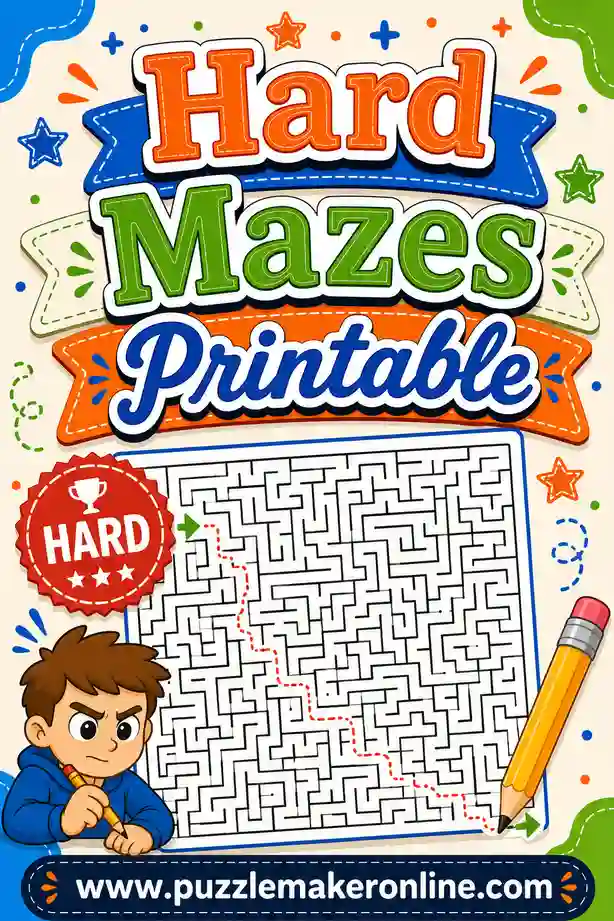
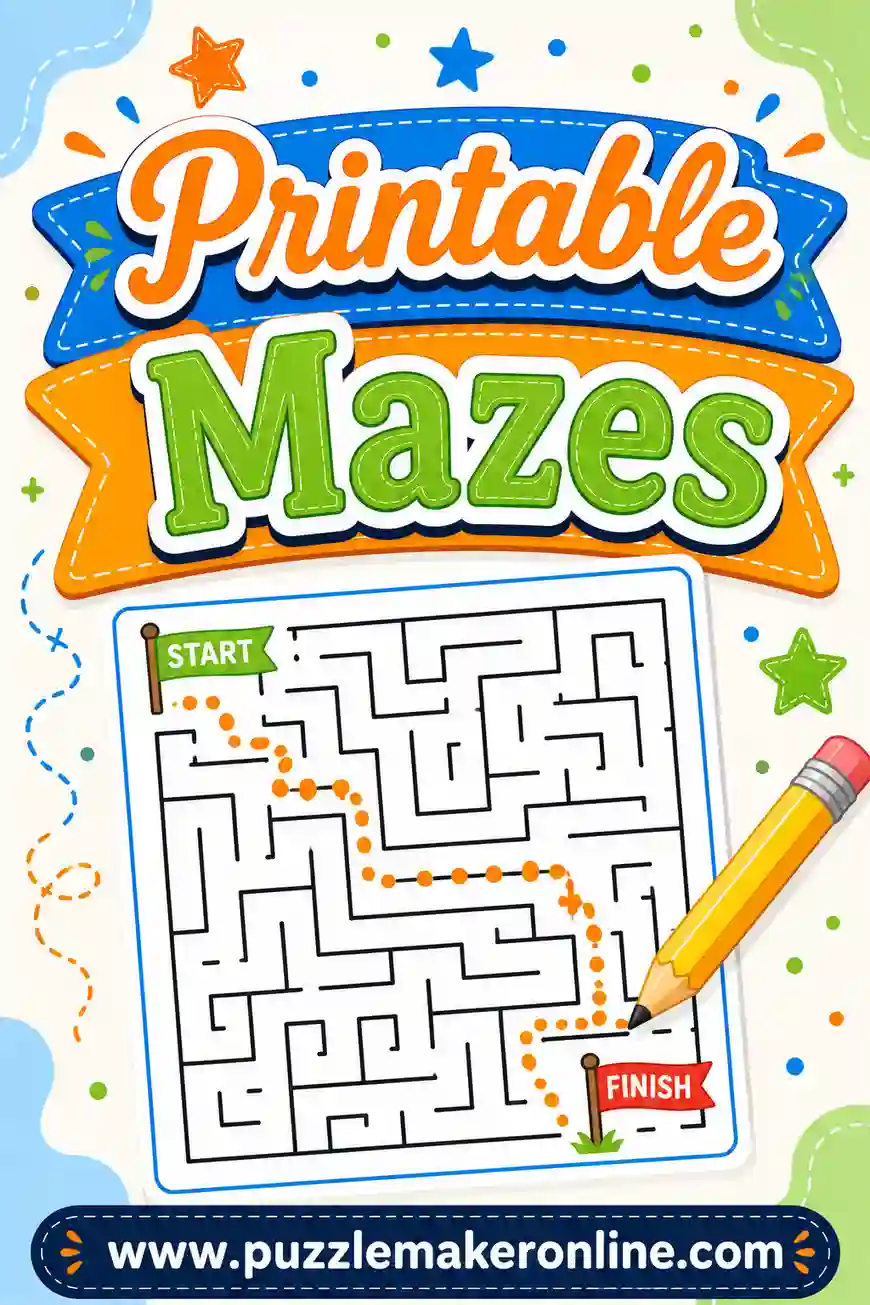
Want to skip ahead? Open the free maze maker, click the Maze tab, choose Hard, hit Generate maze, and Print / Save PDF. The empty maze prints for solving; the solution path prints on the next page.
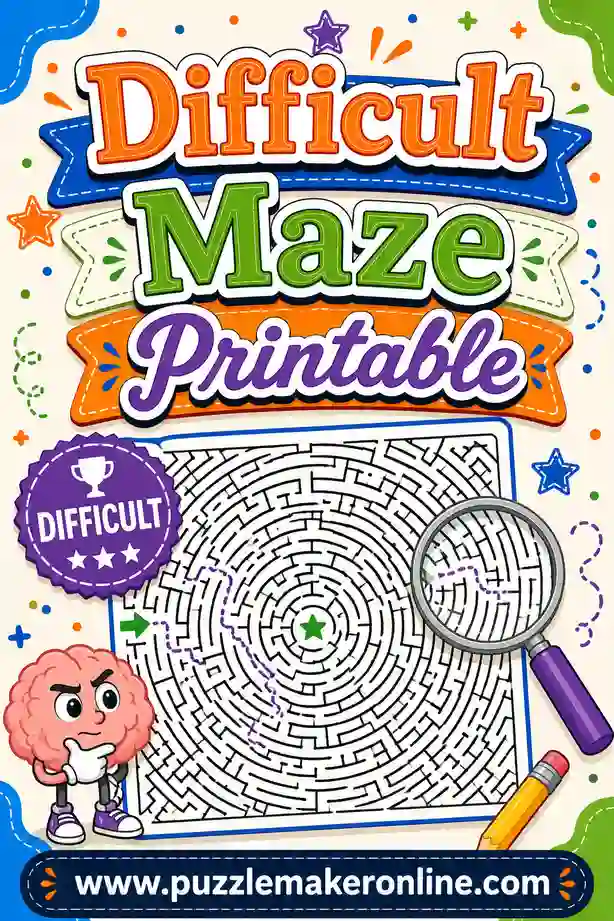
The Three Ingredients of Maze Difficulty
Strip any difficult maze down and you find the same three levers:
1. Territory
Raw size. A maze twice as wide has four times the cells, and the solution path snakes through only a fraction of them — everything else exists to waste your time. Size alone doesn't make a maze clever, but it makes every other trick heavier.
2. Branching
At every junction, the maze asks a question. A corridor with no forks asks nothing; a maze that forks every few cells is an interrogation. Difficulty scales with how often you must choose — and how similar the options look when you do.
3. False-path depth
The decisive ingredient. In gentle mazes, wrong turns are shallow: three cells and a wall, back you go, little lost. In a difficult maze, false paths run deep — a wrong branch can wind plausibly across half the grid, sprouting its own believable sub-branches, before it quietly seals. Deep false paths don't just cost time; they corrupt your mental map, because by the time you've backed out, you've half-forgotten which junctions you've cleared.
The Hard setting on our maze generator turns up all three: a bigger field, denser junctions, and longer blind alleys. And because every maze it builds is a perfect maze — exactly one path from Start (top-left) to Finish (bottom-right), no loops — the difficulty is always honest. There's precisely one answer, and the key proves it.
Print a Difficult Maze in 4 Steps
- Open the maze maker and click the Maze tab.
- Choose Hard from the difficulty chips — that's the size and density dial.
- Optional flourishes. Give it a title ("The Long Way Home"), or pick a themed Start/Finish from the dropdown. Serious solvers usually stick with Classic.
- Generate and print. Print / Save PDF puts the untouched maze on one page and the same maze with the solution path drawn through it on the next.
Every click of Generate is a new layout, so "just one more" is always ten seconds away.
Expert Techniques for Difficult Mazes
Wandering works on easy mazes. Difficult printable mazes demand method — here are the four that matter, in the order worth learning them.
Dead-end filling: the great equalizer
Don't start at the Start. Instead, scan the whole maze for dead ends, and shade each one backward to the junction it hangs from. If that shading turns a junction into a corridor with only one way on, keep shading. Every cell you fill is provably off the solution path. Do it patiently and the maze solves itself in reverse — the unshaded route that remains is the answer. On paper, with a light pencil, this is the single most powerful maze technique there is.
Backward solving
Maze builders (human and algorithmic alike) front-load complexity near the entrance, because that's where solvers spend attention. The Finish side is usually quieter. Start at 🏁 and work toward 🟢, or run both ends toward the middle. On deep-false-path mazes this routinely halves the pain.
Junction dotting
Every time you commit to a branch, dot the junction. When a path dies, return to your most recent dot — not to the beginning. This preserves your mental map, which deep false paths are specifically designed to destroy. Cheap habit, huge return.
Corridor look-ahead
Before pencil touches paper at a junction, follow each option with your eyes for five to ten cells. Most false branches betray themselves within that window — a visible wall, a curl back toward territory you've cleared. Eyes are erasable; graphite less so.
A note on the famous hand-on-wall rule (follow the right-hand wall and never let go): it does eventually solve any perfect maze, including all of ours. But on a big grid it visits a huge share of the corridors, making it the slowest correct method available. Know it, respect it, use dead-end filling instead.
Train Up to Difficult Mazes
Nobody starts at the deep end. Difficulty in mazes is trainable, fast:
| Stage | Goal | |
|---|---|---|
| 1 | Easy mazes | Fluent tracing, comfortable backtracking |
| 2 | Medium mazes | First junction-dotting, look-ahead habit |
| 3 | Medium, timed | Same skills under mild pressure |
| 4 | Hard mazes | Dead-end filling on real territory |
| 5 | Hard + house rules | See below — this is the summit |
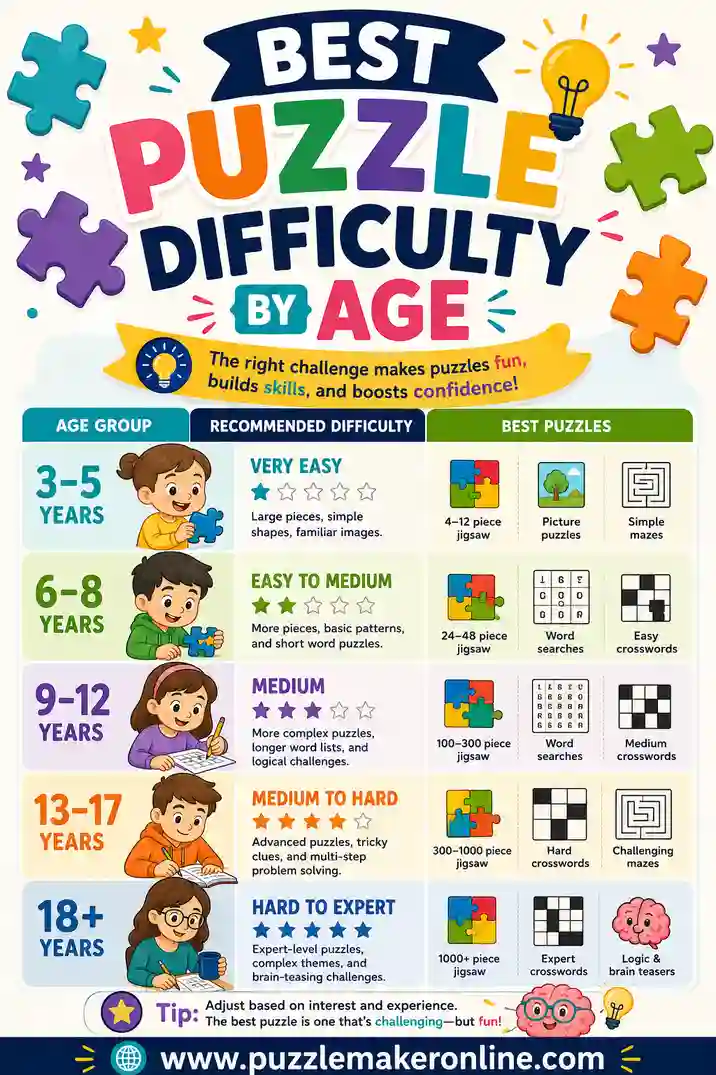
Two or three mazes per stage is usually enough; the whole ladder fits in a week of coffee breaks. Print each stage from the same maze tool with the difficulty chips — and if you're matching mazes to kids rather than training yourself, our puzzle difficulty by age guide maps it out.
House Rules: Difficulty Beyond the Hard Setting
Once the Hard chip stops scaring you, difficulty becomes a rules question:
- Ink run. Pen, not pencil. Every error is permanent and public. Score by fewest visible corrections.
- No-lift. The pen may not leave the paper between Start and Finish — backtracking means physically retracing, so look-ahead becomes survival.
- The thirty-second map. Study the maze for thirty seconds, flip it over, then flip back and solve at speed. You're now solving your memory of the maze as much as the maze.
- Blind opening. Solve the first ten cells with the Start region covered by a coin after one glimpse.
- Race format. Same maze printed twice, two solvers, one timer. Since each generated maze is new to everyone, it's perfectly fair.
These rules are also how one printable serves a mixed group: the maze is identical, but the eight-year-old traces in pencil while the adult suffers under no-lift ink.
Why Difficult Mazes Are Worth the Suffering
There's real cognitive freight under the fun. A deep maze exercises:
- Planning. Look-ahead is literally prefrontal rehearsal — simulating outcomes before acting.
- Working memory. Holding cleared junctions and live options in mind is a memory workout that scales with maze depth.
- Strategic patience. Dead-end filling teaches a transferable lesson: systematic beats impulsive, especially when the territory is designed to mislead.
- Frustration tolerance. A deep false path is a safe, low-stakes setback. Backing out calmly and re-planning is the whole skill of resilience in miniature.
That mix — plus the unambiguous finish line — is why mazes stay beloved from age four to ninety-four. The difficult end of the spectrum just concentrates the dose.
Printing Tips for Serious Mazes
- Full page, one maze. Difficult mazes are dense; every millimeter of corridor width matters for pencil work. Never shrink two to a page.
- Sharp, light pencil. Dead-end filling means lots of light shading; a soft dark pencil turns the page to mud. HB, sharp, light hand.
- Test print for wall clarity. Faint ink makes thin walls ambiguous, and ambiguity in a difficult maze breeds false accusations against innocent puzzles.
- Keep the key face-down, not absent. The solution page is your proof of solvability and your dispute referee. Print it, flip it, forget it until needed.
- Save PDFs of the brutal ones. A maze that humbled your household deserves to humble your guests. Save it, reprint it, spectate.
Common Mistakes to Avoid
- Equating big with difficult. A large maze with shallow false paths is just long. Depth of deception, not acreage, is what you're after — the Hard setting supplies both.
- Wandering without method. On deep mazes, unstructured tracing can triple your time and quadruple your muttering. Technique is the fun part; use it.
- Heavy tracing early. Committing dark ink to unverified branches guarantees a ruined page by mid-maze. Light strokes until a route is confirmed.
- Giving difficult mazes to unready solvers. A kid handed a deep maze doesn't learn grit, they learn mazes are unfair. Climb the ladder — hard mazes covers the step below this one.
- Tossing the answer key. Someone will declare the maze impossible. The key ends the debate in four seconds.
Frequently Asked Questions
Are these difficult mazes printable for free?
Yes. Generate and print unlimited mazes from the free maze maker — no sign-up, no watermark, no cap. Every Hard maze prints with its solution page included.
Is every difficult maze actually solvable?
Yes — each one is a perfect maze with exactly one path from Start to Finish and no loops. The answer key prints the same maze with the true path drawn through it, so solvability is never in doubt.
What's the difference between a hard maze and a difficult maze?
Nothing formal — they're the same top difficulty chip. In this pair of guides we use hard mazes for the practical printing-and-playing side and this page for the anatomy of difficulty and expert technique.
What's the best technique for a difficult printable maze?
Dead-end filling: shade every dead end back to its junction until only the solution remains. It's systematic, it can't be fooled by deep false paths, and it works on any perfect maze.
How long should a difficult maze take?
Solved by wandering: anywhere from 15 to 40 minutes, mood depending. Solved with dead-end filling and backward solving: usually well under half that. The gap between those numbers is the value of technique.
Can kids do difficult mazes?
Persistent solvers from about age 10 up, yes — especially after climbing the easy-medium ladder. For younger kids, match the chip to the child with our puzzle difficulty by age guide.
Print Your Next Opponent
Open the free maze maker, set it to Hard, and print a difficult maze that respects you enough to fight honestly — one true path, deep lies along the way, and the solution on page two when dignity requires it.
Round out the collection with the practical hard mazes guide, the full printable mazes overview, and the difficulty-by-age map for the rest of the family. May your false paths be shallow.