Medium Printable Sudoku: Free Puzzles to Print
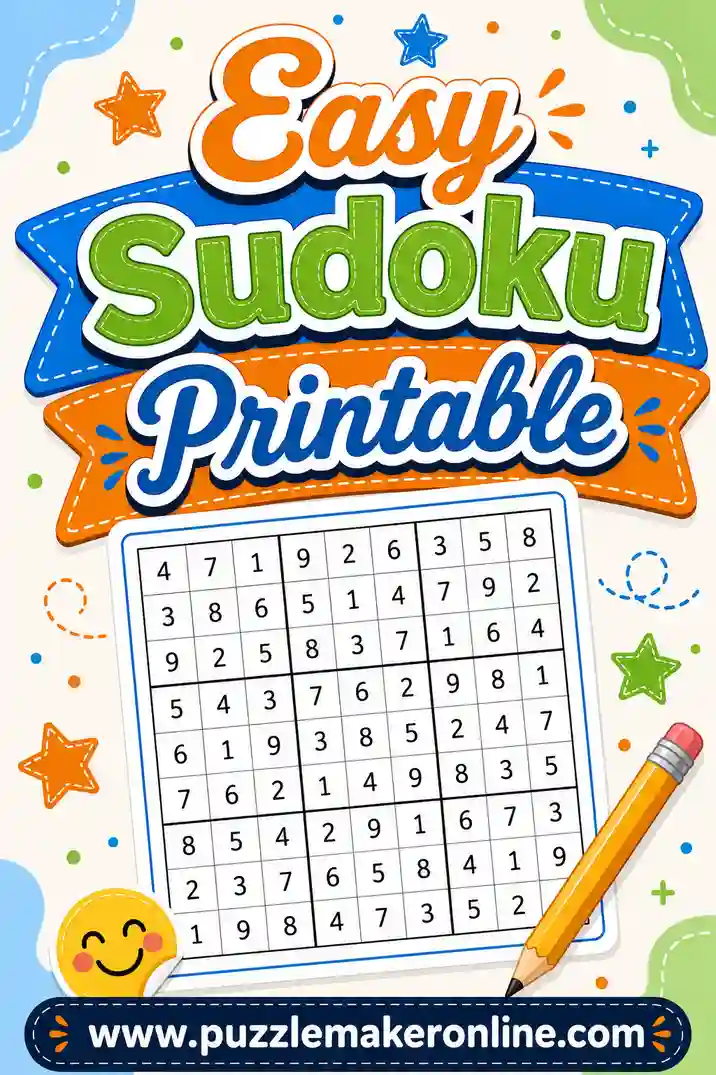
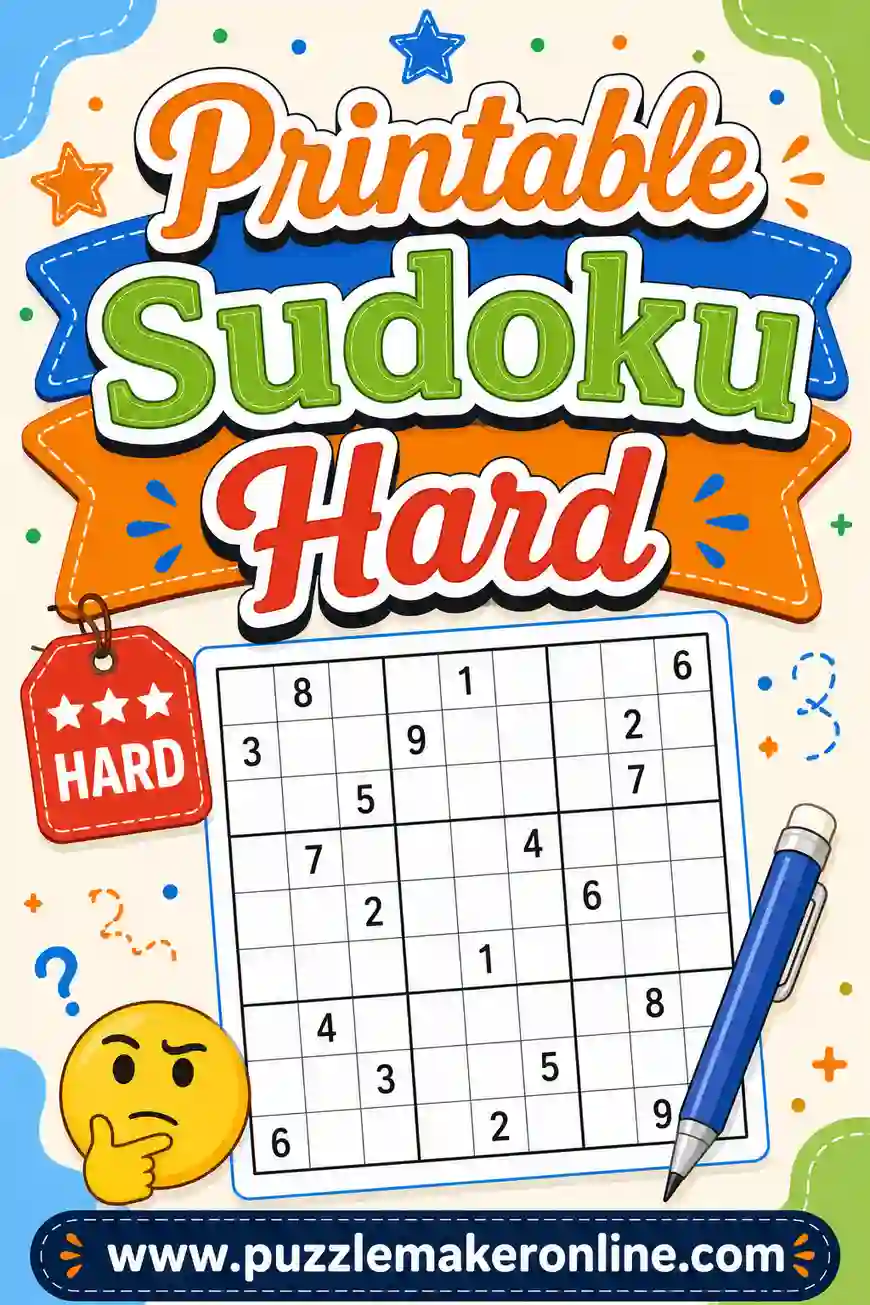
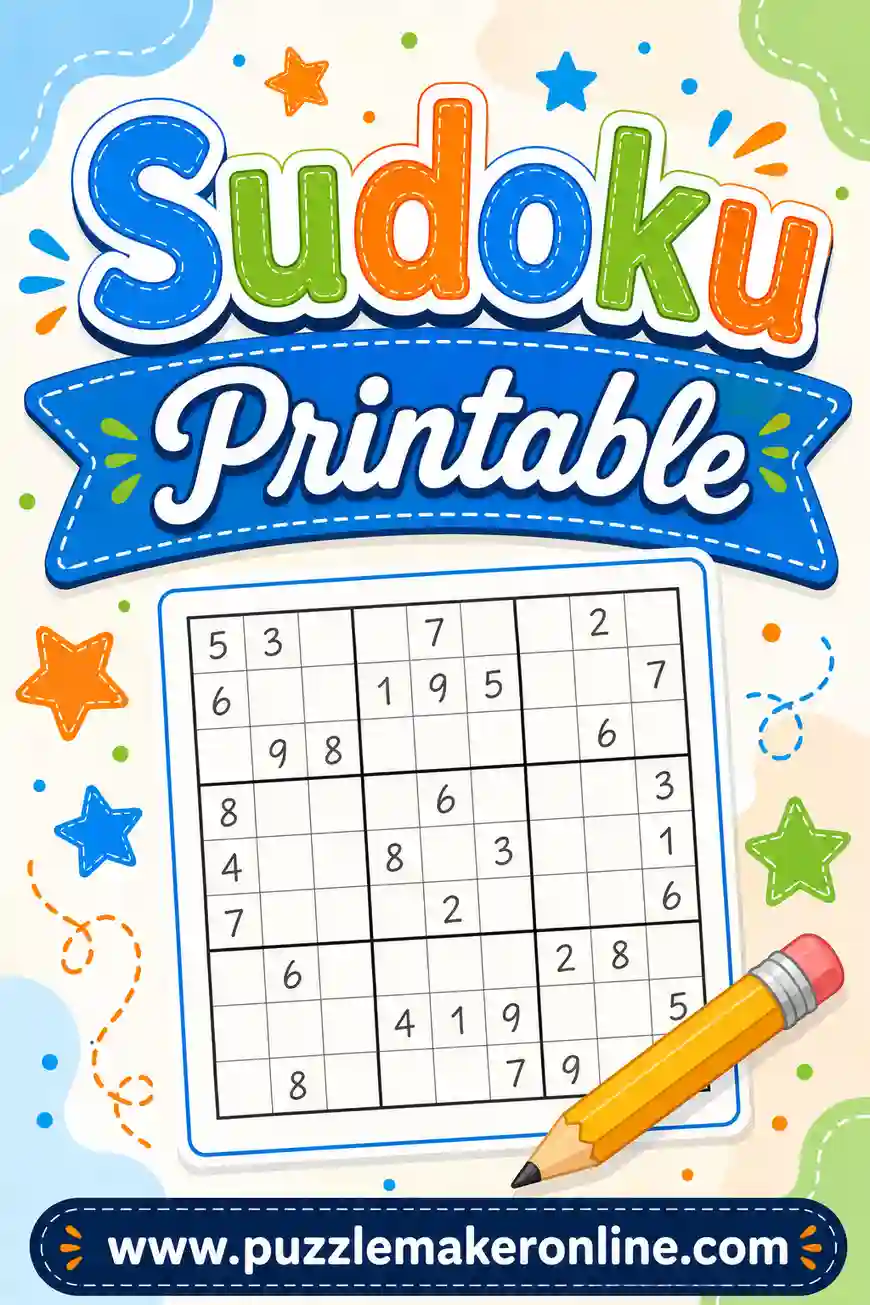
A medium printable sudoku is a 9x9 number-placement puzzle with fewer starting clues than an easy grid, so you'll need light logic techniques, not just scanning, to finish it. It's the level where sudoku stops being a fill-in-the-blanks exercise and starts being a real puzzle. The fastest way to get one on paper is a free puzzle maker that generates a fresh medium sudoku with a guaranteed unique solution and prints it with an answer key.
Want to skip ahead? Open the free puzzle maker, click the Sudoku tab, pick Medium, choose how many puzzles per page, and print. No sign-up, no fee, no app.
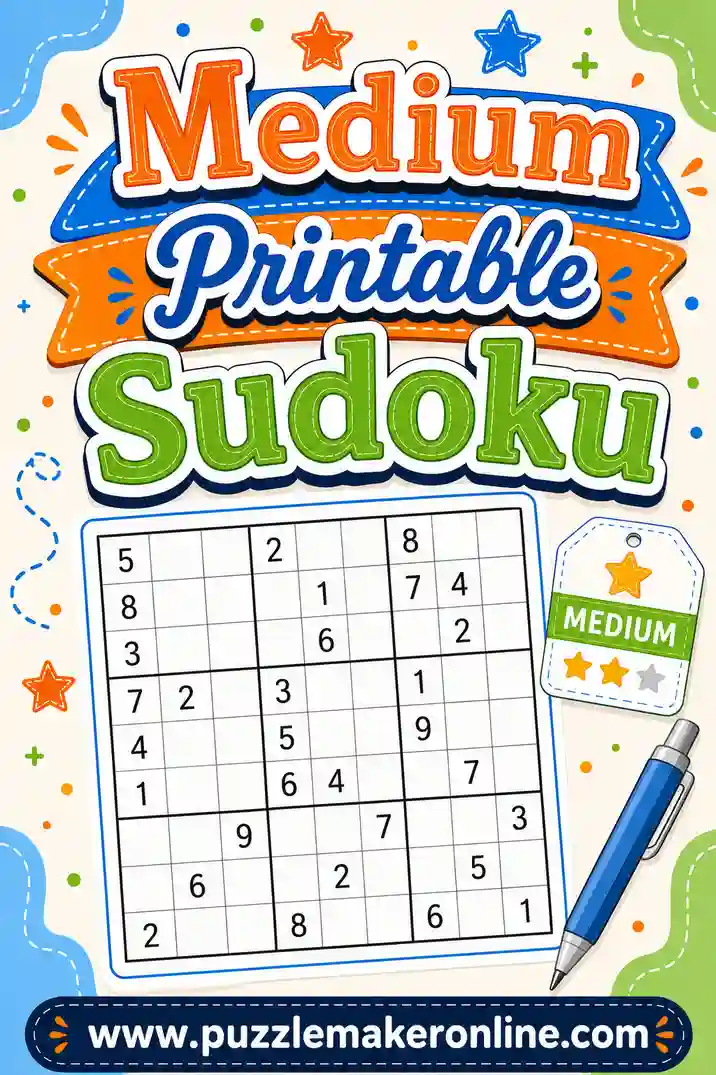
What Is a Medium Sudoku?
Every sudoku uses the same board: a 9x9 grid divided into nine 3x3 boxes, with some cells already filled in. Your job is to place the digits 1 through 9 so that every row, every column, and every 3x3 box contains each digit exactly once. No math, no guessing — pure logic.
Difficulty comes from two things: how many clues you start with and which solving techniques the puzzle forces you to use. An easy puzzle hands you 36 to 40 clues and falls to simple scanning. A medium puzzle typically starts with around 28 to 34 clues and, more importantly, includes at least a few positions where scanning alone stalls and you have to reason about candidates.
A well-made medium sudoku still has exactly one solution and never requires guessing. Every puzzle from our generator is built that way: the grid is created with a full valid solution, then clues are removed only while the puzzle still solves uniquely.
Why Print Sudoku Instead of Solving on a Screen
Apps are convenient, but paper sudoku has real advantages, which is why printable sheets remain so popular.
- Pencil marks feel natural. Jotting tiny candidate digits in cell corners is faster and more flexible on paper than tapping through an app's notation mode.
- No hints to lean on. Apps make it too easy to tap "hint" the moment you stall. Paper makes you actually solve.
- Zero distractions. No notifications, no battery, no blue light before bed.
- Print for a group. One click gives everyone at the table, classroom, or senior center their own identical puzzle for a friendly race.
What Makes Medium Harder Than Easy
If you can finish easy grids comfortably, here's exactly what changes at medium.
| Aspect | Easy | Medium |
|---|---|---|
| Starting clues | 36–40 | ~28–34 |
| Main technique | Scanning rows and boxes | Candidate elimination |
| Pencil marks | Rarely needed | Genuinely useful |
| Typical solve time | 5–10 minutes | 10–25 minutes |
| Stall points | Almost none | A few per puzzle |
The defining experience of a medium puzzle is the stall: you've filled everything obvious and no cell announces itself. That's not a broken puzzle — that's the puzzle asking you to switch techniques.
The Techniques Medium Sudoku Teaches You
You need three tools beyond basic scanning to clear medium grids consistently.
Naked singles
Write the possible candidates for a stuck cell. If only one digit can legally go there once you check its row, column, and box, that's a naked single. Fill it in and re-scan; one placement often unlocks three more.
Hidden singles
Look at a 3x3 box and ask, "Where in this box can the 7 go?" If only one cell in the box can hold a 7 — even if that cell has other candidates — the 7 belongs there. Hidden singles are the workhorse of medium solving.
Naked pairs
If two cells in the same row share exactly the same two candidates, say 2 and 5, then 2 and 5 can't appear anywhere else in that row. Erase them from other cells' pencil marks and watch new singles appear. This is usually the "aha" technique that graduates a solver from easy to medium.
Practice tip: print four medium puzzles on one page and dedicate each to practicing one technique deliberately. Cheaper than a workbook and tailored to exactly what you need.
A worked example of the medium mindset
Say you're staring at an empty cell in the middle row and nothing is obvious. Instead of moving on, interrogate it: the row already holds 1, 3, 4, and 9. The column holds 2 and 6. The box holds 5 and 7. Cross all of those off and only 8 remains — a naked single that scanning alone would never have shown you, because no row, column, or box "pointed" at it. That habit of asking "what can't go here?" instead of "what goes here?" is the entire jump from easy to medium in one sentence.
A One-Week Plan to Get Comfortable at Medium
If easy grids are your home and medium ones still sting, this seven-day ramp fixes it. Total printing time: about two minutes on Sunday.
| Day | Focus | |
|---|---|---|
| Mon | 1 medium, 1 per page | Full pencil marks, no timer |
| Tue | 1 medium | Hidden singles: ask "where can the 7 go?" box by box |
| Wed | 2 mediums, 2 per page | First one relaxed, second one timed |
| Thu | 1 medium | Hunt for one naked pair and use it |
| Fri | 1 medium, no pencil marks until stuck | Build scanning stamina |
| Sat | 2 mediums, timed | Beat Wednesday's time |
| Sun | Rest, or 1 easy for fun | Let it consolidate |
By the second week most solvers find mediums falling in under 20 minutes, and the techniques stop feeling like techniques — they're just how you look at the grid now.
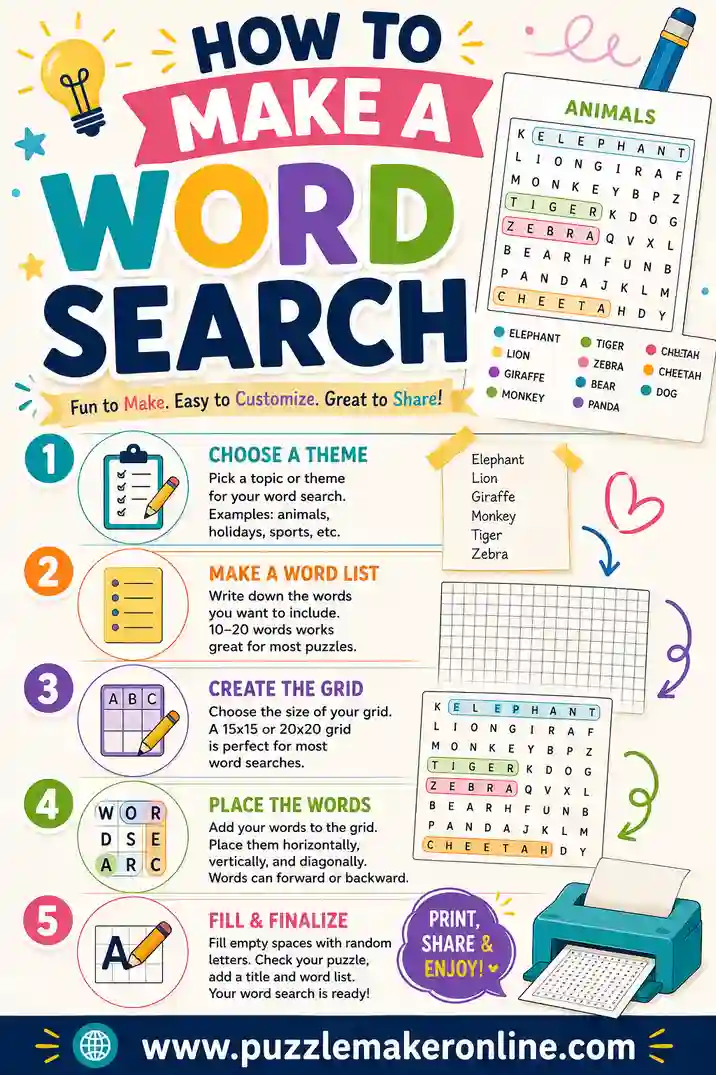
How to Print Medium Sudoku in 4 Steps
- Open the Sudoku tab in the free puzzle maker.
- Choose Medium. The generator builds a puzzle with a single valid solution at medium clue density.
- Pick puzzles per page. Print 1 large grid, or 2, 4, or 6 smaller ones per sheet.
- Print puzzle and answer key. The key prints separately, so you can check your work without spoiling the solve.
Every generation is a brand-new puzzle, so you can print today's batch, tomorrow's, and next week's without ever repeating.
How Many Puzzles Per Page?
The per-page option changes how the sheet feels to solve.
- 1 per page: big cells with room for full pencil marks. Best while you're learning candidate techniques.
- 2 per page: a comfortable pair for a commute or lunch break.
- 4 per page: the classic puzzle-book layout. Cells still fit small pencil marks.
- 6 per page: maximum puzzles per sheet, great for travel packs and volume solvers who don't need many notes.
For medium difficulty specifically, 1 or 2 per page is the sweet spot: you'll want pencil-mark space, and cramped cells are the main reason people give up mid-puzzle. Once your marks get lean — a few candidates in a few cells instead of full notation — graduate to the 4-per-page layout and enjoy the compact puzzle-book feel with a quarter of the paper.
Who Medium Sudoku Is Right For
Improving beginners. If easy puzzles have started feeling automatic, medium is your next rung. Expect the first few to take a while; that's the learning happening.
Daily solvers. Medium hits the "challenging but finishable over coffee" balance that makes a sustainable daily habit. Print a week of puzzles every Sunday.
Teachers and parents. Medium suits sharp middle schoolers and up. Sudoku builds working memory and deductive reasoning, and a printed grid is a screen-free brain workout.
Senior brain-gamers. Medium offers real mental exercise without the frustration spikes of hard grids. Print 1 per page for large, easy-to-read cells, and keep a small stack by the reading chair so a fresh grid is always within arm's reach.
Printing Tips for Better Solving
- Print black and white. Sudoku grids need no color; the bold box borders carry the structure.
- Match layout to pencil marks. Choose 1 or 2 per page if you write candidates; 4 or 6 if you solve mostly in your head.
- Keep the answer key separate. Check only after you finish, or peek at a single cell as a targeted hint when truly stuck.
- Use a pencil with a good eraser. Medium puzzles involve revising candidates. Pen is for easy grids and the very confident.
- Print a batch. Generating and printing five sheets takes one minute and keeps the habit going all week.
Common Mistakes at Medium Level
- Guessing when stalled. A guess that's wrong poisons the grid, and you often won't notice for ten minutes. Every medium puzzle here solves by logic alone; a stall means "switch techniques," not "gamble."
- Sloppy pencil marks. Candidates you don't update after each placement become traps. When you place a digit, erase it from the marks in that row, column, and box.
- Tunnel vision on one region. If a box won't yield, leave it. Progress elsewhere almost always feeds back into the stuck spot.
- Skipping the easy wins. Even medium grids open with several scannable singles. Harvest all of them before breaking out candidate notation.
- Jumping to hard too soon. If medium puzzles still take you 40 minutes, more mediums — not harder puzzles — are what build speed.
Frequently Asked Questions
Are these medium printable sudoku puzzles free?
Yes. Generate and print as many as you like at no cost, with no sign-up and no watermark. Each print includes a matching answer key.
Does every puzzle have exactly one solution?
Yes. The generator builds a complete valid grid, then removes clues only while the puzzle still has a single unique solution. Every medium puzzle can be finished with logic alone, no guessing.
How long should a medium sudoku take?
Roughly 10 to 25 minutes for a solver comfortable with easy grids. Under 10 minutes consistently means you're ready to try hard sudoku.
Can I print more than one puzzle per page?
Yes. Choose 1, 2, 4, or 6 puzzles per page. Fewer per page means bigger cells with room for pencil marks.
What's the difference between medium and easy sudoku?
Medium starts with fewer clues and includes positions where simple scanning stalls, forcing candidate techniques like hidden singles and naked pairs. If you're new, start with easy sudoku first.
Do I need to be good at math?
No. Sudoku uses digits only as nine distinct symbols; there's no arithmetic. It's a pure logic puzzle.
Ready to Print Your Medium Sudoku?
Open the free puzzle maker, hit the Sudoku tab, choose Medium, and print a fresh batch with answer keys in under a minute. Warm up with easy sudoku, graduate to hard sudoku when mediums start falling fast, or browse the full printable sudoku guide. Sharpen that pencil.