Easy Sudoku Printable: Free Beginner Puzzles to Print
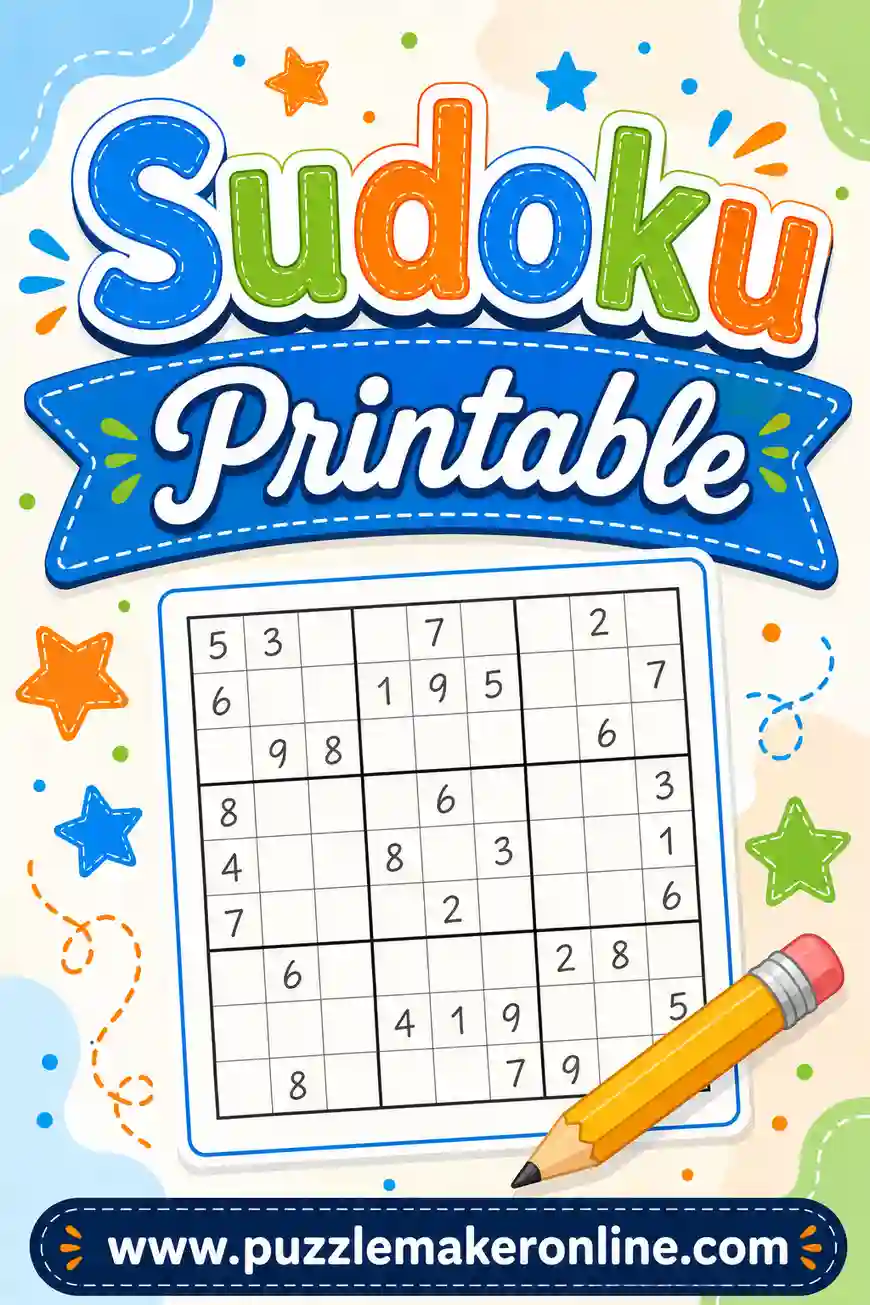
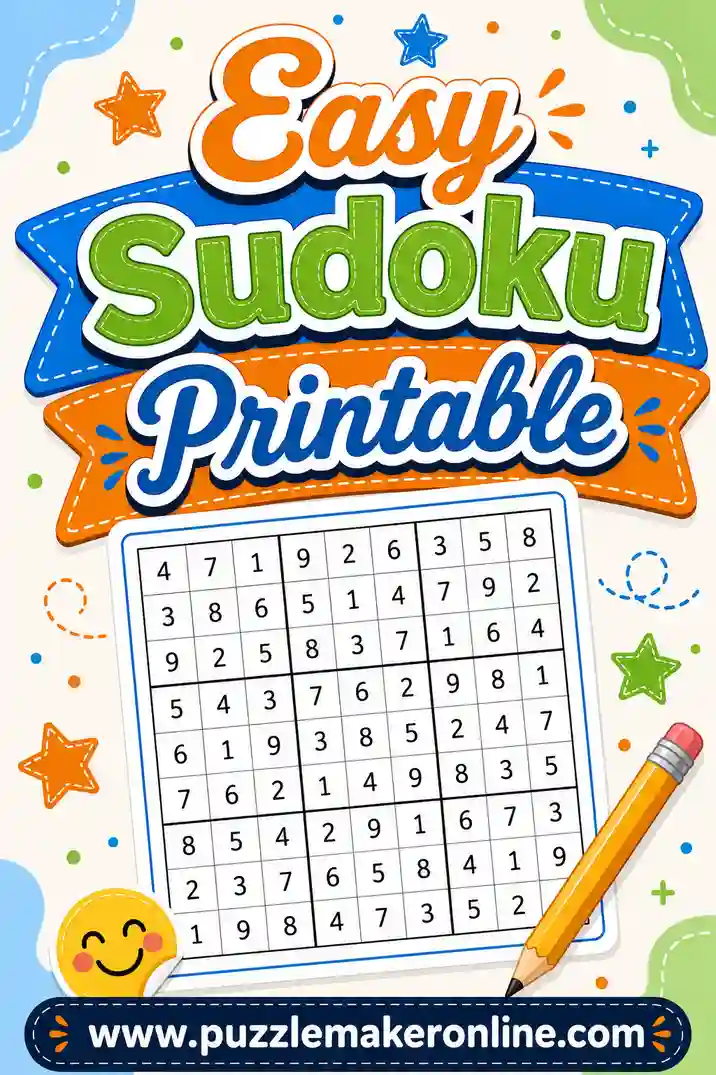
An easy sudoku printable is a 9×9 sudoku with generous starting numbers, printed on paper so a beginner can learn the game with a pencil instead of a screen. Easy puzzles can be solved with just two simple techniques — no advanced tricks, no guessing — which makes them the right on-ramp for kids, newcomers, and anyone returning to the grid after years away. The fastest source is a free puzzle maker with a Sudoku tab: pick Easy, choose how many puzzles per page, and print with full answer keys.
Want to skip ahead? Open the free sudoku generator, click the Sudoku tab, select Easy, and hit Print / Save PDF. No sign-up, no fee, fresh puzzles every time.
Sudoku Rules in 60 Seconds
Sudoku is played on a 9×9 grid divided into nine 3×3 boxes. Some cells come pre-filled with numbers — the "givens." Your job is to fill every empty cell with a digit from 1 to 9 so that:
- Every row contains 1 through 9 with no repeats.
- Every column contains 1 through 9 with no repeats.
- Every 3×3 box contains 1 through 9 with no repeats.
That's the entire rulebook. There's no arithmetic — the numbers are just nine different symbols, and the puzzle would work identically with letters or fruit. And in a properly made puzzle there is exactly one solution, reachable by logic alone. Every puzzle from the sudoku generator is checked for that single-solution guarantee, so if you're stuck, there's always a logical next move waiting to be spotted.
What Makes an Easy Sudoku Easy?
Difficulty isn't decoration — it changes how the puzzle solves. An easy grid gives you:
- More givens. Easy puzzles start with a generous share of the grid filled in, so constraints are everywhere and deductions come quickly.
- Simple logic only. Every cell in an easy puzzle can be found with the two starter techniques below. No candidate lists, no advanced patterns.
- Steady momentum. You should almost never be stuck for more than a minute. Easy sudoku feels like a gentle downhill — one placement reveals the next.
That momentum is the point. Beginners quit sudoku when a "beginner" puzzle secretly requires expert technique. A true easy printable sudoku teaches the game's rhythm and builds the scanning habit that every harder level depends on.
The Only Two Techniques You Need
Print an easy puzzle and try these — they will carry you through the whole grid.
1. Scanning (the workhorse)
Pick a number that appears a lot in the givens — say 5. Look at a 3×3 box that's missing its 5. Now check the rows and columns passing through that box: every 5 already placed in those rows and columns blocks its line inside the box. Cross off the blocked cells in your head. If only one cell in the box can still hold a 5, write it in. Move to the next box, then the next number.
This one move solves the majority of an easy grid. It feels mechanical for the first two puzzles, then your eyes start doing it automatically — that's the skill forming.
2. The last-cell count (the finisher)
Find any row, column, or box that's nearly full. Count which digits are missing. If one cell remains, it's free. If two or three remain, check each empty cell against its own row, column, and box — usually only one of the missing digits fits. Solvers call these naked singles; you can call them gifts.
When scanning stalls, switch to counting nearly-full regions, and vice versa. Ping-ponging between the two is the entire easy-sudoku experience — and it's surprisingly absorbing.
How to Print Easy Sudoku in 4 Steps
- Open the Sudoku tab in the puzzle maker.
- Click Easy. The generator builds a fresh puzzle with beginner-level logic, verified to have exactly one solution.
- Pick puzzles per page. 1 per page prints big, roomy cells (best while learning); 2, 4, or 6 per page for practice volume.
- Print / Save PDF. Puzzles print on one page and complete solutions on the next, so you can check your work — or rescue a stuck grid — anytime.
Add a title if you like ("Emma's First Sudoku") and it prints across the top. Every generate is a brand-new puzzle, so a free easy sudoku printable supply never runs dry.
Who Easy Sudoku Is Perfect For
Complete beginners
If you've never solved a grid, print three Easy puzzles at 1 per page and work through them with the techniques above. Most people finish their first in 15 to 25 minutes and their third in half that.
Kids
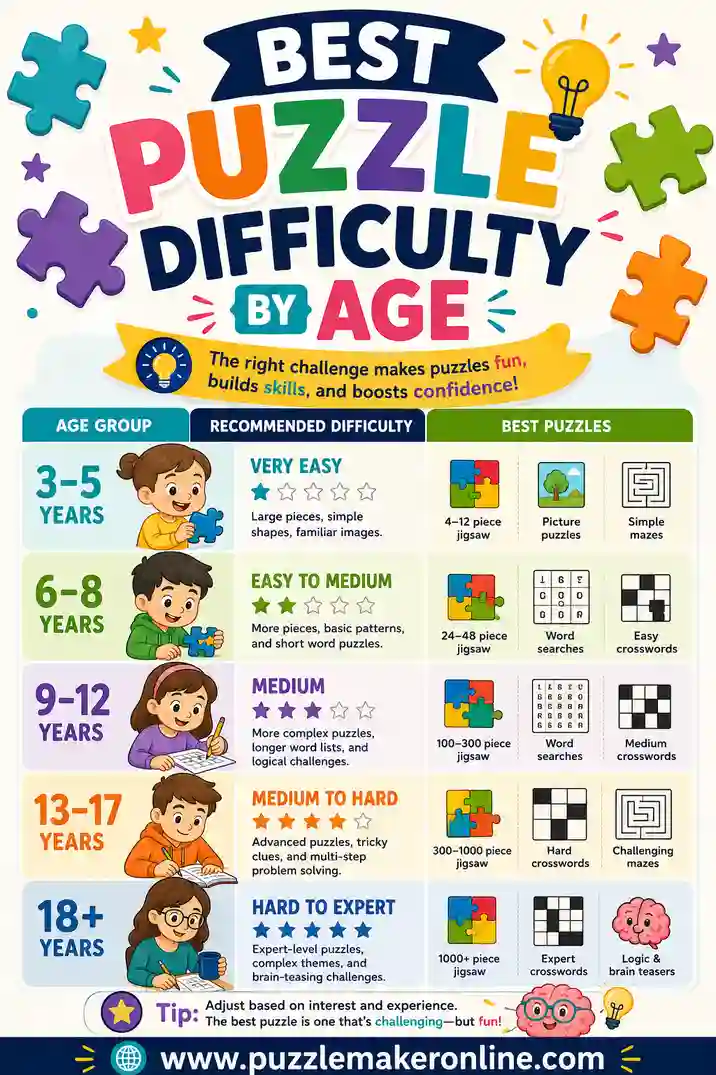
Sudoku is logic without reading, which makes it great from around age 7 or 8. Start kids on the mini 4×4 above to learn the rule, then move to Easy 9×9 with big 1-per-page cells. Solve the first grid together out loud — "which box is missing its 3?" — and hand over the pencil once they start answering before you do. For matching other puzzles to ages, see our guide to the best puzzle difficulty by age.
Seniors and returners
Familiar rules, visible progress, zero screens. Easy grids printed one per page in large cells are a daily staple in senior centers — satisfying without being stressful.
Warm-up solvers
Plenty of experienced solvers print an Easy grid as a two-minute warm-up before the day's real puzzle, the way runners jog before a race.
A Two-Week Beginner Plan
If you like a little structure, here's a printable ramp that takes most people from "never played" to "comfortably finishing Easy grids" in two weeks — about 15 minutes a day.
| Days | Goal | |
|---|---|---|
| 1–2 | One Easy, 1 per page | Finish with the answer key open beside you — check any cell, no guilt |
| 3–5 | One Easy, 1 per page | Finish with the key face-down; peek only when stuck 5+ minutes |
| 6–8 | Two Easy, 2 per page | Finish both without peeking; note your time in the corner |
| 9–11 | Easy sheet, 4 per page | Beat your day-8 time on at least one grid |
| 12–14 | Two Easy + one Medium | Finish the Easies fast, then attempt the Medium with pencil marks |
Two rules make the plan work. First, one sitting per puzzle when possible — momentum is a skill you're training, not just logic. Second, write your solve time on every finished grid and keep the stack. Watching 25 minutes become 9 is the most motivating thing in sudoku, and it's the reason paper beats apps for learners: your progress physically piles up.
When to Move Up from Easy
You're ready for the next level when Easy puzzles feel automatic — roughly when:
- You finish most Easy grids in under 10 minutes.
- You no longer re-check rules ("wait, can a box repeat?" never crosses your mind).
- Scanning happens without narrating it to yourself.
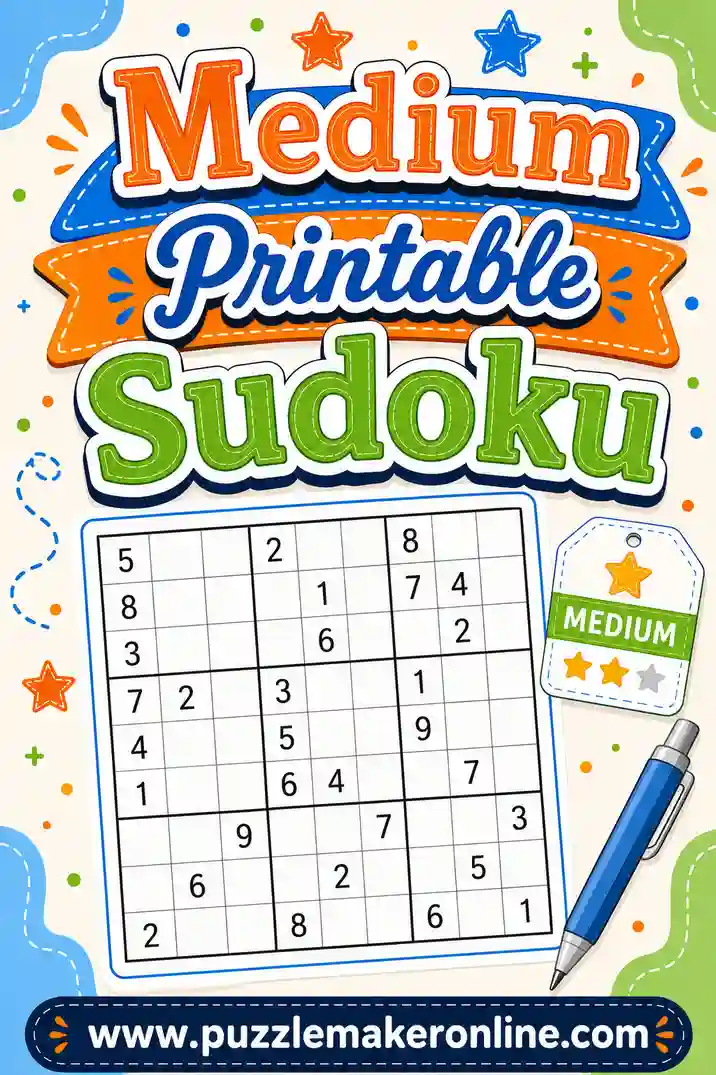
That's usually after 10 to 20 puzzles. Move to Medium, where you'll learn pencil marks — writing small candidate numbers in stubborn cells. Don't rush it: our medium printable sudoku guide covers the jump, and mixing pages (two Easy, one Medium) makes the transition painless. There's no prize for suffering; there's real skill in mastering each level properly.
Printing Tips for Learners
- One per page while learning. Big cells leave room for corrections and keep the grid friendly. Move to 4 or 6 per page when you want volume.
- Grayscale is fine. Sudoku needs no color; just check the givens print clearly darker than the grid lines.
- Print the answer key, and use it well. Stuck for five minutes? Check one cell against the key — just the one you're staring at — and keep solving. One confirmed digit restarts the chain without spoiling the puzzle.
- Pencil, always. Beginners erase constantly, and that's exactly how it should feel.
- Print a small stack. Finishing your first grid and having no second one ready is a tragedy of poor planning. Three pages in a folder covers a week of learning sessions.
Common Beginner Mistakes to Avoid
- Guessing. The cardinal sin. If you're guessing, a deduction is sitting somewhere unnoticed — re-scan your strongest numbers. Every puzzle here is solvable by logic alone.
- Forgetting the box rule. New solvers check row and column and forget the 3×3 box. All three, every time.
- Working one number to exhaustion. If the 7s dry up, don't grind — switch numbers or switch to counting nearly-full rows.
- Starting on Medium or Hard to "save time." A wall of frustration teaches nothing. Easy builds the eye that makes Medium fun.
- Solving in pen. One wrong digit quietly poisons three regions before you notice. Pencil and a good eraser.
Frequently Asked Questions
Are these easy sudoku printables free?
Yes — free with no sign-up, no watermark, and no limits. Print one easy sudoku printable or a hundred pages of them; the generator builds a fresh puzzle every time.
Can I get an easy sudoku printable PDF?
Yes. Click Print / Save PDF and choose "Save as PDF." You get puzzles on one page and full solutions on the next, ready to reprint or share.
How long does an easy sudoku take?
Beginners typically take 15 to 25 minutes for their first few, dropping to 5 to 10 minutes with practice. Kids may want a couple of sessions for their first grid — that's normal.
Is easy sudoku good for kids?
Yes, from around age 7 or 8. Print 1 per page for big cells, teach the scanning technique, and let them check themselves against the answer key. It builds patience and logical thinking with no reading required.
Do easy puzzles ever require guessing?
Never — not from this generator. Each puzzle keeps exactly one solution and falls to the two starter techniques. If you're stuck, the next move exists; take a break and re-scan.
How many easy puzzles fit on a page?
Your choice of 1, 2, 4, or 6 per page. Learners should start at 1 per page for the roomy cells, then compress as confidence grows.
Print Your First Easy Sudoku Now
Open the free sudoku generator, click Easy, and print a page — solutions included. Twenty minutes from now you'll have finished your first grid with the scanning trick, and the second puzzle will already be waiting in the tray.
When Easy turns automatic, step up with our medium sudoku guide, or explore the full range of sudoku printable options — per-page layouts, difficulty levels, and puzzle-book ideas. Happy solving.