Samurai Sudoku Printable: Rules, Strategy & Practice
A samurai sudoku printable is the marathon version of sudoku: five full 9x9 grids arranged in an X, with the center grid sharing its four corner boxes with the four outer grids. One puzzle, five interlocked sudokus, and a solve that can stretch across an entire evening. This guide covers how samurai sudoku works, how to attack one, and how to build the solving muscles it demands — starting with free hard 9x9 puzzles from our puzzle maker that you can print by the sheet.
Want the short version? Samurai rules are ordinary sudoku rules applied five times, with the overlap boxes pulling double duty. If your standard-grid skills are sharp, samurai is stamina, not new theory. Print practice puzzles here, free, with answer keys.
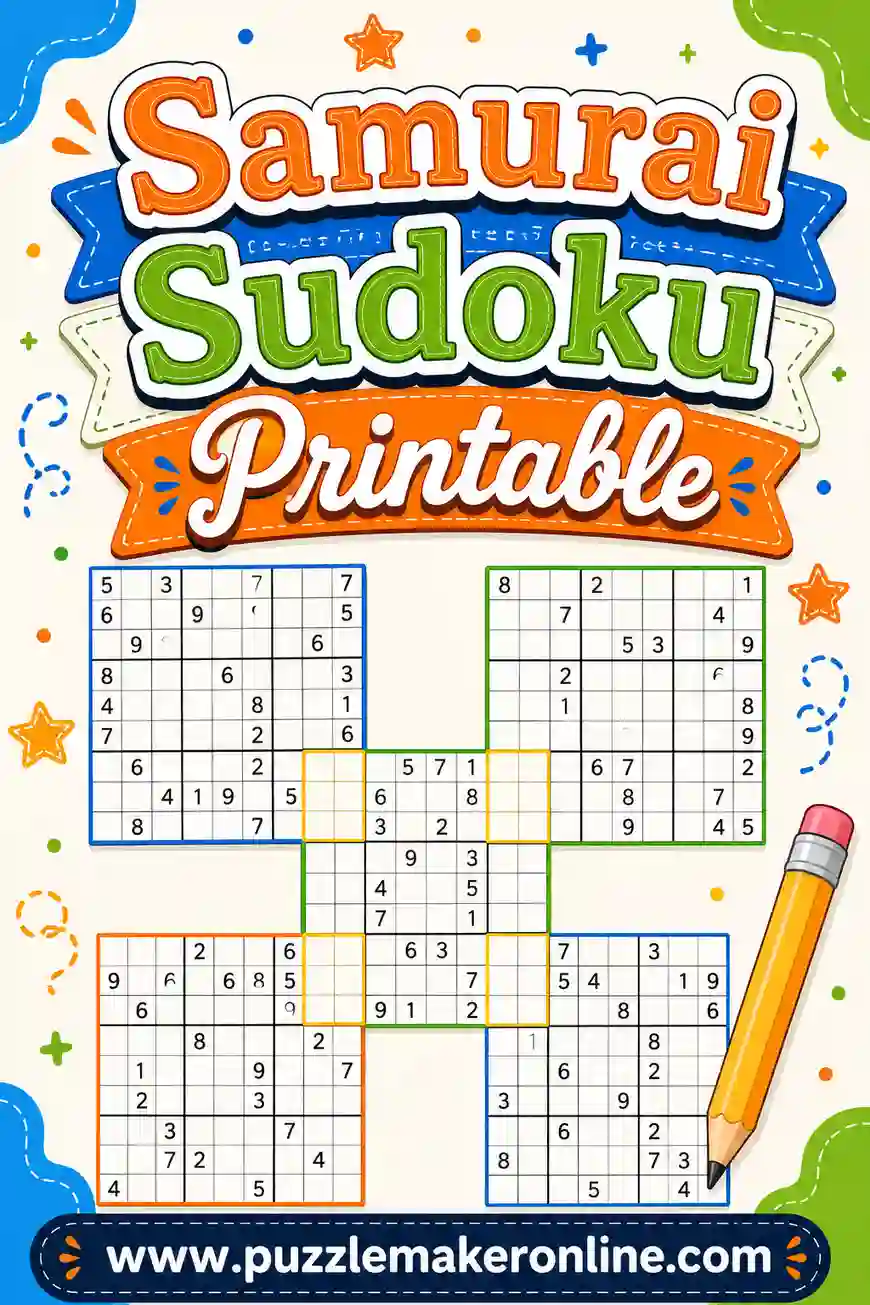
What Is Samurai Sudoku?
Picture five standard sudoku grids laid out like the five on a die: one in each corner and one in the center. Now slide the corner grids inward until each one overlaps the center grid by exactly one 3x3 box. That X-shaped monster — 21 rows deep, 21 columns wide, 41 boxes in total — is a samurai sudoku, sometimes called gattai-5, from the Japanese for "merged."
The rules inside each grid never change: every row, column, and 3x3 box of each individual 9x9 grid must contain the digits 1 through 9 exactly once. The twist is the four shared boxes. Each one belongs to two grids simultaneously, so a digit placed there must satisfy the rows and columns of both grids at once.
One important detail: rows and columns do not run across the whole X. A row in the top-left grid stops at that grid's edge; it doesn't continue into the top-right grid. Only the shared boxes tie the five puzzles together.
Why Solvers Love the Samurai Format
- It's an event, not a break. A standard hard grid is a coffee. A samurai is a Sunday afternoon. Solvers who love long, absorbing sessions get exactly that.
- The overlaps create ripple effects. Cracking a shared box sends deductions flowing into two grids at once — the most satisfying chain reactions in sudoku.
- It punishes and rewards planning. You can't brute-force five grids. Choosing where to work next becomes part of the puzzle.
- Paper is the natural habitat. A 21x21 layout is miserable on a phone screen. Samurai sudoku is a printed puzzle at heart, solved flat on a table with a pencil.
How to Solve a Samurai Sudoku: Strategy That Works
Start in the center
The center grid shares four of its nine boxes with other grids, making it the information hub of the whole puzzle. Clues placed in the center constrain all four outer grids. Harvest every easy placement there first.
Treat shared boxes as gold
Each shared box answers to two grids' worth of rows and columns, which means it's doubly constrained — and doubly likely to yield placements early. When you're stalled, re-check the four overlap boxes before anything else; new digits elsewhere often quietly resolved them.
Rotate grids like crops
Work one grid until it stops giving, then move on. A placement in the top-left grid can unlock the center, which unlocks the bottom-right. Circling the X beats grinding a single stubborn corner every time.
Bring your full 9x9 toolkit
Everything that cracks a standard grid — hidden singles, naked pairs, pointing pairs, X-wings — works inside each grid of a samurai. There is no samurai-only technique; there's only standard technique applied with more patience. That's why training on single grids transfers completely.
Mark which grid you're thinking about
A common samurai disaster is applying the top-left grid's row logic to a cell while accidentally reading the center grid's column. When working an overlap box, physically trace the two rows and two columns it answers to. Slow is fast here.
Train for Samurai With Printable 9x9 Puzzles
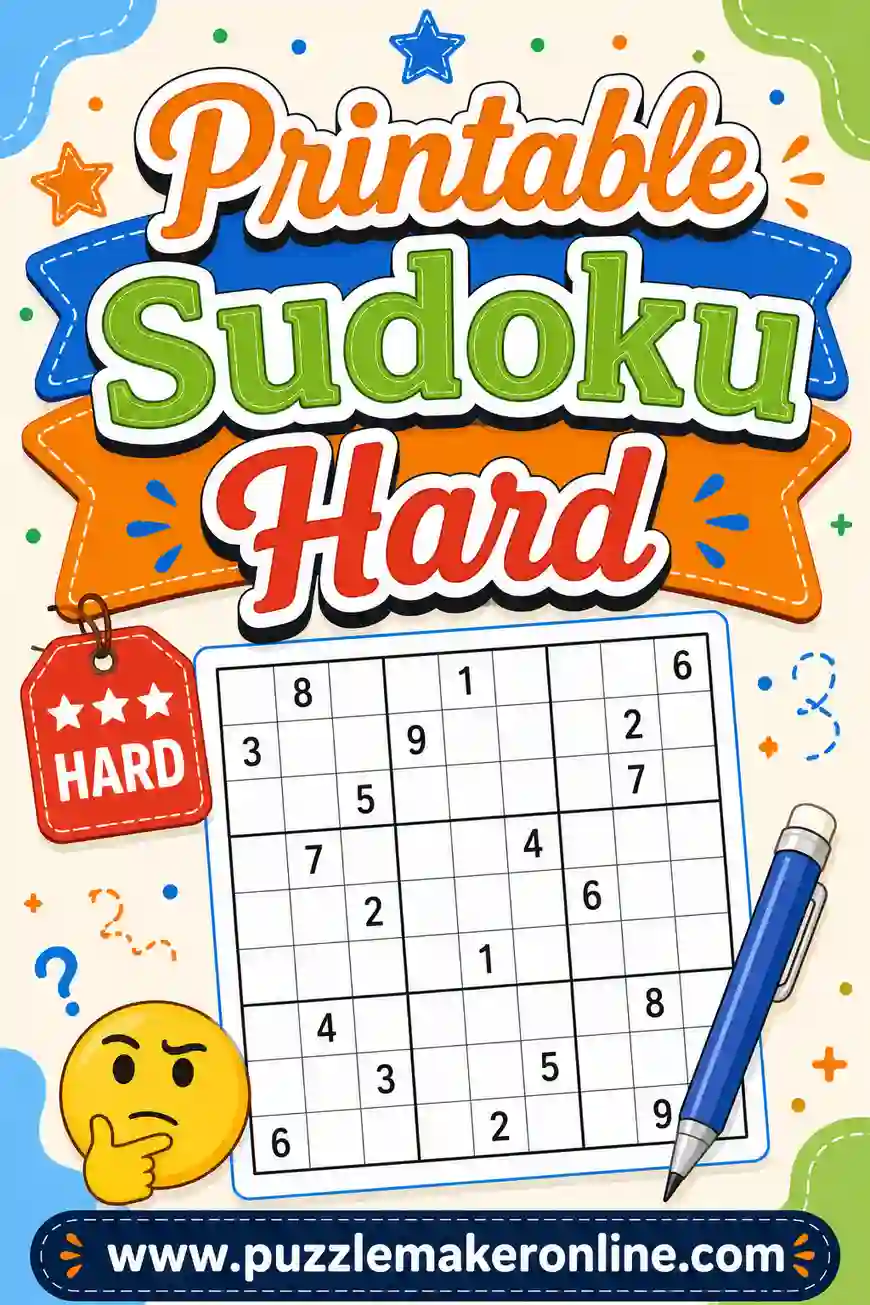
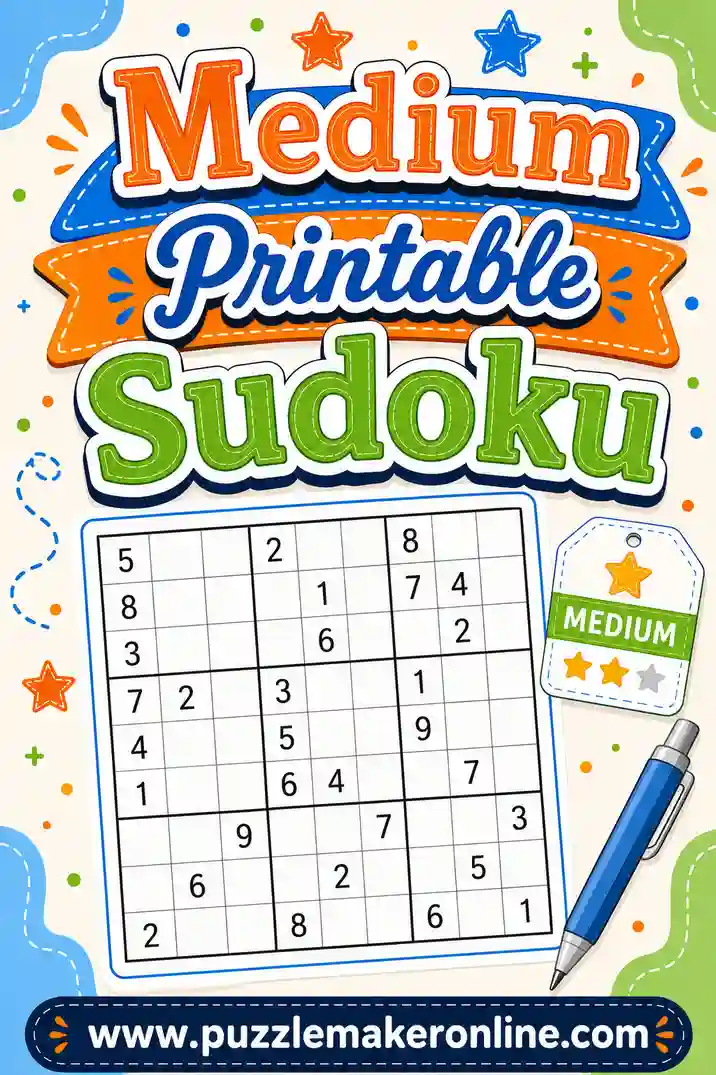
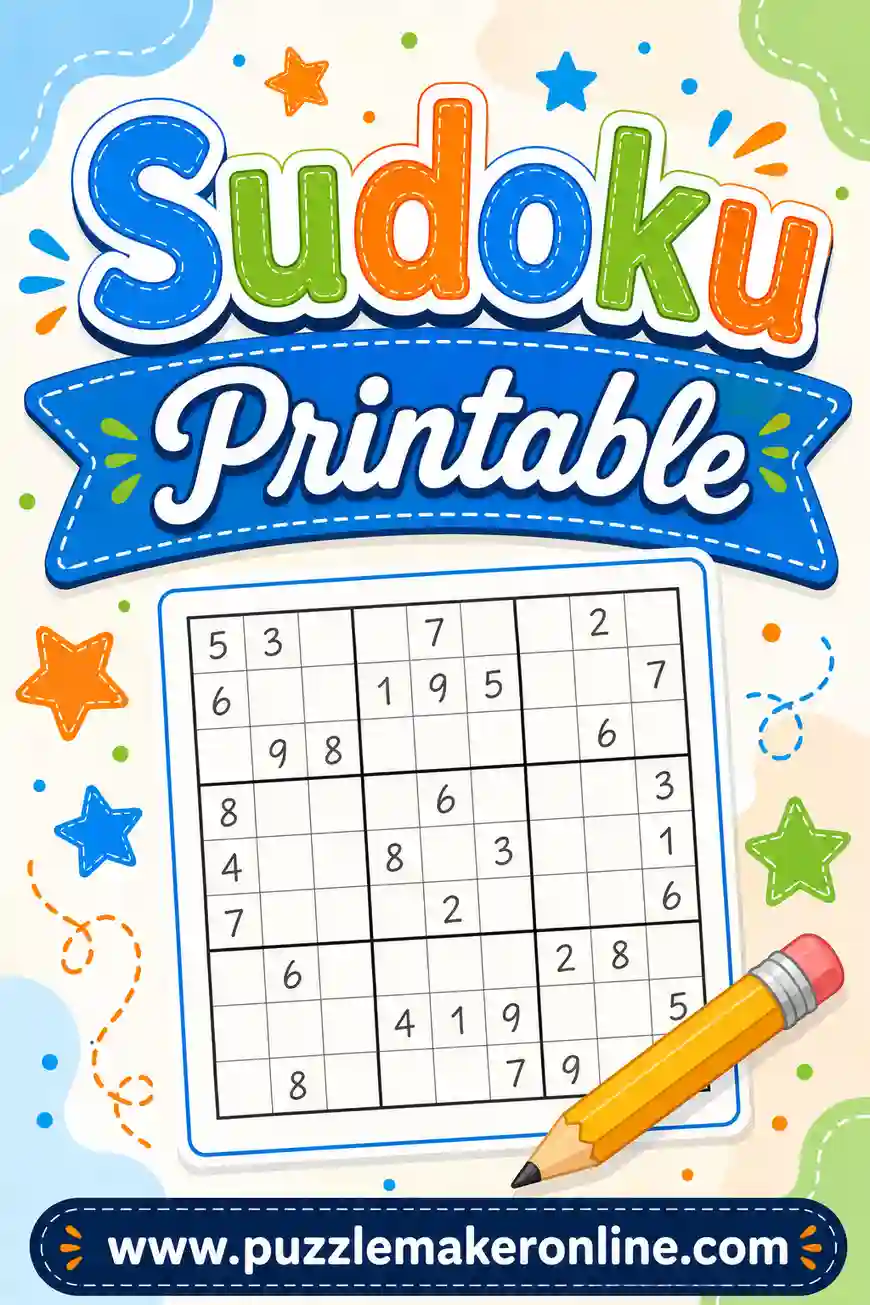
Here's the honest path to samurai strength, and it's free. Our puzzle maker generates standard 9x9 sudoku — Easy, Medium, and Hard — each with a guaranteed unique, logic-only solution and a printed answer key. It doesn't build the five-grid samurai layout itself, but it's the ideal training ground, because samurai solving is 9x9 solving with stamina.
A four-week ramp that works:
| Week | Goal | |
|---|---|---|
| 1 | 4 medium per page, daily | Finish all 4 in one sitting |
| 2 | 6 medium per page | Speed: under 12 minutes each |
| 3 | 2 hard per page, daily | Clean solves, zero guessing |
| 4 | 6 hard on one page | The samurai dress rehearsal |
That week-4 sheet — six hard grids, one sitting — is roughly a samurai's total workload. Solvers who can clear it won't be intimidated by the X.
How to Print Practice Puzzles in 4 Steps
- Open the Sudoku tab in the free puzzle maker.
- Pick your difficulty. Medium for volume training, Hard for samurai-grade logic.
- Choose puzzles per page. 1, 2, 4, or 6 — use 4 or 6 for endurance sessions.
- Print with answer keys. Check your work after the session, not during.
Every generation is a fresh puzzle, so your training supply never runs dry and never repeats.
Who Samurai Sudoku Is For
Bored hard-grid veterans. If single hard grids fall in 15 minutes and the thrill is gone, samurai restores the sense of expedition.
Long-session solvers. Flights, beach days, quiet Sundays. One samurai out-lasts a paperback.
Puzzle gift-givers. A printed samurai plus a nice pencil is a legitimately great gift for the sudoku obsessive who has everything.
Anyone building focus endurance. Sustaining careful logic for two hours is a trainable skill, and samurai sudoku is its gym.
Not there yet? No shame — start with our medium sudoku guide and climb through hard sudoku first.
The Gattai Family: Samurai's Bigger and Smaller Cousins
Samurai sudoku is the famous member of a whole clan of overlapping-grid puzzles, and knowing the family helps you pick your next challenge.
- Gattai-2 (twin sudoku). Two grids sharing one corner box. The gentlest introduction to overlap logic — if the full samurai intimidates you, a twin is the perfect first date with the format.
- Gattai-3 and gattai-4. Three or four grids chained by shared boxes, often in a diagonal staircase. Each added grid raises the stamina requirement more than the difficulty.
- Gattai-5 (samurai). The classic X of five grids described in this guide. The sweet spot of the family: hard enough to be an event, standard enough that answer keys and books are everywhere.
- Monsters beyond. Enthusiasts build gattai-8, gattai-13, and beyond — sprawling quilts of interlocked grids that take a weekend. The logic never changes; only the map gets bigger.
The practical takeaway: every member of this family runs on ordinary 9x9 technique plus overlap awareness. Train the fundamentals once and the entire clan opens up.
Planning a Samurai Session
A two-hour puzzle deserves five minutes of setup. Veterans treat a samurai solve like a small ritual:
- Block real time. Ninety minutes minimum for your first attempt. A samurai started in ten-minute fragments loses its mental thread each time.
- Set up the table. Flat surface, sharp pencil, good eraser, decent light, and the answer key in another room.
- Open with a census. Before placing anything, scan each of the five grids and count its givens. The grid with the most clues is usually your best entry point after the center.
- Take one scheduled break. At the halfway feel, stand up for five minutes. The post-break placement burst is real and reliable.
- Log the finish. Date and total time in the corner. Your third samurai will be dramatically faster than your first, and you'll want the proof.
One more veteran habit worth stealing: solve the four overlap boxes' pencil marks first, before anything else, even before easy placements elsewhere. Those forty-four cells set the tone for the entire puzzle.
Printing Tips for Giant Puzzles
- Go big or go stuck. Print samurai layouts as large as the page allows; 441 cells with pencil marks need every millimeter.
- Landscape can help. The X shape is as wide as it is tall; test both orientations and keep the larger result.
- Use quality black ink. Thin grid lines at small cell sizes vanish in draft mode.
- Solve on a hard surface. A clipboard or table matters at this scale; couch-solving a samurai bends the paper and your accuracy.
- Keep the answer key far away. A two-hour solve deserves protection from your own weaker moments.
Common Samurai Mistakes to Avoid
- Ignoring the overlaps. Treating the five grids as separate puzzles wastes the double constraints that make samurai solvable. The shared boxes are the puzzle.
- Cross-grid contamination. Reading a row as if it continued into the neighboring grid. Rows and columns stop at each grid's edge; only boxes are shared.
- No pencil-mark discipline. Five grids of stale candidates is chaos. Update marks after every placement, ruthlessly.
- Marathon without training. Jumping from casual easy grids straight to samurai ends in abandonment. Climb the difficulty ladder first.
- One sitting or bust. It's fine to leave a samurai on the table overnight. Fresh eyes crack overnight what tired eyes couldn't.
Frequently Asked Questions
What does samurai sudoku mean?
It's a five-grid sudoku variant: four 9x9 grids overlap the corners of a central fifth grid in an X shape. Each grid follows normal sudoku rules, and the four shared 3x3 boxes must work for both grids they belong to.
Are the rules different from normal sudoku?
No new rules — every row, column, and box of each grid still needs 1 through 9 exactly once. The only twist is that shared boxes answer to two grids at the same time.
Can your generator print samurai sudoku?
Not the five-grid layout — it generates standard 9x9 puzzles in Easy, Medium, and Hard, printable 1, 2, 4, or 6 per page with answer keys. That's exactly the practice format samurai solvers train on, since samurai uses pure 9x9 technique.
How long does a samurai sudoku take?
Plan on one to three hours depending on difficulty and experience — roughly the effort of five to six hard 9x9 grids, minus a little thanks to the overlap clues.
Where should I start solving a samurai?
The center grid. It touches all four others through the shared boxes, so progress there pays out across the whole puzzle.
What difficulty should I train at?
If you want samurai to feel good rather than brutal, train until hard 9x9 puzzles fall reliably without guessing. Six hard grids in one sitting is the readiness test.
Ready to Build Samurai Strength?
Open the free puzzle maker, print a page of hard sudoku with answer keys, and start the four-week ramp — your first samurai will thank you. Brush up with the medium sudoku and hard sudoku guides, or browse everything in printable sudoku. Five grids await.