Secret Santa Guess-the-Giver Crossword: Clues About the Person Who Gave the Gift
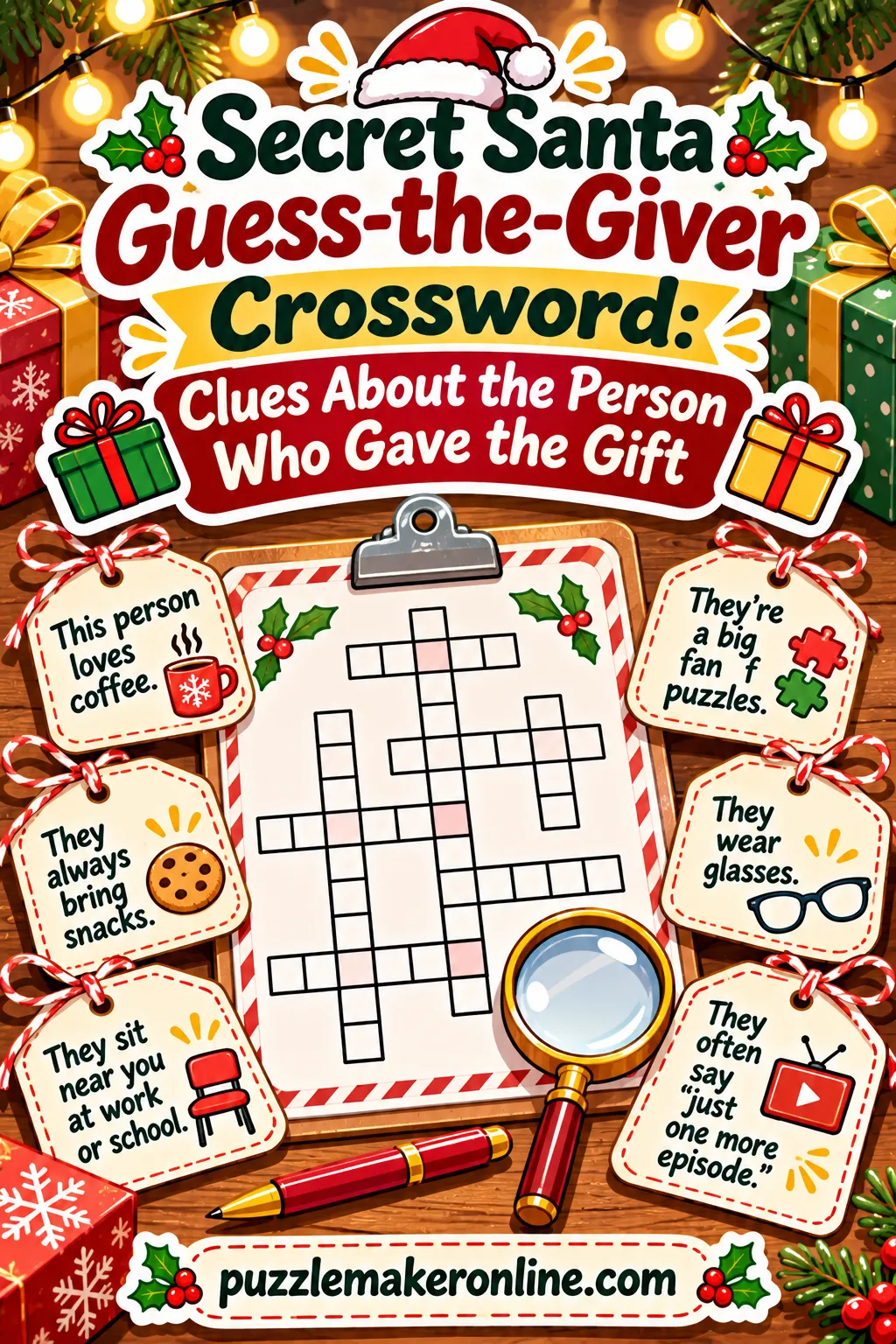
One of the most fun Secret Santa game ideas is a guess-the-giver crossword: every answer in the grid is a giver's name, and every clue is a fun fact about that person, so each recipient solves "their" clue to find out who gave their gift. Write the clue number on each gift tag, hand out the puzzle, and the reveal turns into a game instead of a quick "It was me!"
You can build the whole thing in about 15 minutes with the free crossword maker, answer key included, and print it or share it as a PDF. This guide covers how the game works, how to collect fun facts without spoiling the draw, the exact tool settings, sample clues, a party run of show, variations for families, offices and video calls, and fixes for the snags people hit.
How the Guess-the-Giver Crossword Works
The idea is simple. In a normal Secret Santa, gifts get opened and the giver either speaks up or stays a mystery forever. This puts a puzzle in between.
- Every giver becomes an answer. If eight people are in the exchange, the crossword has eight answers, one per person: MOM, UNCLE, SAM, GRANDPA, MAYA, and so on.
- Every clue is about the giver. Not about the gift. A hobby, a quirk, a well-known habit, a harmless inside joke. "Burns the first batch of cookies every year." "Owns three different hats."
- Each gift tag gets a clue number. The host writes "Your giver is 4 Across" on the tag (or slips a card under the bow).
- Recipients solve to find their giver. They open their gift, then work out their clue. Since crossword answers cross, they'll often need letters from other people's answers, so the whole group ends up solving together.
- The answer key settles it. The host holds page two, the answer key, and reveals answers at the end.
It works because everyone already knows a little about everyone else. The clues are about people in the room, so even a hard clue usually gets an "Oh, that's so you!" when it's solved.
Why it beats the usual reveal
| Typical reveal | Guess-the-giver crossword |
|---|---|
| Takes 10 seconds per gift, then it's over | Turns the reveal into 20 to 40 minutes of play |
| Shy people barely get noticed | Everyone gets a clue written about them |
| Only the recipient cares who gave each gift | The whole group helps solve every clue |
| Nothing to keep | A printed puzzle full of family or team in-jokes to save |
| Same every year | New clues every year, since people change |
It also pairs well with any style of exchange: name-draw Secret Santa, a family gift swap, a classroom exchange, or an office party. You aren't changing how gifts get assigned or given; you're only changing how people find out who gave what.
What you need
- The list of who is giving to whom (the host needs this; more on keeping it secret below).
- One short fun fact per giver.
- About 15 minutes to build the puzzle with the free tool.
- A printer, or a screen to share the PDF on a video call.
- Gift tags or small cards to write clue numbers on.
- Pencils for solvers.
Who Should Host (and How to Keep the Draw Secret)
The host needs to know every giver-and-recipient pair, because they're the one writing clue numbers on tags. That's the one real catch in this game. There are a few clean ways to handle it.
Option 1: A host who isn't playing
The easiest setup. A parent, grandparent, teacher, team lead or friend who isn't in the exchange runs the draw (or receives the results), collects the fun facts, builds the puzzle and labels the tags. They know everything, and that's fine because they have nothing to guess.
Option 2: A host who plays but only sees what they need
If the host is also in the exchange, they don't need to know the pairs. Instead:
- The host builds the crossword from everyone's name and fun fact. Every person is an answer anyway, so the puzzle itself gives nothing away.
- After the puzzle is made, the host posts or sends the list of clue numbers: "Maya is 2 Down, Sam is 5 Across," and so on. This doesn't reveal pairs.
- Each giver writes their own clue number on the tag of the gift they're giving. "Your giver is 5 Across."
Now nobody, including the host, knows who gave what until the puzzle is solved. Givers only need to remember their own number, which takes a few seconds.
Here's the catch: if every giver knows their own clue number, and the full number list is shared, recipients could just look up the number on their tag. Two ways around it:
- Don't share the full list with everyone. The host sends each person only their own clue number, privately.
- Hand out the list only at the end as part of the answer key reveal.
Option 3: Givers write their own clues
A fun twist: instead of the host writing clues, each giver writes one clue about themselves and sends it to the host privately. People tend to pick funny, slightly obscure facts about themselves, which makes for a better puzzle. The host just types them in. This also takes pressure off the host, who might not know everyone well, such as a new team lead or a partner's family.
Collecting fun facts without tipping anyone off
Send everyone the same short message at the same time, so nobody feels singled out. A message you can copy:
"For our gift exchange this year, I'm making a puzzle. Please send me one fun fact about yourself that most people here would recognize once they hear it, like a hobby, a habit or a running family joke. Keep it kind and keep it short. Please send it to me privately by [date]."
Give people about a week. Then send one reminder two days before the deadline. If someone never replies, write a clue for them yourself from something everyone knows.
| Who | When | What |
|---|---|---|
| Host | 2 to 3 weeks before the party | Run the name draw (or get the results) |
| Host | Same day | Send the fun-fact message |
| Everyone | Within a week | Reply privately with one fact |
| Host | 1 week before | Build the crossword, save the PDF |
| Host or givers | Before wrapping or at the party | Write clue numbers on gift tags |
| Host | Party day | Print copies, bring pencils, hold the answer key |
If anyone's shipping gifts to the party or to a remote recipient, check your carrier's official holiday shipping dates early, since they change every year.
How to Make It with the Free Tool: Exact Settings
Open the free puzzle maker on a laptop or desktop. It runs in your browser with no sign-up and no app. Tabs across the top switch between puzzle types; you want Crossword.
Step by step
- Click the 🧩 Crossword tab.
- Puzzle title (optional): type something like Who Is Your Secret Santa? or The Johnson Family Giver Hunt. This prints at the top of the sheet.
- Words & clues: type one giver per line in the format NAME : clue. The name goes first, then a colon, then the clue. For example:
MOM : Burns the first batch of cookies every year
UNCLE : Always falls asleep during the movie
SAM : Owns three different hats
GRANDPA : Tells the same story at dinner
MAYA : Can name every bird at the feeder
JORDAN : Has never once been on time for dinner
- Large print (bigger letters): turn this on if grandparents or young kids will solve on paper. It makes the grid and letters easier to read.
- Add matching pictures: this adds small decorations to the printed sheet. Leave it on for a festive look, or turn it off to save ink.
- Click Generate crossword. The grid arranges itself on shared letters, and numbered Across and Down clue lists appear below it.
- Check for a "Couldn't connect" notice. If a name shares no letters with the rest, the tool lists it and leaves it out. See the fixes below.
- Click 🔀 New layout if you'd like a different arrangement. Each click reshuffles the grid.
- Write down the clue numbers. Once you're happy with the layout, note each giver's number, like "SAM = 3 Down." Do this after your final layout, because a new layout changes the numbers.
- Turn on Show answer key to check every answer on screen.
- Choose your paper from the Paper menu: US Letter or A4.
- Click 📄 Save PDF. The puzzle prints on page one and the answer key on page two. Print only page one for players and keep page two for the host. 🖼️ Save image gives you a picture of the puzzle sheet for sharing on screen or in a group chat, and 🖨 Print sends it straight to your printer.
Settings at a glance
| Setting | Choose | Why |
|---|---|---|
| Tab | Crossword | Names cross on shared letters |
| Puzzle title | Who Is Your Secret Santa? | Prints at the top |
| Words & clues | NAME : fun fact, one per line | One answer per giver |
| Large print | On for older or younger solvers | Easier to read and write in |
| Add matching pictures | Your choice | Decorations or ink saving |
| New layout | Click until you like the grid | Then lock in the numbers |
| Show answer key | On while checking | Confirms every answer |
| Save PDF | Page 1 for players, page 2 for host | Key stays secret |
Puzzles aren't stored on a server, so keep your list of names and clues in a note or document. If you need to rebuild the puzzle, paste the list back in and generate again. Just remember that a rebuilt puzzle may have different clue numbers.
How names behave in the grid
Crossword answers are letters only, so the tool cleans up names for you:
- Spaces and punctuation are dropped. "Mary Ann" becomes MARYANN, and "O'Neil" becomes ONEIL. Solvers should know that answers are written without spaces.
- Accents are removed. "José" becomes JOSE.
- Everything is uppercase in the grid.
- Answers need at least 2 letters. A one-letter nickname won't work.
When two people share a name
Two Sams? Two people called "Grandma"? Each answer needs to be clear, so tell them apart:
- Use a nickname one of them already goes by: SAMMY and SAMUEL.
- Use a family title: GRANDMAJO and NANA, or AUNTLISA and AUNTKAT.
- Add a last name or initial for offices: SAMR and SAMT works, but full last names are friendlier: REYES and TANAKA.
When a name won't connect
If you see "Couldn't connect," that name shares no letters with any other answer in the grid. It happens with very short names or names with unusual letters. Fixes, quickest first:
- Click 🔀 New layout a few times. Sometimes a different arrangement finds room.
- Use a longer version of the name: AL becomes ALBERT or UNCLEAL.
- Use a family title instead of a first name: GRANDPA has common letters that cross easily.
- As a last resort, add one bonus answer that isn't a giver, like SANTA or SNOWFLAKE, with a normal clue. It gives other names something to cross. Tell players there's one bonus answer.
Writing Clues That Point to the Giver
The clues make or break the game. A good clue is something most of the group would recognize once solved, but that isn't instantly obvious. Aim for "Oh, of course!" rather than "Who?" or "Too easy."
What makes a good guess-the-giver clue
- Specific, not generic. "Likes coffee" fits half the room. "Has a different mug for every day of the week" points to one person.
- Kind. Quirks and hobbies, not flaws. If the person would wince to hear it read aloud, skip it.
- Known to the group. An inside joke shared by three people will stump everyone else. Pick facts most players know.
- Short. One line, under about 12 words, fits well on the printed sheet.
- Not about the gift. The clue points to the giver, not what they gave. Otherwise the gift itself gives the answer away.
Clue types that work
| Clue type | Example | Works best for |
|---|---|---|
| Hobby | Can name every bird at the feeder | Any group |
| Famous habit | Has never once been on time for dinner | Families and close friends |
| Signature food | Brings the same green bean dish every year | Families |
| Collection | Owns three different hats | Any group |
| Talent | Can whistle any carol on request | Any group |
| Pet | Has a cat who sits on every keyboard | Offices, friends |
| Travel or place | Grew up on a farm with 40 chickens | Mixed or newer groups |
| Work quirk | Replies to email within 30 seconds, always | Offices |
| Harmless inside joke | Still owes everyone a rematch at cards | Close groups only |
Make it easier or harder
You can tune the difficulty without changing the grid:
- Easier: include a strong hint in the clue, like the person's role. "This grandparent tells the same story at dinner."
- Medium: a fact most people know but have to think about. "Owns three different hats."
- Harder: a lesser-known fact everyone would accept once revealed. "Was once a spelling bee runner-up."
For kids, keep clues easy and name-friendly. For adults who know each other well, harder clues are more fun, since the crossing letters from other answers help them along.
Sample clue sets you can adapt
A family of eight
| Answer | Clue |
|---|---|
| GRANDMA | Knits a scarf for everyone, whether they want one or not |
| GRANDPA | Tells the same story at dinner |
| MOM | Burns the first batch of cookies every year |
| DAD | Insists on carving, then asks for help |
| UNCLE | Always falls asleep during the movie |
| AUNTIE | Sends the longest holiday texts |
| JORDAN | Has never once been on time for dinner |
| MAYA | Can name every bird at the feeder |
An office team of ten
| Answer | Clue |
|---|---|
| PRIYA | Keeps a plant alive on every desk she's ever had |
| MARCUS | First one to join every call |
| ELENA | Has a different mug for every day of the week |
| DEV | Can fix the printer by looking at it |
| TOM | Ran a marathon and never mentions it (except once) |
| GRACE | Brings snacks to every Friday meeting |
| LUIS | Out-of-office message is always a pun |
| HANNAH | Has the neatest spreadsheet in the building |
| OMAR | Knows every coworker's coffee order |
| KIM | Cat appears on every video call |
A group of friends
| Answer | Clue |
|---|---|
| ZOE | Owns more board games than plates |
| NATE | Has a playlist for every mood |
| RILEY | Still talks about that camping trip |
| JESS | Reads the last page of a book first |
| BEN | Will bake bread at any hour |
| ALEX | Always volunteers to drive |
These names are only examples. Swap in your own people, and keep the facts true and friendly.
For more general tips on clue writing, the guide on how to make a crossword covers clue style and grid basics.
Running the Game at the Party
Once the puzzle is printed and the tags are labeled, the game itself is easy to run. Here's a simple order that works for most groups.
Before guests arrive
- Print one puzzle (page one) per person, plus two spares. Keep the answer key (page two) folded in your pocket.
- Check every gift tag has a clue number, like "Your giver is 4 Across." Use a small sticker or folded card if you don't want to write on the tag itself.
- Put pencils and a few erasers on the table. Crosswords and pens don't mix.
- Decide on your format (below) and any small prize.
Three ways to play
Format A: Open, then solve (most common). Everyone opens their gift as usual, but nobody says who gave what. Then hand out the puzzles. Each person works out their own clue first, then helps others. When most clues are solved, the host reads the answer key aloud and each giver stands up or waves when their name is called.
Format B: Solve, then open. Hand out puzzles first. Each person must solve their own clue and say their guess aloud before opening the gift. Givers can't confirm or deny until the end. This builds a lot of suspense and works well for smaller groups of 4 to 10.
Format C: Team race. Split into two or three teams, each with one puzzle. The first team to correctly fill the whole grid wins. Then everyone checks their own tag number against the solved grid to find their giver. Good for big or competitive groups.
| Format | Group size | Time | Best for |
|---|---|---|---|
| A: Open, then solve | Any | 20 to 30 minutes | Families, relaxed parties |
| B: Solve, then open | 4 to 10 | 30 to 45 minutes | Close groups who like suspense |
| C: Team race | 10 to 40 | 15 to 25 minutes | Offices, classrooms, big families |
A host script you can read
You don't need to be a natural host. Something like this works:
"Okay, everyone! Look at your gift tag. There's a clue number on it, like '4 Across.' That's your giver. Every answer in this crossword is the name of someone here, and every clue is a fun fact about them. Solve your clue to find out who picked your gift. You can help each other, but no givers confessing until I read the answers. Pencils are on the table. Go!"
Then, at the end:
"Time's up! Let's go through it. 1 Across: 'Burns the first batch of cookies every year.' Who had that one? What did you guess? ... It's Mom!"
Reading every clue aloud at the end is the best part. Each giver gets a small moment, and people often add the story behind the clue.
Scoring and prizes (optional)
You don't need points. If your group likes a little competition, keep it light:
- 1 point for each clue a person solves on their own.
- 2 bonus points for guessing your own giver before you fill in any crossing letters.
- First team to fill the whole grid in Format C wins.
Prizes that don't need shopping: first pick of leftover dessert, choosing the next game, being excused from dish duty, or keeping the puzzle as a trophy. For more no-shopping party ideas, the puzzles for party favors page has a few.
Variations for Families, Offices, Classrooms and Video Calls
The core game stays the same everywhere: names are answers, fun facts are clues. A few tweaks help it fit your group.
Families with young kids
Kids under 8 may not be able to solve a crossword alone. Pair each young child with an older cousin or adult. Use family titles as answers (GRANDMA, UNCLE, AUNTIE) since kids know those better than first names, and keep clues obvious: "Has a dog named Biscuit." Turn on Large print in the tool so little hands have room to write.
Multi-generation families
Mix easy and hard clues so everyone gets a win. Grandparents often know the oldest family stories; teens know who's always on their phone. Clues from different eras ("Drove the same truck for 20 years," "Can beat anyone at video games") give every age group something to solve.
Office Secret Santa
Keep every clue work-safe and kind. Stick to hobbies, desk quirks and harmless habits. Avoid anything about appearance, age, health, family situations or anything said in confidence. Have the host or a teammate read every clue before printing. First names work well as answers; add a last name or initial only when you need to tell two people apart. For larger teams, Format C (team race) keeps it short enough for a lunch break.
Classroom gift exchange
Teachers can run this with student names and "about me" facts students write themselves: favorite animal, a sport they play, something they collect. Students solve to find who gave their gift. Keep clues positive and let students skip sharing if they'd rather. With 20 to 30 names, the grid gets big, so consider splitting the class into two puzzles of 10 to 15 names each.
Video-call Secret Santa
When the exchange happens on a video call:
- Mail or drop off gifts with the clue number on each tag, or include it in a message sent at gift time.
- Use 🖼️ Save image or the PDF and share your screen during the call.
- Players can print the PDF at home or just call out answers.
- The host fills in the grid on screen, or keeps a list, as answers come in.
Remind anyone shipping gifts to check their carrier's official holiday shipping dates so packages arrive before the call.
Large groups (20 or more)
A crossword with 25 or more names can get crowded, and some names may not connect. Split into two puzzles by table, team or family branch, with 10 to 15 names each. Each recipient's tag says which puzzle to use: "Puzzle B, 7 Down."
| Group | Answers | Clue style | Tool settings |
|---|---|---|---|
| Young kids | Family titles | Very easy | Large print on, pictures on |
| Multi-generation | Titles and first names | Mixed | Large print on |
| Office | First names | Work-safe hobbies and quirks | Pictures off to save ink |
| Classroom | First names | Student-written "about me" | Split into two puzzles if 20 or more |
| Video call | First names | Any | Save image to share screen |
| Large party | Names by group | Mixed | One puzzle per 10 to 15 people |
If you'd also like a regular holiday puzzle for the same party, the Christmas crossword page has a themed one ready to go.
Troubleshooting
| Problem | Likely cause | Fix |
|---|---|---|
| A name won't connect | It shares no letters with other answers | Click New layout, use a longer name or title, or add a bonus answer |
| Clue numbers on tags don't match the grid | You clicked New layout after writing numbers | Use the final saved PDF; rewrite numbers from its answer key |
| Two people have the same name | Duplicate answers | Use nicknames, titles or last names |
| Clue was too obvious, solved in 2 seconds | Fact everyone knows | Fine for kids. For adults, use a less obvious fact next year |
| Nobody can solve a clue | Fact too obscure or an inside joke | Host gives one letter as a hint, or reads the first crossing answer |
| Someone feels left out by their clue | Clue felt like teasing | Read every clue beforehand and ask, "Would they smile at this?" |
| The answer key printed for players | Printed both pages | Print page one only, or remove page two before handing out |
| A name has a space or apostrophe | Answers are letters only | Tell players answers have no spaces, such as MARYANN |
| Someone didn't send a fun fact | Missed the deadline | Host writes a kind clue from something everyone knows |
| The puzzle closed and the list is gone | Puzzles aren't saved on a server | Keep names and clues in a note; paste back and regenerate |
When someone isn't in the exchange
If a guest isn't giving a gift (a newborn, a late arrival, someone who opted out), simply leave them out of the puzzle. The grid only needs givers. Or add them as a bonus answer with a fun clue so they still get a moment when the answers are read.
Make Your Guess-the-Giver Crossword
Here's the short version: collect one kind fun fact per giver, type each as NAME : clue in the Crossword tab, generate, lock in the layout, write each giver's clue number on the gift tag, print page one for players and keep the answer key for yourself.
Open the free crossword maker, click 🧩 Crossword, add the title Who Is Your Secret Santa?, paste your names and clues, and click Generate crossword. Save the PDF, print, and enjoy watching everyone figure out who picked their gift. For printing tips like scaling and paper size, see how to print puzzles.
Frequently Asked Questions
What are some fun Secret Santa game ideas beyond stealing gifts?
A guess-the-giver crossword is a great one: each answer is a giver's name, each clue is a fun fact about them, and each gift tag has a clue number. Recipients solve their clue to find who gave their gift. It turns the reveal into a group game without changing how gifts are drawn or given.
How do I make a crossword where the answers are people's names?
Open the free puzzle maker, click the Crossword tab, and type one line per person as NAME : clue. Click Generate crossword, and the grid builds itself on shared letters. Save the PDF to get the puzzle on page one and the answer key on page two.
How do recipients know which clue is theirs?
Write the clue number on each gift tag, like "Your giver is 4 Across." Do this only after you've settled on the final layout, because clicking New layout changes the numbers. The host can label tags, or each giver can label their own if the host sends them their number privately.
Can the host play too?
Yes. The puzzle includes every person as an answer, so building it reveals nothing. The host just sends each giver their own clue number privately, and givers write it on their gift tag. That way nobody, including the host, knows the pairs until the puzzle is solved.
What if two people have the same name?
Each answer needs to be different, so use a nickname, a family title or a last name. SAMMY and SAMUEL, or GRANDMAJO and NANA, work well. Tell players how names are written so nobody gets stuck on spelling.
What if a name won't fit in the crossword?
The tool shows a "Couldn't connect" notice when a name shares no letters with the others. Click New layout a few times, try a longer version of the name or a family title, or add one bonus answer like SANTA so the name has something to cross.
How long does the game take?
Building the puzzle takes about 15 minutes once you have everyone's fun facts. Playing usually takes 20 to 30 minutes for a group of 6 to 12, a bit longer if you read every clue and its story aloud at the end. A team race version can be done in about 15 minutes.
Is this game okay for an office Secret Santa?
Yes, as long as clues stay work-safe and kind. Stick to hobbies, desk quirks and harmless habits, and avoid anything about appearance, age, health or private life. Have someone read every clue before printing, and let people write their own fun facts if they prefer.