Sight Words Word Search: Free Printable Puzzles
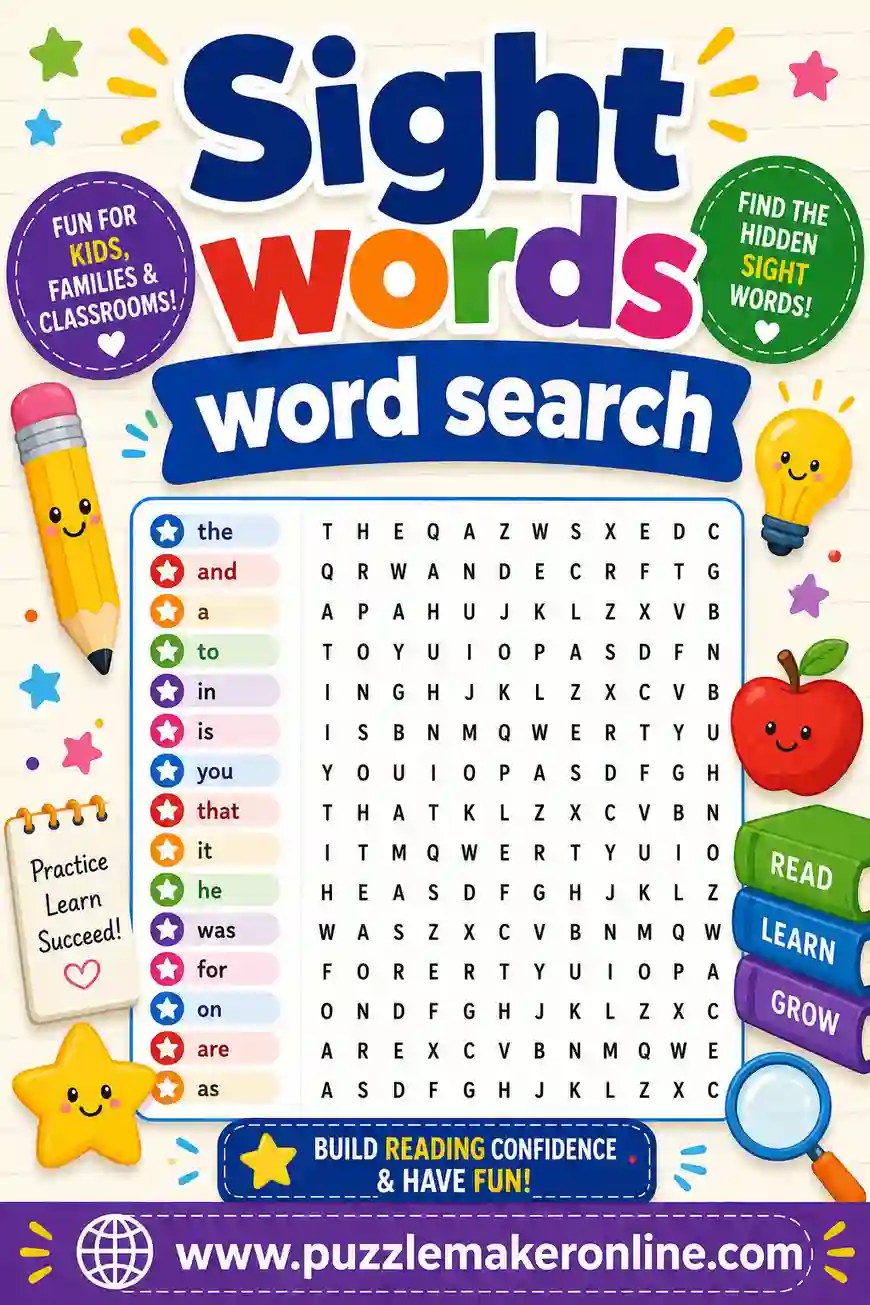
A sight words word search is a letter grid that hides common high-frequency words like the, said, and because for early readers to find. It's a gentle, fun way to build instant word recognition, and the quickest way to make one is a free puzzle maker that turns your word list into a printable grid in seconds. No app, no sign-up.
Short on time? Open the free puzzle maker, paste in a sight word list (there's a grade-by-grade one below), and print a class set in minutes. Pick a grid size, turn off diagonals for the littlest learners, and you're set.
What Are Sight Words?
Sight words are the words that show up constantly in early reading and don't always follow tidy spelling rules. Think the, was, one, they. You can't always sound them out, so kids need to recognize them on sight, fast, without stopping to decode.
The two most common lists are the Dolch list (220 words plus 95 nouns) and the Fry list (the first 1,000 most frequent words). Most schools work through these in grade-level chunks. A word search is a friendly way to give kids one more look at the words they're learning that week.
The goal isn't speed at finding them in a grid. It's repeated, low-pressure exposure to the word's exact shape and letters, which is what builds that instant-recognition reflex.
Why a Word Search Helps Early Readers
Flashcards work, but they can feel like a quiz. A word search feels like a game, and that difference matters a lot for a five-year-old.
- It's playful, not testy. Kids hunt for words like they're searching for treasure. No pressure, no red marks.
- It builds letter-by-letter attention. To find friend, a child has to scan f-r-i-e-n-d in order. That careful look cements the spelling.
- It's self-checking. The word is in the grid or it isn't. Kids know when they've found it without asking you.
- It buys you quiet time. Hand one out and you've got five focused minutes to work with a reading group.
It also pairs perfectly with the words you're already teaching. Build the puzzle from this week's list and you've turned your lesson plan into an activity for free.
Free Sight Word Lists by Grade (Copy & Paste)
Here are 30 common sight words split by level, drawn from the Dolch and Fry lists. Copy a column straight into the puzzle maker. Keep the youngest puzzles short — 6 to 10 words is plenty for a kindergartner.
| Pre-K & Kindergarten | First Grade | Second Grade |
|---|---|---|
| the | said | because |
| and | here | would |
| see | with | their |
| go | have | people |
| me | this | could |
| we | what | through |
| it | from | always |
| can | were | should |
| like | when | every |
| up | them | another |
For a kindergarten grid, pull just the first column. For a mixed-grade classroom, take a few from each so faster readers still get a challenge.
Word families to build around
You can also theme a puzzle around a spelling pattern instead of a grade:
- -at family. cat, hat, bat, sat, mat, rat, fat, pat.
- -an family. can, man, ran, fan, pan, van, tan, plan.
- -ig family. big, pig, dig, wig, fig, jig, twig, sprig.
- -op family. top, hop, mop, pop, cop, stop, drop, shop.
Word-family puzzles do double duty: kids practice sight reading and phonics in the same sitting.
How to Make a Sight Words Word Search in 4 Steps
No design skill needed. Start to finish, this takes about five minutes.
- Pick a short word list. Grab this week's sight words — 6 to 12 is the sweet spot for early readers. Copy a column from above.
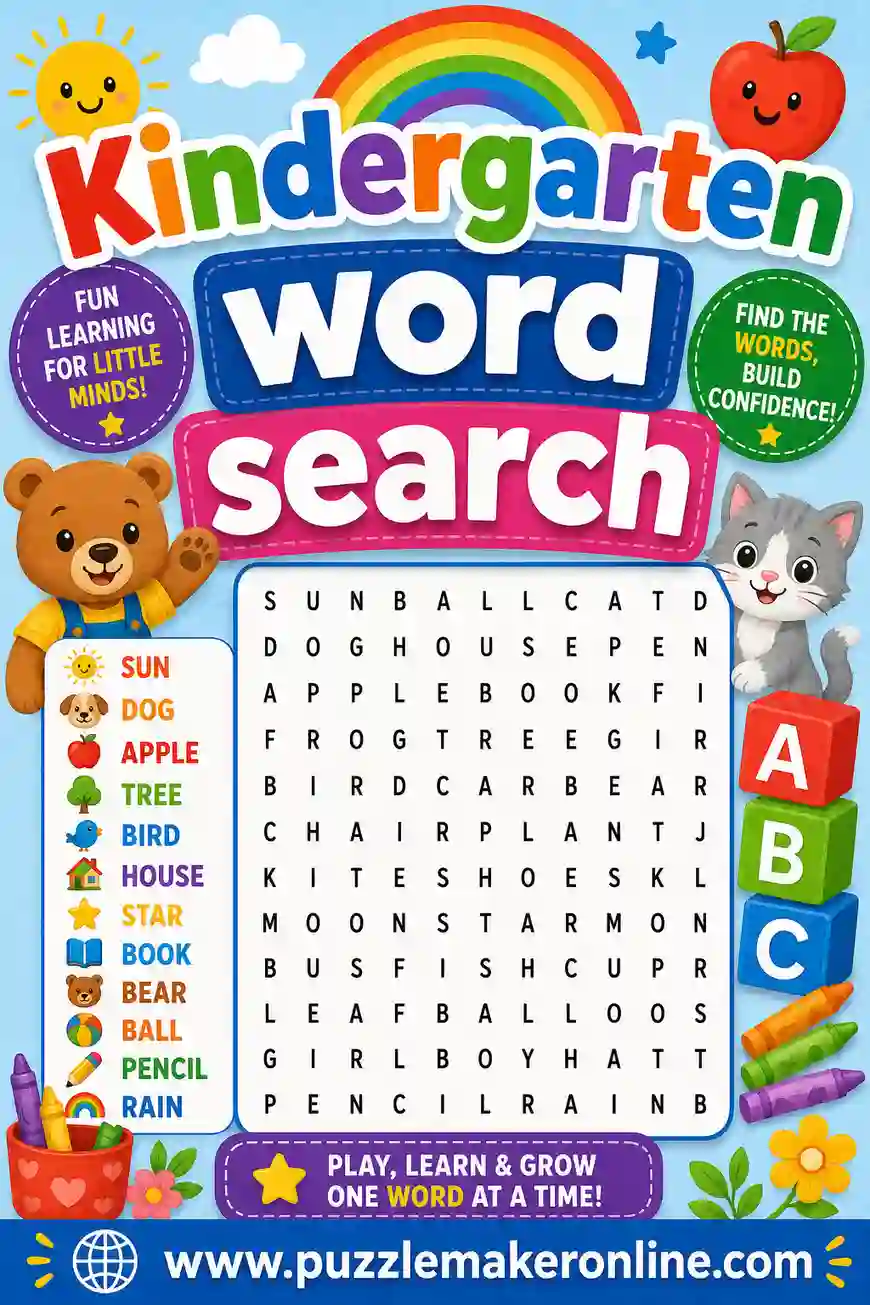
- Set an easy difficulty. Choose a small grid (10×10), turn off diagonals and backward words for the youngest kids.
- Add your words. Paste them into the generator. It places each word and fills the rest with random letters.
- Print. Run a test page to check the letters are big and clear, then print your set.
Want the kids to self-check? Print the answer key too. For tiny learners, you can even highlight the first letter of each word as a hint.
Match the Puzzle to the Age
The same list can be just right or way too hard depending on the settings. Use this to match the puzzle to your readers.
| Age / grade | Grid size | Directions | Word count |
|---|---|---|---|
| Pre-K (3–4) | 8×8 | Across only | 5–6 |
| Kindergarten (5) | 10×10 | Across & down | 6–8 |
| First grade (6) | 12×12 | Add backward | 8–12 |
| Second grade (7) | 13×13 | Add diagonals | 10–15 |
A good test: if a child can find every word in under a minute and isn't building any focus, bump the grid up one size or add a direction.
Classroom and Home Ideas
Once your readers know the format, you can do more with it than a plain hunt.
Word of the week
Build a puzzle around a single tricky word repeated with this week's other words. Seeing because five times in one grid drills it harder than a single flashcard pass.
Highlight-and-write
After a child finds each word, have them write it once on the line below the puzzle. Find it, then spell it. That two-step combo sticks better than finding alone.
Reading-group rotation
Keep a folder of leveled puzzles. While you work with one group, the others rotate through a word search at their own level. Quiet, productive, and zero extra prep once the folder's built.
Mix with a scramble or crossword
The same sight word list works in three formats. Run a word search, then a word scramble, then a simple crossword across the week. Three different ways to meet the same words.
Printing Tips for Early Readers
Little eyes need big, clear letters. A few choices make all the difference.
- Go large. Use a bigger grid cell and a clear, simple font. Tiny letters frustrate beginning readers fast.
- Print in black and white. Sight word puzzles read perfectly without color, and it saves ink for a full class set.
- Keep it short. A crowded grid overwhelms young kids. Fewer words with room to breathe beats a packed page.
- Run a test page. Check the letters are crisp and the grid isn't cut off before you print thirty copies.
- Print on the lighter side. A faint grid with bold letters is easier on the eyes than dense, dark print.
Common Mistakes to Avoid
A few easy missteps can turn a fun activity into a meltdown.
- Too many words for the age. A kindergartner doesn't need 20 words. Six to eight is plenty. Save the long lists for older readers.
- Diagonals too early. Diagonal words are hard for new readers to track. Add them only when kids are confident with across and down.
- Letters too small. If the grid is cramped, kids can't scan it. Bigger cells, fewer words.
- Skipping the answer key. Print it. You'll want it the moment a child insists a word is missing.
Building a Sight Word Routine That Sticks
A word search is a fun touch, but instant word recognition comes from seeing the same words again and again across different activities. Here's how the puzzle fits into a routine that actually builds reading.
Say it, find it, say it again
Before the hunt, read the word list aloud together and have the kids repeat each word. Because. Now when a child finds because in the grid, they've already heard it and said it once. Have them say it again as they circle it. Three quick exposures in one minute, and none of it feels like drilling.
Recycle words week to week
Sight words don't stick after one pass. Build this week's puzzle from the new words plus a few from previous weeks. Seeing said and where again two weeks later is exactly the spaced review that turns "I think I know it" into instant recognition. Keep a running list and sprinkle the older words back in.
Connect the puzzle to a book
After kids finish a word search built from this week's words, hand them a simple book and ask them to spot those same words on the page. Suddenly the word search isn't an isolated worksheet — it's a bridge to real reading. Kids love yelling "There's the again!" when they catch a word they just hunted.
Make it a center, not a test
The magic of a word search is that it never feels like a quiz. Keep a folder of leveled puzzles at a quiet center and let kids work them independently. No grades, no pressure — just repeated, friendly contact with the words they're learning. That low-stress repetition is what builds the recognition reflex.
Sight Words Word Search FAQ
What sight words should kindergartners learn first?
Start with the most frequent ones: the, and, see, go, me, we, it, can, like, up. The list above sorts words by grade so you can grab exactly what your readers need. Keep kindergarten puzzles to 6–8 words.
Are these sight word word searches free to print?
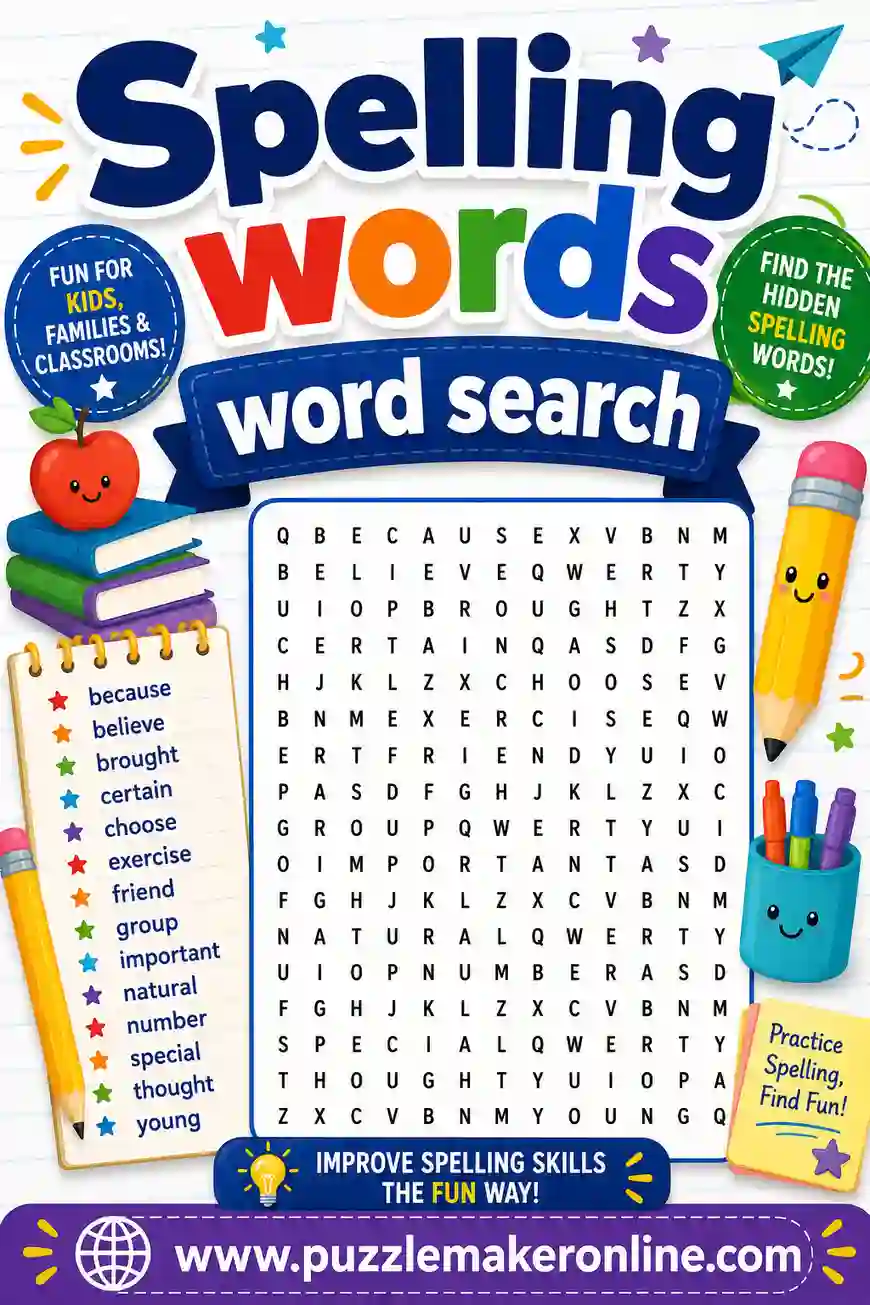
Yes. You build and print them yourself at no cost. There's no sign-up and no watermark, so you can make a fresh puzzle for every week of the year on free word lists.
How many sight words should be in one word search?
For early readers, 6 to 12 words is the sweet spot. Pre-K kids do best with 5 or 6. Older or more confident readers can handle 12 to 15. Match the count to the grid size so the puzzle stays readable.
Should a kindergarten word search have diagonal words?
No. Diagonals are hard for new readers to track. Stick to across and down for the youngest kids, and add backward or diagonal words only once they're reading confidently.
Can I make a word search from the Dolch or Fry list?
Yes. Both lists work perfectly. Pick the grade-level chunk you're teaching, copy those words into the puzzle maker, and you've got a ready activity. The word list above pulls from both.
How is a sight word search different from a spelling one?
Sight word searches focus on instant recognition of high-frequency words, many of which don't sound out neatly. Spelling word searches drill the exact letters of a weekly spelling list. The format's the same — the word list is what changes.
Ready to Build Your Sight Words Word Search?
Grab a grade-level list above, open the free puzzle maker, and you'll have a clean, printable sight words word search in minutes. It's free, there's no sign-up, and you can print an answer key for self-checking. Keep going with our kindergarten word search, spelling words word search, or French word search. Happy reading!