French Word Search: Free Printable Puzzles & Word Lists
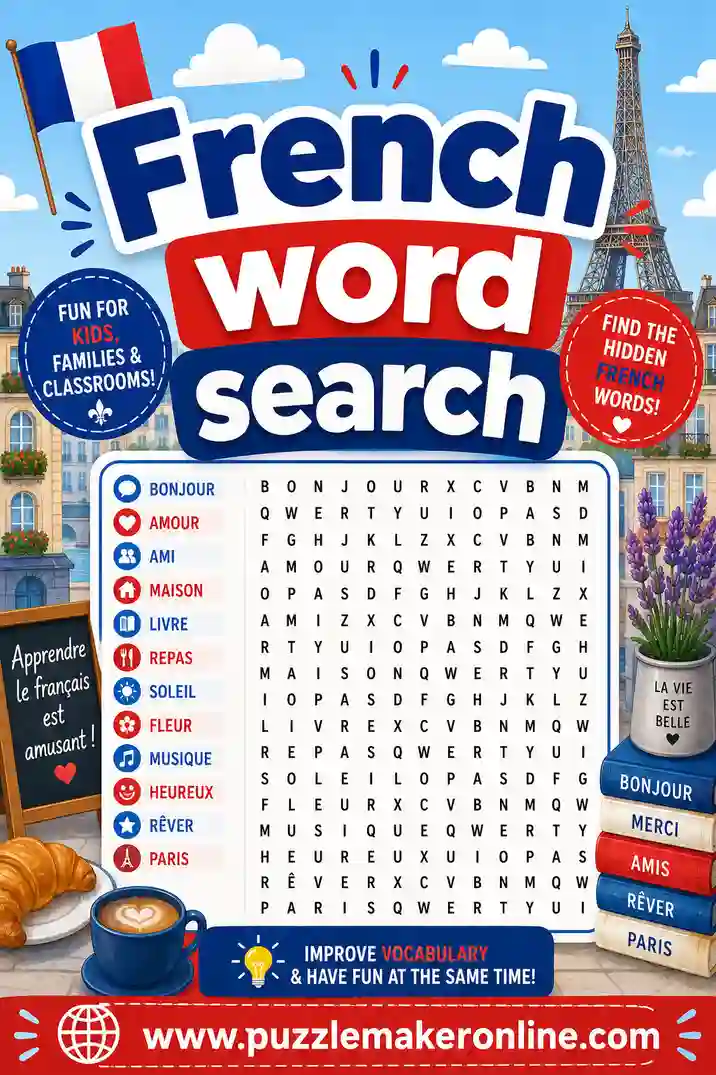
A French word search is a grid of letters hiding French vocabulary words like bonjour, fromage, and école, which students find and circle. It's a low-pressure way to drill spelling and recognition, and the fastest way to build one is a free puzzle maker that drops your word list into a printable grid in seconds. No software, no sign-up.
Want to skip ahead? Open the free puzzle maker, paste in a French word list (there's a ready-made one below), and print a class set in minutes. Pick your grid size, choose whether words can run diagonally, and you're done.
What Is a French Word Search?
It's exactly what it sounds like. You take a block of letters, hide French words inside it (across, down, backward, or diagonally), and the player hunts them down one by one. The words sit in a list to the side so learners know what they're looking for.
The trick that makes it useful for language learning is the spelling. To find anniversaire in a grid, a student has to scan for the exact sequence of letters, accents and all. That repeated visual contact helps the spelling stick far better than a quick glance at a flashcard.
You can run it two ways:
- Word-given mode. The French word sits in the answer list, and the student just finds it. Good for beginners.
- Clue mode. The list shows the English meaning ("cheese") and the student has to recall the French word (fromage) before hunting for it. Tougher, but it builds real recall.
Why Use a Word Search to Learn French
Grammar drills have their place, but they wear kids out fast. A word search feels like a break while still doing real work. Here's why teachers keep coming back to them.
- It's low-stress. There's no wrong answer that gets marked in red. Students just search, and finding a word feels like a small win.
- It reinforces spelling. Accents, silent letters, and tricky vowel pairs all get noticed when you're scanning letter by letter.
- It's self-checking. A word is either in the grid or it isn't. Students know when they've nailed it without waiting on you.
- It works for any level. Beginner couleurs or advanced subjonctif verb forms — same format, different list.
It's also a lifesaver for substitute teachers and early finishers. Print a stack, keep them in a folder, and you've always got a quiet five-minute filler ready.
Free French Word Search Word Lists (Copy & Paste)
Here are 28 common French words sorted into beginner themes. Copy a column straight into the puzzle maker, or mix across columns for a bigger grid. Accents are included — most puzzle makers keep them, and seeing the accent is part of the lesson.
| Greetings & Basics | Food (la nourriture) | Animals & Home |
|---|---|---|
| bonjour | fromage | chien |
| merci | pomme | chat |
| oui | pain | maison |
| non | lait | jardin |
| salut | eau | fleur |
| école | poulet | oiseau |
| ami | gâteau | cheval |
| famille | café | soleil |
| livre | chocolat | lune |
| jour | fraise | arbre |
If your puzzle maker strips accents, that's fine for younger beginners — just teach the accent separately. For intermediate students, keep the accents in so the spelling practice is honest.
Theme ideas to build around
- Les couleurs. rouge, bleu, vert, jaune, noir, blanc, rose, orange.
- Les nombres. un, deux, trois, quatre, cinq, six, sept, huit, neuf, dix.
- Le corps. tête, main, pied, bras, jambe, nez, bouche, yeux.
- La classe. crayon, stylo, cahier, gomme, règle, bureau, tableau, sac.
Each of these makes a tidy 8-to-12-word puzzle that fits a single sheet without crowding.
How to Make a French Word Search in 4 Steps
You don't need any design skills. The whole thing takes about five minutes.
- Pick a theme and word list. Grab 10 to 20 words from one topic so the puzzle feels focused. Copy a column from above to start.
- Choose your settings. Set the grid size (15×15 is a good default), and decide if words can run backward or diagonally. Skip diagonals for younger kids.
- Add the words. Paste your list into the generator. It places each word and fills the gaps with random letters automatically.
- Print. Hit print, run a test page to check the margins, then print your class set.
That's the whole job. If you want an answer key, most makers will print one alongside the puzzle so you can grade at a glance.
Setting the Difficulty for Your Class
The same word list can be easy or brutal depending on a few settings. Match the puzzle to your students with this table.
| Level | Grid size | Directions | Notes |
|---|---|---|---|
| Beginner (Grade 1–3) | 10×10 | Across & down only | Short, simple words. Big letters. |
| Intermediate (Grade 4–6) | 13×13 | Add backward words | Mix in accents. 12–15 words. |
| Advanced (middle school) | 15×15 | Add diagonals | Longer words, clue-mode list. |
| Challenge (high school) | 17×17 | All directions | Verb forms, abstract nouns. |
A quick rule: the more directions you allow and the bigger the grid, the longer the hunt. If your puzzle is solved in 30 seconds, bump the grid size or add diagonals.
Classroom Ideas Beyond the Basic Hunt
Once your students know the format, you can stretch it into a real lesson.
Vocabulary review before a test
Build the puzzle from the exact word list on the upcoming quiz. Students get one more pass over the spelling without feeling like they're cramming. It's review that doesn't feel like review.
Speed rounds and partner races
Hand out the same puzzle to pairs and see who finds all the words first. The competition gets even reluctant learners scanning hard. Keep prizes tiny — a sticker or first pick of the reading corner.
Themed holiday puzzles
Tie the words to Noël (sapin, cadeau, étoile) or Pâques (lapin, œuf, panier). A seasonal puzzle feels festive and sneaks the vocabulary in sideways.
Mix with a crossword or scramble
The same word list works in three formats. Run a word search on Monday, a crossword midweek, and a word scramble on Friday. Three exposures, three different kinds of thinking, one prep session.
Printing Tips for Clean, Readable Puzzles
A few small choices keep your puzzles sharp and easy to read.
- Use a clear font and a decent point size. French accents can blur at tiny sizes. Aim for letters that are easy to tell apart.
- Print in black and white. Word searches read perfectly without color, and it saves your ink for the things that need it.
- Run one test page first. Check that the grid isn't cut off and the accents printed cleanly before you run thirty copies.
- Print the answer key separately. Keep it for yourself or hand it out for self-checking. Don't staple it to the puzzle.
- Leave room in the margins. Students need space to write the words they've found or jot translations.
Common Mistakes to Avoid
A few easy slip-ups can turn a great puzzle into a frustrating one.
- Too many words in a small grid. Cramming 25 words into a 10×10 grid makes overlaps that are impossible to read. Give the grid room.
- Forgetting the accents matter. If your list has élève but the grid shows eleve, students learn the wrong spelling. Decide on accents up front and stay consistent.
- All diagonals for beginners. Diagonal words are hard for young eyes. Save them for older or more confident students.
- No answer key. You'll want one when a student swears a word isn't there. Print it every time.
Pairing Word Searches With Real French Practice
A word search is a great reinforcement tool, but it works best as one piece of a fuller routine. Here's how it fits with the rest of your French teaching.
Before the puzzle: introduce the words
Don't hand out a word search cold. Spend a few minutes first saying each word aloud, showing a picture, and having students repeat it. La pomme — an apple. Now when they hunt for pomme in the grid, they've already heard it, said it, and pictured it. The search becomes the third exposure, not the first.
During the puzzle: connect sound to spelling
As students find each word, have them whisper it to themselves. French spelling and French sound don't always line up the way English speakers expect, so saying the word while looking at its letters helps bridge that gap. The silent -ent on a verb, the eau that sounds like "oh" — these stick better when sound and spelling meet at the same moment.
After the puzzle: use the words in a sentence
Finding chien is good. Writing Le chien est noir is better. Once a student has found a handful of words, ask them to drop two or three into simple sentences. Now the vocabulary isn't floating on its own — it's wired into real French they can actually use.
Build a weekly rhythm
The same short word list can carry a whole week. Introduce the words Monday, run a word search Tuesday, a word scramble Wednesday, a quick crossword Thursday, and a tiny conversation using the words on Friday. Five light touches beat one heavy cram session, and you only prepped the vocabulary once.
French Word Search FAQ
What words should go in a beginner French word search?
Stick to concrete, high-frequency words: greetings (bonjour, merci), food (pomme, pain), animals (chien, chat), and colors. The word list above gives you 28 ready to copy. Keep beginner puzzles to 10–15 words so the grid stays readable.
Do French word searches keep the accents?
Most puzzle makers do, and that's ideal for spelling practice — the accent is part of the word. If yours strips them, that's okay for very young beginners, but teach the accent separately so students learn the correct spelling.
Are these French word searches free to print?
Yes. You build and print them yourself at no cost. There's no sign-up and no watermark, so you can run a whole class or a year of vocabulary review on free puzzles.
How do I make a French word search harder?
Use a bigger grid, allow words to run backward and diagonally, and switch to clue mode — list the English meaning so students recall the French word before they hunt. Longer vocabulary words add difficulty too.
Can I use a word search to teach French verbs?
Absolutely. Build a puzzle from conjugated forms (je suis, tu as, il va) or infinitives by theme. Word searches reinforce the exact spelling of each form, which is where a lot of learners slip.
How many words fit in one French word search?
For a standard 15×15 grid, 12 to 18 words is comfortable. Fewer for younger kids, more for a bigger grid. The puzzle maker tells you if your list is too long for the grid size you picked.
Ready to Build Your French Word Search?
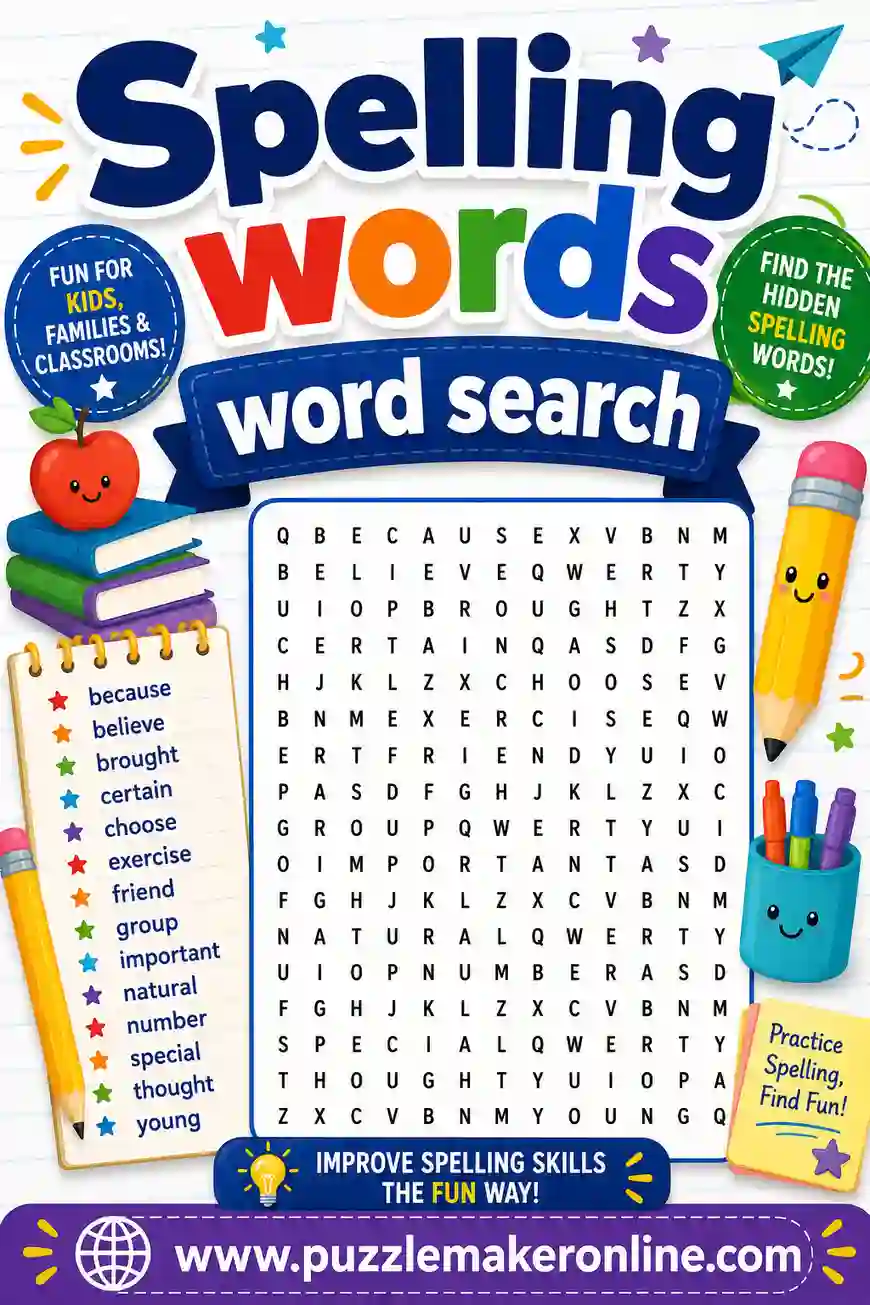
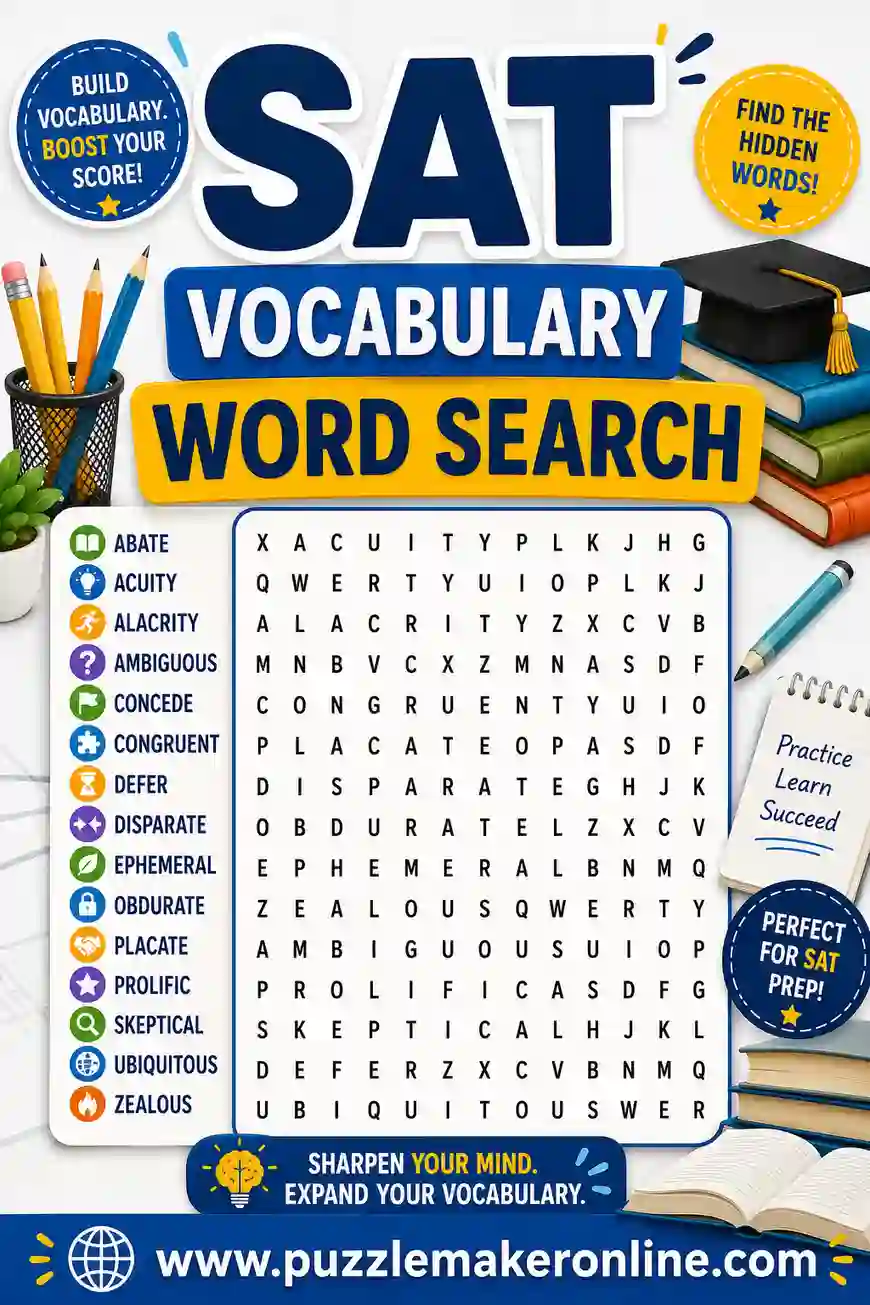
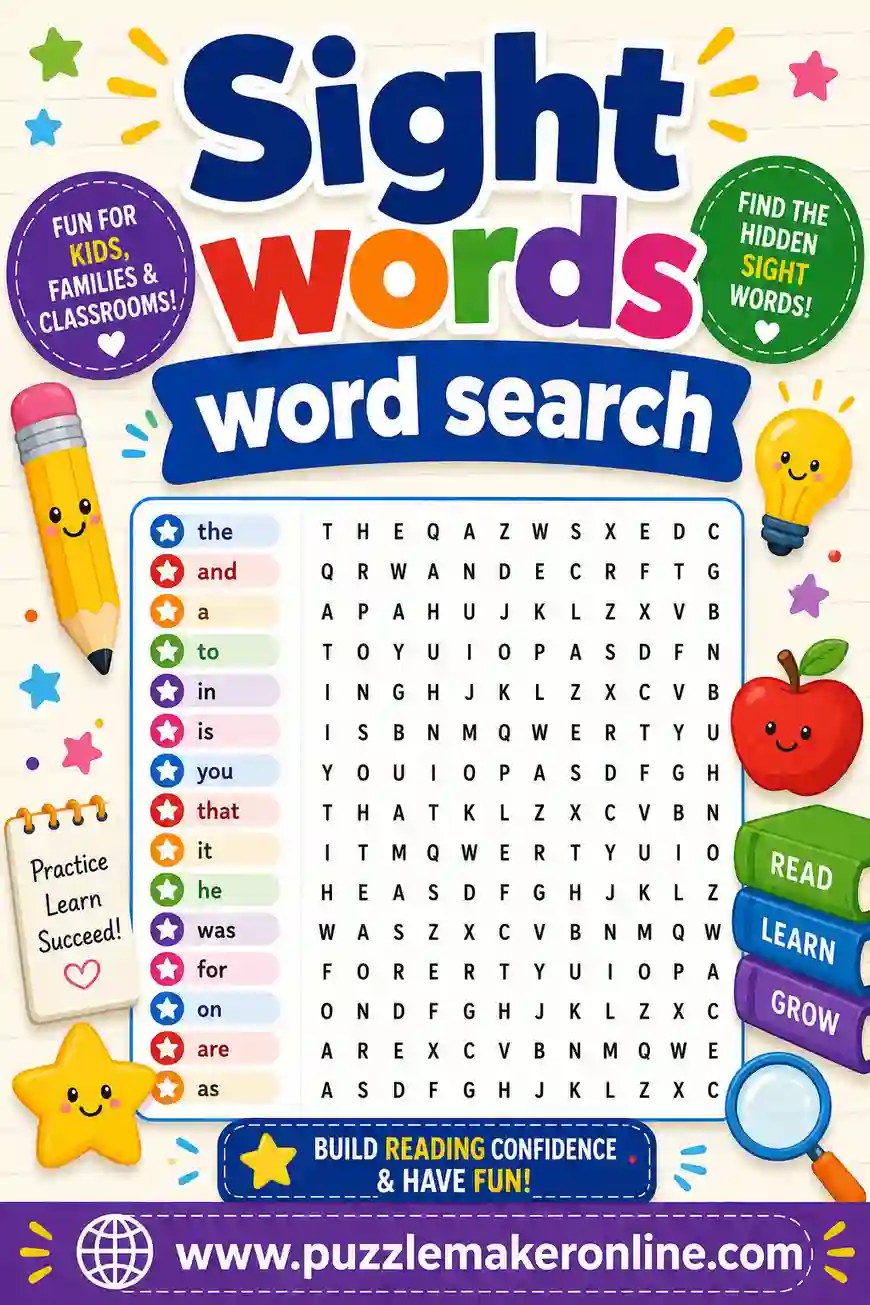
Grab a word list above, open the free puzzle maker, and you'll have a clean, printable French word search in minutes. It's free, there's no sign-up, and you can print an answer key to match. Want to keep building? Try our spelling words word search, SAT vocabulary word search, or sight words word search next. Bonne chance!