Spelling Words Word Search: Free Printable Maker
A spelling words word search turns this week's spelling list into a letter grid that students hunt through, finding each word and reinforcing its exact spelling along the way. It's one of the easiest ways to make spelling practice feel like a game, and the fastest way to build one is a free puzzle maker that drops your list into a printable grid in seconds.
In a hurry? Open the free puzzle maker, paste in your weekly spelling words, pick a grid size, and print. There's a ready-made list below if you need a starting point, plus an answer key option so grading takes a glance.
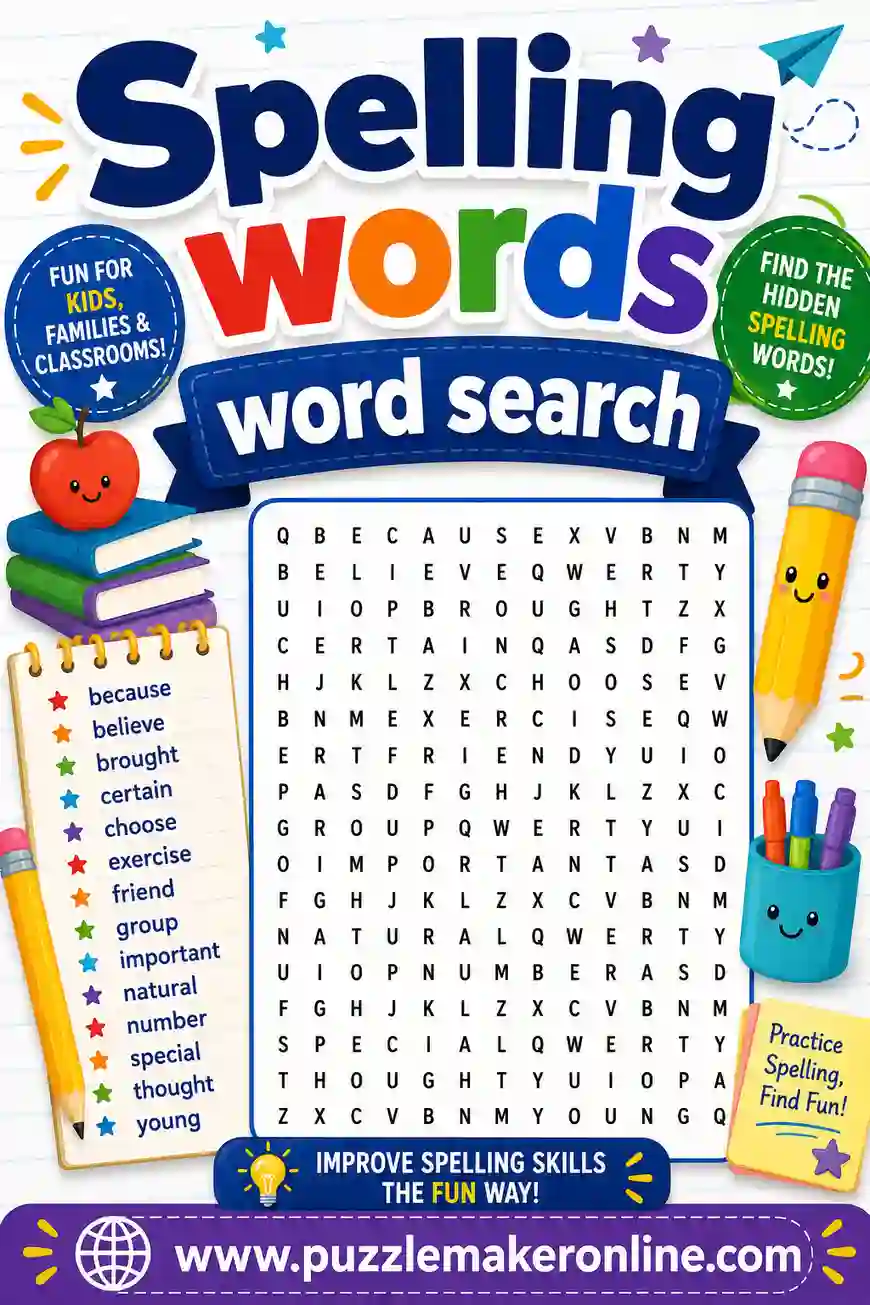
Why Use a Word Search for Spelling Practice
Copying a spelling word ten times is the classic homework, and kids tune out by line three. A word search keeps their eyes on the exact letters without the dull repetition, because finding a word in a grid means scanning it letter by letter.
That's the whole reason it works for spelling. To locate necessary in a sea of letters, a student has to hold the precise sequence — n-e-c-e-s-s-a-r-y — in their head and match it. That active search does more for spelling memory than passive copying.
A few more reasons teachers reach for them:
- It feels like a reward. Hand one out on a Friday and kids treat it as a treat, not a worksheet.
- It's instant prep. Paste the list you already have, and the puzzle builds itself.
- It scales. The same tool handles a first-grade list and an SAT-prep list. Only the words change.
How to Turn Any Spelling List Into a Word Search
You don't need to retype anything fancy. Here's the whole flow.
- Copy your weekly list. Whatever spelling words you're already teaching — 10 to 20 works best.
- Paste into the puzzle maker. Drop them into the generator word box, one per line or comma-separated.
- Set the difficulty. Pick a grid size and decide if words run backward or diagonally. More directions, harder hunt.
- Print the puzzle and key. Run a test page, then print your class set with the answer key for self-checking.
The best part: once it's set up, making next week's puzzle is a 30-second swap. Same settings, new list.
Free Spelling Word List by Grade (Copy & Paste)
Here are 30 commonly misspelled words sorted by level. Copy a column straight into the puzzle maker, or mix across them for a tougher mixed-grade puzzle.
| Early Grades (1–3) | Middle Grades (4–6) | Tricky Words (7+) |
|---|---|---|
| friend | because | necessary |
| school | beautiful | separate |
| because | weather | rhythm |
| people | through | definitely |
| there | answer | embarrass |
| white | island | conscience |
| would | favorite | privilege |
| every | February | maintenance |
| pretty | quiet | occurrence |
| family | minute | accommodate |
These are the words that trip students up the most — silent letters, doubled consonants, sneaky vowel pairs. Putting them in a word search forces a careful look at exactly where those tricky letters fall.
Spelling patterns worth a themed puzzle
Instead of a random weekly list, you can theme a puzzle around one rule:
- Silent letters. knee, wrist, comb, lamb, knife, sign, ghost, island.
- Double consonants. dinner, rabbit, happy, button, bubble, ladder, mirror, kitten.
- -tion endings. action, nation, station, fiction, motion, lotion, caption, fraction.
- i-before-e. believe, achieve, niece, field, piece, chief, brief, shield.
A pattern puzzle teaches the rule, not just the words, so it transfers to spelling words the student hasn't seen yet.
Match the Difficulty to the Grade
The same list can be a breeze or a real challenge depending on your settings. Use this to dial it in.
| Grade level | Grid size | Directions | Word count |
|---|---|---|---|
| Grades 1–2 | 10×10 | Across & down | 6–10 |
| Grades 3–4 | 13×13 | Add backward | 10–15 |
| Grades 5–6 | 15×15 | Add diagonals | 12–18 |
| Grade 7+ | 17×17 | All directions | 15–20 |
A quick gauge: if your students finish in under two minutes, the puzzle's too easy — go up a grid size or add diagonals. If they're stuck for ten, ease off a direction.
Smart Ways to Use Spelling Word Searches
A plain hunt is fine, but a few tweaks turn it into real practice.
Find-and-write
After a student finds each word, they write it once on the line below the grid. Find it, then spell it from memory. That second step is where the learning sticks.
Pre-test warm-up
Run the puzzle the day before the spelling test, built from the exact test list. It's a final pass over the spellings that doesn't feel like cramming.
Beat-the-clock
Hand out the same puzzle to the whole class and time it. The race gets even reluctant spellers scanning hard. Keep stakes low — a sticker or a homework pass.
Spelling station rotation
Keep a folder of leveled word searches. While you run a small group, the rest of the class works a puzzle at their level. It's quiet, useful, and prepped once.
Three formats, one list
The same spelling list works as a word search, a word scramble, and a crossword. Spread them across the week and your students meet each word three different ways without you prepping three times.
Printing Tips for Clean Spelling Puzzles
A few small choices keep your puzzles sharp and easy to grade.
- Print the answer key separately. Keep it for grading or hand it out for self-checking — just don't staple it to the puzzle.
- Use black and white. Spelling puzzles read perfectly without color and it saves your ink for a full class set.
- Leave writing space. Put lines under the grid so students can write each word after they find it.
- Run a test page first. Confirm the grid isn't cut off and the letters are crisp before printing thirty copies.
- Pick a clear font. Avoid fancy fonts where a c and an e blur together — clean letters help students spot exact spellings.
Common Mistakes to Avoid
A few easy slip-ups can make a good puzzle frustrating.
- List too long for the grid. Twenty long words in a small grid overlap into mush. Match the word count to the grid size in the table above.
- All directions for young kids. Backward and diagonal words overwhelm early spellers. Start with across and down.
- No find-and-write step. Finding alone is passive. Add a write-it line so students actively recall the spelling.
- Forgetting the answer key. Print it every time. You'll need it the moment a student claims a word isn't in the grid.
A Week-Long Spelling Routine With One Word List
The real power of a spelling word search shows up when it's part of a routine, not a one-off worksheet. Here's a simple week that turns a single spelling list into five different kinds of practice — all from one prep session.
Monday: meet the words
Introduce the list. Say each word aloud, point out the tricky part — the silent letter, the doubled consonant, the sneaky vowel pair — and have students write each one once. This is where the spelling actually gets taught. The puzzles later in the week reinforce it.
Tuesday: word search
Hand out a word search built from the list. As students find each word, they write it once on a line below the grid. Find it, then spell it from memory. That two-step move is far more effective than a passive hunt, because it forces recall, not just recognition.
Wednesday: word scramble
Run the same words as a word scramble. Now students have to reconstruct each word from jumbled letters, which is a harder, more active task than finding it in a grid. The letters are all there, but the order isn't — exactly the kind of thinking a spelling test demands.
Thursday: crossword
A crossword built from the list flips things again: students get a clue and have to produce the word with no letters given at all. It's the closest thing to a real spelling test, but it feels like a puzzle. By now they've met each word four different ways.
Friday: the test
By test day, students have written each word, found it, unscrambled it, and recalled it from a clue. The spellings are locked in — and you only built one word list to get there. That's the efficiency a good puzzle maker buys you.
Spelling Words Word Search FAQ
How do I turn my spelling list into a word search?
Copy your weekly words, paste them into the puzzle maker, pick a grid size and directions, and print. The generator places each word and fills the gaps with random letters automatically. Making next week's puzzle is just a list swap.
How many spelling words fit in one word search?
For a standard 15×15 grid, 12 to 18 words is comfortable. Younger grades do best with 6 to 10 in a smaller grid. Longer words need more room, so trim the count if your list is full of big words.
Are these spelling word searches free to print?
Yes. You build and print them yourself at no cost. There's no sign-up and no watermark, so you can make a fresh puzzle for every weekly spelling list, all year, for free.
How do I make a spelling word search harder?
Use a bigger grid, allow words to run backward and diagonally, and add longer or trickier words. You can also switch from a tidy theme to a mixed list so students can't predict the pattern.
Should students write the words after finding them?
Yes — it's the most effective way to use the puzzle. Add a line under the grid so each student writes every word once after locating it. Finding plus writing beats finding alone for spelling memory.
Can I make a word search for commonly misspelled words?
Definitely. The "Tricky Words" column above — necessary, separate, rhythm, embarrass — is built for exactly that. A word search forces a careful look at where the silent or doubled letters fall.
Ready to Build Your Spelling Words Word Search?
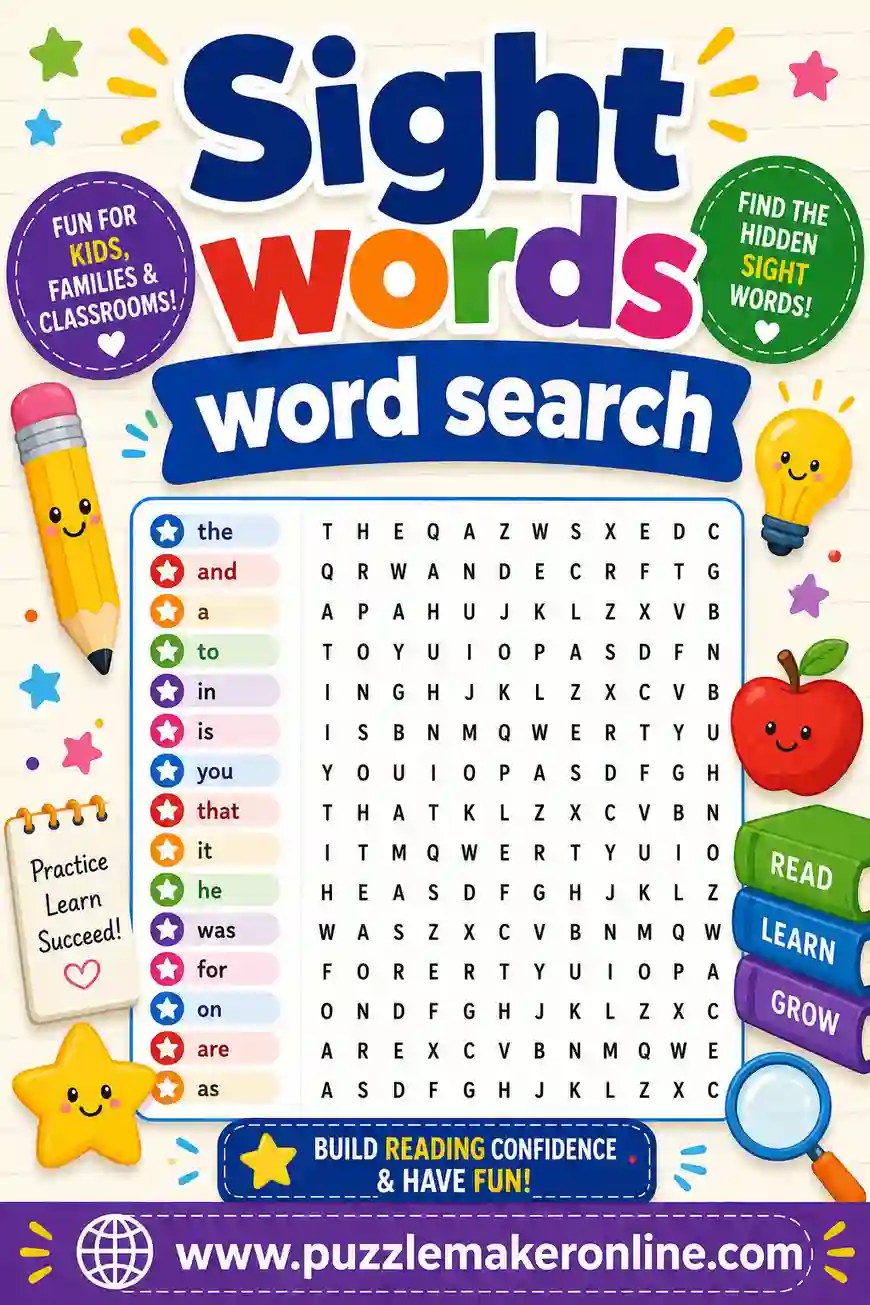
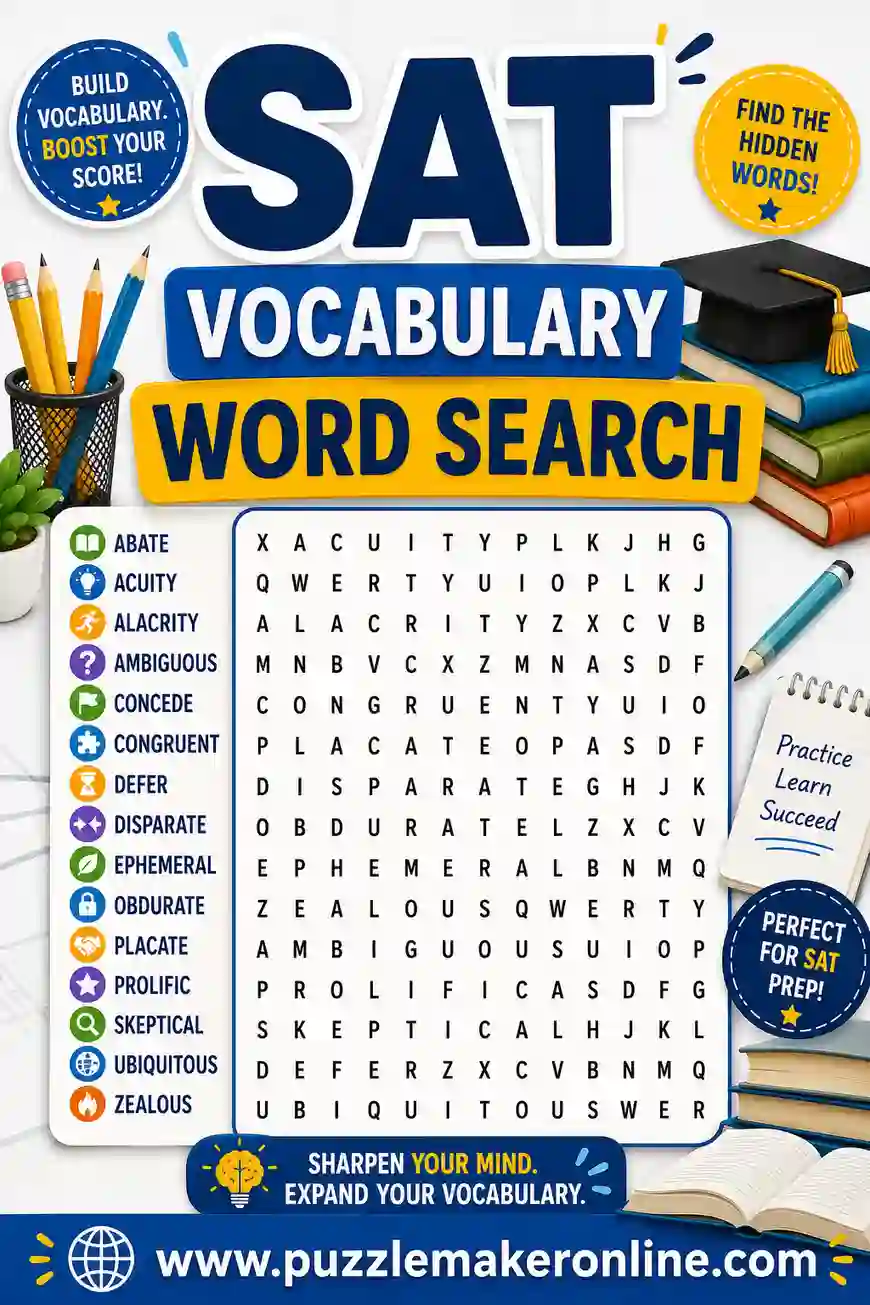
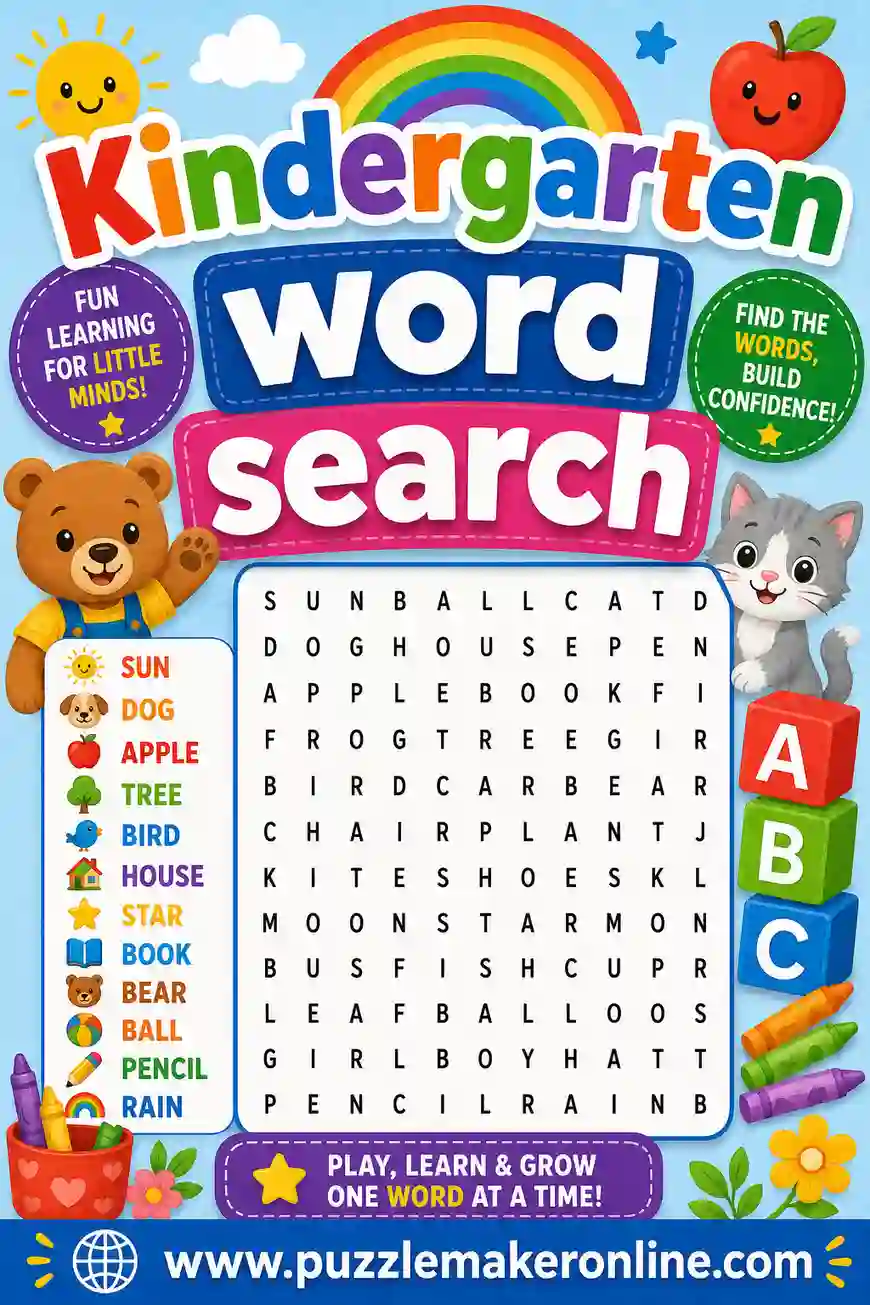
Grab your weekly list or copy one above, open the free puzzle maker, and you'll have a printable spelling word search in minutes. It's free, there's no sign-up, and you can print an answer key to match. Keep the practice going with our sight words word search, SAT vocabulary word search, or kindergarten word search. Happy spelling!