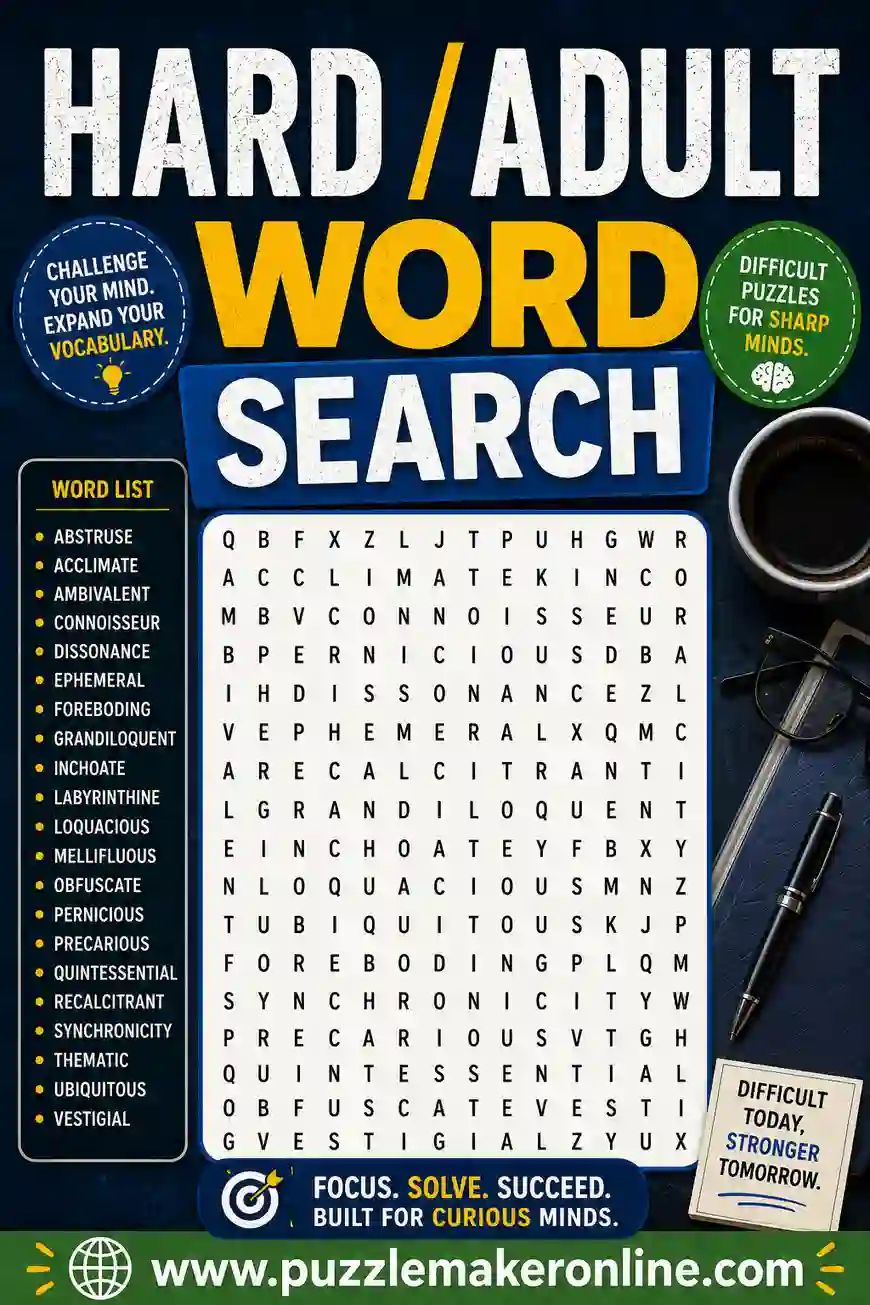
100 Hard Word Search Puzzles Printable: Build a Mega Pack Free
Updated October 13, 2026
Searching for 100 hard word search puzzles printable in one go usually means one thing: you've finished the easy stuff and you want a serious stack — enough tough puzzles to last a month, a road trip, or a whole care package. Here's the good news: you don't need to buy a book or download a sketchy PDF bundle. A free puzzle maker can generate genuinely hard word searches one after another, each with its own answer key, and you can print a full 100-puzzle pack in a single afternoon.
This guide gives you the exact hard-mode settings, 20 theme ideas (5 puzzles each gets you to 100), tough word lists to steal, and a simple system for turning loose pages into a real puzzle book.
Why Build Your Own 100-Puzzle Pack
You could hunt the internet for a hundred separate hard puzzles, but you'd spend hours dodging watermarks, sign-up walls, and grids that turn out to be easier than advertised. Generating your own pack fixes all of that.
- Every puzzle is actually hard. You control the grid size, directions, and word length, so difficulty never dips.
- No two grids repeat. The generator reshuffles letters every time, so puzzle 87 is as fresh as puzzle 1.
- You pick every theme. A hundred puzzles about things you actually care about beats a random assortment.
- Answer keys come standard. Each print includes a matching key page, so a stuck solver is never stuck forever.
- It's free. All it costs is paper and ink.
The trick is treating it like a small production run instead of a hundred one-off jobs — more on the batching system below.
The Hard-Mode Settings That Actually Matter
"Hard" isn't a vibe; it's a handful of specific settings. In the word search maker, a genuinely difficult puzzle looks like this:
| Setting | Hard-mode choice | Why it works |
|---|---|---|
| Grid size | 18×18 or 20×20 | More filler letters to scan past |
| Word count | 25–35 per puzzle | Longer hunt, more overlaps |
| Directions | All four on — horizontal, vertical, diagonal, backwards | Words hide in eight orientations |
| Difficulty preset | Hard | One click sets the tough defaults |
| Letter case | lowercase | Word shapes blur together |
| Pictures | Off | No visual hints for any word |
The two biggest levers are backwards + diagonal placement and lowercase letters. Reversed diagonal words defeat the standard left-to-right scanning habit, and lowercase letters remove the distinctive silhouettes that make words like "pizza" pop out of an uppercase grid.
The 100-Puzzle Plan: 20 Themes × 5 Puzzles
A hundred puzzles sounds like a mountain until you break it into themes. Pick 20 topics, make 5 puzzles per topic (same word list, regenerated five times for five different grids — or five fresh lists if you're ambitious), and you're done. Here are 20 themes with enough depth for hard word lists:
| Everyday but tricky | Knowledge themes | Wordplay-friendly |
|---|---|---|
| Kitchen & cooking terms | World capitals | Words with double letters |
| Jobs & professions | Famous scientists | Words ending in -OUGH |
| Tools & hardware | Rivers & mountains | Compound words |
| Fabrics & sewing | Mythology figures | Words with silent letters |
| Weather extremes | Classical composers | 12+ letter words |
| Car parts | Chemistry terms | Homophones |
| Herbs & spices | Constellations |
Five grids per theme also creates a nice difficulty rhythm for the solver: by the third puzzle on "herbs & spices," they know the words but the grid has changed completely, which tests scanning skill rather than vocabulary.
Hard Word Lists to Steal
The words themselves do half the work. Long words are ironically easier to spot (they create rare letter runs), so the hardest lists mix lengths and share letters. Three starter lists, 12 words each:
- Double trouble (shared letters): raccoon, balloon, bassoon, cocoon, monsoon, buffoon, committee, mattress, blizzard, dilemma, occurrence, millennium
- Science bite: molecule, catalyst, entropy, isotope, quasar, neuron, enzyme, tectonic, photon, genome, viscosity, alkaline
- Vocabulary flex: quixotic, zephyr, gossamer, labyrinth, ubiquitous, cacophony, ephemeral, serendipity, juxtapose, obfuscate, paradigm, anomaly
Notice the first list: when six words contain a double-O, every "oo" in the grid becomes a false lead. That's the kind of trap that makes adult solvers mutter happily. Our difficult word searches guide goes deeper on word-selection tricks.
How to Batch-Print 100 Puzzles in an Afternoon
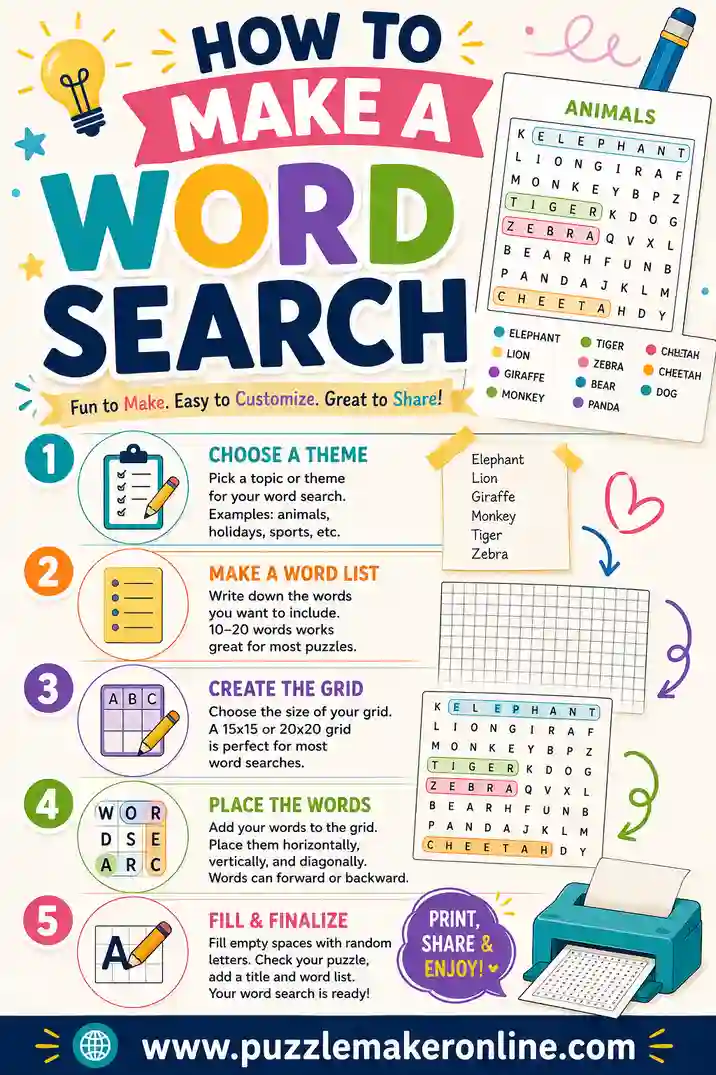
Here's the production line. Once you're warmed up, each puzzle takes about a minute.
- Prep your 20 theme lists first. Write or paste them into a note before you start. This is the slow part; do it over coffee.
- Open the puzzle maker and set your hard-mode settings once: 20×20 grid, all directions on, Hard preset, lowercase, pictures off.
- Paste list #1, title it, generate, print. Use "Save as PDF" in the print dialog instead of physical printing — you'll get a growing folder of PDFs you can print anytime.
- Hit Generate again for a fresh grid from the same list. Save. Repeat until you have 5 versions.
- Paste the next list and keep rolling. Twenty lists later, you have 100 unique hard puzzles, each with its own answer key page.
Number your PDFs as you go (01-herbs-1, 01-herbs-2…) so the answer keys stay matched to the right grids when you print the batch.
Turn the Stack Into a Real Puzzle Book
Loose pages scatter; books survive. To assemble your pack:
- Print single-sided so pencils don't shadow through onto the next puzzle.
- Group answer keys at the back. Print all puzzle pages first, then all key pages, and label each key with its puzzle number and theme.
- Add a cardstock cover with a title — "The Hundred: Hard Word Searches, Vol. 1" — and the date. It instantly feels like a gift instead of a printout.
- Bind it cheap. A heavy-duty stapler handles 25 sheets; for the full hundred, a set of binder rings or a spiral bind at a print shop does the job.
A homemade 100-puzzle book is a genuinely great gift for a grandparent, a hospital stay, deployment care packages, or anyone facing a long stretch of waiting-room time.
Pacing a 100-Puzzle Pack So It Stays Fun
A hundred hard puzzles is a marathon, and marathons need pacing. A few ways to structure the solve:
- One a day. A single 20×20 hard grid takes most solvers 20–40 minutes — a perfect daily coffee companion that lasts over three months.
- Theme weeks. Solve all five grids of one theme across a week and watch your time drop as the word list becomes familiar.
- Track solve times. Write the date and time-to-finish on each page. Watching 38 minutes become 22 is the quiet reward of a big pack.
- Leave the last ten as a challenge set. Make your final theme the nastiest — 12+ letter words, lowercase, every direction — as a finish line worth reaching.
Make Puzzles 90–100 Even Harder
For the final stretch, stack these on top of the standard hard settings:
- Hide a secret message. Type a phrase into the Secret message box and the leftover letters spell it out. Solvers must find every word and decode the message — the answer key shows the decoded phrase.
- Use near-duplicate words. Lists with rain, train, strain, restrain force exact matching instead of pattern-spotting.
- Shrink the word bank font by folding it under. Have solvers work from a separate word list page so they can't rest eyes next to the grid.
- Add a timer. Even a soft 25-minute limit changes how the puzzle feels.
If you want ready-made inspiration for tough adult grids, our hard word searches for adults guide has full word lists in this difficulty range.
Who a Hard 100-Pack Is Perfect For
- Daily solvers who burn through a puzzle-book chapter in a weekend and want volume without repeat grids.
- Seniors who find standard books too easy. Plenty of "adult" puzzle books sit at medium difficulty; this pack doesn't. (Pair hard grids with the Large print option if eyesight is a factor — difficulty and print size are separate settings.)
- Teachers of gifted classes who need early-finisher work that actually takes time.
- Gift-givers. A personalized volume — themes chosen for the recipient — beats a generic book from the checkout aisle.
- Waiting-out-a-storm households. Power's out, Wi-Fi's down, and there are 100 puzzles in the drawer.
For a broader look at grown-up grids beyond the hard end, see our word searches for adults guide.
Printing Tips for a Big Batch
- Grayscale and draft mode. A letter grid needs zero color; draft mode can cut ink use dramatically across 100+ pages.
- Test the first page. Confirm the 20×20 grid fits your margins before committing to a full run.
- Consider 24 lb paper for the book version. Slightly heavier paper turns pages better and takes pencil erasing without tearing.
- Print keys smaller if you like. Answer keys don't need to be solver-friendly size; two keys per page saves 25 sheets across the pack.
- Save the PDFs. Your 100-puzzle folder reprints forever — lose the book, not the pack.
One Super Hard 100-Word Word Search (Word List Included)
Some people searching for "100 hard word search puzzles" actually want the opposite of a big pack: one monster puzzle with 100 words to find. That's a different kind of challenge. Instead of a hundred short sessions, you get one long hunt where the grid fills up with circled words and the last ten are hiding in the only letters you haven't checked yet.
Below is a complete 100-word list, split into ten themed groups of ten. Every group is built to be tricky: lots of shared letter pairs, a few words hiding near other words, and a final group of look-alike spellings that punish quick glances.
How to Build It With the Free Maker
A hundred words is more than any single printable page can hold at a readable size, so the cleanest way to run a 100-word challenge is as four linked grids of 25 words each. Put groups 1 and 2 plus the first half of group 3 in Part 1, and keep going in order so each part gets two and a half themes. Use the hard-mode settings from the table above: the largest grid, every direction on, lowercase letters, pictures off. Print all four grids, staple them together, and treat the set as one puzzle: you're not done until all 100 words are circled.
- Open the word search maker and choose the biggest grid size.
- Turn on horizontal, vertical, diagonal, and backwards.
- Paste 25 words, title the page "100-Word Challenge — Part 1 of 4," and generate.
- Save as PDF, then repeat with the next 25 words for Parts 2, 3, and 4.
- Print the four answer keys on their own pages and keep them out of sight.
The 100 Words, Grouped by Theme
| Group | 10 words |
|---|---|
| 1. In the kitchen | colander, spatula, saucepan, whisk, ladle, skillet, grater, tongs, casserole, percolator |
| 2. In the garden | trellis, compost, seedling, wheelbarrow, hydrangea, marigold, sprinkler, birdbath, petunia, mulch |
| 3. Wild weather | blizzard, monsoon, drizzle, cyclone, humidity, barometer, sleet, thunderclap, whirlwind, overcast |
| 4. Under the sea | anemone, barnacle, plankton, narwhal, seahorse, coral, lagoon, riptide, starfish, manatee |
| 5. The orchestra | clarinet, bassoon, harmonica, xylophone, metronome, crescendo, tambourine, cello, piccolo, trombone |
| 6. Up in space | galaxy, nebula, magnet, fossil, prism, telescope, gravity, orbit, comet, asteroid |
| 7. On the road | passport, luggage, itinerary, compass, souvenir, terminal, ferry, hostel, backpack, postcard |
| 8. Game day | archery, badminton, lacrosse, decathlon, javelin, marathon, curling, fencing, bobsled, triathlon |
| 9. Unusual animals | armadillo, chinchilla, porcupine, platypus, wolverine, meerkat, axolotl, ocelot, tortoise, pelican |
| 10. Look-alike traps | stationary, stationery, desert, dessert, quiet, quite, affect, effect, breath, breathe |
Group 10 is the nasty one. "Breath" sits inside "breathe," and "quiet" and "quite" use the same five letters, so a solver who circles the first match they see will almost always circle the wrong one. Put group 10 in the last grid so it lands as the final boss.
Why These Words Are Hard
- Shared letter runs. "Monsoon," "bassoon," and "lagoon" all end in -oon, so every "oo" in the grid looks promising for a second.
- Short words. Five-letter entries like whisk, tongs, sleet, prism, and comet have no rare letters to grab onto, which makes them the slowest to find.
- Common letter mixes. Words such as "trellis," "terminal," and "stationary" are built from the most common letters in English, which also fill the rest of the grid.
- Words inside words. "Breath" fits inside "breathe," and "desert" is one letter short of "dessert." Good solvers learn to check both ends of a match before circling it.
Tips to Solve a Hard Word Search
A hard grid rewards a plan. These are the habits that separate a 40-minute solve from a 15-minute one, and they work on every puzzle in your 100-pack.
1. Hunt for the rare letters first
Scan the word list for letters that don't show up often: Q, Z, X, J, K, V, and W. In a 20×20 grid there may be only two or three Zs, so a word like "blizzard" or "zephyr" usually starts at one of them. Find every rare letter in the grid, then check the eight directions around it.
2. Look for double letters
Doubles are easy to spot because they break up the visual rhythm of a row. "Committee," "balloon," and "wheelbarrow" each have a double that jumps out once you start looking for pairs instead of whole words.
3. Scan in strips, not at random
Run a finger or the edge of a card along one row at a time, left to right, and then right to left. Then do the same for columns. Random scanning feels faster but skips whole sections of the grid, which is exactly where the last few words like to hide.
4. Search diagonals on purpose
Most people read left to right and top to bottom by habit, so diagonal and backwards words are the ones that survive longest. Once the easy finds are done, switch to diagonals only. Tilting the page 45 degrees sounds silly, but it turns a diagonal into a row your eyes already know how to read.
5. Use the first two letters, not the first one
Looking for every letter S in a grid takes forever. Looking for "S next to T" cuts the candidates down sharply. Pair the first two letters of the word you want, and only follow the paths where both appear side by side.
6. Find the short words last
Short words are the hardest to find and the easiest to find by accident. Leave them for the end, by which point many letters are already circled and the open space is smaller.
7. Cross off as you go
Mark each word on the list the moment you circle it. In a 25- or 35-word puzzle it's easy to search for a word you already found ten minutes ago.
8. Take a break when you stall
If you've stared at the same grid for five minutes without a find, step away. Fresh eyes spot in seconds what tired eyes skipped a dozen times. A big pack makes this easy: set the stuck puzzle aside and start the next one.
How Long Should Each Puzzle Take?
There's no official clock for word searches, but most people find their times settle into a pattern after the first few puzzles in a pack. Use these rough ranges as a starting point and track your own times to see how you improve:
| Puzzle type | Typical first try | After practice |
|---|---|---|
| 15×15 grid, 15 words, forward only | Short coffee break | A few minutes |
| 18×18 grid, 25 words, all directions | About half an hour | 15–20 minutes |
| 20×20 grid, 35 words, all directions, lowercase | 40 minutes or more | 20–30 minutes |
| The four-part 100-word challenge | An evening or two | A long afternoon |
Your times will vary with the word list. Themes you know well go faster because your brain recognizes the words before you finish reading them.
Using a Hard 100-Pack in the Classroom
A big stack of hard puzzles is handy for teachers, too. Older students and strong readers often finish standard worksheets early, and a tough word search on the current unit's vocabulary keeps them working on the same words the rest of the class is learning. A few ideas:
- Build a vocabulary grid per unit. Paste the unit's spelling or science words and print five versions so neighbors can't share answers.
- Keep a folder by the door. Early finishers grab the next numbered puzzle and log it on a sign-out sheet. Our puzzles for early finishers guide has more ways to run this.
- Race in pairs. Two students, one grid, two colored pencils. The student with the most words circled when time runs out wins.
- Hold the answer keys. Keep keys in your own folder and check a finished grid in seconds by laying the key beside it.
If you're building puzzles for younger grades, the hard settings above will be too much. Start with our easy word search puzzles and work up.
Frequently Asked Questions
Are these 100 hard word search puzzles really printable for free?
Yes. You generate them yourself with the free puzzle maker — no account, no watermark, no download limit. A full 100-puzzle pack costs you nothing but paper, and saving to PDF costs nothing at all.
How long does it take to make 100 puzzles?
Budget about two hours: 30–45 minutes to prepare 20 theme word lists, then about a minute per puzzle to generate and save. Reusing each list for five regenerated grids is what makes the pace possible.
What makes a word search "hard" instead of just big?
Direction settings and word choice. Turn on diagonal and backwards placement, use lowercase letters, pick 25+ words that share letters or near-duplicate spellings, and skip picture hints. A big grid with easy settings is just a long easy puzzle.
Do all 100 puzzles come with answer keys?
Yes. Every generated puzzle prints its own answer key on a separate page. Number your pages as you save them so keys stay matched to their grids.
Can I sell or share the puzzle book I make?
Puzzles you generate from your own word lists are yours to print and share freely — classrooms, church groups, care packages, all fine. If you're considering selling, keep your word lists original.
My printer is slow — any way to shrink the job?
Save everything as PDFs first, then print in batches of 20 pages, puzzle pages only, and hold the answer keys until someone needs them. Draft mode roughly doubles print speed on most home printers.
Are there backwards words in a hard word search?
Yes, and they're a big part of what makes a puzzle hard. With the backwards setting on, any word can run right to left, bottom to top, or along a reversed diagonal. Turn it on for every puzzle in a hard pack.
How long does a 100-word word search take?
Much longer than a normal puzzle. Run as four 25-word grids, most solvers need an evening or two the first time through. Track your time on each part and you'll usually see it drop on the next set.
What happens when one word is hidden inside another?
It's a classic trap. If your list has both "breath" and "breathe," the shorter word may sit inside the longer one or appear somewhere else entirely. Always check the letters just past the end of a match before you circle it.
What age is a hard word search right for?
Hard settings suit confident readers, usually older kids, teens, and adults. Younger children do better with smaller grids, fewer words, and forward-only directions, then step up as they get faster.
Can I print copies of a hard puzzle for a whole class?
Yes. Puzzles you make from your own word lists are free to print for your classroom. For a class set, print one puzzle per student and keep the answer key separate. Regenerating the grid gives you different versions of the same list.
Ready to Print Your Hundred?
Grab the theme table above, set the free word search maker to hard mode — 20×20, all directions, lowercase — and start the production line. An afternoon from now you'll have 100 hard word search puzzles, printable answer keys included, stacked and ready to bind. Want to sharpen the difficulty further first? Read our difficult word searches and hard adult word search guides, then go build the book. Happy hunting — a hundred times over.