Explorers Word Search: Printable Age of Exploration Puzzles for K-8
An explorers word search hides the names and words of famous journeys, like COMPASS, VOYAGE, MAP, SHIP and CONTINENT, plus explorers such as MAGELLAN, CABOT and SACAGAWEA. Below are three grade-band word lists (K to 2, 3 to 5 and middle school), a fact table to go with them, and links that build a free printable explorers word search with an answer key.
Try a mini explorers word search right here:
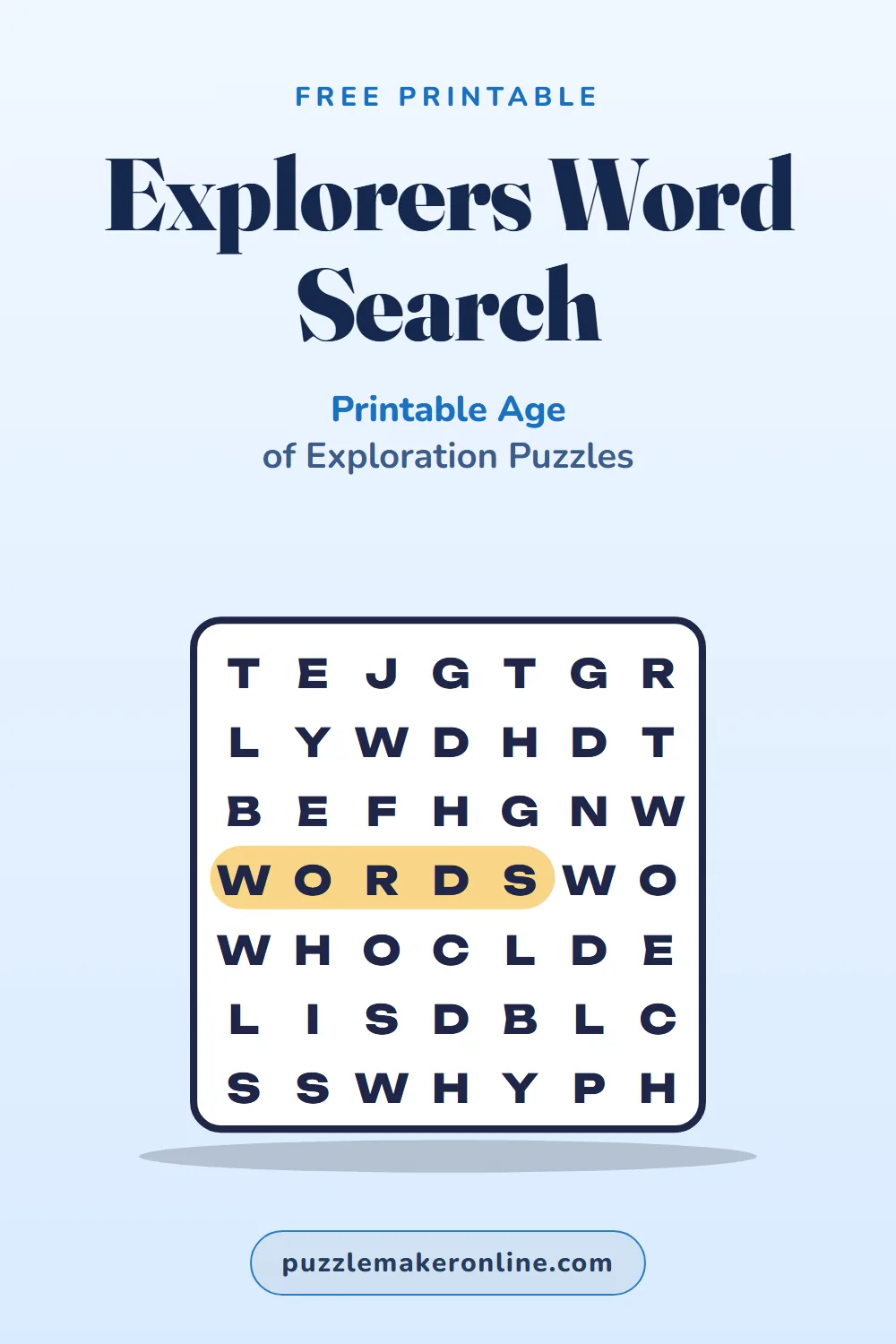
Explorers word search for K to 2nd grade
Simple exploring words, across and down only, so young kids can focus on the big idea: people traveling to see new places.
map, ship, compass, sail, ocean, globe, island, explore, journey, boat.
Make the easy explorers word search.
Explorers word search for grades 3 to 5
Explorer names that often come up in elementary social studies, plus key vocabulary.
Columbus, Magellan, Polo, Cabot, Hudson, Cartier, Champlain, Lewis, Clark, Sacagawea, Voyage, Continent, Navigator, Expedition, Route.
Make the grades 3 to 5 explorers word search.
Age of exploration word search for middle school
A harder list with explorers from around the world, navigation tools and vocabulary. Spaces and accents are dropped in the grid.
Da Gama, Ponce de Leon, Zheng He, Ibn Battuta, Erikson, Amundsen, Henson, Hillary, Norgay, Astrolabe, Caravel, Latitude, Longitude, Circumnavigate, Colony, Trade Route.
Make the middle school explorers word search (diagonals and backwards words).
Famous explorers: a quick fact sheet
Print this on the back of the puzzle so students learn who each name belongs to.
| Explorer | Known for | When |
|---|---|---|
| Leif Erikson | Norse explorer who reached North America, in what's now Canada | Around the year 1000 |
| Marco Polo | Venetian traveler whose book described his years in Asia | Late 1200s |
| Ibn Battuta | Traveled across Africa, the Middle East and Asia and wrote about it | 1300s |
| Zheng He | Led huge Chinese fleets on seven voyages across the Indian Ocean | Early 1400s |
| Christopher Columbus | Crossed the Atlantic for Spain and reached the Caribbean | 1492 |
| John Cabot | Sailed for England and reached North America's coast | 1497 |
| Vasco da Gama | First European to reach India by sailing around Africa | 1498 |
| Juan Ponce de León | Led the first known Spanish expedition to Florida | 1513 |
| Ferdinand Magellan | Led the first voyage around the world; he died on the way, and Juan Sebastián Elcano finished it | 1519 to 1522 |
| Jacques Cartier | Explored the St. Lawrence River for France | 1534 |
| Samuel de Champlain | Founded Quebec City | 1608 |
| Henry Hudson | Explored the river later named for him | 1609 |
| Lewis and Clark, with Sacagawea | Explored the American West to the Pacific | 1804 to 1806 |
| Matthew Henson | Member of Robert Peary's expedition that claimed to reach the North Pole | 1909 |
| Roald Amundsen | Led the first team to reach the South Pole | 1911 |
| Edmund Hillary and Tenzing Norgay | First confirmed climbers to reach the top of Mount Everest | 1953 |
Many places these explorers "discovered" were already home to people who had lived there for thousands of years. Voyages like Columbus's also brought great harm to Indigenous peoples, through conflict, enslavement and disease. A good class discussion can look at exploration from both sides: the courage and navigation skill, and the impact on the people already there.
Explorers vocabulary
| Word | Meaning |
|---|---|
| Expedition | A journey with a purpose, like exploring or mapping |
| Navigator | The person who plans and steers the route |
| Compass | A tool with a magnetic needle that points north |
| Astrolabe | An old tool for measuring the height of the sun or stars to find latitude |
| Caravel | A small, fast sailing ship used by Portuguese and Spanish explorers |
| Latitude | Imaginary lines measuring distance north or south of the equator |
| Longitude | Imaginary lines measuring distance east or west |
| Circumnavigate | To sail all the way around something, like the world |
| Colony | A settlement ruled by a faraway country |
| Trade route | A path traders used to carry goods between places |
Ways to use an explorers word search in class
- Unit opener. Hand it out before the lesson to preview names and words.
- Fact hunt. After finding each name, students find one fact about that explorer in the fact sheet.
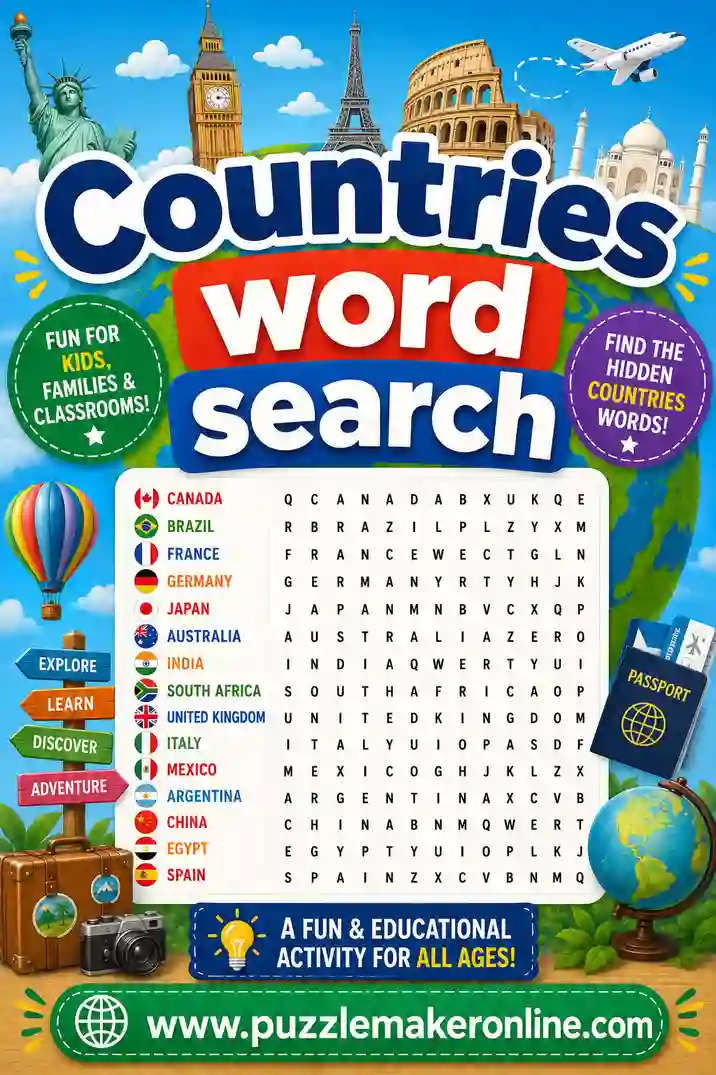
- Map link. Trace each explorer's route on a world map once they find the name. Our countries word search is a good follow-up.
- Early finishers and sub plans: it's self-checking with the answer key.
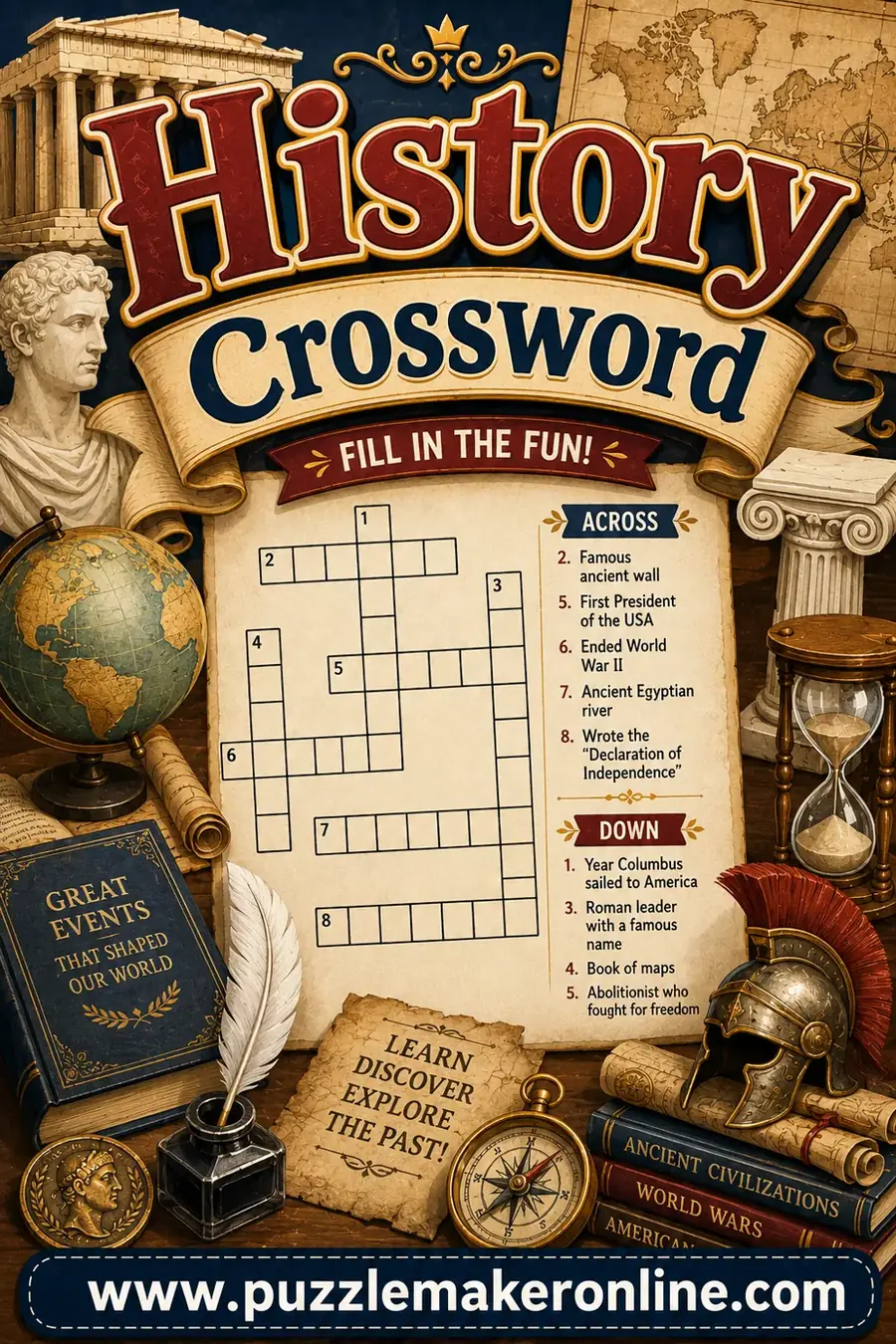
- Pair with a crossword. Our history crossword uses clues instead of a word list.
How to make your own explorers word search
- Open the free word search maker, or use the button under the mini puzzle.
- Paste the names and words your class is studying.
- Choose easy, medium or hard and a grid size.
- Generate and print the puzzle and answer key.
Teaching other history units? Our US presidents word search works the same way.
Frequently Asked Questions
What words go in an explorers word search?
Explorer names like Columbus, Magellan, Cabot, Hudson, Cartier, Champlain, Lewis, Clark and Sacagawea, plus words like compass, voyage, map, ship, continent and expedition.
What is the age of exploration?
It usually means the period from the 1400s to the 1600s when European sailors made long ocean voyages to Africa, Asia and the Americas.
Who was the first person to sail around the world?
Ferdinand Magellan led the first voyage around the world, from 1519 to 1522, but he died on the way. Juan Sebastián Elcano finished the trip.
How do I make an explorers word search for my class?
Paste the names and words your class is studying into a free word search maker, pick a difficulty and print it with the answer key.
Is there an explorers word search for kids?
Yes. The K to 2 list uses simple words like map, ship, compass, sail, ocean and globe, with large print and words going across and down.