The History of Crossword Puzzles: From Arthur Wynne's 1913 Word-Cross to Today
The history of crossword puzzles starts with a single date: December 21, 1913. That Sunday, a Liverpool-born journalist named Arthur Wynne printed a diamond-shaped "Word-Cross" puzzle in the New York World. Within about a decade, crosswords had spread to newspapers across the United States, set off a national craze in 1924, crossed to Britain, and turned into two quite different traditions: the American puzzle built on straight definitions, and the British cryptic built on wordplay.
This guide walks through that story in order. You'll see where the crossword came from, who shaped its rules, why the most famous newspaper in America refused to print one for nearly thirty years, how a crossword contest helped recruit wartime codebreakers, and how a handful of editors turned a fad into a daily habit for millions. There's a timeline table near the end if you just want the dates.
The History of Crossword Puzzles in Brief
If you only have a minute, here's the short version:
- Before 1913: Word squares and acrostics were already popular. Small puzzles that look a bit like crosswords showed up in 19th-century English children's books.
- 1913: Arthur Wynne's "Word-Cross" appears in the New York World. It's widely credited as the first modern crossword.
- Early 1920s: Other papers copy the idea. By 1924 there's a full-blown craze, helped along by the very first crossword book.
- 1922 to 1930: Crosswords reach Britain, first in a magazine and then in The Times of London.
- Mid-1920s onward: British setters invent the cryptic clue, and the two traditions split.
- 1942: The New York Times, the last big holdout, finally runs a crossword. It goes daily in 1950.
- 1978 onward: Tournaments, speed solving and, later, screens and apps make the crossword more social than ever.
Now for the longer version, which is a lot more fun.
Before 1913: Word Squares, Acrostics and Children's Puzzles
Crosswords didn't appear out of nowhere. People had been playing with letters arranged in grids for a long time before Wynne came along.
The closest ancestor is the word square. A word square is a block of letters where the same words read across and down. Here's a small one we made to show the idea:
| 1 | 2 | 3 | 4 | |
|---|---|---|---|---|
| 1 | A | R | E | A |
| 2 | R | E | A | L |
| 3 | E | A | S | E |
| 4 | A | L | E | S |
Read the rows and you get AREA, REAL, EASE, ALES. Read the columns and you get the same four words. That's a neat trick, but it's rigid: every letter has to work twice in a perfectly packed block, with no black squares to give you breathing room.
According to a history excerpt published by the American Crossword Puzzle Tournament, the first crossword-like puzzles appeared in England in the 19th century. They were simple, seem to have grown out of the word square, and showed up in children's puzzle books and magazines. In the United States, the same basic idea would later become a serious adult hobby.
The other big ancestor is the acrostic, a puzzle or poem where the first letters of lines or answers spell out a hidden word or phrase. The Library of Congress notes that word puzzles like acrostics were already popular in newspapers before the crossword format arrived. Editors knew readers liked puzzles. They just hadn't found the one that would stick.
December 21, 1913: Arthur Wynne's "Word-Cross"
Arthur Wynne was a journalist from Liverpool who had moved to the United States and was working on the New York World. In December 1913 he was putting together puzzles for the paper's Sunday "Fun" section.
The Library of Congress identifies his puzzle as "FUN's Word-Cross Puzzle," published in the World on December 21, 1913, in the Fun section on page 6. It was hand-drawn in the shape of a diamond. The ACPT history adds two details worth knowing: the grid had no internal black squares, and it came with 31 clues.
That's a big difference from a modern puzzle. Wynne's diamond was really a ring of interlocking words around a hollow middle, with every white square serving two answers. There were no black squares scattered through the grid to separate words, the way you see in a newspaper crossword today. The clues were plain definitions, the kind you'd still find in an easy puzzle now: a word for this, the opposite of that, a part of something.
Why Wynne gets the credit
You'll sometimes read that Wynne "invented" the crossword. It's more accurate to say he's usually credited with the first published crossword in its modern form. The ACPT history uses exactly that careful wording, and so does the Library of Congress, which says the earliest crossword "is attributed to" him.
The reason is simple. Puzzles with words crossing each other existed earlier, as we just saw. What Wynne did was put a large, free-standing grid with numbered clues in a mass-circulation newspaper, week after week. That's the format that spread. Being first in print, in the right paper, at the right moment, mattered more than being first with the idea.
From "Word-Cross" to "Cross-Word": The 1920s Craze
For several years the puzzle stayed mostly a World feature. Then, in the early 1920s, other newspapers picked it up. The ACPT history says that within a decade, crosswords appeared in almost all American newspapers.
The name changed along the way. Wynne called his puzzle a "Word-Cross." Readers and editors soon flipped it to "cross-word," and for years it was written as two words or with a hyphen. The Library of Congress collection shows headlines like "The Daily Cross Word Puzzle" (1925) and "Today's Cross-Word" (1925) sitting side by side with "Crossword Puzzle" (1924). The single word we use today took a while to win.
Newspapers compete with shapes, contests and prizes
Once every paper had a crossword, they needed ways to stand out. The Library of Congress collection shows some of their tricks:
- Unusual shapes. Some papers used grids shaped like circles or a big letter X, with the black squares forming patterns.
- Contests. Some ran crosswords as competitions, with prizes for readers who solved quickly and correctly. One 1925 Omaha headline offered free theater tickets.
- Different levels. Small puzzles went in the children's pages, while adult puzzles pulled clues from current news.
The first crossword book
The craze got its biggest push from a book. In 1924, the young publishing partners Simon and Schuster put out a collection of puzzles from the World. It was edited by Margaret Petherbridge (later Margaret Farrar), F. Gregory Hartswick and Prosper Buranelli.
The publishers weren't sure it would work. According to the Women in World History entry on Margaret Farrar, Simon and Schuster were so doubtful that they issued it under another imprint. It went on to sell nearly 400,000 copies in its first year, and puzzle books became a cornerstone of the young company. (Different accounts give different sales figures, so treat any exact number with some caution.)
Critics call it a passing madness
Not everyone was charmed. Marketplace recounts how The New York Times treated the craze in the 1920s. On November 7, 1924, the paper ran an editorial titled "A Familiar Form of Madness," comparing crossword solvers to the people who'd recently overspent on mahjong sets. By March 1925 the paper said the craze was "dying out fast." In 1929 it declared that the crossword had "gone the way of all fads."
The Times was wrong, of course. But it would take the paper another thirteen years to admit it.
Margaret Farrar and the Rules of the American Crossword
If Arthur Wynne gave the crossword its start, Margaret Farrar gave it its shape. She's probably the single most important person in crossword history, and many casual solvers have never heard her name.
Born Margaret Petherbridge in Brooklyn in 1897, she graduated from Smith College in 1919 and went to work at the World, where she ended up in charge of the weekly crossword. The Women in World History entry credits her with several changes that made puzzles feel modern:
- A cleaner numbering system, so solvers could match clues to squares easily.
- Livelier clues, including ones tied to current events, instead of dry dictionary definitions.
- Theme puzzles, where several long answers share a single idea.
She went on to edit more than 130 puzzle collections. Many of the conventions American solvers take for granted, like neat symmetrical grids and the idea that a puzzle should be fair and fun rather than a vocabulary test, grew out of the editing culture she led. The ACPT history notes that Wynne's early grids had no internal black squares; it was editors in the generation after him who settled on the look we know today.
The New York Times Holds Out, Then Joins In
By the late 1930s, nearly every big American newspaper had a crossword. The Women in World History entry describes The New York Times as the only major American paper that had resisted the craze. Marketplace says that by 1941 it was the last major metropolitan daily in the country without one.
What changed the paper's mind
World War II did. Japan attacked Pearl Harbor on December 7, 1941. Eleven days later, on December 18, the paper's Sunday editor, Lester Markel, sent a memo to publisher Arthur Hays Sulzberger saying, in effect, that it was time to go ahead with a puzzle. Marketplace reports that Markel pointed to the long nights ahead, including possible blackouts, and that Margaret Farrar's note was attached. Her point was simple: you can't think about your troubles while you're solving a crossword.
The first Times puzzle
The paper hired Farrar as its crossword editor. On Sunday, February 15, 1942, it published its first crossword. Marketplace gives the details: the puzzle was by Charles Erlenkotter, it was called "Headlines and Footnotes," and it sat on a big 23-by-23 grid. The Sunday size later settled at 21 by 21, which is still the standard.
The daily puzzle came later. The Women in World History entry says the Times introduced a daily crossword under Farrar's editorship in 1950. From then on, the Times crossword became the puzzle many Americans measured themselves against. If you want to try the big weekend format yourself, our guide to Sunday crossword puzzles explains how they differ from weekday grids.
Britain Goes Cryptic: Torquemada, Ximenes and The Times
While America was busy with its craze, the crossword crossed the Atlantic. The ACPT history dates the first British crossword to Pearson's Magazine in February 1922. The Times of London ran its first crossword on February 1, 1930, a date confirmed by both the ACPT history and Marketplace.
British puzzles soon went their own way. American clues mostly asked for a synonym or a fact. British setters started hiding the answer inside a little riddle, mixing a definition with wordplay such as anagrams, hidden words and sound-alikes. That's the cryptic clue, and a puzzle made entirely of them is a cryptic crossword.
The first fully cryptic puzzle
Guinness World Records credits the first crossword made entirely of cryptic clues to Edward Powys Mathers, who set puzzles under the pen name Torquemada. It appeared in 1925 in The Saturday Westminster Gazette. Earlier puzzles had included some cryptic elements, but Mathers used nothing else, which is why he's usually called the inventor of the cryptic crossword.
Pen names and fair play
British setters often worked under pseudonyms, and some had a dark sense of humor about it. Simon Horobin, a professor of English at Oxford, points out on the OUPblog that both Torquemada and Ximenes took their names from Spanish inquisitors. That tells you something about how solvers felt about their puzzles.
Cryptics could easily become unfair, so setters and editors worked out rules. The ACPT history says A. F. Ritchie and D. S. Macnutt laid down the rules that are generally treated as governing cryptic puzzles. The core idea is that every clue must contain a real definition and honest wordplay that leads to the same answer, so a solver can be sure once they've cracked it. Our separate guide to solving cryptic crosswords walks through every clue type with examples.
Crosswords at War: The Telegraph Contest and Bletchley Park
The most famous crossword story from World War II happened in Britain. The facts are a bit more modest than the legend, but they're still remarkable.
By the end of 1941, the codebreaking center at Bletchley Park needed more people. Writing in Finest Hour, the journal of the International Churchill Society, Michael Smith tells the story in "How The Telegraph Put One Across Hitler." After the Daily Telegraph published its 5,000th crossword, the paper held a contest in which readers tried to finish a puzzle in under 12 minutes.
Here's how it went, according to Smith's account:
- One contestant finished in just over six minutes but was disqualified for misspelling a word.
- The fastest qualifier, F. H. W. Hawes, finished in 7 minutes 58 seconds.
- A handful of others also beat the 12-minute mark.
- A clerk named Stanley Sedgewick was one word short when time ran out.
Even so, Sedgewick was later invited to an interview by military intelligence, trained as a codebreaker, and joined a section working on German weather codes. Horobin's OUPblog piece also notes that successful competitors were approached by the War Office and went on to work at Bletchley Park.
Why would a crossword be a good test for a codebreaker? Both jobs reward the same habits: spotting patterns in letters, holding several possible readings in mind, and refusing to accept the obvious meaning too quickly. A cryptic clue is, in a small way, a coded message: the surface sentence is meant to mislead, and the real instructions are hidden underneath. Practicing on those every morning is not a bad warm-up for reading enemy signals.
The Editors Who Shaped the Modern Puzzle
In America, the Times crossword became so influential that its editors effectively set the national style. Dictionary.com's history of the NYT crossword lists four editors in its first several decades: Margaret Farrar, Will Weng, Eugene Maleska and Will Shortz.
Margaret Farrar (1942 to the late 1960s)
Farrar ran the puzzle from its first issue. Sources give her retirement as 1968 or 1969. She built the house style: fair clues, clean grids and the growing use of themes.
Will Weng
Weng followed Farrar and held the job until the late 1970s. His era is less written about, but he kept the puzzle running as the daily habit Farrar had built.
Eugene Maleska (1977 to 1993)
Maleska was a former Latin and English teacher and school administrator. A 1993 obituary reprinted by The Seattle Times says he edited the Times crossword from 1977 and wrote more than 7,000 puzzles for the daily paper and the Sunday magazine. He'd built his first puzzle as a college student in 1933, freelanced for the New York Herald Tribune from 1940, and had his work published in the Times from 1943.
His puzzles leaned literary and classical, with opera characters, literature and puns. Fans loved the learning. Critics found some of the vocabulary stuffy, and his era is often linked with the obscure short words solvers call "crosswordese."
Will Shortz (1993 onward)
Will Shortz took over in 1993, according to Dictionary.com's history. He's famous for holding a self-designed degree in "enigmatology," which simply means the study of puzzles. He'd also been running a national crossword tournament since 1978, which we'll get to in a moment, so he arrived at the Times already knowing what thousands of keen solvers liked and disliked.
Shortz is known for pushing the puzzle toward fresh, everyday language: brand names, phrases people actually say, pop culture and playful themes. Under his editorship the weekday puzzles are known for climbing in difficulty, from a gentle Monday to a tough Saturday. If you want to work up that ladder, our guides to easy crosswords and hard crossword puzzles are good places to start.
Tournaments, Speed Solving and the Digital Era
For most of the 20th century, crosswords were a private pleasure: you, a pencil and the Sunday paper. That started to change in 1978.
The American Crossword Puzzle Tournament
The ACPT's own history page describes it as the first major American crossword tournament since the 1930s, directed by Will Shortz from the start. It began at the Stamford Marriott in Connecticut. Early scoring gave points for correct letters, which meant a lot of hand grading. From 1979, points went to correct words plus a bonus for finishing early, and by 2009 judges marked papers that were scanned for automatic scoring.
The event has grown a lot. The history page lists 803 solo solvers and 112 pairs competing in person in 2026, plus several hundred more online. It also records the champions with the most wins: Dan Feyer with nine titles, Tyler Hinman and Jon Delfin with seven each, and Doug Hoylman with six.
Screens, apps and the daily streak
Today, many people solve on a phone or computer. That's changed the hobby in a few ways. You can see your time, keep a streak going and compare notes with friends right after you finish. Constructors can use word databases and software to check their grids. And smaller formats, like 5-by-5 "mini" puzzles, have become a quick daily habit for people who don't have time for a full grid.
Paper hasn't gone away, though. Lots of solvers still prefer pencil on paper, and printable puzzles are popular in classrooms, waiting rooms and at kitchen tables. For a steady supply at your own pace, see our daily crossword puzzles page.
How the Crossword Grid Changed Over a Century
It's easy to think of "the crossword" as one fixed thing. In fact, the grid itself has changed a lot since 1913, and each change made the puzzle a little easier to enjoy.
From a diamond to a checkerboard
Wynne's first puzzle was a diamond with no black squares inside it. That shape is hard to build, because every letter has to fit two words with nothing to separate them. Once editors started placing black squares inside the grid, constructors gained room to maneuver. A black square ends one word and lets another begin, so you're no longer forced into a perfectly packed block like the word square earlier in this article.
Bigger and then standard
Early grids came in all sorts of sizes and shapes, as the Library of Congress examples of circles and X patterns show. Over time, papers settled on a few standard sizes. The first Times puzzle in 1942 was 23 by 23 squares, but the Sunday grid later settled at 21 by 21. A standard size means solvers know roughly how long a puzzle will take, and editors can lay out the page the same way every week.
Clean numbering and fair clues
Farrar's tidier numbering system sounds like a small thing, but it matters. When numbers run in a simple order, left to right and top to bottom, you can jump straight from a clue to its square without hunting. Fair, lively clues mattered just as much. A clue that could have three equally good answers isn't a puzzle; it's a coin toss.
Themes, then themeless puzzles
Theme puzzles, where several long answers share a joke or idea, gave each grid a personality and a little "aha" of its own. Much later, many papers added "themeless" puzzles too, usually late in the week, where the fun comes from long, lively answers and tricky clues rather than a shared gimmick.
One idea, many formats
Here's what's striking: none of these changes broke the original idea. A modern grid, a 5-by-5 mini and a British cryptic all still do exactly what Wynne's diamond did. They cross words so that each answer helps you find the next. Every innovation since 1913 has been a new way to make that one simple pleasure easier, fairer or more surprising. For a feel of how grids vary in difficulty today, try our crossword puzzles for adults.
Crossword History Timeline: Key Dates at a Glance
Here are the main dates from this article in one place, with where each one comes from.
| Year | Event | Source |
|---|---|---|
| 1800s | Simple crossword-like puzzles, related to the word square, appear in English children's books and magazines | ACPT history excerpt |
| 1913 | Arthur Wynne's "FUN's Word-Cross Puzzle" runs in the New York World on December 21 | Library of Congress |
| 1922 | First British crossword, in Pearson's Magazine (February) | ACPT history excerpt |
| 1924 | First crossword book, edited by Petherbridge, Hartswick and Buranelli; the craze peaks | Women in World History |
| 1924 | The New York Times calls crosswords "A Familiar Form of Madness" (November 7) | Marketplace |
| 1925 | Torquemada's all-cryptic crossword in The Saturday Westminster Gazette | Guinness World Records |
| 1930 | The Times of London's first crossword (February 1) | ACPT history excerpt; Marketplace |
| 1941 | Lester Markel's memo urging a Times puzzle (December 18) | Marketplace |
| 1942 | First New York Times crossword (February 15), edited by Margaret Farrar | Marketplace |
| 1950 | The New York Times crossword goes daily | Women in World History |
| 1977 | Eugene Maleska becomes Times crossword editor | Seattle Times obituary |
| 1978 | First American Crossword Puzzle Tournament | ACPT |
| 1993 | Will Shortz becomes Times puzzle editor | Dictionary.com |
American and British Crosswords: How the Two Traditions Differ
The split that started in the 1920s is still with us. If you've ever picked up a British newspaper puzzle and felt lost, this is why. The table below sums up the main differences.
| Feature | American-style crossword | British cryptic crossword |
|---|---|---|
| Clues | Mostly straight definitions, trivia and fill-in-the-blanks | A definition plus wordplay, hidden in a sentence that reads like something else |
| Grid | Every letter is checked: each white square belongs to an Across and a Down answer | Many letters are "unchecked," appearing in only one answer |
| Black squares | Fewer; dense, interlocking grids | More; grids often look like a lattice |
| Answer length shown? | No, you count the squares | Yes, a number in parentheses after each clue |
| Themes | Common; several long answers share a joke or idea | Less common in daily puzzles |
| Key early figures | Arthur Wynne, Margaret Farrar | Torquemada (Edward Powys Mathers), A. F. Ritchie, D. S. Macnutt |
Neither style is "better." They're simply two games that grew from the same 1913 seed. Lots of people enjoy both, and American publications such as The Nation have run cryptic puzzles for years.
Common Myths and Mix-Ups About Crossword History
Crossword history attracts tall tales. Here are a few things that often get garbled.
"Arthur Wynne invented word puzzles with crossing words"
Not quite. Word squares and simple crossing-word puzzles came earlier. Wynne is credited with the first modern crossword in a newspaper, and that's the claim the Library of Congress and the ACPT both make.
"The first crossword looked just like today's"
It didn't. Wynne's puzzle was a diamond with no internal black squares, as the ACPT history points out. The checkerboard of black squares, the strict symmetry and the standard square sizes came later.
"The New York Times was the first paper to run a crossword"
You'll see this claim online, but it's backward. The Times was famously the last major American paper to add one, in 1942, after mocking the craze in the 1920s.
"Bletchley Park hired everyone who finished the Telegraph puzzle"
The real story, as told in Finest Hour, is narrower. A small group finished in under 12 minutes, and some contestants, including one who didn't quite finish, were later approached and recruited. The contest was one route into codebreaking, not a mass hiring event.
"Crosswords were a fad that came back"
The Times predicted in 1925 and again in 1929 that the fad was over. It never really ended. The craze cooled, but crosswords stayed in newspapers continuously, and the format simply kept growing.
Try It Yourself: Build a 1913-Style Puzzle
One of the best ways to appreciate Wynne's achievement is to try his approach. You don't need special skills, just paper and a pencil.
- Start with a word square. Use the AREA, REAL, EASE, ALES square near the top of this page, or make your own 3-by-3 square first. Three-letter words are much easier: try CAT, ARE, TEN.
- Write plain clues. Do what Wynne did and give a simple definition for each word. For example, for EASE you might write "Comfort" or "Freedom from effort." For ALES, "Pub drinks."
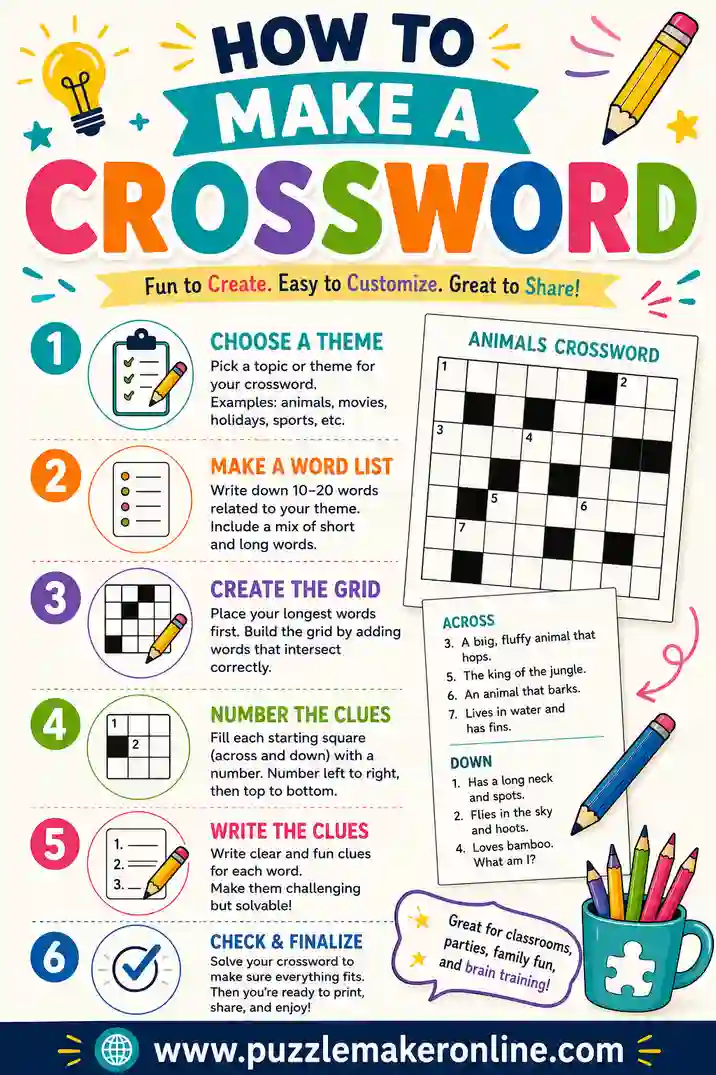
- Number the squares. Put a small number in each square where an answer starts, reading left to right, top to bottom. This is the numbering convention Farrar helped tidy up.
- Add a black square. Now try a 5-by-5 grid with a black square in each corner. Notice how much easier it is to fit words once you have a few gaps. That's why modern grids use black squares.
- Test it on a friend. Watch where they get stuck. Usually, it's a clue that has more than one good answer. Tightening those clues is the core job of an editor.
If you enjoy this, our step-by-step guide on how to make a crossword goes much further, from choosing words to checking that every clue is fair.
Why the Crossword Lasted When Other Fads Didn't
The 1920s had plenty of crazes. So why did this one stick? Looking back over the history of crossword puzzles, a few reasons stand out.
- Newspapers needed it. A puzzle kept readers coming back every day, and it cost little space. Once one paper had it, its rivals had to follow.
- Editors kept improving it. Farrar's rules, the British cryptic tradition and Shortz's fresh vocabulary each renewed the puzzle for a new generation.
- It scales. The same idea works as a five-minute mini, a children's puzzle or a fiendish Saturday grid. Everyone can find a level.
- It's satisfying. Every crossing answer confirms or corrects the last one, so you get a steady stream of small wins, and a sudden "Aha!" when a tough clue finally gives way. That feeling hasn't changed since 1913.
- It comforts. Farrar's wartime argument still rings true: a crossword gives your mind something absorbing to do when the news is hard.
If you want a broader look at the variety of puzzles that came out of this history, browse our main crossword puzzles page.
Make Your Own Crossword
More than a century after Arthur Wynne's diamond, anyone can make a crossword. Our free puzzle maker lets you type your own words or pick a theme, choose a puzzle type, and print it with an answer key. It's a fun way to put a bit of crossword history into practice: start with a handful of words you like, write clues in your own voice, and hand a printed copy to a friend, a class or the family on a Sunday morning.
Five People Behind the Crossword at a Glance
This table puts the main people from the story side by side, so you can see who did what and when.
| Person | Connection | What they are known for |
|---|---|---|
| Arthur Wynne | Liverpool-born journalist at the New York World | Printed the diamond-shaped "Word-Cross" on December 21, 1913, widely credited as the first modern crossword |
| Margaret Farrar | Ran the World's weekly crossword, then became the Times crossword editor in 1942 | Gave the American crossword its shape with cleaner numbering, livelier clues and theme puzzles |
| Edward Powys Mathers ("Torquemada") | British setter | Made the first crossword of entirely cryptic clues, in 1925 |
| Eugene Maleska | Times crossword editor from 1977 to 1993 | Wrote more than 7,000 puzzles; his literary, classical style is often linked with crosswordese |
| Will Shortz | Times crossword editor from 1993 | Holds a degree in "enigmatology" and has run a national crossword tournament since 1978 |
Frequently Asked Questions
Who invented the crossword puzzle?
Arthur Wynne, a journalist from Liverpool working for the New York World, is usually credited with the first modern crossword. His puzzle ran on December 21, 1913. It's fair to say he popularized the format rather than invented the idea from nothing, because word squares and simple crossing-word puzzles had appeared in English children's books in the 1800s. What Wynne did was publish a large numbered grid with clues in a big-city newspaper, week after week, and that's the version that caught on.
What was the first crossword puzzle called?
Wynne called it a Word-Cross. The Library of Congress lists it as FUN's Word-Cross Puzzle, from the Fun section of the New York World. Within a few years people had flipped the name to cross-word, often with a hyphen or as two separate words, and newspaper headlines from 1924 and 1925 use several spellings side by side. The single word crossword became standard later, once the puzzle was firmly established in papers everywhere.
What did the first crossword look like?
It was a hand-drawn diamond with 31 clues and no internal black squares. Every white square belonged to two answers, so it worked more like a ring of interlocking words around a hollow center than a modern checkerboard grid. The clues were plain definitions. Black squares placed through the grid, strict symmetry and standard grid sizes came later, as editors in the 1920s and beyond refined the format.
When did The New York Times start its crossword?
The New York Times published its first crossword on Sunday, February 15, 1942, edited by Margaret Farrar. The paper had mocked the 1920s craze and was the last major American paper to hold out. After Pearl Harbor, its Sunday editor argued that readers would want something absorbing during long wartime nights, and the paper agreed. The puzzle became a daily feature in 1950, still under Farrar.
Who was Margaret Farrar?
Margaret Farrar, born Margaret Petherbridge in 1897, was the editor who did most to shape the American crossword. She ran the puzzle at the New York World, co-edited the first crossword book in 1924, and became the first crossword editor of The New York Times in 1942. She tidied up the numbering system, encouraged livelier clues tied to current events, introduced theme puzzles and edited more than 130 puzzle collections before retiring in the late 1960s.
When did cryptic crosswords begin?
Cryptic clues developed in Britain in the 1920s, after the crossword arrived there in 1922. Guinness World Records credits the first crossword made entirely of cryptic clues to Edward Powys Mathers, who wrote as Torquemada, in The Saturday Westminster Gazette in 1925. Earlier British puzzles mixed in a few tricky clues, but Mathers used only wordplay clues. Later setters and editors, including A. F. Ritchie and D. S. Macnutt, worked out the fairness rules most cryptics still follow.
Is it true a crossword was used to recruit codebreakers?
Yes, in a limited way. During World War II, the Daily Telegraph held a contest in which readers tried to finish a crossword in under 12 minutes. A small group succeeded. Some contestants, including at least one who ran out of time one word short, were later approached and went on to work at Bletchley Park, Britain's codebreaking center. It was one route into codebreaking, not a mass hiring program, but the story is well documented.
Why was the 1924 crossword book so important?
The 1924 book, a collection of New York World puzzles, turned a newspaper feature into a national craze and helped launch the young publishing house of Simon and Schuster. The publishers were so unsure of it that they first issued it under another imprint. Sales were enormous for the time, with one reference work putting first-year sales near 400,000 copies, and puzzle books became a regular product for the company afterward.
How many editors has The New York Times crossword had?
For most of its history, the Times crossword has had four editors. Margaret Farrar ran it from 1942 until the late 1960s, followed by Will Weng. Eugene Maleska took over in 1977 and held the job until his death in 1993, editing in a literary, classical style. Will Shortz became editor in 1993 and brought in fresher, everyday vocabulary and playful themes, while keeping the weekly climb in difficulty that solvers know well.
Sources
We checked every source below while writing this guide. Last reviewed October 30, 2026, by Joan Ramos.
- Free Puzzles: Word Cross, Crosswords, and Acrostics (Library of Congress, Headlines and Heroes blog)
- A Quick Crossword History (excerpt from a thesis by Sik Cambon Jensen) (American Crossword Puzzle Tournament)
- Farrar, Margaret (1897-1984) (Women in World History, via Encyclopedia.com)
- The legacy of the crossword puzzle in times of crisis (Marketplace (American Public Media))
- First cryptic crossword (Guinness World Records)
- Clues, code-breaking, and cruciverbalists: the language of crosswords (Simon Horobin) (OUPblog, Oxford University Press)
- How The Telegraph Put One Across Hitler (Michael Smith, Finest Hour 101) (International Churchill Society)
- The History Of The New York Times Crossword Puzzle (Dictionary.com)
- Crossword Ace Eugene Maleska Laced His Puzzles With Puckish Puns (The Seattle Times (from the Orlando Sentinel), August 5, 1993)
- ACPT Capsule History (American Crossword Puzzle Tournament)