The History of Word Searches: Who Invented Them and How They Spread
The short history of word searches goes like this: the puzzle is usually credited to Norman E. Gibat, who published a grid of hidden Oklahoma place names in his small advertising paper, the Selenby Digest, in Norman, Oklahoma, on March 1, 1968. There's a competing claim from Spain, where a puzzle maker named Pedro Ocón de Oro made similar "sopa de letras" (letter soup) puzzles, though nobody has pinned down exactly when. Neither man patented the idea, so it spread freely into newspapers, classrooms and puzzle books around the world.
That's the answer most sources give. But the real story has more gaps, odd details and open questions than the tidy version suggests. This guide walks through what we actually know, what's only repeated, and how the puzzle went from a giveaway flyer to one of the most familiar puzzles on earth. Along the way you'll see how word searches are built, why they're harder than they look, and how to make one yourself.
The history of word searches at a glance
Before we get into the details, here's the big picture in a few lines:
- Before 1968: letter grids and hidden-word games existed in various forms, and Spanish "sopa de letras" puzzles may predate Gibat, though their first publication date is unknown.
- March 1, 1968: Norman E. Gibat publishes a hidden-word grid in the Selenby Digest in Norman, Oklahoma.
- Soon after: teachers ask for extra copies for their classes, an early sign of the puzzle's future in schools.
- Around 1970: the Selenby Digest closes, but the puzzle idea lives on.
- The following decades: because nobody owns the format, it spreads into publications across the world under many different names.
- Today: word searches appear in newspapers, puzzle books, classrooms, apps and printable puzzle makers.
Let's take those one at a time.
Norman E. Gibat and the Selenby Digest
The most detailed newspaper account of Gibat's puzzle comes from a 2020 history of newspaper puzzles by Charles Apple in The Spokesman-Review. It says Gibat created and published the first word search on March 1, 1968, in his weekly advertising digest, the Selenby, in Norman, Oklahoma. That first puzzle hid 34 words, all names of Oklahoma locations. Teachers quickly asked for extra copies for their classes.
It helps to picture what an "advertising digest" was. Many towns had free weekly papers filled mostly with local ads. Publishers needed something that would make people pick them up, keep them around and actually look at the pages. A puzzle is perfect for that. It's free entertainment, it takes a while to finish, and every minute a reader spends on the page is a minute near the ads.
The Argentine newspaper La Nación gives a similar account in a 2024 article on the origin of the sopa de letras. It says Gibat invented the game in 1968 to attract readers to the Selenby Digest, and that he wanted a simple puzzle people could play while waiting in a supermarket line or at a bus stop. According to that article, his first puzzle was about Oklahoma cities, and his second was about the street names of Norman. It adds that teachers soon started using the puzzles in class, and that the Selenby Digest closed in 1970 under pressure from competitors.
Put those two accounts side by side and a consistent picture appears:
| Detail | The Spokesman-Review (2020) | La Nación (2024) |
|---|---|---|
| Inventor | Norman E. Gibat | Norman E. Gibat |
| Place | Norman, Oklahoma | Norman, Oklahoma |
| Publication | His weekly advertising digest, the Selenby | The Selenby Digest |
| Date | March 1, 1968 | 1968 |
| First topic | 34 Oklahoma place names | Oklahoma cities (second puzzle: Norman street names) |
| Classroom use | Teachers requested extra copies | Teachers soon used it in class |
| What happened next | Not covered | The digest closed in 1970 |
Notice that both sources describe the puzzle as a local, practical invention, not a grand idea. Gibat wasn't a famous puzzle editor. He was a small publisher who needed a hook. That's part of why the history is so thin: nobody thought a giveaway flyer in Norman would be worth archiving.
What we know about Norman Gibat himself
Gibat is a surprisingly hard person to pin down, and it's worth being honest about that. A 1982 profile republished by the Fostoria Area Historical Society in Ohio describes a Norman Gibat who grew up in Fostoria, served in the Marine Corps from 1947 to 1953, and studied at several colleges, including one year at Oklahoma City University. It says he majored in mathematics with a minor in electrical engineering.
That profile goes on to describe his businesses after he returned to Fostoria in 1973. His first venture was a printing business called Popular Topics Press. He also bought, rebuilt and resold used printing equipment, and later sold computers and set up computer systems for local businesses. The family's companies eventually went by the name Noguska Industries.
Here's the interesting part: the 1982 profile doesn't mention word searches at all. It's a portrait of a hands-on, technical small businessman with a background in math, printing and computers. Researchers who connect this Ohio businessman to the Oklahoma puzzle publisher point to the Oklahoma City University link and the printing background, which fit the story of a man running a small printed digest in Norman in the late 1960s. Still, the profile itself is silent about puzzles, so treat the connection as a reasonable link rather than something that 1982 article proves.
Why does that matter? Because a lot of web pages about word search history add colorful details, like what Gibat "called" his puzzle or how many copies he printed, without saying where those details came from. When the best available sources disagree or say nothing, it's better to admit the gap than to fill it with guesses.
The Spanish claim: sopa de letras
The other name that comes up in the history of word searches is Pedro Ocón de Oro. La Nación says this puzzle maker from Madrid is credited with creating 125 puzzles in Castilian Spanish, and that in Spanish-speaking countries the word search is known as "sopa de letras," which means "letter soup."
The name is a good one. A word search grid really does look like a bowl of alphabet soup, with letters floating in no obvious order until you spot a word.
The trouble is dating. La Nación notes that there's no record showing when the first Spanish word search was published. Historians have generally settled on Gibat as the creator, the article says, though many people believe he may have been inspired by the Spanish version. That's a fair summary of where things stand:
- Gibat's puzzle has a specific date, a specific publication and a specific town.
- The Spanish puzzles may be older, but no one has produced a dated first example.
- There's no evidence either way about whether Gibat ever saw a Spanish puzzle.
It's also possible that both men came up with the idea on their own. That happens a lot with simple puzzle formats. Hiding words in a grid of letters is an obvious enough idea that several people in different countries could have landed on it without knowing about each other. The difference is that Gibat's version left a paper trail in English-language reporting, and it's the version most American sources repeat.
Why nobody owns the word search
One fact explains a lot about how word searches spread: neither Gibat nor Ocón de Oro patented the puzzle. La Nación makes this point directly, saying that because neither inventor patented his creation, the puzzle spread quickly through publications all over the world.
In practice, a puzzle format like this would be very hard to protect anyway. You can copyright a specific puzzle, meaning one particular grid and word list, but the general idea of "hide words in a letter grid and ask people to find them" is just an idea. Anyone can make their own version with their own words.
That openness was a gift to the puzzle's popularity. Newspapers could run word searches without paying a license fee for the format. Teachers could make their own on graph paper. Puzzle-book publishers could fill entire magazines with them. And decades later, software makers could build generators that produce a fresh grid in seconds. The crossword followed a similar path decades earlier, which is why you see crosswords from so many different sources today.
How word searches spread: classrooms, papers and puzzle books
The detail that teachers asked Gibat for extra copies is a small one, but it tells you a lot. From the very start, word searches had two audiences: casual puzzlers and classrooms.
It's easy to see why teachers liked them. A word search can be built around any topic. A science teacher can hide the planets. A Spanish teacher can hide vocabulary. A history teacher can hide presidents. Students have to recognize the spelling of each word to find it, so the puzzle quietly reinforces the vocabulary list. If you're curious about what classroom word searches can and can't do, our guide to word search benefits for kids covers that in more detail.
For newspapers and magazines, word searches solved a different problem. They're cheap to produce, easy for any reader to understand, and they don't require the specialized clue-writing skill a crossword does. A word search editor needs a theme, a word list and a grid, and the puzzle is ready.
The Spokesman-Review history places word searches in a long line of newspaper puzzles. It's helpful to see where they fit:
| Puzzle | Key early date | What happened |
|---|---|---|
| Crossword | December 21, 1913 | Arthur Wynne's "Word-Cross" runs in the New York World |
| Crossword book | April 1924 | Simon and Schuster publish The Cross Word Puzzle Book |
| Jumble | 1954 | Martin Nadel creates the "Scramble," later renamed "Jumble" |
| Word search | March 1, 1968 | Norman E. Gibat publishes his hidden-word grid in Norman, Oklahoma |
| Number Place (sudoku) | 1979 | Dell begins running "Number Place" puzzles |
| Sudoku in the UK | November 12, 2004 | Wayne Gould's sudoku puzzles first appear in The Sunday Times of London |
All of these dates come from the same Spokesman-Review article. Seen together, they show that the word search is a relative newcomer. It's 55 years younger than the crossword (1968 minus 1913), yet it became just as familiar.
What word searches are called around the world
Because the puzzle spread without a trademark, it picked up different names in different places. La Nación notes that there's no single universal name and lists several:
| Name | Where it's used | What it means |
|---|---|---|
| Sopa de letras | Spain, Spanish-speaking countries and Portugal | "Letter soup" |
| Caça Palavras | Brazil | "Word hunt" |
| Word Search | English-speaking countries | The most common English name |
| Word Find, Find a Word | English-speaking countries | Same puzzle, different title |
| Word Seek, Word Sleuth | English-speaking countries | Same puzzle, different title |
| Mystery Word | English-speaking countries | Often used when leftover letters spell a hidden message |
You'll still see many of these names in puzzle books today. If you've ever wondered whether a "find a word" is different from a word search, it isn't. Our page on find-a-word puzzles shows the same format under its other name. And if you're learning Spanish, a Spanish word search is literally a sopa de letras.
A timeline of the history of word searches
Here's a combined timeline built only from dated facts in our sources. Where a date isn't known, the timeline says so.
| When | Event | Source |
|---|---|---|
| Unknown (possibly before 1968) | Pedro Ocón de Oro of Madrid creates Spanish "sopa de letras" puzzles | La Nación |
| 1947 to 1953 | A Norman Gibat from Fostoria, Ohio, serves in the Marine Corps | Fostoria Area Historical Society |
| March 1, 1968 | Gibat publishes a word search of 34 Oklahoma place names in the Selenby digest | The Spokesman-Review |
| 1968 | A second puzzle hides the street names of Norman | La Nación |
| Soon after 1968 | Teachers request copies and use the puzzles in class | Both newspapers |
| 1970 | The Selenby Digest closes | La Nación |
| 1973 | Gibat returns to Fostoria, Ohio, and runs printing and computer businesses | Fostoria Area Historical Society |
| 1980 | Psychologists Treisman and Gelade publish an influential theory of how people search visually | Cognitive Psychology |
| 2012 | University of Illinois researchers use word searches to study how people decide when to give up and switch tasks | Cognitive Science Society |
The last two rows aren't about the puzzle's invention, but they're part of its story. Word searches turned out to be useful not just as entertainment but as a research tool, which we'll look at below.
How word searches are built, by hand and by computer
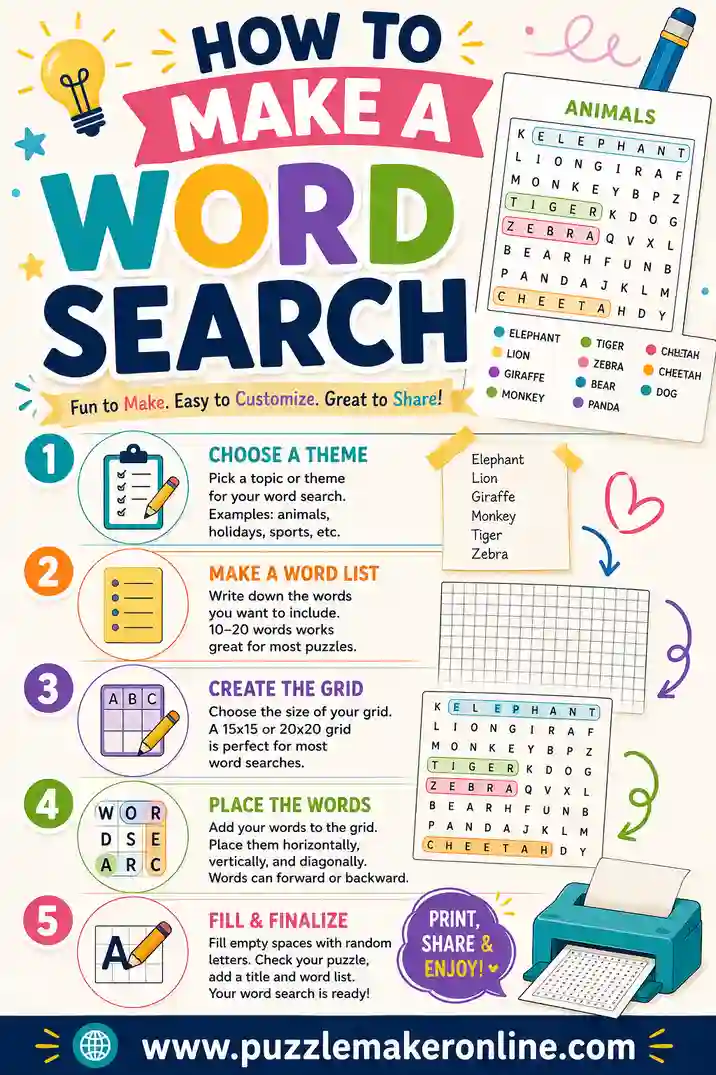
Gibat would have built his grids by hand. Today most word searches are made by software, but the method is the same either way. Here's how it works, step by step.
- Pick a theme and a word list. Oklahoma towns, planets, wedding words, anything you like.
- Choose a grid size. Small grids with few words suit beginners. Big grids with many words suit experienced solvers.
- Decide which directions are allowed. Easy puzzles use only left-to-right and top-to-bottom. Hard puzzles allow all eight directions, including backward and diagonal.
- Place the longest words first. Long words are hardest to fit, so they go in while the grid is still mostly empty.
- Check each placement. A word can go in a spot only if every square it needs is empty or already holds the same letter. Shared letters are allowed and make a grid tighter.
- Retry when stuck. If a word won't fit anywhere, a person erases and rearranges. A computer simply tries another random position and direction, often hundreds of times in a split second.
- Fill the empty squares with random letters.
- Check the fill. Make sure the filler letters haven't accidentally spelled a second copy of a hidden word, or anything you wouldn't want on a classroom handout.
- Make the answer key. Circle or highlight each word's position.
A worked example
Here's a tiny 6x6 word search built with those steps. It hides five words: GRID, CLUE, FIND, WORD and LIST. Try to find them before you read the answer key below it.
| Row | 1 | 2 | 3 | 4 | 5 | 6 |
|---|---|---|---|---|---|---|
| 1 | G | R | I | D | A | M |
| 2 | C | F | O | P | E | T |
| 3 | L | B | I | K | N | S |
| 4 | U | H | A | N | Y | I |
| 5 | E | Q | M | R | D | L |
| 6 | S | V | D | R | O | W |
Here's where each word is hidden, and the direction it runs:
| Word | Starts at | Direction | Difficulty level |
|---|---|---|---|
| GRID | Row 1, column 1 | Left to right | Easiest |
| CLUE | Row 2, column 1 | Top to bottom | Easy |
| FIND | Row 2, column 2 | Diagonal, down and to the right | Medium |
| LIST | Row 5, column 6 | Bottom to top | Harder |
| WORD | Row 6, column 6 | Right to left | Harder |
Even in a grid this small, you can feel the difference between directions. GRID jumps out because we read left to right. WORD is sitting in plain sight in the bottom row, but backward it looks like DROW, and many people skim right past it. That's the main lever puzzle makers use to control difficulty. Our guide on how to make a word search goes further into choosing sizes and directions, and our difficult word searches show what happens when every direction is allowed.
How puzzle makers control difficulty
Gibat's first puzzle was meant for adults killing time in a checkout line, and his readers soon included schoolchildren. That same split still shapes word searches today. A puzzle for a first grader and a puzzle for a seasoned solver use the same basic idea, but the maker turns several dials to change how hard it feels. Here are the main ones.
| Dial | Easier setting | Harder setting | Why it matters |
|---|---|---|---|
| Grid size | 8x8 to 10x10 | 20x20 or larger | More squares means more places to check for each word |
| Directions | Left to right and top to bottom only | All eight, including backward and diagonal | Backward and diagonal words fight our reading habits |
| Word list | Shown, in the order the words appear | Hidden, or given as clues | Without a list, you have to recall the words yourself |
| Overlaps | Few shared letters | Many words crossing each other | Shared letters make the grid look more uniform |
| Filler letters | Random letters | Letters borrowed from the hidden words | Decoy fragments like "WOR" or "LIS" lead you down false trails |
| Word length | Short, distinctive words | Long words with common letters | Common letters such as E, T and S appear all over the grid |
| Print size | Large letters with wide spacing | Small, tightly packed letters | Crowded letters are harder to scan |
You can see several of these dials in the small example above. The two hardest words, LIST and WORD, run backward. LIST also uses three very common letters, so there are lots of S and T squares to check. And if you rewrote the grid's filler letters to include extra W, O and R squares, WORD would become even sneakier.
A good puzzle maker also thinks about fairness. Every word on the list should appear exactly once. If a short word like ANT turns up twice by accident, solvers can't tell which one the answer key wants. That's why checking the fill, step 8 in the list above, matters so much. Computers make this easy, because they can scan every row, column and diagonal for unwanted repeats in an instant, something that would take a person a long time by hand.
Why word searches are harder than they look: the science of searching
A word search seems like the simplest puzzle in the world. You know exactly what you're looking for, and it's right there on the page. So why can it take so long?
Psychologists have studied this kind of task for decades. In 1980, Anne Treisman and Garry Gelade published "A feature-integration theory of attention" in the journal Cognitive Psychology. Their work became one of the best-known accounts of visual search. In plain terms, the idea is that some targets "pop out" because they differ from everything around them in one simple feature, like a red dot among green ones. Other targets only stand out because of a particular combination of features, and finding those takes focused attention, one spot at a time.
A word search is almost entirely the second kind of task. Every letter in the grid is made of the same kinds of strokes, printed in the same font, at the same size and in the same color. Nothing about the word you want makes it pop. You have to check spots one by one, looking for the right first letter and then testing each direction. That's why it feels slow, and why hiding a word backward or diagonally makes such a difference. You're fighting your own reading habits.
Here are some practical tips that follow from that idea:
- Hunt for rare letters. If a word contains Q, Z, X, J or K, search for that letter first. There are fewer of them in the grid, so you'll have fewer spots to check.
- Look for doubled letters. A word like BALLOON has LL and OO. Pairs are easier to spot than single letters.
- Scan in one direction at a time. Sweep the whole grid for backward words, then for diagonals, rather than checking all eight directions at every letter.
- Use a pointer. A finger or pencil tip helps keep your place in a dense grid. For people who find tight grids tiring, a large-print word search spreads the letters out.
Word searches in the lab
Word searches have even been used as a research tool. In a 2012 study presented at the annual meeting of the Cognitive Science Society, researchers from the University of Illinois gave younger and older adults a set of four word search puzzles. Participants tried to find as many words as possible and could stay on one puzzle or switch to another at any time. The researchers were studying "information foraging," which is how people decide when to keep working on one source and when to move on.
The findings are fun to read as a puzzler. Younger adults found words faster at first, but their pace slowed down more as the easy words ran out. Older adults switched between puzzles less often. And both groups tended to stay on a puzzle longer than the best possible strategy would suggest. Anyone who has stared at a grid hunting for that last stubborn word will recognize the feeling.
Variations that grew from the basic word search
Once the format was free for anyone to use, puzzle makers started tinkering. La Nación mentions a few common variations: word searches with no word list, ones with clues instead of a list, and a version called "serpiente" (snake), where words bend and change direction partway through.
Here's how those and a few other common variations change the solving experience:
- No word list: you're told only the theme, like "ten fruits," and must discover the words yourself. This turns a search puzzle into a recall puzzle.
- Clues instead of words: the list says "a yellow fruit monkeys love" instead of BANANA. You solve the clue, then find the answer in the grid. It's a bridge between a word search and a crossword.
- Bending words: words turn corners like a snake. Much harder, since you can't rely on straight lines.
- Hidden message: after you circle every word, the leftover letters, read in order, spell out a phrase or answer. This is where names like "Mystery Word" come from.
- Shaped grids: the letters fill a shape, like a heart or a tree, instead of a rectangle.
Our word searches for adults use several of these tricks to keep things challenging, and you can browse more styles on our main word searches page.
Common mix-ups in word search history
Because the early record is thin, the history of word searches has collected a lot of confident-sounding claims. Here's how to sort them.
- "Word searches were invented in Spain." Possibly, but unproven. Spanish puzzles may be older, yet no dated first example has been produced. The best you can honestly say is that the Spanish and American versions may have developed separately.
- "Gibat called his puzzle a Word-Cross." You'll see this online, but it's easy to confuse with Arthur Wynne's 1913 "Word-Cross," which was the first crossword. We couldn't find a reliable source for Gibat using that name, so we don't repeat it.
- "Someone else invented it even earlier in Illinois." Some web pages mention an earlier American claimant. We didn't find any well-documented evidence for it, and the major newspaper histories don't mention it.
- "Gibat got rich from it." There's no evidence for that, and the lack of a patent makes it unlikely. The 1982 Fostoria profile describes him running printing and computer businesses, with no mention of puzzles at all.
- "Word searches are only for kids." They started as a puzzle for adults waiting in line, according to La Nación, and teachers adopted them later. Today they're popular with every age group.
Try it yourself: make a word search the 1968 way
The best way to appreciate Gibat's invention is to make one by hand. You'll need graph paper and a pencil.
- Pick a local theme, just as Gibat did. Write down 10 to 15 street names, town names or landmarks from where you live.
- Draw a 12x12 grid on graph paper, one letter per square.
- Place your longest word first, in pencil. Then add the rest, mixing directions: some across, some down, a couple diagonal and one or two backward.
- Try to cross at least two words on a shared letter. It's satisfying, and it makes the grid harder to read.
- Fill the empty squares with random letters. Use letters that also appear in your words, so the real words don't stand out.
- Ink it and make a key. Trace the final letters in pen, then make a photocopy and circle the answers on the copy.
- Test it on someone. Time how long they take, and note which word they find last. That's your hardest placement.
Doing it by hand takes a while, which helps explain why software took over the job. A computer can test thousands of possible placements in the time it takes you to place one word.
Make your own word search today
The history of word searches starts with a small advertising digest in Norman, Oklahoma, a grid of 34 hidden place names, and teachers who wanted copies for class. A possible Spanish forerunner, the lack of any patent and the simple charm of the format did the rest. More than half a century later, the puzzle is everywhere.
If you'd like to carry on the tradition, our free puzzle maker lets you type your own words or pick a theme, choose a word search or another puzzle type, and print it with an answer key. Hide your own street names, just like the very first puzzle did.
Five Word Search Twists Compared
Once the format was free for anyone to use, puzzle makers started tinkering. This table compares five common variations and what each one asks of the solver.
| Variation | How it works | What changes for the solver |
|---|---|---|
| No word list | You are told only the theme, like "ten fruits" | A search puzzle becomes a recall puzzle |
| Clues instead of words | The list gives a clue instead of the word itself | You solve the clue, then find the answer, a bridge between a word search and a crossword |
| Bending words | Words turn corners like a snake (called "serpiente") | Much harder, since you can't rely on straight lines |
| Hidden message | The leftover letters spell a phrase or answer | This is where names like "Mystery Word" come from |
| Shaped grids | The letters fill a shape, like a heart or a tree | The grid is no longer a plain rectangle |
Frequently Asked Questions
Who invented the word search puzzle?
Norman E. Gibat is usually credited. Newspaper histories say he published a hidden-word grid on March 1, 1968, in the Selenby, a weekly advertising digest he ran in Norman, Oklahoma. A Spanish puzzle maker from Madrid, Pedro Ocón de Oro, also made similar puzzles called sopa de letras, and some people think his may be older. Nobody has found a dated first example of the Spanish version, though, so Gibat's 1968 puzzle remains the earliest one with a clear date and place.
When was the first word search published?
The most specific date in reporting is March 1, 1968, when Norman E. Gibat published his first word search in Norman, Oklahoma. It hid 34 words, all names of Oklahoma places. A 2024 article in the Argentine newspaper La Nación adds that his second puzzle hid the street names of Norman. Spanish sopa de letras puzzles may be older, but their first publication date has never been established, so 1968 is the date most histories use.
What was the Selenby Digest?
It was a small weekly advertising paper that Norman E. Gibat published in Norman, Oklahoma, in the late 1960s. Free ad papers like this needed something to make readers pick them up and keep them, and a puzzle did the job. According to La Nación, Gibat wanted a simple game people could play while waiting in a supermarket line or at a bus stop. The same article says the digest closed in 1970 under pressure from competing publications.
Why is a word search called sopa de letras in Spanish?
Sopa de letras means letter soup. The grid of jumbled letters looks a lot like a bowl of alphabet soup, with letters floating in no clear order until you spot a word among them. The name is used in Spain and Spanish-speaking countries. In Brazil the puzzle is called caça palavras, which means word hunt. In English you'll see many names for the same puzzle, including word search, word find, find a word, word seek, word sleuth and mystery word.
Did Norman Gibat patent the word search?
No. According to La Nación, neither Gibat nor the Spanish puzzle maker Pedro Ocón de Oro patented the idea, and that's a big reason the puzzle spread so quickly around the world. A format as simple as hiding words in a letter grid would be very hard to protect anyway. You can copyright one specific grid and word list, but anyone is free to make their own word search with their own words, which is why so many publishers and teachers do.
Are word searches older than crosswords?
No, the crossword is much older. Arthur Wynne's Word-Cross, generally treated as the first crossword, ran in the New York World on December 21, 1913. The first dated word search appeared on March 1, 1968, so the word search is about 55 years younger. Even so, it caught on quickly, partly because it is easy to understand, needs no clue-writing skill to make, and can be built around any theme a reader or teacher might want.
Why were word searches popular with teachers?
Teachers liked them almost from the start. Newspaper accounts say teachers asked Gibat for extra copies of his early puzzles for their classes. A word search can be built around any list of words, so it fits spelling lists, science terms, history names or a new language's vocabulary. Students have to recognize each word's exact spelling to find it in the grid, which gives the word list extra attention. They're also quick to print and easy for any student to understand.
Is a find-a-word the same as a word search?
Yes. Find a word, word find, word seek, word sleuth and mystery word are all names for the same puzzle: a grid of letters with hidden words to circle. Because nobody owned the format, publishers gave it their own titles over the years. Some names hint at a twist. Mystery word puzzles, for example, often hide a message in the letters left over after you've circled every word. The basic way of solving is the same no matter what the puzzle is called.
How do computers make word search puzzles?
They follow the same steps a person would, just much faster. The program places the longest words first, picking a random spot and direction and checking that each square is empty or already holds the matching letter. If a word won't fit, it tries another spot, often hundreds of times in a fraction of a second. Then it fills the empty squares with letters and checks that no hidden word appears twice by accident. Finally, it produces an answer key.
Why are some words in a word search so hard to find?
Because nothing makes them stand out. Visual search research, such as Treisman and Gelade's 1980 feature-integration theory, explains that a target with one unique feature, like a different color, pops out, while targets defined by a combination of features need focused attention, one spot at a time. Every letter in a word search looks similar, so you check spot by spot. Backward and diagonal words are harder still because they fight your reading habits.
Sources
We checked every source below while writing this guide. Last reviewed October 30, 2026, by Joan Ramos.
- A History of Newspaper Puzzles (Charles Apple, February 5, 2020) (The Spokesman-Review)
- Cuál es el origen de la sopa de letras (May 6, 2024) (La Nación)
- The Enterprising Gibat Family (1982 profile) (Fostoria Area Historical Society)
- A feature-integration theory of attention (Treisman and Gelade, 1980) (Cognitive Psychology)
- Information foraging in the unknown patches across the life span (Chin et al., 2012) (University of Illinois / Cognitive Science Society)