Spanish Word Search: Free Printable Vocabulary Puzzle
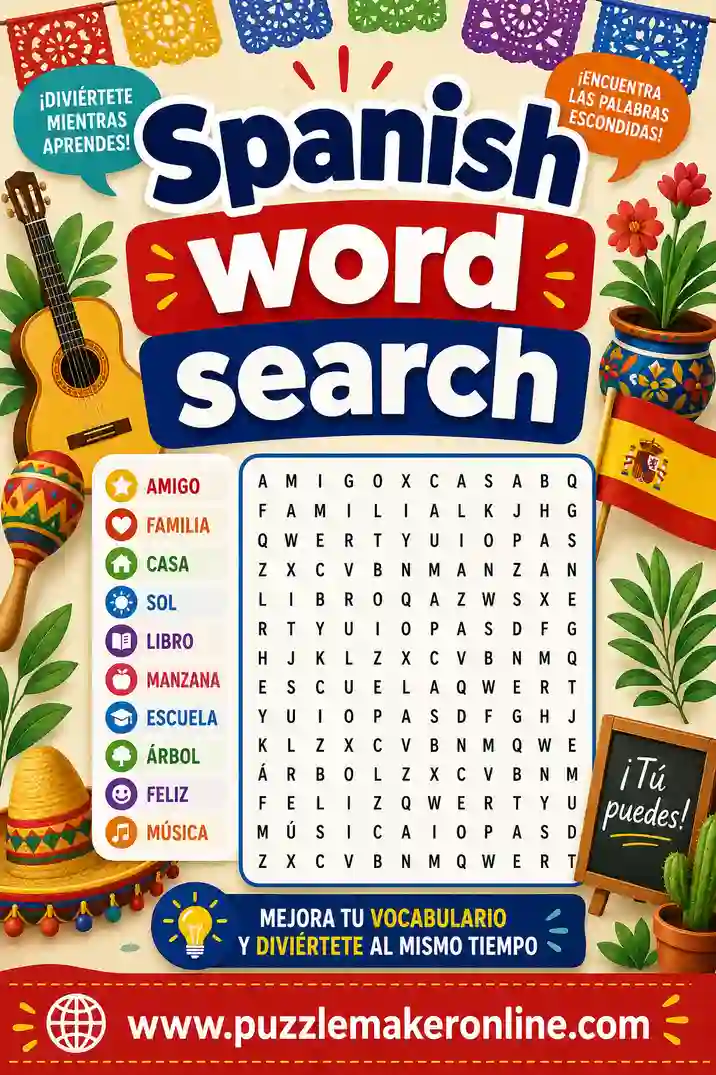
A Spanish word search is a printable letter grid with Spanish words like "perro," "casa," and "azul" hidden inside, running across, down, and diagonally. Students circle each word as they find it, which builds vocabulary and spelling at the same time. The fastest way to make one is to drop a Spanish word list into a free puzzle maker that hides your words in a fresh grid you can print for the whole class.
Want to jump straight to building one? Open the free puzzle maker, paste in a Spanish word list (there's a ready-to-copy one below), and print as many copies as you need. No sign-up, no fee, nothing to install.
What Is a Spanish Word Search?
It's a grid of letters with Spanish vocabulary words hidden inside. Students find and circle each one. The words can run across, down, diagonally, and backward, depending on how hard you want it. A word bank below the grid lists the words to hunt for, often with the English translation next to each one.
Spanish word searches are a favorite in language classrooms because they sneak in real practice. To find "biblioteca," a student has to recognize the spelling letter by letter, which cements it far better than just reading it once. Group the words by theme, like colors, animals, or food, and one puzzle reinforces a whole unit.
They also work for any level. Beginners hunt for short, friendly words like "sol," "casa," and "ojo." More advanced students take on longer ones like "computadora" and "cumpleaños." A generator handles the tedious part of hiding the words and filling the gaps, so you can focus on picking the right vocabulary.
Why Make Your Own Spanish Word Search
You can find generic printables, but making your own is better for a few reasons.
- It's free. Print one for every student at no cost.
- You match the vocabulary. Hide exactly the words from this week's unit, so the puzzle reinforces your lesson.
- Every copy can be unique. Need different grids so students can't copy answers? A generator makes fresh ones in seconds.
It's also fast. From "I need a Spanish review activity" to a printed class set usually takes under ten minutes. No software, no design skills.
Free Spanish Word List (Copy & Paste)
Here's a ready-to-use list of 30 common Spanish words grouped by theme, with English meanings. Pick one column for a focused puzzle, or mix them for variety. Copy the Spanish words straight into the puzzle maker.
| Colores (Colors) | Animales (Animals) | Casa & Más (Home & More) |
|---|---|---|
| Rojo (red) | Perro (dog) | Casa (house) |
| Azul (blue) | Gato (cat) | Libro (book) |
| Verde (green) | Pájaro (bird) | Agua (water) |
| Amarillo (yellow) | Pez (fish) | Mesa (table) |
| Negro (black) | Caballo (horse) | Silla (chair) |
| Blanco (white) | Vaca (cow) | Puerta (door) |
| Rosa (pink) | Ratón (mouse) | Ventana (window) |
| Naranja (orange) | Conejo (rabbit) | Familia (family) |
| Morado (purple) | Oso (bear) | Escuela (school) |
| Gris (gray) | Tortuga (turtle) | Amigo (friend) |
A quick tip for the puzzle maker: most word search tools ignore accent marks, so "pájaro" gets hidden as PAJARO. That's fine for the grid. Just keep the accent on the word bank so students learn the correct spelling.
Theme variations to try
- Numbers (los números). Uno, dos, tres, cuatro, cinco, seis. Perfect for a first-week puzzle.
- Food (la comida). Manzana, pan, queso, leche, arroz, pollo. Great before a unit on ordering at a restaurant.
- Days and months. Lunes, martes, enero, febrero, primavera, verano. Builds calendar vocabulary.
Spanish Word Search by Theme: 10 Ready-to-Use Word Lists
Need more than 30 words? Here are ten themed lists with 187 more Spanish words, each with its English meaning. Every list is sized for one puzzle: copy the Spanish column into the puzzle maker, keep the English column for your word bank, and you have a finished worksheet. The words are everyday vocabulary that shows up in most first- and second-year Spanish courses.
La comida (Food)
Great before a restaurant or grocery unit. Most words are short, so this list works in a 12x12 grid.
| Español | English | Español | English |
|---|---|---|---|
| Manzana | apple | Plátano | banana |
| Naranja | orange | Uva | grape |
| Fresa | strawberry | Pan | bread |
| Queso | cheese | Leche | milk |
| Huevo | egg | Arroz | rice |
| Pollo | chicken | Pescado | fish |
| Sopa | soup | Ensalada | salad |
| Tomate | tomato | Papa | potato |
| Zanahoria | carrot | Galleta | cookie |
| Jugo | juice | Pastel | cake |
La familia (Family)
Pair this with a family-tree drawing. Ask students to label their own family members in Spanish after the puzzle.
| Español | English | Español | English |
|---|---|---|---|
| Madre | mother | Padre | father |
| Hermano | brother | Hermana | sister |
| Abuelo | grandfather | Abuela | grandmother |
| Tío | uncle | Tía | aunt |
| Primo | cousin (boy) | Prima | cousin (girl) |
| Hijo | son | Hija | daughter |
| Bebé | baby | Esposo | husband |
| Esposa | wife | Nieto | grandson |
| Nieta | granddaughter | Sobrino | nephew |
| Sobrina | niece | Mamá | mom |
Los números (Numbers)
Number words get long fast, so use a 13x13 grid or bigger. A good follow-up: have students write the digit next to each word they find.
| Español | English | Español | English |
|---|---|---|---|
| Uno | one | Dos | two |
| Tres | three | Cuatro | four |
| Cinco | five | Seis | six |
| Siete | seven | Ocho | eight |
| Nueve | nine | Diez | ten |
| Once | eleven | Doce | twelve |
| Trece | thirteen | Catorce | fourteen |
| Quince | fifteen | Veinte | twenty |
| Treinta | thirty | Cien | one hundred |
Los días y los meses (Days and Months)
In Spanish, days and months are written in lowercase. Point that out in the word bank, since English speakers tend to capitalize them.
| Español | English | Español | English |
|---|---|---|---|
| Lunes | Monday | Martes | Tuesday |
| Miércoles | Wednesday | Jueves | Thursday |
| Viernes | Friday | Sábado | Saturday |
| Domingo | Sunday | Enero | January |
| Febrero | February | Marzo | March |
| Abril | April | Mayo | May |
| Junio | June | Julio | July |
| Agosto | August | Septiembre | September |
| Octubre | October | Noviembre | November |
| Diciembre | December |
Los verbos (Common Verbs)
Use the infinitive (the -ar, -er, -ir form) in the grid. Once students find a verb, ask them to conjugate it for yo, tú, and él.
| Español | English | Español | English |
|---|---|---|---|
| Hablar | to speak | Comer | to eat |
| Beber | to drink | Vivir | to live |
| Correr | to run | Caminar | to walk |
| Escribir | to write | Leer | to read |
| Cantar | to sing | Bailar | to dance |
| Dormir | to sleep | Jugar | to play |
| Estudiar | to study | Trabajar | to work |
| Nadar | to swim | Cocinar | to cook |
| Escuchar | to listen | Mirar | to watch |
| Abrir | to open | Aprender | to learn |
En la clase (Classroom Objects)
A perfect first-week puzzle. After solving, students can label real objects around the room with sticky notes.
| Español | English | Español | English |
|---|---|---|---|
| Lápiz | pencil | Bolígrafo | pen |
| Cuaderno | notebook | Mochila | backpack |
| Papel | paper | Tijeras | scissors |
| Regla | ruler | Borrador | eraser |
| Pizarra | board | Maestra | teacher |
| Estudiante | student | Clase | class |
| Tarea | homework | Examen | test |
| Escritorio | desk | Mapa | map |
| Reloj | clock | Calculadora | calculator |
| Pegamento | glue | Libreta | notepad |
Las fiestas (Holidays and Celebrations)
Use this one in December, around Día de los Muertos, or for any class party. It mixes winter, fall, and birthday words.
| Español | English | Español | English |
|---|---|---|---|
| Navidad | Christmas | Fiesta | party |
| Regalo | gift | Piñata | piñata |
| Vela | candle | Globo | balloon |
| Árbol | tree | Estrella | star |
| Campana | bell | Nieve | snow |
| Calabaza | pumpkin | Disfraz | costume |
| Dulces | candy | Desfile | parade |
| Flores | flowers | Ofrenda | altar offering |
| Pavo | turkey | Bandera | flag |
| Música | music | Baile | dance |
El cuerpo (The Body)
Sing "cabeza, hombros, rodillas y pies" first, then hand out the puzzle. The words stick much better after the song.
| Español | English | Español | English |
|---|---|---|---|
| Cabeza | head | Nariz | nose |
| Boca | mouth | Oreja | ear |
| Mano | hand | Pie | foot |
| Brazo | arm | Pierna | leg |
| Dedo | finger | Pelo | hair |
| Diente | tooth | Cara | face |
| Rodilla | knee | Hombro | shoulder |
| Cuello | neck | Espalda | back |
| Estómago | stomach | Ojo | eye |
El tiempo (Weather and Seasons)
Tie this list to a daily weather chart. Students can point to the word that matches today's sky.
| Español | English | Español | English |
|---|---|---|---|
| Sol | sun | Lluvia | rain |
| Nube | cloud | Viento | wind |
| Nieve | snow | Calor | heat |
| Frío | cold | Tormenta | storm |
| Arcoíris | rainbow | Primavera | spring |
| Verano | summer | Otoño | fall |
| Invierno | winter | Cielo | sky |
| Relámpago | lightning | Trueno | thunder |
La ropa (Clothing)
Good for a shopping role-play. After the puzzle, students can describe what they are wearing: "Llevo una camisa azul."
| Español | English | Español | English |
|---|---|---|---|
| Camisa | shirt | Pantalones | pants |
| Falda | skirt | Vestido | dress |
| Zapatos | shoes | Calcetines | socks |
| Sombrero | hat | Gorra | cap |
| Chaqueta | jacket | Abrigo | coat |
| Bufanda | scarf | Guantes | gloves |
| Botas | boots | Suéter | sweater |
| Cinturón | belt | Pijama | pajamas |
A quick note on capital letters: the tables start each word with a capital so they read cleanly, but in a real Spanish sentence days, months, and most common nouns stay lowercase. The puzzle grid prints everything in capitals anyway, so it makes no difference to the search itself.
How to Make a Spanish Word Search in 4 Steps
No special skills needed. Here's the whole process.
- Pick your grid size. A 10x10 grid suits short words. Go 13x13 or bigger for longer vocabulary.
- Add your words. Paste 12 to 15 Spanish words for an easy puzzle, or 20+ for a hard one.
- Set the difficulty. Turn on diagonals and backward words for advanced students, off for beginners.
- Print. Hit print and hand out the stack.
That's it. To reuse the puzzles, print on cardstock or slip them into clear sleeves so students can solve with a dry-erase marker.
Spanish Word Search by Level
Spanish gets taught from elementary school through college. Here's how to match the puzzle to the level.
| Level | Grid size | Word count | Settings |
|---|---|---|---|
| Beginner / young learners | 10x10 | 8–10 short words | Across and down only |
| Early intermediate | 12x12 | 12–16 words | Add diagonals |
| Intermediate | 13x13 | 16–20 words | Diagonals + a few backward |
| Advanced / heritage | 15x15 or bigger | 20–30 words | All directions, longer words |
The two biggest difficulty dials are word direction and grid size. Backward and diagonal words make a puzzle much harder. Long words like "computadora" also raise the difficulty, since they're harder to find than "sol" or "pan."
Spanish Word Searches for Kids, Teens, Adults, and AP Spanish
The same puzzle format works for a kindergartner and a high school senior. What changes is the word list, the grid size, and what you ask students to do once the words are found.
Young kids (preschool to 2nd grade)
Keep it tiny and friendly. Use six to eight words of three to five letters, like sol, pan, oso, and casa, and keep every word running left to right or top to bottom. Add a small picture next to each word in the bank if you can, so pre-readers match the picture to the word. Colors and animals are the easiest starting themes because kids already know the English words.
Elementary grades (3rd to 5th grade)
Move up to 10 to 14 words and a 12x12 grid. Classroom objects, family, and food lists fit well here. Turn on diagonals once students are comfortable. A nice twist is to print the word bank in English only, so students have to remember the Spanish word before they can find it.
Middle school and first-year high school
Use 15 to 20 words from the current unit, including longer ones like miércoles, calcetines, and zanahoria. Allow backward words for a challenge. Ask students to sort the words they found into masculine and feminine, or to add el or la in front of each noun. That small step turns a fun activity into grammar review.
Adults and self-study learners
Adult learners often like word searches as a calm review after a lesson or on a commute. Use bigger grids, 20 or more words, and mix themes you are studying, such as travel, food, and clothing. Saying each word out loud as you circle it adds pronunciation practice for free.
AP Spanish and advanced classes
For advanced students, the search itself is easy, so make the word list do the work. Hide verbs and ask students to conjugate each one in the preterite or the subjunctive. Hide vocabulary tied to big course themes, such as families and communities, science and technology, or global challenges. Or skip the English entirely and give definitions in Spanish, so students must read a clue like "el lugar donde se compran libros" and find LIBRERIA.
How to Print Answer Keys for Your Spanish Word Search
An answer key saves a lot of time when you grade a class set or check a homeschool worksheet. The free puzzle maker shows a matching answer key for the grid you made, so you can print the puzzle and its solution together. Print the student copies first, then switch to the answer key and print one copy for yourself.
Keep the key with the puzzle in a folder, and write the theme and date on top. If you reuse a list next year, you can print the same pair again instead of solving the grid by hand. For a step-by-step walkthrough, see our guide on how to make an answer key for any printable puzzle.
Spanish Letters, Accents, and the Ñ
Spanish uses a few characters English does not: accented vowels (á, é, í, ó, ú), the ü in words like pingüino, and the letter ñ. Here is how to handle them in a puzzle.
- Accented vowels. Most grids print plain capitals, so canción becomes CANCION. That is normal. Keep the accent in the word bank so students still see the correct spelling.
- The ñ. Ñ is its own letter in the Spanish alphabet, not an n with decoration. If your grid turns it into a plain N, mention it to students, and keep the ñ in the word bank. Words like niño, año, and señora are worth teaching with the ñ visible.
- Two-word phrases. Phrases like "buenos días" are usually hidden without the space (BUENOSDIAS). List them in the bank as two words so the meaning stays clear.
- Accent hunt bonus. After solving, ask students to circle every word in the bank that has an accent mark and say where the stress falls. It is a quick, useful pronunciation check.
Fun Ways to Use a Spanish Word Search
A word search can do more than fill a worksheet. Here's how Spanish teachers and parents put them to work.
In the classroom
Hand it out as a warm-up while students settle in. To stretch the learning, ask students to write the English meaning next to three words they found, or use one of the words in a simple sentence. It's a low-stress way to review before a vocabulary quiz.
For homeschool and home practice
If you're teaching Spanish at home, a word search makes a calm, screen-free activity. Read the English clue aloud and have your child find the Spanish word, which turns it into a mini listening exercise too.
For clubs and culture days
Running a Spanish club or a Hispanic Heritage Month activity? A word search is an easy, welcoming table activity. Offer a small prize, like a sticker, for the first finished puzzle.
Printing Tips for Clean, Reusable Puzzles
A few small choices make your puzzles look sharp and last.
- Print in black and white. Word searches read fine without color and save ink.
- Keep accents on the word bank. Even if the grid drops them, the bank should show correct spelling so students learn it right.
- Use cardstock for a reusable class set. It survives a busy classroom better than copy paper.
- Laminate or use sleeves. Then students solve with dry-erase markers and you wipe the sheets clean.
- Run one test copy. Confirm the grid and word bank fit on the page before printing the whole batch.
What to solve with
Nothing fancy required:
- A pencil or pen to circle words
- Highlighters for a colorful finish
- Dry-erase markers if the page is laminated
Common Mistakes to Avoid
A Spanish word search is easy to make, but a few snags can trip up learners.
- Long words in a small grid. "Computadora" won't fit in a 10x10. Match word length to grid size.
- No translations. Always print the English meaning next to each Spanish word, or beginners won't connect the two.
- Difficulty mismatched to level. Backward diagonals will frustrate a first-year class. Save them for advanced students.
- Mixing themes randomly. A puzzle that jumps from colors to verbs to food feels scattered. Group words by topic so the practice has focus.
Turn the Word Search Into a Full Spanish Lesson
One puzzle can anchor a whole vocabulary unit if you build around it. Here are a few easy ways to stretch it.
Add a matching crossword
After students find the Spanish words in the search, give them a crossword where the clue is the English word and the answer is the Spanish one, like "dog" for perro or "house" for casa. Now they have to recall the spelling, not just spot it. The same puzzle maker builds the crossword from your list, so it's two puzzles from one word bank.
Run a translation race
Once the puzzle's done, have students write the English meaning next to each word they found. Time it, or make it a quiet pair activity. It checks comprehension instantly and shows you which words still need review before the quiz.
Use the words in simple sentences
Ask students to pick three words from the puzzle and write a short Spanish sentence with each, like "El perro es negro." It pushes them from recognizing words to actually using them, which is where real language learning happens.
Build a themed follow-up puzzle
For the next class, make a new word search from a related theme. If this week was colors and animals, next week's puzzle could be food or family words. Reusing the same simple format lets students focus on the new vocabulary instead of relearning how the activity works.
More Themed Word Searches to Try
Once you've made a Spanish puzzle, the same tool builds plenty of others. For a geography tie-in, try a countries word search. For science and nature units, a plants word search and an insects word search work great. One tool, any theme or language.
Teaching more than one language or building a full vocabulary unit? The Spanish crossword page has clue ideas that pair with these word lists, a French word search uses the same approach for French classes, and a vocabulary crossword works for any word list you want students to recall instead of just spot. For a food unit in English first, try the food word search, then switch to the Spanish food list above.
Frequently Asked Questions
What words should go on a Spanish word search?
Use common Spanish vocabulary grouped by theme, like colors (rojo, azul, verde), animals (perro, gato, pájaro), or home words (casa, libro, agua). The list above gives you 30 ready to copy, with English meanings.
Are these Spanish word search puzzles really free to print?
Yes. You make and print them yourself at no cost. There's no sign-up and no watermark, so you can print a copy for every student on a single free word list.
Do accent marks work in the puzzle?
Most word search tools ignore accent marks, so "pájaro" appears as PAJARO in the grid. That's normal and fine. Just keep the accent on the word bank so students still learn the correct spelling.
How do I make a Spanish word search for beginners?
Use a small 10x10 grid, eight to 10 short words like sol, casa, and ojo, and keep every word running across or down. Add the English translation to each word in the bank so new learners connect meaning to spelling.
Can I include the English translations on the page?
Yes, and you should. Listing each Spanish word with its English meaning in the word bank turns the puzzle into a real vocabulary exercise instead of just a letter hunt.
How many words should a word search have?
It depends on level. Eight to 10 words suit beginners, 12 to 16 fit early intermediate, and 20 to 30 make a solid challenge for advanced students. More words plus a bigger grid means a harder puzzle.
Where can I print Spanish word searches for free?
Build one in the free puzzle maker on this site and print it from your browser. Copy any themed list above, paste the Spanish words in, and print as many copies as you need. There is no sign-up, so you can print a class set in a few minutes.
Are answer keys included with the Spanish word search?
Yes. The puzzle maker shows an answer key that matches the exact grid you made, so you can print the puzzle and its solution together. Print the student copies first, then print one answer key for yourself.
Can I make a Spanish word search with accents and the ñ?
You can, but most grids print plain capital letters, so á becomes A and ñ may show as N. Keep the accents and the ñ in the word bank so students learn the correct spelling, and tell them the grid version is simplified.
Should I add el or la to the words in a Spanish word search?
Leave the article out of the grid, since it makes words longer and harder to hide. Put el or la in front of each noun in the word bank instead. That way students practice gender without making the puzzle confusing.
What is a good Spanish word search for Hispanic Heritage Month?
Use the holidays and celebrations list above, or build a list of Spanish-speaking countries and capitals. Add a short fact about each country to the word bank to turn the puzzle into a mini culture lesson.
How do I make a Spanish word search harder for advanced students?
Use a 15x15 or bigger grid, turn on backward and diagonal words, and give clues in Spanish instead of English. You can also hide verbs in the infinitive and ask students to conjugate each one after they find it.
Ready to Print Your Spanish Word Search?
Grab the word list above, open the free puzzle maker, and you'll have a printable Spanish word search in minutes. It's free, there's no sign-up, and you can print a unique copy for every student. ¡Buena suerte, and may every word get found!