Puzzles for Escape Rooms: Free Printable Ideas
Puzzles for escape rooms are printed challenges like word searches, crosswords, and word scrambles that hide a code, a clue, or the next step in a game. Players solve the puzzle, pull a hidden answer from it, and use that answer to unlock the following stage. The fastest way to build them is a free puzzle maker that turns your own word list into clean, printable sheets you can hide around a room.
Want to start building right now? Open the free puzzle maker, drop in a themed word list (there's a ready-made one below), and you'll have the bones of your escape room ready in minutes. No sign-up, no fee, nothing to install.
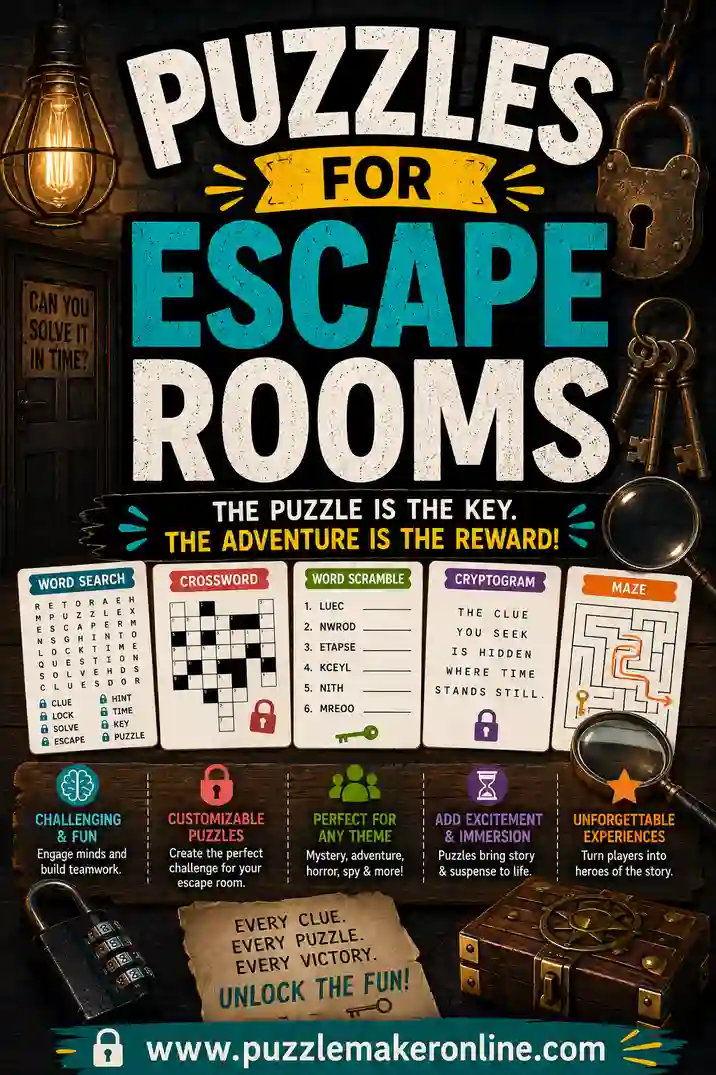
Why Word Puzzles Are Escape Room Gold
The best escape room puzzles feel clever but solvable. Word puzzles hit that sweet spot perfectly. They're familiar enough that nobody needs a tutorial, but you can hide a code inside them in ways that make players feel like genius detectives when they crack it.
They're also cheap and reusable. A printed word search costs pennies, and you can reset it in seconds for the next group. Compared to fancy locks and electronics, a clever paper puzzle gives you a huge payoff for almost no money.
And they scale. A single word search can be a five-minute warm-up or, with the right hidden clue, the key to the whole game. That flexibility is exactly why escape room designers, teachers, and party hosts reach for them again and again.
The Best Puzzle Types for an Escape Room
Each format hides clues in its own way. Mix them so the room keeps players guessing.
- Word search. Hide a secret word among the answers, or circle specific letters that spell a code. The leftover letters trick is a classic.
- Crossword. Number the clues so that specific squares spell out the next password. Solving the whole grid reveals it.
- Word scramble. Unscramble a set of words, then take the first letter of each to form a hidden message or a lock combination.
The trick that makes any of these an escape room puzzle is the hidden layer. The puzzle isn't the goal. The answer it reveals is.
How to hide a code in each puzzle
| Puzzle type | Hidden-code trick |
|---|---|
| Word search | Leftover uncircled letters spell the code |
| Word search | Highlight specific grid squares to reveal a word |
| Crossword | Shaded squares spell out the next password |
| Crossword | First letters of each answer form a phrase |
| Word scramble | First letter of each solved word makes a code |
| Word scramble | One scramble unlocks a 4-digit number |
Free Escape Room Word List (Copy & Paste)
Here's a ready-to-use list of 30 mystery and adventure words. Paste any 15–20 into the puzzle maker and it'll build your word search, crossword, or scramble in seconds. Mix across columns to fit your theme.
| Mystery & Codes | Locks & Tools | Adventure |
|---|---|---|
| Cipher | Keycode | Escape |
| Riddle | Vault | Mission |
| Clue | Padlock | Detective |
| Mystery | Combination | Suspect |
| Secret | Hidden door | Treasure |
| Password | Trapdoor | Map |
| Decode | Safe | Compass |
| Enigma | Lockbox | Tunnel |
| Hint | Blacklight | Countdown |
| Symbol | Toolbox | Final clue |
For a themed room, swap a few of these for words that fit. A spy room gets "agent" and "dossier," a pirate room gets "doubloon" and "plank," and a haunted room gets "phantom" and "crypt."
Theme ideas for your room
- Spy headquarters. Hidden codes, secret agents, and a self-destructing message. Word lists full of "dossier," "cipher," and "agent."
- Pirate treasure. A map, a compass, and a buried chest. Scrambles that reveal coordinates.
- Haunted mansion. Ghosts, locked rooms, and a creepy countdown. Crosswords that spell out an escape route.
How to Build an Escape Room Puzzle in 4 Steps
You don't need to be a designer. Here's the whole process.
- Decide the hidden answer first. Pick the code or password the puzzle should reveal. Build everything backward from there.
- Make the puzzle. Paste your themed words into the puzzle maker and generate a word search, crossword, or scramble.
- Plant the trick. Decide how players extract the code, such as leftover letters, shaded squares, or first letters.
- Print and hide it. Place the puzzle where players will find it at the right moment, and print a clean answer key for yourself.
Keep an answer key in your pocket so you can drop a hint if a group gets stuck. A stalled team is a frustrated team, and a small nudge keeps the fun going.
Chaining Puzzles Into a Full Game
A great escape room is a chain, not a pile. Each solved puzzle should hand players the key to the next one. Here's how to link them.
- Puzzle one reveals a number. A scramble's first letters spell a word, and the word's letter-count or a hidden digit opens a small lock.
- The lock holds puzzle two. Inside the box is a word search with a hidden phrase.
- The phrase points to a location. "Look under the third book" leads to the final crossword.
- The final puzzle is the escape. Its shaded squares spell the password to the exit or the prize box.
This breadcrumb structure is what makes an escape room feel like a real adventure instead of a worksheet. Three to five linked puzzles is a sweet spot for a 30 to 45 minute game.
Keeping the difficulty fair
- Start easy. The first puzzle should be quick so players gain confidence.
- Ramp up gradually. Each step a little harder than the last.
- Build in hints. Have a backup clue ready for every puzzle so nobody hits a dead end.
- Test it once. Run a friend through before the real group. You'll spot the confusing parts fast.
Printing and Hiding Tips
A few small choices make your escape room run smoothly.
- Print a test page first. Check the margins so no hidden letters get cut off at the edge.
- Use color cues carefully. If your trick relies on shaded squares, make sure they print clearly. Test in black and white if that's all you have.
- Laminate for reuse. If you'll run multiple groups, laminate the puzzles so players use dry-erase markers and you reset in seconds.
- Hide in plain sight. Tape a puzzle under a table, slip it inside a book, or fold it into an envelope marked with a clue.
- Keep a master answer key. One solved copy of every puzzle lets you give hints and verify the escape instantly.
What you'll want on hand
- Small cheap padlocks with set codes (number and letter locks)
- A blacklight pen for invisible-ink style clues
- Envelopes and small boxes to hide puzzles inside
- A timer or countdown clock for tension
Escape Room Puzzles for Different Settings
The same word list flexes to almost any group. A few common setups:
Home escape rooms and parties
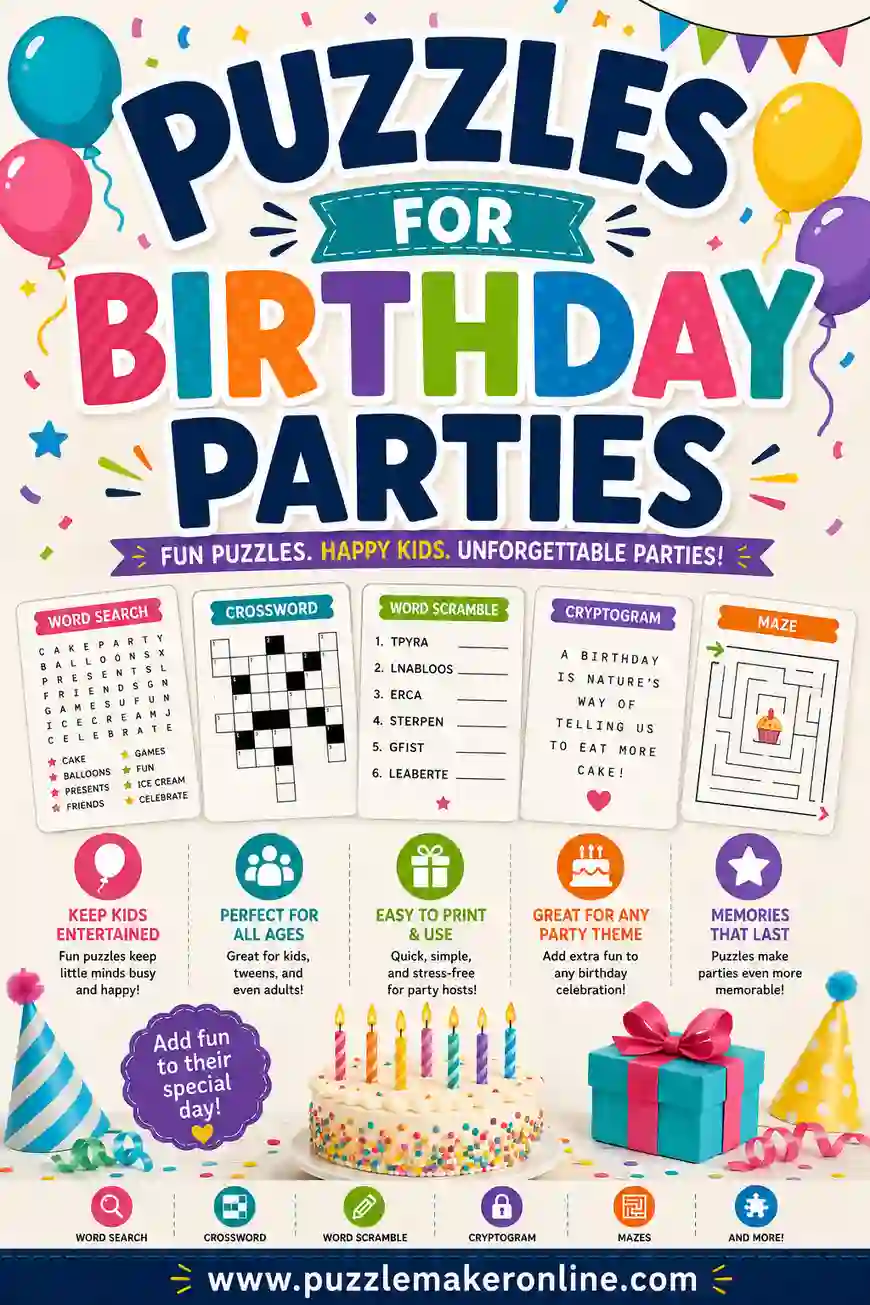
A birthday or game night escape room is a huge hit and costs almost nothing. Three or four linked puzzles, a couple of cheap locks, and a prize box at the end give you an hour of entertainment for the price of paper.
Classrooms
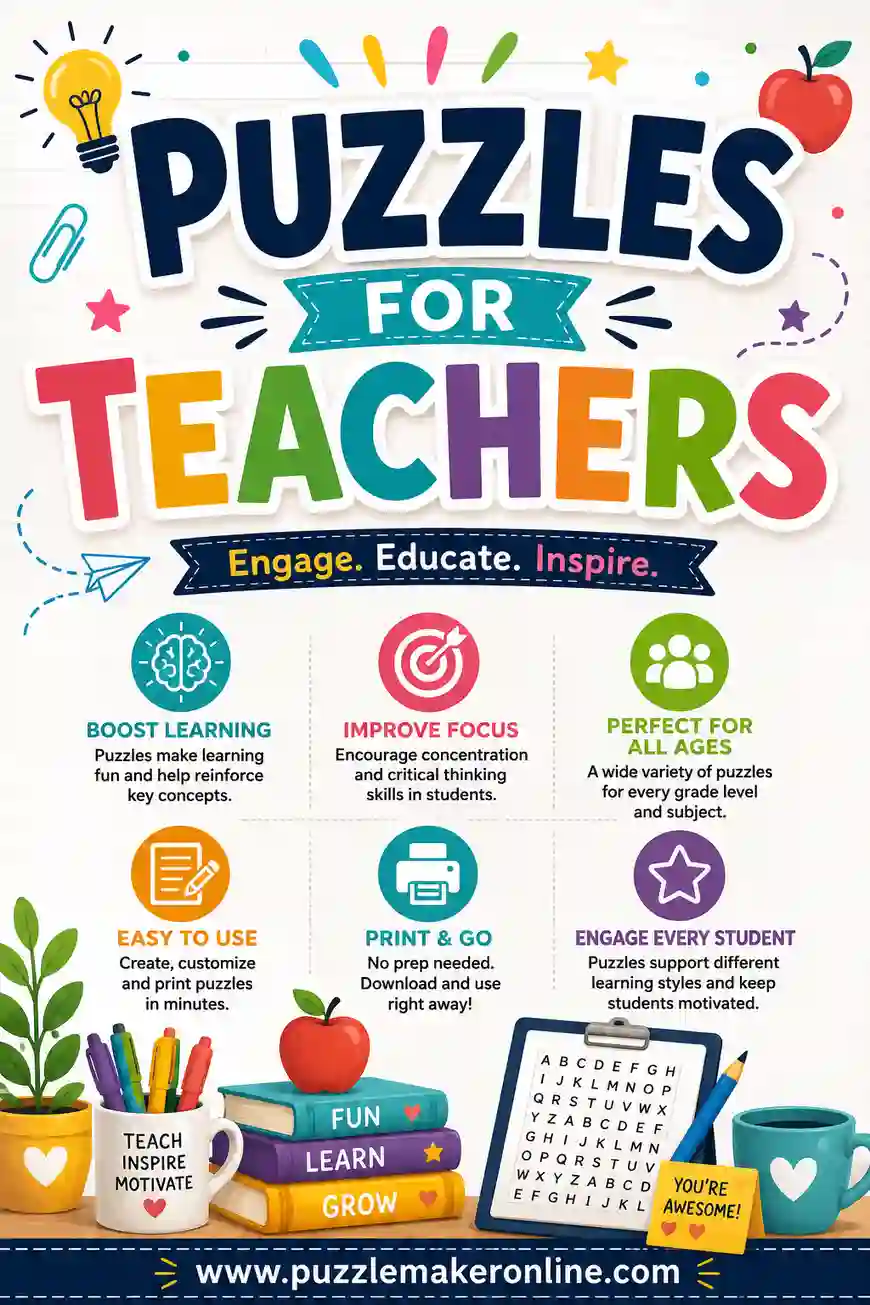
Teachers use escape room puzzles to review material in a way that doesn't feel like studying. Build the crossword clues around the lesson, hide the answer code, and let teams race to "escape." It turns review day into the best part of the week.
Team-building events
For an office or club, an escape room gets people collaborating fast. Word puzzles are perfect because everyone can contribute, and the shared "aha" moment when a code clicks builds real camaraderie.
Kids' adventure games
For younger players, keep the puzzles simple and the theme exciting. A pirate treasure hunt with easy scrambles and a buried prize box is pure magic for elementary-age kids.
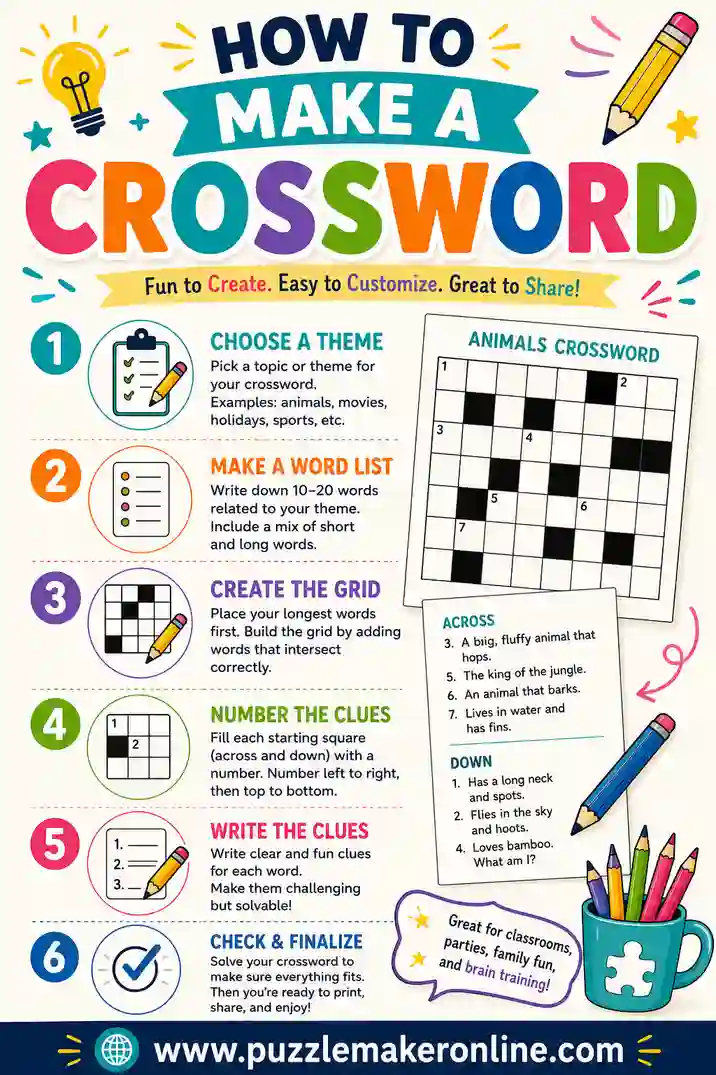
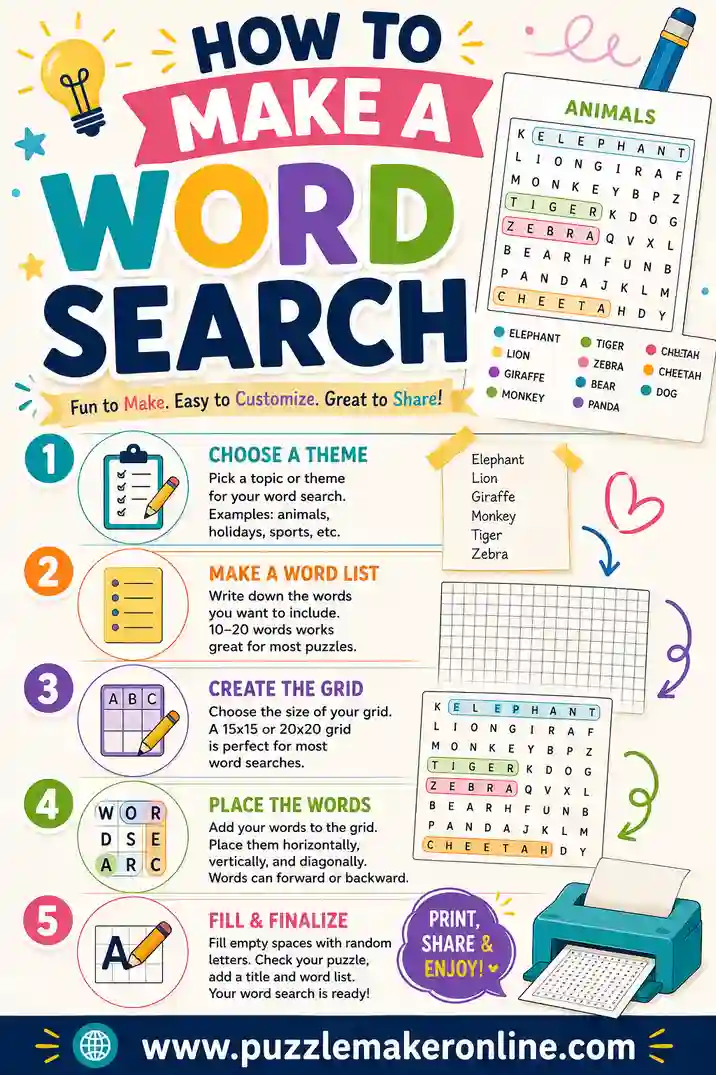
Ready to build the pieces? Learn how to make a crossword with a hidden password, or follow how to make a word search with a secret leftover-letter code. Planning a celebration around it? See puzzles for birthday parties.
Frequently Asked Questions
What puzzles work best in an escape room?
Word searches, crosswords, and word scrambles all work beautifully because you can hide a code inside each one. Word searches hide codes in leftover letters, crosswords use shaded squares, and scrambles use the first letter of each solved word.
How do I hide a code in a word search?
The classic trick is the leftover-letters method. After players circle every word in the list, the uncircled letters, read top to bottom, spell out the secret code. You can also highlight specific grid squares that spell a word.
Are these escape room puzzles really free to make?
Yes. You build and print them yourself at no cost. There's no sign-up and no watermark, so you can design a whole escape room on free word lists and print as many puzzles as you need.
How many puzzles should an escape room have?
Three to five linked puzzles is a good target for a 30 to 45 minute game. Each one should reveal the key to the next, building a chain that ends with the final escape code.
How hard should escape room puzzles be?
Start easy so players gain confidence, then ramp up gradually. Always have a backup hint ready for every puzzle so no group hits a dead end, and test the whole thing once with a friend before the real game.
Can I reuse escape room puzzles?
Yes. Laminate them or slip them into clear sleeves so players mark with dry-erase markers. Wipe them clean between groups and reset your locks, and you're ready to run the next team in seconds.
Ready to Build Your Escape Room Puzzles?
Grab the word list above, open the free puzzle maker, and you'll have printable escape room puzzles in minutes. It's free, there's no sign-up, and you can build word searches, crosswords, and scrambles with hidden codes all from one list. Now go set the trap and start the countdown.